


Zurich’s wine country is marketed as a gentle landscape of rolling vines, river valleys and half-timbered villages that you can explore on foot or by bike, with trains and buses whisking you to the trailheads. On paper, it looks ideal for car-free wine travel. On the ground, my attempt to tour several vineyards around the Zürcher Weinland and Lake Zurich using only rail, regional buses, walking and a rental bike was more complicated than the glossy brochures suggested. Public transport mostly did its job, but the last kilometers into the vineyards, appointment logistics and the simple question of what to do with purchased bottles turned a theoretical idyll into a day of trade-offs.
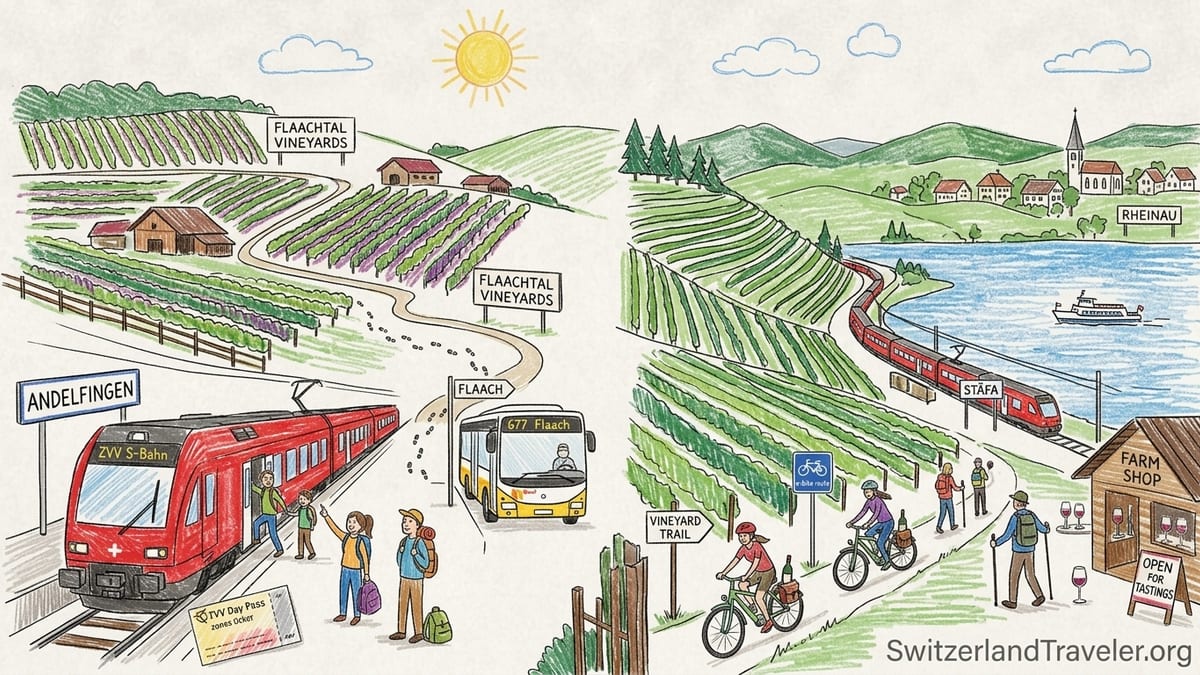
Where Zurich’s Wine Country Begins for Car-Free Travelers
Zurich’s closest wine landscapes fall into two broad zones that work for travelers without a car. To the north and northwest lies the Zürcher Weinland and Zürcher Unterland, with villages such as Andelfingen, Flaach, Benken and Rheinau connected to Zurich by S-Bahn and regional buses. To the south and east, vines line the shores and slopes around Lake Zurich, in places like Stäfa, Herrliberg and on the Au peninsula near Wädenswil and Au ZH. Official tourism materials highlight these areas as perfect for walking and cycling, and they do have real advantages for anyone arriving by train.
From Zurich Hauptbahnhof, Andelfingen is around 30 to 35 minutes away by S-Bahn, typically on a direct S29 or with an easy change in Winterthur depending on the time of day. Trains run at least hourly during the day, often every 30 minutes at peak times. Reach the Au peninsula in roughly 25 to 30 minutes on an S8 or S24 suburban train to Au ZH, which stops a short walk from vineyards and lakeside paths. These rail links make it easy to choose one wine village cluster and settle in. The trouble starts when you try to string together multiple areas in a single day or chase specific wineries scattered up on hillsides.
Regional bus coverage, coordinated under the ZVV network, fills some of the gaps. From Andelfingen, buses go into the Flaachtal and up to villages like Flaach and Benken, with stops such as Flaach Post or Benken ZH. These buses are included in standard Zurich zone tickets and day passes. However, outside commuter hours, many lines drop to hourly service. If you miss a connection by four minutes, you may find yourself nursing a coffee at the station for almost an hour while the afternoon tasting window ticks down.
The marketing message about exploring Zurich’s wine country on foot and by bike is not completely wrong. Trails really do leave straight from train stations like Eglisau toward vineyard routes above the Rhine, and there are published wine-walk itineraries starting at Andelfingen with signposted paths through the vines. But the official language often glosses over gradients, seasonal bus timetables, and the fact that many wineries are not walk-in bars but working farms that require advance bookings for tastings.
Testing the Theory: A Car-Free Circuit via Andelfingen and Flaach
I began one day’s experiment the way most visitors would: with a mid-morning train from Zurich Hauptbahnhof to Andelfingen, the small mill town whose name anchors the Zürcher Weinland region. The S-Bahn rolled in on time, the platform was level with the train doors, and I stepped off into a station forecourt with clear signs for the village center and bus bays. So far, the car-free narrative held beautifully. My goal was to combine a short stroll through Andelfingen’s vineyards with a bus ride into the Flaachtal to visit two producers before looping back.
The first segment was a success. A signed path led uphill from the old mill district toward terraced vines that belong to a mix of cooperative and private estates. It took roughly 20 minutes of steady climbing on paved lanes and gravel tracks to reach viewpoints across the Thur river plain. The route was comfortable in walking shoes and never felt remote. I passed vineyard huts where Zurich’s tourism office promotes picnic-style wine walks, with pre-arranged tasting bags picked up in town. For independent visitors, the reality is more modest: delightful scenery and a chance to spot winery names on plot signs, but no spontaneous glass-pouring at 11 a.m.
I had pre-booked a lunchtime tasting at a family-run winery near Flaach, reachable by bus 677 from Andelfingen toward Flaach Post. According to the ZVV timetable, I had an eight-minute margin between descending from the vineyards and the bus departure. That would be generous with a suitcase, but on foot it turned out to be tighter than expected. Coming down through narrow lanes, I misjudged a shortcut and arrived at the bus stop just in time to watch the coach pull away. Outside the weekday commute, the headway stretched to one bus per hour. My tasting appointment survived, but with 55 minutes to wait I improvised an early sandwich from a bakery and double-checked that my host was still expecting me.
Once on board, the bus ride itself showed why promoters boast about combining public transport with wine. The road from Andelfingen to Flaach threads between fields and low hills, with glimpses of vines on slopes above the Thur. The stop at Flaach Post sits in a compact village core of traditional houses. From there, however, it was another 20-minute walk slightly uphill along a side road into the vines to reach the winery. There was no sidewalk for parts of the way, and while traffic was light, I would hesitate to recommend that stretch for families with children in tow. The distance and gradient are manageable for most adults but underline a key gap: many wine estates are not directly on bus routes, and that last kilometer requires time, confidence and decent shoes.
Appointment-Only Cellars and the Reality of Timetables
At the Flaach winery, the appointment-only nature of Zurich’s wine culture became clear. The tasting took place in a working cellar under the family farmhouse, with tanks and equipment in plain view. My host was generous with pours of Pinot Noir and regional white varieties, and offered to ship cases within Switzerland if I preferred not to carry bottles. For local customers, drop-in sales were possible within posted shop hours, but structured tastings needed prior agreement, partly because staff split time between cellar, shop and vineyard work.
This model is typical across the Zürcher Weinland, where estates remain relatively small and many owners juggle viticulture with other farming or outside jobs. Some wineries near Lake Zurich, such as those in Stäfa, Herrliberg or Meilen, operate vinotheques with more regular opening hours in village centers, but even there, many tastings beyond a quick purchase are advertised as bookable experiences rather than walk-up bars. Travelers expecting the density of tasting rooms you might find in parts of Italy or California can be caught off guard.
Synchronization with public transport timetables adds another layer of complexity. My Flaach appointment had to be sandwiched between one hourly bus arrival and another departure that would connect back to Andelfingen and onward trains. Twenty extra minutes of conversation risked turning a relaxed tasting into a time trial. When a neighboring couple arrived late from their own walk and joined the table, I faced a familiar dilemma: linger over a final glass with new friends or leave abruptly to catch the only bus that avoided a long delay. In the end I chose the bus, hugging my newly purchased two bottles and speed-walking the lane back to Flaach Post.
That two-bottle decision was itself shaped by mobility. Each 750 ml bottle adds around 1.2 kilograms to your backpack. Two bottles plus water, a light jacket and notebook translated into a load I still felt on the 20-minute walk back to the bus stop and the 10-minute stroll at the other end from Andelfingen station to a riverside viewpoint while killing connection time. More bottles would have meant either using a simple folding shopping trolley, which I had not packed, or arranging shipping from the winery at local rates that make sense for Swiss addresses but would be steep for most international visitors.
Lake Zurich Vines: Better Rail, Tricky Hills
A second field test took me south from Zurich along Lake Zurich’s right bank, often branded the Gold Coast for its sunny slopes and prosperous communities. Here, centuries-old terraced vineyards rise behind villages like Erlenbach, Herrliberg and Stäfa, with S-Bahn stations mere minutes from central Zurich. Tourism materials highlight these vineyards as ideal for walking trails between stations, and the S8 or related lines provide at least two trains per hour in each direction for much of the day.
I chose to focus on the area around Stäfa, one of the lake’s best-known wine communes. From Zurich Hauptbahnhof, the ride to Stäfa station took around 25 minutes on an S7 train. Exiting the station, clear signposts indicated both lakeside promenades and uphill routes into the old village and vineyards. The railside location is convenient, but the vines are not on the platform edge. It was a solid 20-minute uphill walk on paved streets to reach the first terraced plots and the courtyard of a well-regarded winery with a small shop and tasting space.
Here, public transport shone. The frequency of trains meant I did not need to obsess over timetables, and the ascent from station to vines, though steep in parts, was on proper sidewalks with intermittent shade. The challenge shifted from connections to topography and time. I had optimistically sketched a plan to walk from Stäfa to a second winery near another station further along the lake, visiting both in a single afternoon. On the map, the distance between the two looked like a gentle contour. On the ground, the combination of 150 to 200 meters of accumulated climbing, summer heat and pauses for tasting stretched the schedule.
After a convivial session sampling Riesling-Silvaner and Pinot Noir, including informal conversation with the winemaker about harvest pressures in warmer years, I realized that reaching the second estate would require either a 50-minute power walk largely uphill or a bus ride plus additional ascent. The local bus serving the upper neighborhoods ran roughly every 30 minutes at that time of day. Missing one departure when checking the wrong side of the street added a full half-hour of delay, enough to turn my planned second visit into a rushed drop-in rather than a proper tasting.
When a Tasting Becomes a Sprint
The most telling moment of the trip came in the late afternoon on that Lake Zurich day. I managed to board a bus from near Stäfa’s upper village that climbed further up the slope toward residential streets, from which a narrow lane led into the vineyards and the second winery. Between the bus stop and the estate gate, it was another 12 to 15 minutes of brisk walking along a combination of residential alleys and a farm track. The location was bucolic, with birdsong, lake views and rows of vines glowing in the late sun, but my eye kept darting to the time.
I had contacted this second winery by email the week before and received a friendly reply confirming that their shop would be open for casual tastings until early evening on that specific weekday. What neither of us fully anticipated was how the transport chain would compress my visit. By the time I arrived, I had about 25 minutes before the last bus of the hour passed the nearest stop in a direction that would reliably connect back to Zurich without spending a long stretch in an intermediate town.
The staff were welcoming and quickly poured a flight of three wines. We chatted about the contrast between Zurich’s lake vineyards and heavier red wine regions elsewhere in Switzerland, but I felt the ticking clock. Savoring each glass properly while watching for signs of a bus along a road you cannot see from the tasting room is not exactly the relaxed idyll the tourism posters promise. When I finally excused myself, bought a single bottle, and half-jogged back down the lane with the bottle wrapped in my jacket, I passed a signboard advertising themed vineyard walks that begin and end at nearby stations. It was a reminder that organized packages can smooth some of these seams, while independent visitors must stitch their own schedules.
In the end, I made the bus with a few minutes to spare, slightly flushed and grateful for Swiss punctuality. Back in Zurich that evening, the contrast between the comfortable city tram system and the slightly improvisational feel of my suburban bus and vineyard lane sprints underscored a central lesson: the region’s backbone of trains and mainline buses is robust, but the micro-mobility between stops and cellars needs more thought than most casual planners expect.
Carrying Bottles, Managing Gradients and Choosing Bikes
Beyond timetables and appointments, traveling car-free in Zurich’s wine country forces you to think physically about each purchase and meter of ascent. On flat city streets, a couple of bottles in a backpack are inconvenient but manageable. Add vineyard gradients and uneven farm tracks, and you may change your buying behavior. After my Flaach and Stäfa experiences, I became extremely selective. A wine had to be memorable enough to justify carrying its weight up or down 20 minutes of hillside and through multiple station transfers.
There are ways to reduce that burden. Several Zurich wineries, particularly those closer to the city, offer shipping within Switzerland for a fee once you reach a modest minimum order, often around a mixed six-bottle case. For residents or long-stay visitors with local addresses, this is ideal. For international tourists staying in a hotel for two or three nights, it is more complicated. Coordinating delivery windows with hotel reception, and factoring in the cost of onward transport in luggage, can negate the convenience. In my case, I settled on two to three bottles per day at most and resigned myself to the occasional shoulder ache.
Gradients themselves are another argument for thinking beyond pure walking. Many of the signposted wine routes around Andelfingen, Flaach and Rheinau, and around Lake Zurich’s Au peninsula, are billed as suitable for both hikers and cyclists. In practice, an e-bike can turn what feels like a chore of repeated climbs into an enjoyable cruise. On a subsequent day, I rented an e-bike near the Rhine and tested a segment of the living wine trail between Eglisau and Rafz. The train to Eglisau from Zurich took about 35 minutes, including a change in Bülach. From Eglisau station, I rolled straight into a riverside street and then into vineyards along a marked route.
The difference in comfort was striking. Uphill ramps that would have left me sweaty on a conventional bike became manageable with pedal assist, even with two bottles in panniers. The living wine trail includes informational boards about viticulture and invites stops at viewpoints rather than specific cellars, so the pressure of appointment times is lower. I still had to keep half an eye on the clock to avoid a long wait in Rafz for the next train home, but the day felt more fluid, and I finished without sore shoulders.
Renting an e-bike is not cheap in Switzerland, and day rates vary widely between local shops and tourism offices. However, for one or two focused days of wine-country exploration, folding the cost into the broader travel budget can be worthwhile, especially compared with taxi rides to and from remote vineyards if you give up on public transport entirely. Crucially, an e-bike also makes it easier to detour between nearby villages within a cluster, such as moving from one estate to another around Andelfingen or circling the Au peninsula, without being beholden to hourly buses.
What Worked Well: Trains, Signposted Trails and Compact Villages
Despite the friction points, several aspects of Zurich’s wine country are genuinely friendly to travelers without a car. The backbone rail network, coordinated by SBB and regional partners, provides frequent, reliable service along the lake and into the Weinland. Trains to hubs such as Andelfingen, Eglisau, Stäfa and Au ZH run throughout the day, rarely deviating from published timetables. Delays are comparatively rare, and platform information is clear even for visitors with limited German.
Many wine villages themselves are compact. Andelfingen’s station sits within walking distance of the old mill district, river bridges and the lower slopes of vineyards. In places like Stäfa and Au, you can step off a train and in five to ten minutes reach either the lakeshore or the first streets of the hillside old town. This proximity makes it easy to build in culture and scenery before or after tastings, without worrying about parking or navigating unfamiliar roads.
Signposted walking routes add another layer of user-friendliness. The living wine trail from Eglisau toward Rafz, promoted by SBB as a highlight along the Zurich to Schaffhausen corridor, is clearly marked from the station and designed to function as both a hike and an educational route, with panels explaining the history of local viticulture. Around the Au peninsula, paths from the station up through meadows and small vineyards are likewise marked, and an exhibition in a historic barn presents the area’s winemaking heritage. These curated trails shift the emphasis from chasing specific wineries to immersing yourself in the wider wine landscape.
For travelers concerned about sustainability, the combination of electric trains, buses and e-bikes makes Zurich’s wine country an appealing alternative to driving. The region’s tourism bodies explicitly promote hiking, cycling and public transport as preferred ways to explore, and station-area information boards often include suggestions for loop walks through nearby vineyards. In this sense, the marketing message is aligned with real infrastructure. The gap lies in the details of matching that infrastructure to the particular rhythms of wine visits.
Where the Gaps Show: Infrequent Buses, Limited Hours and Human Limits
Where Zurich’s wine country is less friendly to car-free visitors is at the junction between transport and hospitality. Hourly or half-hourly buses are fine if you are sightseeing in a village center or hiking loops that can end at several different stops. If you are due at a single winery at 14:00 and the bus that gets you there without a long walk arrives at 13:35 or 14:35, your window narrows. There is little slack for spontaneous detours or delays, and a missed departure can mean either a costly taxi ride or a heavy rescheduling effort with your host.
Wineries’ own schedules also matter. Many estates in the Zürcher Weinland and along Lake Zurich run tasting rooms or shops just a few afternoons per week or only on Saturdays. Some focus almost entirely on events or group bookings, taking individual visitors by advance request. There is nothing unreasonable about this from the producers’ perspective, especially in a region where wine is one part of a broader agricultural or business mix. But for travelers used to regions with multiple walk-in tasting rooms open six or seven days a week, it can feel as if a theoretically dense wine map shrinks to a handful of realistic options on any given day.
Human limits play a role too. Hiking through vineyards, tasting responsibly and navigating timetables requires energy and attention. After one longer day combining Andelfingen, Flaach and a late-afternoon loop to a viewpoint above the Thur, I noticed that my ability to enjoy nuanced conversations about soil types and barrel regimes was slipping by late afternoon. If I had been driving, I would also have had to moderate alcohol intake heavily or skip tastings altogether, which undermines the point of a wine trip. The logic of staying car-free remains compelling, but it reinforces the need to tighten your geographic focus rather than trying to see everything.
Even mundane matters such as restroom access and shelter from sudden showers become more noticeable without a vehicle. When a light rain passed over the vineyards above Stäfa, there was nowhere to duck under cover except occasional trees and, eventually, the next winery yard. Had I been between two distant estates in the Flaachtal without a bus shelter nearby, the choice would have been to keep walking or stand under a sparse hedge. These are minor discomforts in good weather, but worth factoring into how far from transport and village centers you want to roam.
The Takeaway
Zurich’s wine country can absolutely be explored without a car, and for many travelers who want to enjoy tastings without worrying about blood-alcohol limits, that is not just a preference but a necessity. The region’s trains are frequent and reliable, and several wine villages sit close enough to stations that you can step almost directly from platform to vineyard views. Signposted walking routes, curated wine walks and the option of renting e-bikes all reinforce the idea that this is a landscape best savored at human speed.
What my trip revealed, however, is that trying to cover multiple clusters in a single day with a patchwork of trains, hourly buses and uphill walks turns a theoretically elegant plan into a tightly choreographed exercise. Important frictions include appointment-only cellars, limited opening hours, last-kilometer climbs on narrow lanes, and the physical reality of carrying glass bottles over uneven ground. One missed bus can compress a tasting into a rushed sprint, and one extra bottle can make the difference between a pleasant stroll and sore shoulders.
If I were to design the trip again, I would choose one village cluster per day and treat it as a base rather than a waypoint. Around Andelfingen and Flaach, that would mean booking a morning or early afternoon tasting at a single winery, then using the rest of the day to walk signed vineyard routes or visit a second producer within easy reach on foot or by e-bike, without crossing multiple valleys. Along Lake Zurich, it would mean spending a half or full day around Stäfa or the Au peninsula, combining one or two tastings with lakeside walks instead of zigzagging along the shore in pursuit of several estates.
In practice, that strategy looks like this: reserve tastings in advance, aiming for one main winery and perhaps a secondary shop or vinotheque per day; rely on trains from Zurich to reach your chosen cluster; walk or use an e-bike to move within that compact area; and buy selectively, opting for shipping where feasible or limiting yourself to one or two bottles that you are genuinely happy to carry. The result is a slower, more sustainable trip that fits the strengths of Zurich’s public transport and the rhythms of its small-scale wine culture, without ever needing to get behind the wheel after a glass.
FAQ
Q1. Do I need a car to visit Zurich’s wine country from the city?
Cars are not necessary if you plan carefully. Trains reach hubs like Andelfingen, Eglisau, Stäfa and Au ZH in 25 to 40 minutes, and regional buses plus walking or e-bikes can bridge the last kilometers into vineyards. For most visitors who want to taste wine, staying car-free is the safer and more relaxed option.
Q2. Which wine villages near Zurich are easiest to reach by train?
Among the most accessible are Andelfingen and Eglisau in the Zürcher Weinland and Zürcher Unterland, and Stäfa, Erlenbach and Au ZH along Lake Zurich. All have S-Bahn stations with regular service from Zurich Hauptbahnhof and vineyard landscapes a short walk or uphill stroll away.
Q3. How often do buses run between Andelfingen and villages like Flaach or Benken?
Regional buses typically run about once per hour outside peak commuter times, with slightly more frequent service at morning and evening rush hours. Exact times vary by line and season, so it is important to check the current ZVV or SBB timetable for your travel date rather than relying on older schedules.
Q4. Can I visit wineries in Zurich’s wine country without an appointment?
Some estates, especially those with village vinotheques near Lake Zurich, maintain regular shop hours for walk-in purchases and informal tastings. However, many wineries in the Zürcher Weinland and on the lake slopes work mainly by appointment for structured tastings. Contacting your chosen estate in advance by email or phone is the safest approach.
Q5. Is walking between multiple wineries in one day realistic?
Walking between several wineries is possible in compact clusters, but gradients and distances make back-to-back tastings ambitious. A more comfortable plan is to focus on one primary winery visit and then enjoy a vineyard walk or a secondary stop nearby, rather than stringing together three or four estates spread across valleys.
Q6. Are e-bikes a good option for exploring Zurich’s vineyards?
E-bikes work well in Zurich’s hilly wine landscapes. They make uphill segments between villages and vineyards much easier and reduce fatigue when carrying a couple of bottles. Rentals are available in several towns and through some tourism offices, though daily prices can be relatively high compared to basic city bike rentals.
Q7. What should I do with wine bottles if I am traveling by train and bus?
Plan to carry only what you are comfortable with on hills and station platforms, usually one or two bottles in a sturdy backpack with padding. Ask wineries about shipping within Switzerland if you want a larger quantity, and consider pooling purchases into a single shipped case rather than accumulating heavy bags over several days.
Q8. How many wineries should I plan to visit in a single day without a car?
For a relaxed experience using public transport, one pre-booked winery visit plus possibly a second casual stop nearby is usually enough. This leaves time for walks, village exploration and unforeseen delays in trains or buses without turning the day into a race against timetables.
Q9. Are the vineyard walks around Zurich suitable for all fitness levels?
Many vineyard routes are graded as easy to moderate, but they often include sustained uphill and downhill sections on paved lanes or gravel tracks. Travelers who are comfortable walking 30 to 60 minutes with some climbing should manage fine. Those with limited mobility may prefer flatter lakeside promenades or short walks from stations to village centers.
Q10. When is the best season to explore Zurich’s wine country by public transport?
Late spring through early autumn, roughly May to October, offers the most pleasant conditions and the widest range of open winery doors and outdoor events. Vines are in leaf, village festivals are more frequent, and daylight hours are long enough to make afternoon tastings compatible with catching evening trains back to Zurich.