

On a clear Sunday in late summer, I joined the stream of locals rolling out of Zurich with one simple goal: ride a full lap around Lake Greifensee and see if this really is one of the region’s easiest and most rewarding cycling loops. Switzerland Tourism lists Greifensee alongside Lake Zurich as a key natural lake of the canton, but on the ground it feels like a completely different world: flatter, quieter, more intimate, and wrapped in one of Zurich’s largest nature reserves. Over several relaxed hours, I pedaled the circuit, swam, lingered at bird hides and watched the path gradually fill with weekend traffic, taking notes for anyone considering the same easy escape from the city.
Finding Greifensee: An Easy Escape From Central Zurich
Greifensee sits roughly 11 kilometers east of central Zurich, separated from Lake Zurich by the forested Pfannenstiel ridge. Trains from Zurich Hauptbahnhof reach the lake’s surrounding towns such as Uster, Schwerzenbach and Nänikon-Greifensee in about 15 to 20 minutes, making it very realistic to leave the city after breakfast, ride a lap, swim and be back in town before dinner. On my ride, I boarded a mid-morning S-Bahn to Schwerzenbach with my bike, sharing the carriage with a mix of Lycra-clad road cyclists and families with children on smaller bikes.
From stations such as Schwerzenbach or Nänikon-Greifensee, signposted cycle routes funnel you quickly toward the lake. Within ten minutes of leaving the platform at Schwerzenbach, I was rolling on dedicated bike paths through low-rise suburban streets, the roofs giving way to open fields and the flat, gray-blue strip of Greifensee ahead. It felt immediately more rural than anything along most of Lake Zurich’s urban shorelines.
This proximity to Zurich is part of Greifensee’s appeal. You do not need to plan a full-day mountain excursion or wrestle with long transfers. Instead, the lake functions almost like a giant car-free park on the edge of the city, with locals arriving by bike, S-Bahn or a short drive to enjoy a traffic-light loop that still offers real nature, from reed beds and wetlands to distant views of the Alps on a clear day.
The Circuit: Distance, Direction and First Impressions
Officially, the Greifensee-Stiftung describes a nearly 20 kilometer asphalted path encircling the lake, primarily intended for cyclists and inline skaters. In practice, the exact distance of your lap will depend on where you join the trail and whether you take minor detours to viewpoints, bathing spots or the nature center. My complete loop, starting and ending near Schwerzenbach and including short side trips for swims and photos, came to just under 24 kilometers according to my bike computer.
Local ride guides and mapping apps list the main circular route at roughly 21 kilometers, with a total elevation gain of only about 70 meters. That low figure reflects how flat the shoreline is. Unlike the varied climbs around Lake Zurich or the steeper shores of some alpine lakes, Greifensee is gentle enough that the path feels almost level for long stretches. Most people ride clockwise, starting from towns such as Uster or Greifensee, but I chose an anti-clockwise direction from the southwest corner to keep the morning sun at my back and afternoon light on the lake.
Within the first kilometer on the official lakeside loop, it was clear this was designed for slow travel. Pedestrians, pushchairs and skaters share the path with cyclists, and the posted signage requests considerate speeds, especially where the surface narrows through wooded sections or past picnic meadows. The lake is never far away, although the immediate shore is often screened by reeds that form part of the protected nature reserve. Where Lake Zurich can feel urban and nautical, with marinas and traffic on the main road, Greifensee’s first impression is of birdsong, reeds and big skies over farmland.
Surface, Bike Choice and Why an E-Bike Is Optional
The main ring around Greifensee is notably well surfaced. The core loop consists largely of smooth asphalt, wide enough to accommodate two-way cycling plus walkers in most places. In dry weather it feels as fast as a city cycle lane, and I saw everything from carbon road bikes to city step-throughs, kids’ bikes and inline skates sharing the same strip. Interspersed with the asphalt are short sections of compacted gravel, especially where the path threads through wooded areas or beside fields, but these are firm and easily manageable on standard touring or city bikes.
I rode a standard hybrid bike on 35-millimeter tires, which felt ideal. A pure road bike with slick 25-millimeter tires would also be fine for confident riders, although you might prefer slightly wider rubber for the occasional tree root or gravel patch. There is no need for suspension or mountain bike tread unless you want to explore additional unpaved farm tracks away from the main loop. Ordinary city bikes, and even cargo bikes with child seats, were out in force, underlining how non-technical the riding is.
Because the loop is almost entirely flat and around 20 kilometers long, an e-bike is not strictly necessary for most adults with basic fitness. Many riders complete the circle in 60 to 90 minutes of easy pedaling, and even those stopping frequently for photos, swimming and snacks will rarely spend more than three hours in the saddle. That said, e-bikes do appear in good numbers, especially among older riders and couples who use the motor assistance to maintain a comfortable pace while chatting. If you already have an e-bike or are renting one for a longer day that might include the hills toward Pfannenstiel or into the Zürcher Oberland, it is certainly pleasant here, but the Greifensee loop alone does not demand it.
Traffic, Crowds and Coexistence on a Sunny Weekend
Arriving at the lake around 10 a.m. on a sunny Sunday, I had the path mostly to myself on the first gentle kilometers, with only a few joggers and dog walkers for company. By late morning, the dynamic changed. Families on bikes joined from side paths, larger groups of road cyclists began to lap the lake and the picnic lawns started to fill. By early afternoon, especially near the more accessible bathing areas and towns such as Niederuster and Greifensee, the loop felt as busy as an urban park at peak time, though still moving smoothly thanks to the absence of cars on the shoreline path.
The key for cyclists here is to treat the route as a shared promenade rather than a training circuit. Official guidance from the Greifensee-Stiftung asks fast cyclists to stick to the asphalted bike routes and use off-peak hours if they want to ride at higher speeds. That recommendation makes sense in practice. I passed more than one tightly packed group of inline skaters, parents jogging while pushing strollers, and children weaving a little across the path as they grew tired. A bell and a friendly “Grüezi” or “Danke” go a long way toward keeping everyone relaxed.
On narrow stretches through woodland or beside the reeds, overtaking required patience, sometimes sitting behind a family cluster for a minute or two until the path widened. In a few places where local farm access crossed the trail, tractors entered slowly and pedestrians were quick to step aside, but these road vehicles were infrequent and moved cautiously. Compared to many waterfront rides, especially along national routes beside Lake Zurich or the Limmat, Greifensee felt remarkably stress free from a traffic perspective, even at peak weekend times.
Scenery: From Reed Beds and Birdlife to Ordinary Farm Roads
Greifensee’s reputation among Zurich residents rests heavily on its nature. Much of the lakeshore is part of the canton’s largest contiguous nature reserve, overseen by the Greifensee-Stiftung. That protection explains why there are long stretches where the lake is screened by reed belts, wet meadows and woodland rather than lined with private gardens and boat houses. For birds, amphibians and wetland plants, this is excellent news. For cyclists hungry for continuous lake panoramas, it means a more varied visual rhythm.
Riding anti-clockwise from the southwest, I first passed through open agricultural land. Here, the path runs just inland from the reeds, and views alternate between the blue of the lake, the pale green of fields and the distant silhouettes of the Alps when the air is clear. Herons stood statue-still in the shallows, and swans worked through the patches of open water between reed clumps. The soundtrack was more birdsong than motor traffic, with only the occasional hum from local roads set slightly back from the shore.
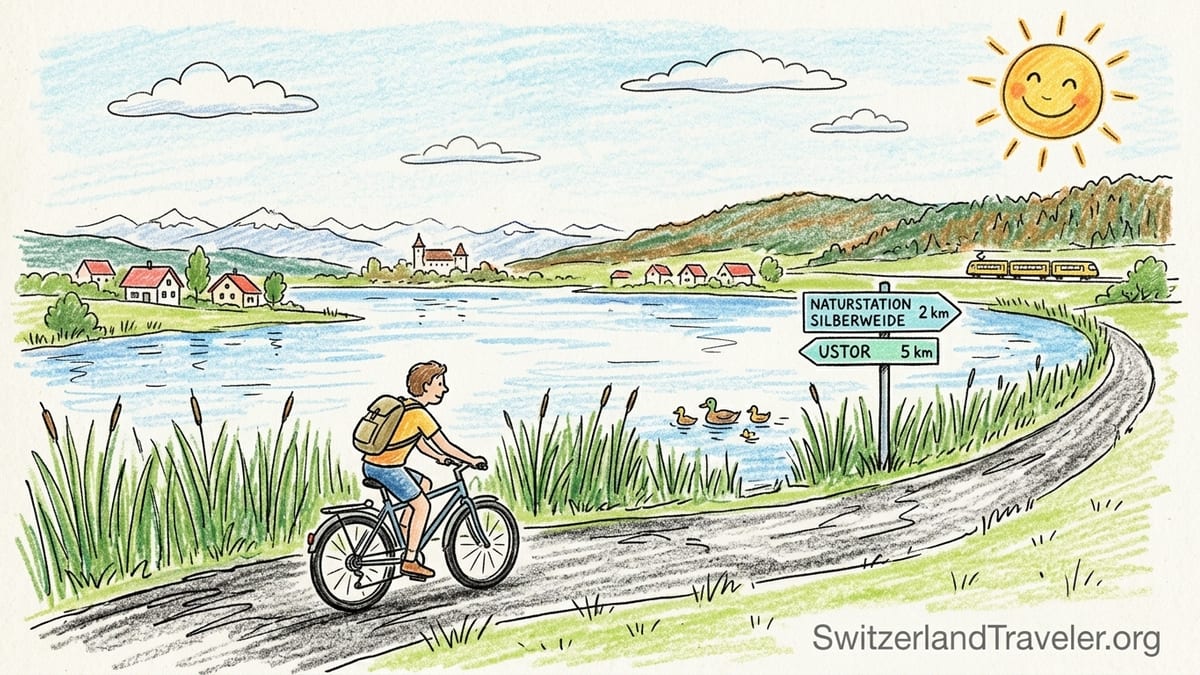
The eastern side of the lake, near the Naturstation Silberweide, is where Greifensee feels most like a dedicated nature experience. Short detours lead to bird hides and observation platforms that overlook ponds and marshy channels. I stopped at one such hide and watched grebes diving repeatedly while a group of schoolchildren, armed with binoculars provided by the visitor center, tried to tick different species off a worksheet. The combination of easy cycling, car-free zones and visible wetland life makes this side of the lake particularly appealing for families and photographers.
Not every meter of the loop is equally scenic. On the northern side, especially as you pass near Uster and through more built-up villages, the route shifts to paths that shadow local roads. For a couple of kilometers, the lake is mostly out of view behind houses or reed belts, and the experience feels closer to a suburban commuter route flanked by traffic noise. One short stretch required me to ride on local streets without a dedicated bike lane, threading between parked cars. These sections are not unpleasant, and signage keeps you oriented, but they do not deliver the same sense of immersion in nature as the quieter western and eastern shores.
Wetlands, Birdlife and Nature Station Silberweide
One of the defining elements of a Greifensee ride is the wetland landscape that encircles the lake. Unlike many Swiss lakes that are ringed by development, Greifensee still has extensive reed beds, marshy floodplains and wet meadows. The protected shore zone is vital for migratory and resident birds, and this becomes very concrete when you step off the bike and into places like Naturstation Silberweide on the eastern shore.
Silberweide serves as a small nature center and environmental education hub, typically open from spring through autumn. Entry fees are modest, and the facility offers boardwalks, observation huts and information boards that explain the lake’s ecology. On the day of my ride, families pushed bikes up to the gate, locked them outside and spent an hour or two walking quiet loops through the wetlands, spotting ducks, coots and occasional raptors overhead. It is easy to combine a Greifensee lap with a visit here, either as a mid-ride break or as a primary destination.
Even without entering a center, the lake’s birdlife is a constant presence. I saw great crested grebes performing short dives within a few meters of the shore, cormorants drying wings on posts and mixed flocks of gulls circling noisily over feeding grounds. In shallow bays, frogs sounded from the margins, and dragonflies patrolled the air just above the surface. The fact that much of the immediate shoreline is off limits for free roaming protects these habitats, but cyclists are never far from visual access. Well-placed benches and short side paths lead to openings in the reeds where you can sit quietly with a telephoto lens or simply watch the changing light.
For travelers who value nature more than mountain views or urban promenades, this aspect of Greifensee is a major advantage over more famous Lake Zurich. Here, the loop feels built around the needs of the ecosystem first and recreation second, rather than the other way around. As a cyclist, you are essentially a guest skirting the perimeter of a large outdoor nature gallery.
Swimming Spots, Picnic Lawns and Lakeside Villages
Part of the charm of riding Greifensee is how naturally a relaxed cycling day blends into swimming and picnicking. Several official bathing areas dot the shore, typically with lawns, trees, simple facilities and roped-off swimming zones. On my loop, I stopped mid-morning at a public bathing area near Fällanden, where a gently sloping lawn led to a short section of gravelly beach. Locals had propped bikes against trees or racks, and some families had set up full picnic spreads, from portable grills to thermos flasks of coffee.
Later in the day, I swam again near Uster at a more developed lakeside park. Here, a kiosk sold ice cream, soft drinks and simple snacks, and a pontoon floated just offshore where teenagers were jumping into the lake. Bike parking was plentiful, but at peak afternoon time every patch of shade seemed claimed by a towel or blanket. Locking my bike to a designated rack, I joined the swimmers for a quick cool-down. The water was clear and a comfortable temperature after a few warm kilometers in the sun.
The villages themselves, especially the historic town of Greifensee on the eastern shore, are worth at least a brief pause. The old town has a small castle, narrow alleys and a compact lakeside promenade. Cafes spill onto terraces, and it is easy to grab a coffee or mineral water, lean your bike against a wall and watch the steady stream of cyclists glide past. Compared with lakeside spots on Lake Zurich that can feel crowded and expensive, these Greifensee villages strike a quieter, more lived-in note, frequented by locals out for a routine Sunday rather than visitors ticking off a highlight.
For those who tire partway around or travel with companions who prefer less riding, boat services operated by the local Schifffahrts-Genossenschaft Greifensee connect lakeside points such as Maur, Greifensee and Niederuster. Seasonal schedules usually run from spring into autumn, with round trips and point-to-point rides that last under an hour. Tickets for a full circuit are typically in the region of a modest restaurant lunch in Zurich, while shorter crossings cost less, and they provide a scenic way to shorten your cycling distance while still enjoying time on the water.
Bike Rental and Practical Logistics
One of the biggest questions for visitors is whether you need to travel with your own bike to enjoy Greifensee. The answer is no. Zurich’s city center and the lake’s surrounding towns offer several rental options. In Uster, for example, local shops such as Schark Bikes rent standard touring bikes and e-bikes suitable for exploring both the Greifensee loop and the wider region. Daily rates for a regular trekking bike generally fall somewhere around the cost of a casual restaurant meal in Zurich, while e-bikes command a higher fee more comparable to a mid-range dinner for two. Advance reservations in peak summer weekends are sensible, as locals also rent for day trips.
Closer to the lake, bike rentals or service points are available in towns like Schwerzenbach and Fällanden, sometimes through local two-wheeler shops that loan both conventional bikes and e-bikes. While exact pricing can vary from year to year and between shops, you can expect to pay significantly less than for a full-day guided tour, which makes a self-guided Greifensee loop an economical activity for couples or families. Some visitors also arrive with rental bikes from Zurich itself, taking them on the S-Bahn to Uster or Schwerzenbach and returning them in the city later that evening.
Logistically, the loop is forgiving. You never stray far from a train station or bus stop, and there are frequent access points where you can exit the path toward nearby supermarkets, bakeries or cafes for provisions. On my ride, I stopped at a supermarket in Uster a few hundred meters off the loop to buy picnic supplies and water. Several public fountains around the villages and parks also provide potable water, reducing the need to carry large volumes on the bike. Simple public toilets are scattered at bathing areas and parks.
Remember that this is a shared recreational zone with clear conservation rules. In some stretches, cycling is restricted to designated paths, with certain sensitive shoreline sections closed to bikes to protect wildlife. Signage is clear, and on-the-spot rangers occasionally patrol, especially near the nature stations, to answer questions and ensure compliance. Respecting these rules is straightforward and helps maintain the relaxed atmosphere that makes Greifensee so appealing.
Who the Greifensee Loop Really Suits
After completing a full lap, watching the crowds grow and shrink and noting how my own energy levels barely dipped, it became clear that Greifensee’s loop is not trying to be an epic ride. It is a gentle, scenic circuit that shines precisely because it is accessible to many different types of visitors. Families with older children, perhaps 10 years and up who are comfortable riding 20 kilometers on mostly flat terrain, are especially well served. Car traffic is kept largely distant, surfaces are forgiving and regular picnic and swimming stops break the day into manageable stages.
Casual cyclists who want exercise without major climbs will find the route ideal. This includes travelers who perhaps rent a city bike for the day and worry about encountering alpine gradients they are not prepared for. Greifensee is closer in spirit to a leisurely canal-side ride than to a mountain pass. Runners and walkers also share the shore path, often combining partial loops with out-and-back segments, and many appeared to use the path for regular training runs, with the flat profile lending itself to consistent pacing.
For photographers and nature enthusiasts, the blend of water, reeds, distant Alps, village scenes and birdlife creates a slow-travel canvas rich with detail. Sunrise and sunset light over the lake can be particularly beautiful, and it is easy to imagine starting an early-morning lap with mist over the water and finishing at a bakery as the villages wake up. Travelers who have already cruised Lake Zurich and want something quieter, more tactile and less marina-focused will appreciate how different Greifensee feels despite being only a short train ride away.
If your idea of cycling involves high average speeds, long uninterrupted efforts or serious climbing, Greifensee will function more as a warm-up lap or recovery ride than a challenge. For that, you might link it with the rolling roads toward Pfäffikon or the hillier Zürcher Oberland. But as a stand-alone half-day adventure outside Zurich, the Greifensee loop excels at exactly what it promises: easy movement, real nature, and a sense of local life unfolding around the lake.
The Takeaway
Cycling around Greifensee is less an athletic achievement and more a gentle immersion in the quieter side of the Zurich region. The roughly 20 kilometer loop is short, flat and almost entirely on well-maintained paths, with only brief encounters with local streets. Lake views, wetlands and birdlife are frequent companions, especially on the eastern and western shores, while short suburban sections on the north simply remind you how close you remain to everyday Swiss life.
You do not need an e-bike, expensive gear or advanced fitness to enjoy this ride. A basic city or touring bike, a swimsuit, a bottle of water and light picnic supplies will be enough to turn it into a rewarding half-day excursion. The crowds on sunny weekends are real, but they bring an easygoing energy rather than stress, provided you accept that this is shared terrain where children, pedestrians and skaters all have as much claim as cyclists.
For visitors to Zurich deciding between a Lake Zurich cruise and a cycling trip, Greifensee offers a complementary experience rather than a substitute. Where Lake Zurich is about open water vistas, city skylines and larger boats, Greifensee is focused on reeds, birds, village bathing lawns and the soft hum of bicycle wheels. If you have even a passing interest in cycling or simply want to move at your own pace through a significant natural lake landscape, Greifensee fully merits a place on your itinerary.
FAQ
Q1. How long is the cycling loop around Lake Greifensee?
The main circular route around Lake Greifensee is roughly 20 to 21 kilometers, with total elevation gain of only around 70 meters, making it a relatively flat and accessible ride.
Q2. Do I need an e-bike for the Greifensee circuit?
No, most reasonably fit adults can comfortably complete the loop on a regular bike in one to two hours of easy riding. E-bikes are popular with older riders or those planning a longer tour beyond the lake, but they are not essential for the circuit itself.
Q3. What type of bike is best for cycling around Greifensee?
A standard city or trekking bike with moderately wide tires is ideal. The loop is mostly smooth asphalt with occasional compact gravel sections, so you do not need a mountain bike or suspension.
Q4. Is the path around Greifensee safe for families with children?
Yes, the loop is well suited to families with older children who can manage 20 kilometers. The route is largely separated from car traffic, and speeds are generally moderate, but parents should still supervise closely in busier sections.
Q5. Are there good swimming spots along the route?
Several public bathing areas around the lake offer lawns, access to the water and simple facilities. Many cyclists break up the ride with a swim at places near villages such as Fällanden, Uster or Greifensee.
Q6. Can I rent a bike near Lake Greifensee?
Yes, bike rental is available in nearby towns such as Uster and Schwerzenbach, as well as in central Zurich. Shops typically rent standard bikes and e-bikes suitable for the loop, though advance booking in summer is a good idea.
Q7. How crowded does the route get on sunny weekends?
On warm, sunny weekends the path can become quite busy from late morning onward, with many families, skaters and walkers. Riding earlier in the morning or on weekdays offers a much quieter experience.
Q8. Is the ride scenic the whole way around?
Much of the loop is very scenic, with lake views, reed beds and distant mountains, especially on the eastern and western shores. A few stretches on the northern side feel more like suburban commuter routes with limited direct lake views.
Q9. Can I shorten the ride if someone in my group gets tired?
Yes, because towns and public transport are close by, it is easy to cut the loop short by heading to a nearby train or bus stop. Seasonal boat services on the lake also allow you to combine a partial ride with a ship crossing.
Q10. Who is the Greifensee loop best suited for?
The loop is ideal for families with older children, casual cyclists, runners, walkers, photographers and travelers looking for an easy half-day nature escape from Zurich without significant hills or technical terrain.