


My first glimpse of Zurich Oberland from the train window felt almost too gentle. After years of chasing big Alpine names like Jungfrau and Zermatt, the idea of spending precious Swiss days in a region defined not by jagged peaks but by “rolling hills and lakes” sounded suspiciously like settling. Switzerland Tourism itself frames the Zürcher Oberland as a landscape of natural lakes, forest and the canton’s highest mountain rather than a dramatic Alpine arena, which did not exactly raise my expectations. I went anyway, half curious and half skeptical, and discovered that what looked underwhelming beside the Alps slowly became its biggest advantage.
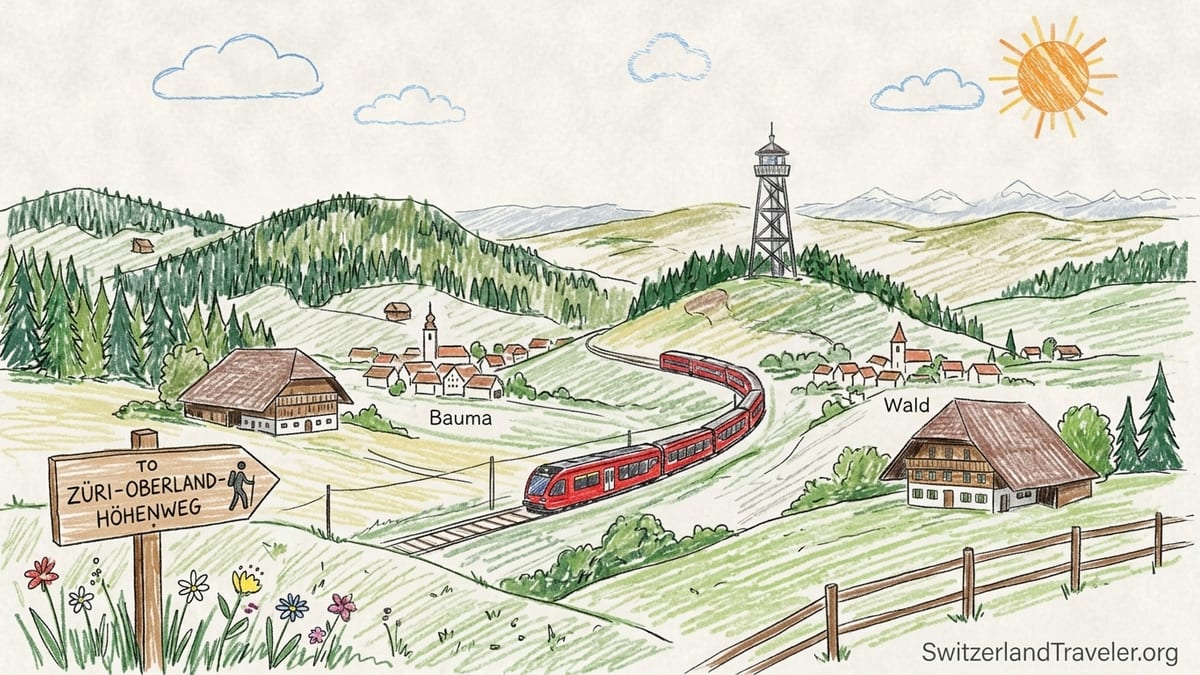
Expectation: Another Mini Alps, Just Closer to Zurich
My mental picture of Zurich Oberland before arriving was essentially a downsized Bernese Oberland. I imagined smaller versions of Mürren and Wengen perched above valleys, cable cars whisking day trippers to crowds of selfie sticks on viewing platforms, and prices to match the country’s most famous resorts. When I read that the canton’s highest point, the Schnebelhorn, reaches only about 1,292 meters, barely half the elevation of many Alpine passes, it reinforced that idea of “Alps lite” rather than a destination in its own right.
Tourism descriptions did little to change that impression. Official materials emphasize pre-Alpine hiking along ridges, small lakes tucked between hills and views towards distant mountain chains rather than the feeling of standing among giants. The language is full of words like “gentle,” “rolling,” and “peaceful,” which for a traveler primed on Alpine superlatives can sound like code for “nice, but you could do better.” I expected pretty scenery, certainly, but also the nagging thought that I should have gone deeper into the high Alps instead.
Even on the approach from Zurich, the landscape builds expectations in a subtle way. The S-Bahn glides past suburban neighborhoods and light industry before fields begin to widen and the hills start to fold upwards. There are no cinematic reveals, no dramatic tunnels spitting you out beside a glacier. Instead, each stop toward the Oberland feels like turning down the volume on city life, station by station, until you realize that the soundtrack has become cowbells and wind in the beech trees.
In other words, I arrived half-convinced that Zurich Oberland would be a pleasant compromise: an easy day trip when you do not have time for “real” mountains. What I found was a region that refused to compete on the same terms as the Alps and was stronger for it.
Reality: Rolling Hills, Forests and Farms Instead of Drama
Zurich Oberland is not a stage set of high Alpine cliffs. Its shapes are softer. Hills rise in rounded backs instead of sharp ridges, and much of what you see is working countryside rather than wilderness. Meadows slope towards traditional farmhouses with wide, overhanging roofs. Forest belts wrap around the ridgelines, broken by occasional clearings where a bench, a cross or a wooden picnic table marks a viewpoint. Lakes such as Pfäffikersee sit calm and low in the landscape, usually bordered by reed beds and cycling paths rather than rock walls.
The best way to feel this difference is on the Züri Oberland-Höhenweg, a signed long-distance route that threads from Winterthur across the pre-Alpine hills to the lakes around Rapperswil. One section climbs steadily towards the Schnebelhorn, passing through villages like Steg im Tösstal and forest tracks above Fischenthal. The path weaves between stands of fir and beech, then emerges along a crest where the views open not only to the distant Glarus and Central Swiss Alps but also back across Canton Zurich, its lakes glinting like scattered mirrors.
Compared with a balcony trail in the Bernese Oberland, the vertical scale is modest. The Schnebelhorn’s summit cross stands just above the tree line on a grassy knoll; sometimes you share the view with a handful of local walkers and a dog or two, but seldom with tour groups. On a clear day, snow covered peaks form a serrated horizon far away, while below you see patchwork fields, isolated farmsteads and winding lanes. It feels like standing in the countryside looking at the Alps, not standing inside the Alps themselves.
This is the crucial reality check. If your heart is set on cable car ascents and glaciers at arm’s length, Zurich Oberland cannot and does not try to compete. Its appeal lies in that green in-between zone where Switzerland’s urban crescent fades into rural life, a place that is as much about how people live as it is about views.
Underwhelmed on Bachtel: When Expectations Were Too High
My most vivid expectation-versus-reality moment came on the Bachtel, one of the Oberland’s signature hills. The ridge tops out around 1,115 meters and is crowned by a steel observation tower, the Bachtelturm, which promises panoramic views over Lake Zurich and the distant Alps. I hiked up from the valley on a humid summer morning, climbing from Wetzikon via farm roads and forest paths. After more than an hour of steady uphill, I emerged at the summit meadow, legs pleasantly tired and anticipation high.
At first glance, I felt a flicker of disappointment. I had recently been in the Bernese Oberland, where stepping off a cable car at First above Grindelwald puts you eye-level with glaciers and towering walls of rock. On Bachtel, the foreground was dominated by green fields, scattered woods and orderly villages. The Alps appeared as a hazy band on the horizon rather than a looming presence. The scene was beautiful, of course, but in that understated way that does not immediately grab you after you have watched sunrise on the Matterhorn.
Climbing the Bachtel tower sharpened the contrast. From the top platform, the city of Zurich was visible in the distance with Lake Zurich stretching southeast, and on a clear day you can trace peaks in the Glarner and Central Swiss Alps. Yet I caught myself mentally ranking the vista against other, more theatrical Swiss viewpoints and feeling that it came up short. There was no dizzying drop, no cable car swinging beneath, no icy air at 3,000 meters to remind you that you were in high Alpine territory.
That moment was important because it forced me to admit how much my own expectations were shaped by Switzerland’s most famous postcards. I had come looking for another high drama performance and instead found something closer to a pastoral painting. It felt underwhelming only until I stopped insisting that every viewpoint justify the cost of a Jungfraujoch ticket.
When Quietness Became the Main Attraction
The shift came later that same day, on an unplanned detour. Instead of taking a bus directly back from the Bachtel area, I followed a signposted footpath down through forest to the village of Bauma in the Töss Valley. The trail zigzagged through beech woods, passed a couple of lonely farmsteads and then traced the edge of a meadow where chickens pecked in the grass. There were no waymarked “photo points,” no information boards in multiple languages. It was just everyday Swiss countryside, which was precisely the point.
In Bauma, I reached the small railway station just as an S26 suburban train rolled in from Winterthur on its way to Rüti. The platform was quiet enough that the diesel heritage carriages of the local steam railway, the Dampfbahn-Verein Zürcher Oberland, stood out like something from a museum exhibit shunted off to the side. I stepped into a modern Thurbo train instead, tapped my travel card and a few minutes later was gliding down the valley beside the Töss river, back toward Zurich.
Somewhere on that journey, I realized that the absence of crowds and infrastructure that had underwhelmed me in the morning had become the trip’s real strength. I had not needed to reserve a seat days in advance, or worry about which cable car departure to book. There had been no queues at ticket kiosks, no strict time slots for entry to viewing platforms. Planning consisted of glancing at a timetable app over breakfast and deciding which village name looked appealing. The cost, too, stayed within the boundaries of a normal train zone ticket rather than the premium price tag attached to the country’s most famous mountain railways.
As the train rolled past small stations like Fischenthal and Gibswil, each with its own simple platform and cluster of houses, the contrast with the big resorts felt stark. There was no sense of being processed through an attraction. Instead, the day had folded into the everyday rhythm of local life: commuters, schoolchildren with backpacks, a hiker or two leaning their poles in the doorway. It was still Switzerland, but not the Switzerland of glossy posters. That quietness and normality turned out to be exactly what I had not known I was looking for.
Trains, Villages and the Luxury of Easy Access
Part of Zurich Oberland’s appeal lies in the simple fact that it is an ordinary part of the greater Zurich commuter belt, just one that happens to be wrapped around ridges and valleys. From Zurich Hauptbahnhof, lines like the S5, S15 and S14 reach towns on the lake and in the foothills, while the S26 winds deep into the Töss Valley and across to Rüti. Many of these journeys take between 30 and 60 minutes, often with departures at least every half hour during the day, so slipping from city to countryside requires almost no effort.
For a visiting traveler, this ease translates into a kind of spontaneous luxury. You can decide after breakfast whether you prefer lakeshore walking at Pfäffikersee, an afternoon on a low ridge above Hinwil or a village-to-village stroll between Bauma and Steg. There is usually no need to book anything in advance or commit to a fixed schedule beyond checking when the last train returns to Zurich in the evening. Even weekend heritage steam services from Bauma toward Hinwil, when operating, are a pleasant optional extra instead of the main way to access the hills.
Compare that with a day trip to Jungfraujoch or Pilatus from Zurich, which often involves reserving specific mountain railway departures, budgeting for high excursion fares and building in spare time for queues at transfer points. Those are memorable journeys, of course, but they require planning and a willingness to accept that half your day might be spent in transit and lines. In Zurich Oberland, the planning overhead is almost laughably small by comparison, which makes it especially attractive for last-minute walkers or travelers adjusting around uncertain weather.
Villages here reinforce that down-to-earth feeling. In places like Bauma, Wald or Fischenthal, you step off the train and see a mix of traditional farmhouses, modest apartment blocks and small shops: a bakery displaying buttered Zopf loaves and fruit tarts, a Coop or Volg grocery where hikers stock up on chocolate and mineral water, perhaps a café with outdoor tables facing the station. These are not resort villages designed around tourism. They are working communities that happen to have excellent access to walking trails, which gives visits a more authentic, lived-in texture.
Eating Well Without Alpine Price Tags
A common fear with any Swiss trip is the restaurant bill at the end of the day. In the big Alpine resorts, dining options skew heavily toward visitors and day trippers, and prices for a simple main course can feel as elevated as the surrounding peaks. Zurich Oberland is not cheap by global standards, but its focus on local rather than international tourism noticeably softens the blow.
Many eateries in the region are straightforward inns and cafés serving regional specialities to locals as much as to visitors. On one walk above the Töss Valley, I stopped at a Berggasthaus marked only by a small sign and a scattering of picnic tables. The menu leaned heavily on dishes like Rösti with mountain cheese, bratwurst with onion gravy and seasonal soups. The atmosphere was informal; muddy boots were unremarkable, and the hostess readily topped up water bottles for hikers. Prices reflected countryside Switzerland rather than top-tier resorts, with hearty plates of food often costing less than equivalent meals at altitude in world famous destinations.
Down in the valleys, simple restaurants near station squares offer lunchtime menus that might include sliced sausage salad, vegetable tart or schnitzel, often with a soup or salad included. Supermarkets play a bigger role too. Because so many trails pass close to everyday towns, it is easy to assemble a picnic from a bakery and grocery store in the morning, then eat it on a bench overlooking the hills. For families in particular, being able to rely on normal shops rather than mountaintop restaurants opens up budget friendly options that are much harder to arrange on remote Alpine ridges.
The food itself mirrors the landscape: comforting rather than flashy, and shaped by the region’s agricultural roots. Dairy from nearby farms finds its way onto cheese plates and into ice cream; apple juice or cider often comes from orchards on the same slopes you have walked past. It all contributes to the sense that Zurich Oberland is not a stage for visitors but a place where tourism has to coexist with everyday rural life.
Who Should Choose Zurich Oberland on Purpose
The more time I spent in Zurich Oberland, the more it felt like a destination that shines for certain kinds of travelers precisely because it is less spectacular in the conventional sense. If you are planning your first and possibly only trip to Switzerland, the headline Alpine regions still deserve their fame. Standing face to face with glaciers or riding a rack railway above a sea of peaks is unforgettable. Yet if you have already done that, or if you value quieter moments over bucket list shots, Zurich Oberland becomes very compelling.
Repeat visitors to Switzerland will appreciate how little energy it takes to fold the Oberland into a Zurich stay. You can use the city as a base, enjoy its museums and lakefront, then step into the countryside with a short, inexpensive train ride whenever the weather invites. There is no need to change hotels or commit to package excursions. For walkers who prefer gentler terrain, the region’s network of paths along valleys, lakes and modest ridges offers plenty of satisfaction without the exposure or steep gradients that characterize many high Alpine routes.
Families benefit in several ways. Distances are manageable for smaller legs, the risk of sudden weather changes is lower at these altitudes and there are frequent escape routes back to the train if children tire early. Playgrounds often appear near restaurants at viewpoints such as those on Bachtel, so adults can enjoy the panorama while children explore. Because trailheads are typically close to villages, it is also easier to adapt plans on the fly if someone needs a shorter loop or an early return.
Finally, there is a category of traveler who simply enjoys landscapes best when they come without pressure. In Zurich Oberland, you do not queue for a perfect photograph, and you are unlikely to feel that you are repeating scenes you have seen in a thousand social media posts. Instead, you notice how the light changes on farm roofs in late afternoon, or how a line of beech trees along the Schnebelhorn ridge bends in the prevailing wind. For those who value this softer, more personal relationship with scenery, the lack of Alpine drama stops feeling like a compromise and becomes the point.
The Takeaway
By the end of my stay, Zurich Oberland had quietly rewritten my expectations of what a Swiss mountain day could be. It did not deliver the head-spinning scale of the high Alps, and it never tried to. The ridges remained modest, the lakes compact and the villages reassuringly ordinary. Yet that ordinariness, combined with excellent train access and an almost total absence of crowds, created a different kind of richness.
Switzerland Tourism’s description of the region as a landscape of hills, forests and the canton’s highest mountain is accurate both geographically and emotionally. This is pre-Alpine country, the threshold between city and summit. If you come expecting the showmanship of the great Alpine resorts, your first reaction may well be to feel underwhelmed standing on a hill like Bachtel. But if you stay long enough to recognize the value in quiet paths, unscripted encounters and simple logistics, Zurich Oberland reveals itself as a place that rewards attention rather than spectacle.
For repeat visitors, for walkers seeking gentler routes, for families who want flexibility and for travelers who find joy in scenery that does not come packaged with cable car prices, Zurich Oberland is worth choosing on purpose. It is not the Switzerland of glossy posters, but it might just be the Switzerland you end up missing most when you leave.
FAQ
Q1. How long does it take to reach Zurich Oberland from central Zurich by train?
Most gateways to Zurich Oberland, such as Wetzikon, Bauma or Rüti, can be reached in roughly 30 to 60 minutes by S-Bahn from Zurich Hauptbahnhof, usually with departures at least every half hour during the day.
Q2. Is Zurich Oberland suitable for first time visitors to Switzerland?
It can be, but travelers on a once in a lifetime trip often prioritize famous Alpine regions like the Bernese Oberland or Zermatt. Zurich Oberland is especially rewarding for repeat visitors or those who prefer quieter, less dramatic landscapes.
Q3. Do I need to book cable cars or mountain railways in advance in Zurich Oberland?
In most cases no, because the region relies heavily on regular trains and buses rather than large cable car networks. Many hikes start directly from S-Bahn stations, so you can often decide your plans on the same day.
Q4. What is the difference between Zurich Oberland and Bernese Oberland?
The Bernese Oberland is a true high Alpine region with glaciers and peaks over 4,000 meters, while Zurich Oberland is pre-Alpine, with rolling hills, forests, farms and views toward distant mountain chains rather than being among them.
Q5. Is hiking in Zurich Oberland easier than in the high Alps?
Generally yes. Elevations are lower, paths are often less steep and many routes follow ridges or valleys rather than demanding long, exposed climbs. This makes the area well suited to casual walkers and families.
Q6. Are there good places to eat during hikes in Zurich Oberland?
Yes, but they tend to be simple inns, cafés and farm restaurants rather than elaborate resort dining rooms. Many trails pass close to villages, so it is easy to combine a walk with a meal or to buy picnic supplies in local shops.
Q7. What viewpoint or hike should I choose for a first visit?
A popular introduction is to hike on or around the Bachtel ridge, which offers broad views over Lake Zurich and the distant Alps. For a longer day, sections of the Züri Oberland-Höhenweg around Schnebelhorn provide a good sense of the region’s character.
Q8. Is Zurich Oberland a good choice for families with children?
Yes, because distances are manageable, there are frequent public transport options back to the city, and many viewpoints include playgrounds or open meadows where children can play while adults enjoy the scenery.
Q9. How expensive is a day out in Zurich Oberland compared with major resorts?
Travel costs are typically limited to standard regional train and bus fares rather than premium mountain railway or cable car tickets. Food and drink at local inns and village restaurants also tend to be a bit more modestly priced than in the most famous Alpine resorts.
Q10. When is the best time of year to visit Zurich Oberland?
Late spring through autumn works well for walking, with green hills and clear views. Summer brings longer days and warmer temperatures, while early autumn often offers stable weather, colorful forests and quieter trails.