


Most visitors come to Zurich for its lake, old town and mountain day trips, and never realise that the canton is also a serious wine region. Yet vines climb suburban hillsides, ferries connect lakefront wineries and whole valleys north of the city are carpeted with Pinot Noir and crisp white grapes. Exploring “Zurich Wine Country” means tasting characterful local bottles where they grow, walking through vineyards on marked trails and doing it all with the reliability of Swiss public transport instead of a car.
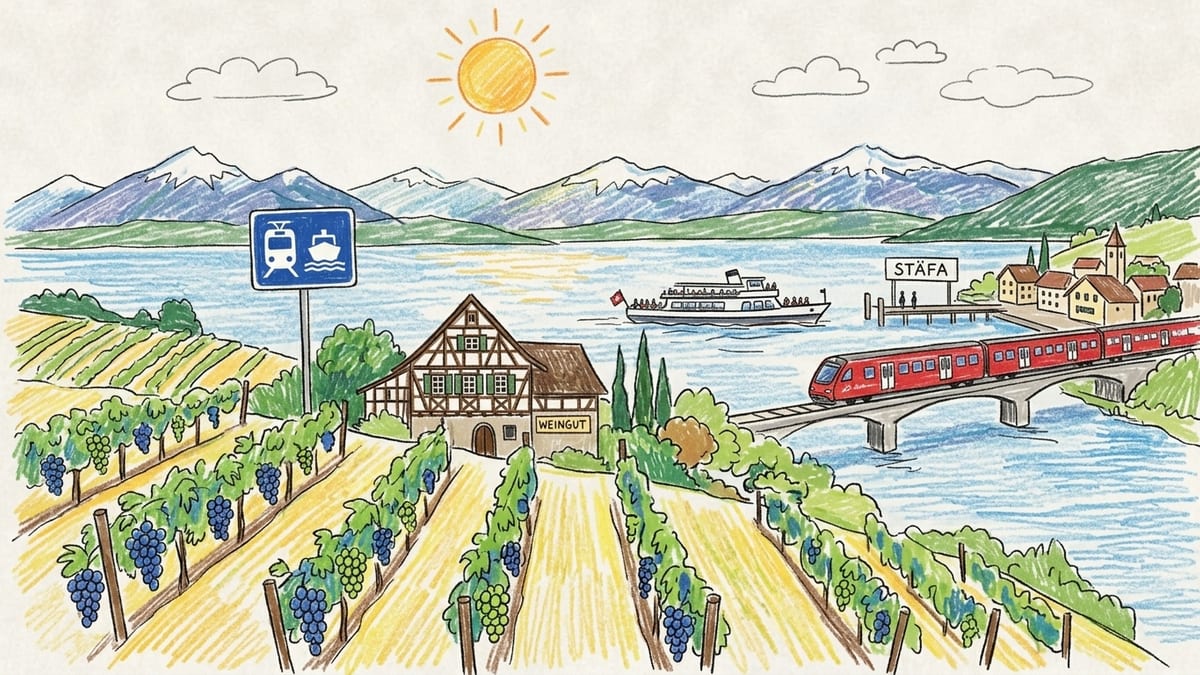
Zurich’s Wine Identity and How to Explore It
Zurich’s reputation abroad still leans more toward finance than vineyards, but the canton is one of Switzerland’s important wine areas, particularly for Pinot Noir, Riesling-Silvaner (often called Müller-Thurgau) and the indigenous white grape Räuschling. Around Lake Zurich, vines line much of the right bank from Zurich’s eastern suburbs through Erlenbach, Herrliberg, Meilen and Stäfa, while north of Winterthur the Zürcher Weinland forms a patchwork of elongated vineyards between the Rhine, Thur and the German border. In the city itself, small but historic vineyards cling to sunny slopes in districts such as Enge and Riesbach, and the city even bottles its own wine.
For visitors this compact geography has a major advantage: wine villages, city vineyards and lakeside slopes are tied together by dense public transport and signposted walking routes. Regional S-Bahn trains connect Zurich Hauptbahnhof with Andelfingen in the Weinland and with Meilen, Uetikon and Stäfa along Lake Zurich, often in under 40 minutes. Passenger ferries criss-cross the lake between Zurich, Rapperswil and smaller piers near wine-growing communes, while local buses climb from lakeside stations into the hills. This makes Zurich one of the easiest wine regions in Europe to explore without a car.
Most wineries around Zurich are small, family-run operations and are not open for casual drop-in tastings every day. Advance reservations are the norm, especially for cellar tours or groups. Some producers open on set “Degustation” days, or operate seasonal taverns and garden terraces in late spring through autumn. For a first visit, it is often simplest to choose a base in a wine village such as Andelfingen or Stäfa, check local tourist office listings for visiting hours and plan one or two pre-booked tastings combined with vineyard walking or cycling.
Zurich’s wine year is most visible in late summer and autumn. Harvest usually begins around mid-September and can run into October depending on grape variety and weather. This is when slopes above Lake Zurich turn shades of gold, when temporary harvest restaurants open in some villages and when many municipalities host local wine festivals. Dates vary by year and village, so travellers should check current event calendars from Zurich Tourism or municipal websites before planning a dedicated harvest trip.
Zürcher Weinland: North of Winterthur to the Rhine
The Zürcher Weinland lies roughly 30 to 60 minutes north of Zurich by train and feels worlds apart from the city. Rolling hills, traditional farmhouses and long rows of vines stretch between small communities such as Trüllikon, Truttikon, Rudolfingen and Marthalen. Official cycling and wine routes link these villages, and a regional network of winegrowers markets the area as its own destination under the “Zürcher Weinland” name. Pinot Noir dominates plantings here, with Riesling-Silvaner and other cool-climate whites providing fresh, aromatic counterpoints. Many producers sell directly from the farm, and tastings are arranged on request.
Andelfingen, roughly 25 minutes from Winterthur or about 40 minutes from Zurich Hauptbahnhof by S-Bahn, is one of the most practical bases for exploring the Weinland without a car. Trains on line S33 link Zurich via Winterthur to Andelfingen, and from the station visitors can follow marked hiking and cycling routes into the surrounding vineyards. Regional maps highlight routes that loop through villages like Trüllikon and Truttikon, where small wineries grow Pinot Noir, Riesling-Silvaner and newer varieties on gentle slopes and sell bottled wine at the farm gate. Local restaurants often feature Weinland wines on their lists, so even a short day trip can include tastings with lunch.
Walking is the most atmospheric way to experience the Weinland’s landscape of elongated vineyard ridges. Well-marked yellow hiking signs point from village centres up into the vines and along tractor tracks with long views toward Germany or the distant Alps. Some routes can be shortened by using post buses between villages, useful if you have booked a late-afternoon tasting and want to end the day at a specific winery without rushing. Because wineries are discrete private businesses rather than open bars, it is essential to arrange visits in advance and allow enough time between appointments to walk safely.
Cyclists will find a network of signed regional routes suitable for hybrid or touring bikes, with gradients that are generally gentle but occasionally steep enough to be a workout. Several local tourism partners promote e-bike itineraries that combine vineyard views, river valleys and cellar stops. Helmets are strongly recommended, and after tasting wine it is sensible to limit yourself to small samples, drink water with each flight and plan any downhill sections early in the ride. An alternative is to schedule the heaviest riding before your main tasting and then roll gently back to Andelfingen or another station to return by train.
Lake Zurich’s Right Bank: The Gold Coast Wine Villages
The right bank of Lake Zurich, often nicknamed the “Gold Coast” for its long evening sun, is the most visible expression of Zurich’s wine culture for many visitors. Starting from Zurich’s eastern districts, vineyards appear above lakeside towns such as Zollikon, Küsnacht, Erlenbach, Herrliberg, Meilen and Uetikon, culminating in the large wine community of Stäfa. Railside and lakeside walking paths thread between stations, piers and vineyard lanes, while commuter trains and boats keep everything connected. This is an ideal area for travellers who want to combine an easy walk, a few glasses of wine and a quick return to the city.
The backbone of right-bank travel is S-Bahn line S7, which runs at regular intervals from Zurich Hauptbahnhof through Stadelhofen and on to Meilen, Uetikon, Männedorf, Uerikon and Stäfa, continuing to Rapperswil. Between Zurich and Meilen, a combination of S7 and other lines provide frequent connections, typically with journey times of about 15 to 30 minutes depending on the stop. Ferries of the Lake Zurich Navigation Company supplement the trains, offering scenic approaches to wine villages, for example by cruising to a pier near Stäfa and walking back along the lakeside.
Stäfa itself, about 30 minutes from central Zurich by S-Bahn, is considered the largest wine-growing municipality on Lake Zurich, with roughly 50 hectares of vines spread across hillside terraces above the town. Pinot Noir is again important here, but the lakeside microclimate also favours expressive whites such as Räuschling, which is particularly associated with the Lake Zurich region. Visitors based in Stäfa can walk up marked paths from the station into the vineyards, enjoy sweeping views across the lake to the Alps, and then continue on gentle routes west toward Uerikon and Männedorf or east toward Feldbach and Rapperswil.
Between Meilen and Stäfa, a shoreline walking path allows travellers to stitch together short vineyard strolls, swimming stops and tastings. Sections of the Zurichsee-Rundweg, a signed trail around the lake, climb slightly above the water through vines and orchards. Local producers often post small signs at lane entrances announcing open cellar days or seasonal taverns. Because regular opening hours vary and can change from year to year, it is wise to check Zurich Tourism’s wine pages or individual winery sites before counting on a spontaneous visit. As a fallback, many villages have wine shops that stock multiple local producers, offering casual tastings without the need for an appointment.
Upper Lake Zurich, the Obersee and Ufenau Island
East of Stäfa and Rapperswil, Lake Zurich narrows and becomes the Obersee, a quieter body of water framed by lower hills and distant mountain silhouettes. Here, on both the northern and southern shores, vines have been cultivated for centuries. Around the upper end of the main lake, wineries near Rapperswil and along the shores produce wines marketed as “Zürichsee” or “Obersee” origin. Some estates combine wine production with restaurants or event spaces, making them natural focal points for wine excursions.
One atmospheric way to reach the Obersee wine area is by boat from Zurich or intermediate piers to Rapperswil. The cruise takes around two hours on the longer routes and delivers passengers directly beneath Rapperswil Castle, a landmark visible from much of the lake. From here you can walk across the wooden footbridge and causeway toward Pfäffikon or continue onward by boat to smaller stops that serve hiking routes around the Obersee. Regional cycling route 99, known as the Heart Route, loops the Obersee and climbs toward Einsiedeln, passing near vineyards and offering multiple opportunities for food and wine breaks in lakeside villages.
Ufenau Island, owned by Einsiedeln Abbey and reachable by seasonal passenger ferries, is one of the most distinctive wine-related destinations on the lake. The island is a protected nature reserve with two Romanesque churches and a restaurant housed in a historic building that once served as the tenant’s house for the farm and vineyard. Grapes grown on the island and on surrounding abbey holdings are vinified by the abbey’s wine cellar, and the restaurant features these abbey wines alongside regional dishes. Swimming is not permitted on Ufenau, which helps preserve its quiet atmosphere, but a shore path circles the island in about half an hour, passing small vineyard plots and lake viewpoints.
To combine Obersee landscapes with tastings, visitors can base themselves in Rapperswil-Jona or Pfäffikon and plan a day that mixes short boat hops, vineyard walks and one or two pre-arranged cellar visits. Public transport makes this straightforward: frequent S-Bahn trains link Zurich with both Rapperswil and Pfäffikon, while ferries connect them with Ufenau and lakeside piers. A popular pattern is to sail out to Ufenau for lunch and a glass of abbey wine, then return to Rapperswil and stroll through the town’s own historic vineyards on the castle hill before catching a train back to Zurich in under 40 minutes.
City Vineyards and Urban Wine Experiences
Few European financial centres can match Zurich’s blend of glass towers and working vineyards within the city limits. On the lakeside slopes of Riesbach and Hottingen, and above the station in Enge, vines are planted among villas and parks. The city itself operates vineyards such as the Chilesteig site, where grapes grow on land once cultivated by the Romans, and produces an official city wine. Private producers have also maintained and expanded historic estates on the hills above the lake, often pairing their wines with tasting rooms and small event venues tucked behind residential streets.
Urban wine walks highlight this unexpected side of Zurich. One popular itinerary links three city vineyards between Enge and Riesbach, taking in sites such as the Bürgli vineyard above Enge, the Sonnenberg slopes above Hottingen and the Burghalde vineyard in Riesbach. Participants taste several wines, usually a mix of Pinot Noir, Räuschling and other local varieties, while guides explain how viticulture fits into Zurich’s history and modern urban planning. These organised walks typically need to be booked in advance through event operators or directly via Zurich Tourism, and they demonstrate how compact the city really is. Within a few hours you can move from tram stops to steep terraces with unobstructed lake views and rows of ripening grapes.
For independent travellers, the city’s wine culture is also visible in its vinotheques and wine-focused bars, many of which showcase bottles from Lake Zurich, the Weinland and other Swiss regions. Some producers, such as long-established urban wineries, operate their own tasting rooms where visitors can sample current vintages and purchase bottles to take home. Opening hours can be limited, often concentrating on Thursday to Saturday, and tastings beyond a basic sample usually require a paid flight or a pre-booked session. In return visitors gain insight into Zurich’s broader wine scene, from traditional cooperatives to younger winemakers experimenting with barrel styles and lesser-known varieties.
Because these vineyards are embedded in residential neighbourhoods, etiquette matters. Paths through vines are usually public rights of way, but picnicking among the rows or entering the vines during harvest is discouraged unless specifically permitted. City regulations also limit noise late at night, so outdoor tastings in residential courtyards tend to wind down on the earlier side. Staying in central Zurich and using trams or on-foot routes to reach vineyards keeps logistics simple and avoids any need to drive after tasting.
Grapes, Tasting Culture and Visiting Etiquette
The three headline grapes in Zurich’s wine country are Pinot Noir, Riesling-Silvaner and Räuschling. Pinot Noir, known locally as Blauburgunder, accounts for a significant share of the red plantings and produces everything from light, fresh reds suited to lakefront summer evenings to more structured bottlings aged in wood. Riesling-Silvaner is a white grape created in the 19th century that thrives in cool climates. Around Zurich it often yields crisp, aromatic wines with notes of apple and herb, served as aperitif wines or paired with lake fish. Räuschling, once in decline, has seen a revival on the sunlit slopes of Lake Zurich and has become something of a regional signature, frequently offering citrus, stone fruit and salty-mineral notes that echo the lake breeze.
Smaller plantings of grapes such as Sauvignon Blanc, Pinot Gris and specialty reds also dot the canton, especially in the Weinland and along the Obersee. Many wineries produce sparkling wines from Pinot Noir or white varieties, and some experiment with barrique-aged cuvées. During tastings, guests can usually expect a lineup of three to six wines, often starting with a sparkling or light white, moving through fuller-bodied whites including Räuschling and then progressing to one or more Pinot Noirs. In family-run cellars, the winemaker or a family member typically guides the tasting, happy to explain vineyard sites, soils and food pairing ideas.
Reservations are central to Zurich’s wine tourism culture. Outside of large public open days, most wineries ask that visits be arranged by phone or email in advance, with group tastings often requiring a minimum number of participants and a per-person fee that may be offset against bottle purchases. For individual travellers, some estates offer shorter by-appointment tastings that last around an hour, ideal to pair with a half-day walk. When booking, it is worth mentioning how you will arrive, especially if you plan to come by public transport and on foot, so hosts can advise on timing and the most convenient path through the vineyards.
Wine pricing in Zurich generally reflects Switzerland’s high cost base. Entry-level local bottles in winery shops often start at prices that would be considered mid-range in other European regions, while single-vineyard Pinot Noirs and speciality Räuschling bottlings cost more. On the upside, tasting fees, when charged, are usually moderate compared with international standards and often include generous pours and snacks. Tipping is not obligatory but rounding up the bill slightly or leaving a small amount for excellent service is appreciated.
Getting Around Without a Car: Trains, Boats and Bikes
One of Zurich’s strengths as a wine region is that nearly every major subregion can be reached easily by public transport. The Zurich S-Bahn network fans out from Hauptbahnhof to Lake Zurich and the Weinland, while boats and buses cover the lake and its shores. This allows visitors to design itineraries that prioritise safety and relaxation over driving and parking. A day pass for the relevant fare zones often covers trains, boats, buses and even certain cableways, simplifying ticketing.
For the right bank wine villages, S-Bahn lines such as S6 and S7 are the main tools. S7 runs from Winterthur through Zurich and along the right bank to Rapperswil, stopping in key wine communes like Meilen, Uetikon, Männedorf, Uerikon and Stäfa. S6 supplements this between Zurich and Uetikon, offering additional stopping services. Journeys from Zurich Stadelhofen to Meilen can be as fast as around 15 minutes, with a few more minutes to Uetikon or Stäfa. From these stations, signposted shore paths and local roads lead uphill into the vines, usually within 10 to 20 minutes on foot.
North toward the Zürcher Weinland, line S33 links Winterthur and Andelfingen, where cyclists and walkers can follow regional routes into the vineyard landscape. Many visitors start in Zurich, change trains at Winterthur and arrive in Andelfingen in under an hour. Bicycles are permitted on many regional trains, subject to current regulations and in some cases a bike ticket, which makes it practical to bring your own bike or a rental onto the network. During peak commuting hours, however, carriages can be busy, so planning travel in the late morning or mid-afternoon is more comfortable.
Boats operated by the Lake Zurich Navigation Company knit together both shores and the Obersee. From Zurich Bürkliplatz, classic lake cruises call at places such as Meilen, Stäfa and Rapperswil, where passengers can disembark for a vineyard walk or cellar visit before returning by train. Seasonal ferries connect Rapperswil and Pfäffikon with Ufenau Island, allowing a car-free circuit that combines a lake cruise, island walk and abbey wine tasting. On warm days, many locals bring swimsuits to combine lakeside bathing with terrace glasses of wine, though responsible consumption is important if you plan to swim or continue hiking afterward.
Walking, Cycling and Tasting Safely
Zurich’s wine landscapes invite exploration on foot and by bike, but combining physical activity with alcohol requires some planning. A good rule of thumb is to treat tastings as you would a long lunch with wine, not as a bar-hopping session. When booking, you can often request smaller pour sizes, which allows you to sample more wines while keeping total consumption moderate. Alternating each glass with water and a snack, whether provided by the winery or brought as trail food, helps maintain energy over a full day of walking.
Structured wine walks are an excellent option for those who prefer to have logistics handled. In the city, guided routes between vineyards in Enge, Hottingen and Riesbach include pre-arranged tastings, clear walking directions and a set schedule, reducing the temptation to add extra stops spontaneously. Around Lake Zurich, hiking suggestions from Zurich Tourism and the local public transport network include tried-and-tested routes, such as the vineyard walk along the Gold Coast between Feldbach and Stäfa, that balance scenic effort with easy access to stations.
Cyclists should be particularly cautious, as cycling under the influence of alcohol is taken seriously under Swiss traffic law. It is sensible to front-load your ride, covering the longer or more technical stretches before scheduling a single main tasting close to your end point, then using trains or boats to return. E-bikes are widely available from rental outlets and public bike-sharing schemes, but their extra speed and weight make responsible riding even more important after tastings. Wearing helmets, obeying traffic signals in villages and yielding to farm vehicles in vineyard lanes are basic best practices.
Finally, autumn harvest is the most atmospheric period but also a time when vineyard traffic increases, with tractors, picking teams and temporary equipment in the rows. Keeping to marked paths, avoiding stepping into the vines and respecting temporary closure signs or rope barriers is essential. If in doubt about a particular track during harvest, choose an alternative marked route or ask at a village tourism office. The reward for this care is a landscape alive with colour and activity, where you can watch grapes being picked in the morning and taste the previous vintage in the afternoon.
The Takeaway
Zurich’s wine country rewards travellers who look beyond clichés of banks and shopping streets. For scenery, the right bank of Lake Zurich from Meilen through Stäfa and onward to the Obersee combines glinting water, vine-clad slopes and distant mountain backdrops in a way that rivals better-known Swiss regions. Approaching a hillside winery by boat and watching the sun set behind Zurich’s skyline from a terrace above the lake is one of the region’s most memorable experiences.
For visitors without a car, the easiest area to explore is the right bank around Stäfa and Meilen, where frequent S-Bahn trains, lake boats and shore paths interlock almost seamlessly. Here you can step off a train, follow waymarks through vineyards, taste Räuschling with a view of the Alps and be back at Zurich Hauptbahnhof within an hour. Urban wine walks inside the city add another car-free layer, letting you discover vineyards within tram distance of the old town.
Travellers chasing Zurich’s strongest sense of traditional wine culture will find it in the Zürcher Weinland north of Winterthur, where farmsteads, small cellar doors and long rows of Pinot Noir define the landscape. Staying in Andelfingen and moving between villages on foot, bicycle and S-Bahn trains delivers an insight into everyday winegrowing life that is more rural than lakeside. Meanwhile, those planning a classic autumn wine trip should aim for late September or early October, when harvest activity, chestnut stands and changing foliage align around both the lake slopes and the Weinland hills.
Whichever subregion you choose first, Zurich’s wine country proves that serious vineyards exist within easy reach of Switzerland’s largest city. By relying on public transport, planning tastings in advance and weaving in vineyard walks or bike rides, you can experience a side of the canton that many visitors never see, glass in hand and alpine peaks shimmering on the horizon.
FAQ
Q1: Can I visit Zurich’s wineries without renting a car?
Yes. Most wine areas in Canton Zurich are accessible by S-Bahn, boats and local buses, especially the right bank villages like Meilen and Stäfa, the city vineyards and the Zürcher Weinland around Andelfingen.
Q2: What is the best time of year to visit Zurich wine country?
The most atmospheric time is usually late September to early October, when harvest is in full swing and the vineyards show autumn colours, but pleasant visits are possible from late spring through early autumn.
Q3: Do I need reservations for wine tastings?
In most cases yes. Many wineries are small family operations and ask visitors to book tastings by phone or email in advance, especially for cellar tours or larger groups.
Q4: Which grape varieties should I look out for around Zurich?
Pinot Noir is the main red, while Riesling-Silvaner and the local speciality Räuschling are key whites. Many wineries also produce sparkling wines and smaller quantities of other varieties.
Q5: Where is a good base for exploring the Zürcher Weinland?
Andelfingen makes an excellent base, with S-Bahn connections to Winterthur and Zurich, marked walking and cycling routes into the vineyards and easy access to nearby wine villages.
Q6: Is Stäfa really worth visiting for wine?
Yes. Stäfa is one of the largest wine-growing communities on Lake Zurich, with extensive hillside vineyards, views over the water to the Alps and convenient S-Bahn and boat connections.
Q7: How can I combine a lake cruise with wine tasting?
You can take a boat from Zurich to Meilen, Stäfa or Rapperswil, visit nearby vineyards or wine bars on foot and then return to the city by train or another boat later in the day.
Q8: Are there wine experiences inside Zurich city itself?
Yes. Zurich has active city vineyards and urban wineries, and guided wine walks link sites in districts like Enge, Hottingen and Riesbach, combining tastings with short walks.
Q9: Is cycling between vineyards safe after tastings?
Cycling is a popular way to explore, but you should keep tastings moderate, drink plenty of water and plan your main riding before visiting a winery, then return by train if needed.
Q10: Can I visit Ufenau Island for wine-related experiences?
Yes. Seasonal ferries reach Ufenau Island, where Einsiedeln Abbey maintains vineyards and a restaurant that serves abbey wines alongside regional dishes in a peaceful lakeside setting.