


Lake Zurich is far more than a pretty backdrop to the city. Its boats function as a floating extension of Zurich’s public transport network, linking downtown with lakeside villages, hiking trails and even islands. With regular departures, integrated fares and varied routes, you can treat the lake as a web of practical connections rather than a one-off sightseeing detour. This guide explains how to use Lake Zurich cruises strategically, from quick city hops to full-day journeys toward Rapperswil, and combines real-world examples of timetables, fares and pass coverage as they stand in late 2026.
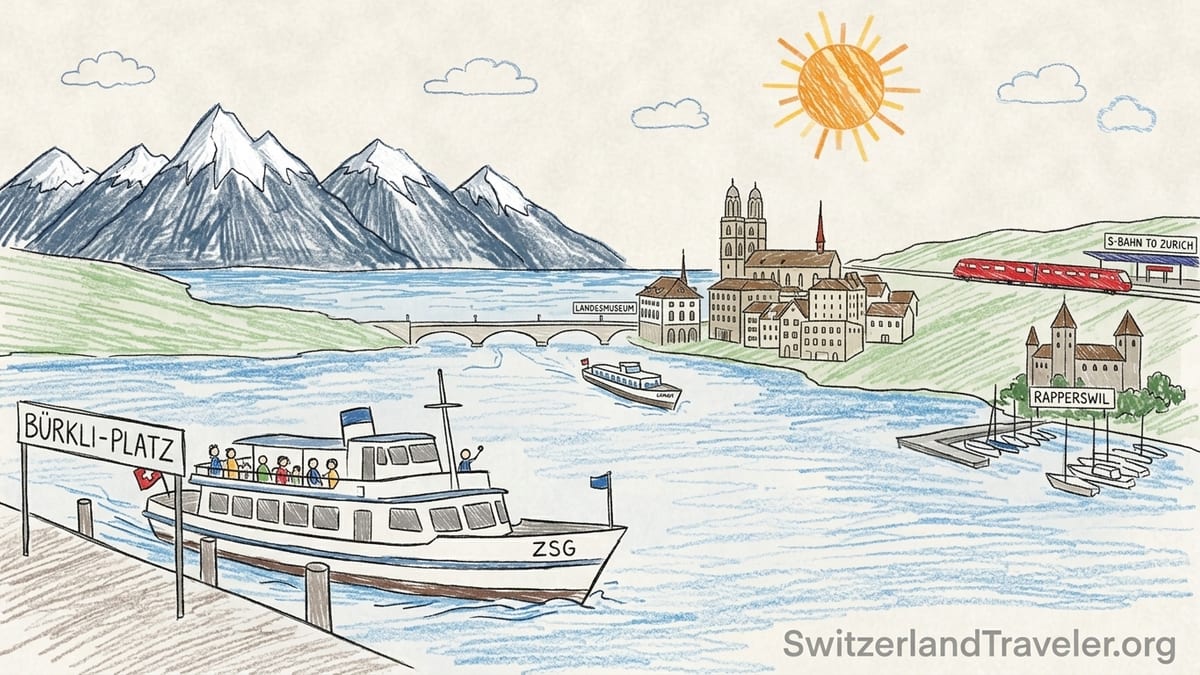
How Lake Zurich’s Boat Network Works
Passenger services on Lake Zurich are operated primarily by the Zürichsee-Schifffahrtsgesellschaft (ZSG), which runs scheduled boats on the lake, into the upper lake near Schmerikon and along the Limmat River through central Zurich. These services are coordinated with the Zurich public transport association (ZVV), so in practice the boats behave like floating trams: you board at signed piers, validate a regular public transport ticket and can use the same passes that work on trams, buses and most local trains. The main lake hub is Bürkliplatz, a short walk from Zurich’s Bahnhofstrasse, with secondary piers at Wollishofen, Zürichhorn, Enge and along both shores of the lake.
Several types of lake cruise operate simultaneously. At the short end are mini and short round trips that loop close to the city in about 60 to 90 minutes. Longer services travel deep into the lower lake and on to Rapperswil, a small medieval town at the far end of the main basin, while others continue into the upper lake toward Schmerikon in summer. In parallel, the separate Limmat river boats connect the Landesmuseum stop near Zurich main station with Bürkliplatz and Zürichhorn, giving a sight-filled 30 to 60 minute ride right through the historic center. Ferries on a different concession run vehicles and foot passengers between Horgen and Meilen, effectively stitching the two shores together.
For most visitors, the crucial point is that almost all regular ZSG services follow a published timetable and accept public transport tickets. Only special evening, brunch or event cruises fall outside this scheme and require separate tickets. This means you can treat the lake fleet as flexible infrastructure when planning a day around Zurich, using boats for scenic hops between museums, swimming areas, villages and train connections rather than buying a one-off “tourist cruise” that begins and ends at the same point.
From a seasonal perspective, there is year-round service on the core sections of the lake, but frequencies, end points and vessel types vary significantly. Between roughly April and October there are multiple long round trips each day between Zurich and Rapperswil, mini and short city loops, and more frequent calls at smaller piers. Outside this window there are fewer departures and some upper-lake segments may be suspended. Near record low water periods, which have occurred in recent years, ZSG publishes temporary low-water timetables with curtailed routes and alternative shuttles. Always verify the specific timetable for your travel date, especially in shoulder seasons or late autumn.
Short City Cruises and Limmat Boat Options
If you want to experience the lake without dedicating half a day, the mini lake cruise and short lake cruise are the most efficient options. ZSG’s own materials describe a mini lake cruise of around 60 minutes from Zurich via Wollishofen and nearby stops before returning to Bürkliplatz, while the short lake cruise extends this loop toward Thalwil and Erlenbach for about 90 minutes. These are true round trips, making them convenient if your time is limited or you simply want a restful interlude between museum visits and shopping.
City cards such as the Zürich Card include some of these shorter cruises at no extra cost, which can represent excellent value if you are already planning to use public transport and visit museums. For example, on a 24-hour Zürich Card you might ride a Limmat boat from the Landesmuseum to Bürkliplatz, join a mini lake cruise around the nearby shoreline, then finish the day with tram rides and cable-car trips in the city hills, all covered on a single pass. The practical advantage is that you are not locked into a single narrated tour but are free to mix boats with trams and walking.
The Limmat boats represent another short-cruise option with a distinctly different character. These low-profile vessels depart from the pier near the Swiss National Museum, slip beneath the old town’s bridges, and eventually emerge into the lake, calling at Bürkliplatz, Enge and Zürichhorn before returning upriver. The full circuit takes about an hour in summer, but you can use the boats one way as public transport. Many visitors ride downstream from the station to Bürkliplatz, continue immediately on a lake loop and then walk back along the lakeside promenades, effectively turning the waterway into a scenic sightseeing corridor.
In terms of views and atmosphere, these city-oriented cruises are about urban scenery rather than wide Alpine panoramas. You will glide past the old guild houses along Limmatquai, see the twin towers of the Grossmünster from water level and pass popular swimming spots such as Seebad Utoquai. For a first afternoon in Zurich they provide a soft landing and help you understand the geography of the city before committing to longer excursions.
Longer Routes to Rapperswil and the Upper Lake
The signature long cruise on Lake Zurich is the route between Zurich and Rapperswil. Current schedules confirmed for the 2024 to 2025 period show typical journey times of about two hours in each direction, with the classic full round trip taking roughly four and a half hours including intermediate stops. Boats leave Zurich multiple times per day in the high season, calling at lakeside communities on both shores and at Ufenau Island when water levels allow. By October the frequency usually drops, and in winter only selected departures cover the full length of the lake.
As a transport-and-excursion network, this route is powerful because it links several rail nodes and excursion areas. You can ride from Zurich to Rapperswil by boat, spend one to three hours wandering the old town and lakeside promenade, then return to Zurich in about 35 minutes by S-Bahn train. Alternatively, you might take an S-Bahn from Zurich to a mid-lake village such as Meilen or Horgen, then ride the boat one way back to the city. In practice, many locals use exactly this boat-plus-train pattern on sunny weekends when the lake ships are crowded, timing their journeys to avoid the busiest midday departures.
Upper-lake sailings that continue beyond Rapperswil toward Schmerikon or Lachen operate primarily in the main summer months and on certain shoulder-season days. These add a very rural flavor, with low-lying reed beds, fewer built-up areas and a greater sense of being on a tranquil river than a busy commuter lake. Train coverage along some stretches of the upper lake is patchier, so if you ride all the way to Schmerikon by boat you should check in advance whether your rail pass and ZVV ticket zones cover the return journey from that particular station.
Travelers sometimes ask whether the full Zurich to Rapperswil round trip becomes repetitive. The answer depends on your expectations and the weather. Because the route zigzags between the western and eastern shores, you see different angles of the same mountains and villages as you progress, and the feel of the journey changes from urban basin near Zurich to broader, more rural perspectives past Meilen and Wädenswil. On a bright day with good visibility the cumulative effect is pleasant rather than monotonous, especially if you build in a stop at Rapperswil or Ufenau instead of staying seated on deck for the entire four and a half hours.
Routes, Directions and Where to Find the Best Alpine Views
Lake Zurich is aligned roughly southwest to northeast, with Zurich at the northwest end and Rapperswil toward the southeast. On a clear day the Glarus Alps appear as a jagged backdrop beyond the far end of the lake, while nearer ridges such as the Albis chain and Pfannenstiel flank the basin. For postcard-style Alpine views framed by water and shoreline villages, it usually helps to travel away from Zurich toward Rapperswil in the late morning or early afternoon, when the sun is higher and often behind you, illuminating the mountain ridge ahead rather than silhouetting it.
Direction matters most for photographers. Sailing south from Zurich in the morning places the sun to your left or slightly behind you, lighting up the eastern shore with its villa-lined slopes and vineyards around Meilen and Stäfa. In the later afternoon, returning from Rapperswil toward Zurich often works better, because the western shore villages such as Horgen and Thalwil catch the warm side light and the city skyline comes into view with soft reflections on the water. If you are keen on Alpine backdrops, scrutinize the forecast for haze or low cloud, because in humid summer weather the distant peaks can fade into a gray blur even when the sky overhead is blue.
Short city cruises are less sensitive to direction but still offer subtle differences. A mini lake cruise that loops south to Wollishofen and back keeps you mostly within the built-up zone, showcasing architecture, lakeside parks and the constant rhythm of trams and commuter trains running parallel to the water. The short lake cruise extending to Thalwil and Erlenbach adds low, rolling hills and a few vineyard patches, but the real sense of distance and open water only develops once you reach mid-lake near Meilen or Wädenswil, typically experienced on the longer Rapperswil routes.
For photographers who want both city and mountain perspectives in one sequence, a classic option is to ride the Limmat boat from the Landesmuseum to Bürkliplatz for old-town views, immediately transfer to a long lake boat toward Rapperswil and then return by train from Rapperswil’s elevated station, which offers a final vantage point across the water toward the mountains. This boat-plus-train triangle fits comfortably into a six to eight hour day and avoids retracing your steps.
Tickets, Fares, First vs Second Class and Pass Coverage
ZSG is integrated into the ZVV fare system, which means that regular scheduled cruises between piers on Lake Zurich can be used with zone-based public transport tickets. In practice, shorter city loops and hops between adjacent villages are priced like any other zonal journey, while the full Zurich to Rapperswil run approaches the upper end of the ZVV fare range. Independent fare analyses reflecting the current 2024 to 2025 schedule indicate that a complete Zurich to Rapperswil journey without a pass costs on the order of the high twenties in Swiss francs one way in standard class, while short hops between neighboring piers fall roughly in the 4 to 8 franc range.
Public transport passes significantly change the equation. The Swiss Travel Pass and the Swiss GA (Generalabonnement) cover regular ZSG lake services in the valid zones at no extra cost, making long cruises essentially “free” on the day. The Half-Fare Card and many international rail passes, including Interrail and Eurail in their Swiss sections, usually give 50 percent reduction on ZSG scheduled services, although you should verify the current discount level at the pier or in official tariff documents. ZVV day passes, including the popular “9 o’clock pass” valid after 9 in the morning for all zones in the Zurich region, also cover lake cruises within the purchased zones. This means that a resident or visitor who buys a ZVV all-zones day ticket can combine unlimited trams, trains and lake boats, including to Rapperswil, without additional boat tickets.
Most of the larger lake boats offer both first and second class. The main functional difference is access to certain indoor lounges and, on some vessels, priority seating on upper decks. Travelers have reported that on selected ships the main à la carte restaurant seating is reserved for first-class passengers, while second-class travelers use more informal self-service counters or outdoor areas. On busy weekend afternoons in summer, second-class decks can become crowded and noisy, especially when large groups board in Zurich, whereas first-class sections stay noticeably calmer and offer better shelter in changeable weather. If you value quiet, table service and more reliable window seats, the first-class supplement may be worthwhile for a long Rapperswil run, but is harder to justify on a one-hour mini cruise.
Tickets can be bought in multiple ways. There is a staffed ticket pavilion at Bürkliplatz, standard ZVV ticket machines at or near many piers, and ticket sales on board the boats themselves. In addition, ZVV’s mobile app now sells specific lake round-trip tickets, letting you purchase and validate a mini, short or long cruise digitally on the day. If you already hold a pass such as a Swiss Travel Pass, GA or ZVV day card, you usually do not need an extra lake ticket, but always check whether first-class travel or restaurant access requires an upgrade before boarding.
Onboard Experience, Food, Bikes and Avoiding Repetition
Lake Zurich’s scheduled boats range from historic paddle steamers on selected days to modern motor vessels with large indoor salons and multiple decks. Seating is mostly unreserved, and many passengers head directly to the open upper deck in good weather. On a sunny Saturday it is common to see families spreading out with picnic bags and folding strollers, commuters reading newspapers on shaded benches and visitors clustering at the bow for unobstructed views of the shoreline villas. In cooler seasons or during evening sailings, the interior lounges become the main gathering space, with panoramic windows useful even when it is too windy to sit outside.
Catering is handled by Zürichsee Gastro, which runs restaurants and snack counters on the larger ships. Menus change with the season but typically include items such as coffee and pastries in the morning, soups, salads, sausages and simple hot dishes at lunchtime, and desserts and local wines in the afternoon and evening. Prices reflect Swiss norms, so a sit-down meal onboard can quickly exceed what you would pay for a casual lunch onshore. Many travelers compromise by buying a drink and small snack on the boat while bringing their own sandwiches or bakery treats from Zurich. On some vessels, full restaurant seating is tied to first-class travel, while self-service counters are open to all; when in doubt, ask a crew member where you are allowed to sit with your ticket type.
Bicycle transport is generally possible on many ZSG services, but capacity is limited and bikes are not accepted on all departures, especially during commuter peaks. There is usually a small surcharge for bikes in addition to the passenger fare, and loading is at the crew’s discretion based on available space. If you plan to combine a lakeside cycling route with a boat leg, study the current timetable for bike symbols next to individual sailings and avoid peak-hour commuter runs from lakeside suburbs into the city, when bike restrictions are most stringent.
The question of whether long cruises feel repetitive hinges on how you structure your day. Sitting for four and a half hours continuously on a Zurich to Rapperswil round trip can indeed begin to blur into one long sequence of similar villages and wooded hills. A better approach is to use the boat as one leg of a multi-part excursion. For instance, ride from Zurich to Rapperswil by boat in the morning, disembark for a leisurely walk through the lakeside quarter and along the wooden footbridge toward Hurden, then return to Zurich by fast S-Bahn or regional train. Alternatively, take a morning train to Rapperswil, visit the town and then ride the boat back to Zurich in late afternoon when the light can be especially good for photography. A shorter variation is to sail only a portion of the lake, such as Zurich to Meilen or Zurich to Wädenswil, then hop off for a lakeside walk, swim or café stop before returning by train.
Using Boats as Transport: Real-World Day Trip Combinations
Thinking of Lake Zurich as a transport network opens up several practical day trip combinations that feel effortless rather than over-planned. One of the most popular patterns for visitors holding a ZVV day pass or Swiss Travel Pass is a triangular route linking Zurich, a lakeside village and Rapperswil. You might leave Zurich by S-Bahn to Meilen in the mid-morning, stroll the hillside vineyards or lakeside promenade for an hour, then board a lake boat to Rapperswil, enjoying increasingly open scenery as the lake broadens. After exploring Rapperswil’s old town and castle hill for a couple of hours, you return to Zurich by fast train in under forty minutes, arriving back in time for dinner.
An alternative focuses on the Limmat and the near-lake suburbs. Start at Zurich main station, walk a few steps to the Landesmuseum Limmat pier and take the river boat downstream through the old town to Zürichhorn. Disembark to visit the lakeside parks and cultural institutions in the Zürichhorn area, such as lakeside sculpture gardens or the nearby Seefeld district, then in the afternoon ride a short lake cruise back to Bürkliplatz and complete the day with a stroll along Bahnhofstrasse. This pattern uses two boat legs primarily as transport between clusters of attractions, yet still delivers the sense of being on the water.
For a more rural-feeling day that still starts and ends in Zurich, consider combining the boat with short hikes. For example, ride a morning boat from Bürkliplatz to Wädenswil, where you can connect to the local train or bus network leading into the hills above the lake, then in the afternoon rejoin the lake at a different pier such as Richterswil or Horgen for a return sailing. Because ZSG timetables are fully integrated with ZVV, printed and online journey planners can show you real-time connections between boat and train, making it easier to judge whether you have enough time to complete a hike or village walk before the next sailing.
Those who are primarily interested in crossing between shores rather than cruising lengthwise can also make use of the Horgen–Meilen ferry route. These car ferries run frequently and accept foot passengers, linking the western and eastern lakeshores at a narrow point of the lake. For example, you might take a train from Zurich to Horgen, cross by ferry to Meilen for lakeside lunch or a vineyard visit, then rejoin a northbound ZSG boat toward Zurich later in the afternoon. While the ferry itself is a short ten-minute crossing and has a different operator from ZSG, it integrates naturally into a multi-leg, multi-operator day that keeps you close to the water throughout.
The Takeaway
Lake Zurich’s boat services are most rewarding when you treat them as part of a flexible network rather than as a single cruise you must “tick off.” The mini and short cruises work well for first-time visitors with limited time, giving an hour or ninety minutes of calm water, city skyline views and a sense of Zurich’s layout. The long Zurich to Rapperswil run comes into its own when combined with a stopover in town and a return by train, or when used one way to link hikes or village visits along the lake.
For families, the short lake cruise or a segment of the long route paired with a lakeside playground or swimming area tends to be ideal. Children have enough time to move around the decks, watch the crew at work and enjoy snack breaks without being stuck on board for half a day. Couples often gravitate toward late-afternoon departures to or from Rapperswil, when the light is softer, the decks slightly less crowded and the onboard restaurant service feels more atmospheric. Booking first class can be a subtle upgrade here, especially if you want a quiet corner table and panoramic windows.
Photographers and serious sightseers should pay attention to direction, weather and pass coverage. Traveling out from Zurich toward Rapperswil in the late morning and returning by train allows for clear lake and mountain vistas without fatigue. Holding a Swiss Travel Pass, GA or ZVV day ticket makes spontaneous boat hops painless, so you can adapt to changing light or cloud conditions and board the next promising sailing rather than being tied to prebooked tours. Travelers who mainly need transport, such as commuters to lakeside offices or visitors connecting to hikes and wineries, can use the same boats tactically, boarding only for the most scenic or time-efficient legs.
Ultimately, Lake Zurich cruises reward a mindset that blends practicality with pleasure. Check the current ZSG timetable for your specific dates, look up whether any low-water adjustments are in force, and verify fares or supplements for first class, bikes and special cruises. Then sketch a day that uses the lake not as a backdrop, but as an integral part of how you move through the Zurich region. When you step off the boat at sunset with the city lights flickering ahead and the last commuter ferries crisscrossing the bay, it will feel less like a packaged excursion and more like you have briefly joined the daily rhythm of the lake.
FAQ
Q1. How long does the Zurich to Rapperswil boat trip take and is it worth a full round trip?
The direct scheduled ZSG journey between Zurich and Rapperswil typically takes about two hours each way, with a full round trip lasting roughly four and a half hours including intermediate stops. Whether it is worth doing as a continuous loop depends on your patience and the weather. Many travelers prefer to ride one way by boat, explore Rapperswil on foot, then return to Zurich by S-Bahn train in around 35 minutes to avoid cruise fatigue.
Q2. Are Lake Zurich cruises included in the Swiss Travel Pass or ZVV tickets?
Regular ZSG scheduled services on Lake Zurich are covered by the Swiss Travel Pass and by the nationwide GA travelcard, so you can board without extra tickets in the relevant zones. ZVV zone tickets and day passes, including the all-zones “9 o’clock pass,” also cover lake cruises within the purchased zones. If you hold only a Half-Fare Card or an international rail pass such as Interrail, you typically receive about 50 percent reduction on ZSG fares, but should confirm the exact discount with current tariff information or at the pier.
Q3. What is the difference between first and second class on Lake Zurich boats?
On larger ZSG vessels, second class covers most open decks and standard indoor seating areas, while first class usually provides access to quieter lounges and sometimes upper-deck or restaurant sections with better window tables. The physical comfort is similar, but first class often feels less crowded on busy days and can be linked to table service in the main restaurant. For short city cruises, second class is sufficient for most travelers, whereas for a long Zurich to Rapperswil run, paying the first-class supplement can make the experience more relaxed.
Q4. Can I bring a bicycle on Lake Zurich cruises?
Bicycles are allowed on many ZSG scheduled services, subject to space and crew discretion, and usually incur a small additional charge beyond your passenger ticket. Not all departures accept bikes, and restrictions may apply during peak commuter times when boats are heavily used by residents. When planning a combined bike-and-boat itinerary, check the latest timetable symbols indicating bike acceptance on particular sailings and avoid early-morning and late-afternoon rush-hour boats between suburban piers and Zurich.
Q5. Do the boats operate year-round and how do seasonal timetables affect planning?
Lake Zurich boats run in some form throughout the year, but service levels change with the seasons. From roughly April to October there are multiple daily long cruises between Zurich and Rapperswil, as well as mini and short lake cruises and more frequent calls at smaller piers. In winter, departures are fewer, some routes are shortened and certain upper-lake segments may not operate. Occasionally low water leads to special reduced timetables. For precise planning, always consult the current ZSG schedule for your exact travel date.
Q6. Which direction offers the best Alpine views from the boat?
On clear days, the most rewarding Alpine perspectives tend to come when traveling away from Zurich toward Rapperswil in late morning or early afternoon, with the sun illuminating the distant Glarus Alps and the eastern shore villages. Returning toward Zurich in late afternoon can also be attractive, especially for warm side light on the western shore around Horgen and Thalwil and for city skyline views at the end of the journey. In hazy summer weather, distant peaks may be faint, so checking visibility in the morning helps set realistic expectations.
Q7. Is onboard food good value, or should I bring my own snacks?
Onboard catering by Zürichsee Gastro is convenient and generally good quality, with hot dishes, snacks and drinks available on larger ships. However, prices reflect Zurich’s relatively high dining costs and can exceed what you would pay at a casual lakeside café. Many travelers choose a hybrid approach: they bring sandwiches or bakery items from the city and then buy coffee, soft drinks or a glass of wine on board. On some boats, access to the main restaurant area is reserved for first-class passengers, so check where you may sit before ordering a full meal.
Q8. How can I avoid a long cruise feeling repetitive?
The best strategy is to break the journey and mix transport modes. Instead of sitting through a four and a half hour Zurich–Rapperswil–Zurich loop, ride one direction by boat and return by S-Bahn, or disembark at an intermediate stop such as Meilen, Horgen or Wädenswil for a short walk, swim or café break before continuing. Using the boat as one leg in a triangle that also includes trains or buses keeps your day varied while still giving you substantial time on the water.
Q9. Do I need to book Lake Zurich cruises in advance?
For standard scheduled ZSG services you usually do not need advance reservations. Tickets can be purchased at Bürkliplatz, at ticket machines, through the ZVV app or on board. In very busy summer periods, arriving a little early for popular departures such as the mid-morning Zurich to Rapperswil boat can improve your chances of securing a preferred seat, especially in first class or on the open deck. Reservation requirements are more common on special themed cruises like brunch, sunset or event sailings, which use separate ticketing.
Q10. What are the best cruise choices for first-time visitors, families, couples and photographers?
First-time visitors with limited time usually benefit most from the mini or short lake cruise combined with a Limmat boat segment, giving a concentrated introduction to city and lake in under two hours. Families often prefer short to medium-length segments with flexible stopoffs near playgrounds and swimming areas, avoiding very long continuous journeys. Couples may enjoy an afternoon or early evening Zurich to Rapperswil one-way cruise with first-class seating and a lakeside dinner before a quick train back. Photographers should focus on one-way boat legs in the best light toward or away from Rapperswil, combined with shore-based vantage points and a flexible pass that allows spontaneous boarding based on changing conditions.