


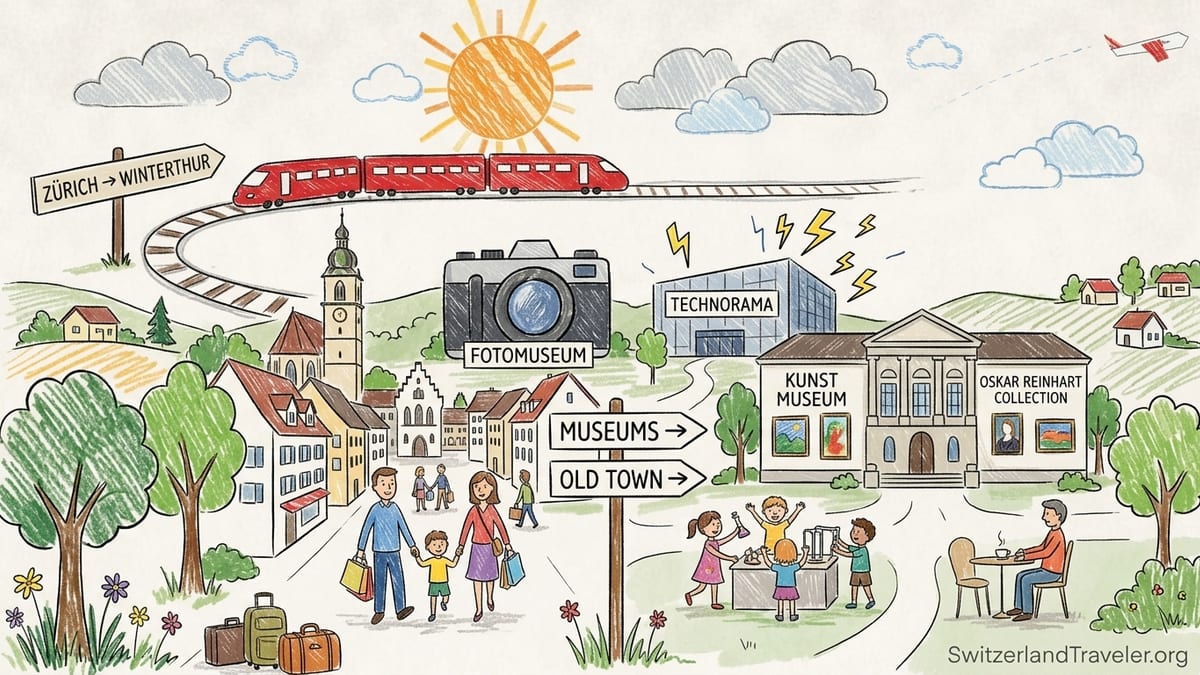
Spend a few days in Zurich and you quickly hear the same tip from Swiss tourism boards and culture lovers alike: if you want a different side of Canton Zurich’s museum scene, go to Winterthur. Just twenty minutes by train from Zurich Hauptbahnhof, this former industrial city has evolved into a compact cultural capital, with a science center that ranks among Europe’s most engaging hands-on museums and an art landscape that rivals much larger cities. This guide looks at Winterthur’s key museums by visitor type, from families and science fans to photography lovers and art-focused travelers, and explains how to turn them into an efficient day trip or a rewarding overnight stay.
Why Winterthur Is Zurich’s Strongest Cultural Alternative
Winterthur sits in the northeast of Canton Zurich and has a reputation inside Switzerland that still surprises many international visitors. Official tourism bodies describe it as a small city with an unusually dense network of high-caliber museums, from world-class art collections to the only science center in Switzerland. Unlike Zurich, which spreads its institutions across a larger urban area, Winterthur concentrates its cultural weight in a walkable old town and nearby districts, making it easy to combine several museums and still have time for cafés, parks and the pedestrian streets around Marktgasse.
Zurich Tourism markets Winterthur as a day trip focused on culture, often pairing its historic center and art museums with the Swiss Science Center Technorama as a major excursion from Zurich. Switzerland Tourism highlights the same duo: the car-free old town with villas and gardens, and Technorama as a standout for interactive science and family travel. This shared messaging matters when you are choosing where to spend limited cultural days. Rather than adding yet another Zurich gallery to your schedule, a half-hour train and bus ride brings you to a different urban story built on engineering, textiles and philanthropy, which in turn funded collections on a scale that seems out of proportion for a city of about 115,000 residents.
For travelers deciding between staying in Zurich and hopping around the region, the logistics are simple. Direct trains run roughly every 10 minutes between Zurich Hauptbahnhof and Winterthur main station, with typical journey times of about 20 minutes on InterRegio or S-Bahn services. From Winterthur station, most central museums lie within a 10 to 15 minute walk through the traffic-free core. Technorama sits outside the center but is reached by a short city bus ride or a dedicated stop called “Technorama” on local routes, which makes it easy to tack onto a day that begins or ends in Zurich.
Winterthur also offers a practical advantage as a rainy-day back-up. When weather closes in on the lake or nearby hills, a cluster of indoor museums within a few blocks of each other, plus one very large science center that comfortably fills an entire day, gives you several robust options without rethinking your base in Zurich. That flexibility is one reason Swiss families, school groups and international business travelers with free days repeatedly choose Winterthur when they need an engaging plan in less-than-perfect weather.
Swiss Science Center Technorama: Hands-On Heaven For All Ages
The Swiss Science Center Technorama is the anchor that pulls many visitors from Zurich to Winterthur at all. Instead of glass cases and long labels, you find more than 500 interactive experiment stations spread over several floors, encouraging visitors to touch, push, spin and reconfigure exhibits that explore electricity, magnetism, water, air pressure, optics and human perception. It is designed less like a traditional museum and more like a giant science playground, where adults are as likely as children to be absorbed in balancing metal hoops over magnetic fields or stepping into a corridor of swirling mist to see how turbulence behaves.
For planning purposes, Technorama is a destination in its own right. Feedback from both local and international visitors suggests that a rushed two or three hours barely covers a single thematic area, while a full day from opening to late afternoon allows time for multiple zones, live demonstrations and breaks in the café. The institution itself advises allowing at least four to six hours if you want a relaxed visit. Many families arrive at opening time, often at 10:00, and stay until closing, pausing for lunch at the self-service restaurant, which offers casual hot dishes, sandwiches and desserts, or making use of picnic areas outside in warmer months.
Current published admission prices in 2026 place Technorama among the more substantial ticket purchases in the Zurich region, but its value comes from the sheer amount of content. Adult day tickets are often in the range of several dozen Swiss francs, with reduced prices for children, students and seniors, and family tickets that bundle two adults with one or more children. Because details can change from season to season, it is wise to confirm exact prices and any online discounts directly with the official site or at the ticket desk before you travel. Many Swiss-based visitors use regional travel cards or rail promotions to soften the cost, and some museum passes include Technorama as part of multi-day combinations.
Several features make Technorama particularly attractive for families and science-minded travelers. There are daily shows such as the famous high-voltage lightning demonstrations in the physics theater, where staff safely channel electrical discharges across large gaps, and workshops where children and teenagers build simple machines or experiment with materials under guidance. Exhibit text is presented in multiple languages, including German and English, so international visitors can follow along without difficulty. Importantly, almost everything is robust and meant to be handled, so parents do not spend the visit shushing children or worrying about them touching the exhibits.
Fotomuseum Winterthur: For Photography Lovers And Curious Beginners
Closer to the center, Fotomuseum Winterthur has built a reputation as one of Switzerland’s key institutions dedicated to photography and related media. Rather than a static collection, it functions primarily as a venue for changing exhibitions that range from classic documentary and art photography to experimental image-based work, digital practices and visual culture. If you have already visited big-name European photo venues in Paris or London, you will recognize the curatorial style here, which often groups several mid-size exhibitions around a theme or presents a major solo retrospective with archival material and contemporary responses.
The experience at Fotomuseum Winterthur is more traditional than Technorama in the sense that you move through quiet, controlled gallery spaces and look at framed prints and projections, but it still suits a broad audience. Photography enthusiasts will appreciate the detailed wall texts and catalogs, but casual visitors often find that the directness of photographic images makes large concepts approachable. For example, an exhibition on urban change might show before-and-after cityscapes from around the world, while another on portraiture could mix early studio images with contemporary smartphone-based series, inviting discussion even among non-specialists.
In practical terms, you can expect to spend one to two hours here, depending on how slowly you read and whether you also visit the neighbor institution Fotostiftung Schweiz, which focuses more on Swiss photographic heritage and is often presented in tandem. Combined tickets are typically available on site and represent good value for travelers specifically interested in photography. Both buildings stand a short bus ride or manageable walk north of the main station, and the surrounding neighborhood includes cafés that make it easy to turn the visit into a relaxed half-day program.
Fotomuseum Winterthur tends to attract a mix of local art students, professional photographers and international travelers who build their itinerary around photography. Families with younger children can still visit, but the contemplative atmosphere and absence of hands-on exhibits mean it works better for teenagers or adults who enjoy looking closely and discussing images. On a rainy afternoon, however, even non-specialists often appreciate an hour or two here as a focused, indoor counterpoint to Zurich’s larger and more crowded art museums.
Kunst Museum Winterthur & Oskar Reinhart Collections: An Art Lover’s Cluster
Winterthur’s strength in art comes from a network of institutions that share close ties but offer distinct experiences. Under the umbrella of Kunst Museum Winterthur you find an ensemble of venues, including the main museum near the old town that focuses on modern and contemporary art, Villa Flora with its roots in the Hahnloser-Bühler collection, and the Museum Oskar Reinhart in the city center, which presents works that industrialist and collector Oskar Reinhart donated to Winterthur. Slightly outside the core sits the separate but related Sammlung Oskar Reinhart “Am Römerholz,” a villa in a garden setting that houses big-name nineteenth and early twentieth-century European paintings.
The core Kunst Museum Winterthur site offers a mix of permanent holdings and temporary exhibitions, with strengths in classical modernism and postwar art. Visitors can expect to see works by artists such as Klee, Picasso and Giacometti in the context of broader European movements, alongside Swiss painters who may be less familiar internationally. Displays change regularly, so an art-focused traveler who returns to the region may find a different set of works on the walls from year to year. Interpretation is typically multilingual, and the atmosphere is calm enough that even on weekends it rarely feels as crowded as Zurich’s Kunsthaus.
The Oskar Reinhart collections reward slower visits. At the central Museum Oskar Reinhart, you move through rooms that present German, Austrian and Swiss paintings from the eighteenth to early twentieth centuries, many with themes of landscape, portraiture and everyday life. At “Am Römerholz” you enter a more intimate villa environment, where French Impressionists, Post-Impressionists and Old Masters hang in spaces that still feel partly residential, surrounded by a historic park. For art travelers used to viewing such works in big-city environments, the combination of high-quality paintings and human-scale rooms is a key part of Winterthur’s appeal.
Time-wise, you should budget at least two hours for a focused visit to the main Kunst Museum Winterthur, and a similar amount if you include one Oskar Reinhart site. Seeing all of them carefully in a single day quickly becomes tiring, which is why some travelers choose to spread Winterthur’s art institutions over two half-days or an overnight stay. Combined tickets and museum passes for Winterthur often cover multiple art venues, and some packages add in other local museums, which can be economical for travelers intent on visiting three or more sites over one or two days.
Beyond the Big Names: Other Winterthur Museums Worth Knowing
While Technorama, Fotomuseum Winterthur and the various art museums draw most of the headlines, the city’s broader museum landscape helps explain why Switzerland Tourism markets Winterthur as a true culture hub rather than a single-attraction side trip. Local listings from the city authorities mention roughly seventeen museums, many of them within easy reach of the station. Among these, the Naturmuseum Winterthur explores natural history with dioramas and regional geology, while the Gewerbemuseum Winterthur focuses on design, applied arts and material culture, often through thematic exhibitions that link craft, industry and contemporary issues.
Families with school-age children often combine Technorama with the Naturmuseum on separate days, particularly if they are based in Winterthur itself or staying longer in the region. The naturmuseum format is closer to a classic natural history museum, with taxidermied animals, fossils and interactive displays that explain local ecosystems. It provides a quieter, shorter experience than Technorama but offers more context about the Swiss environment, which can be useful if you are heading into the Alps or exploring lakes and forests later in your trip.
Design-minded visitors, or those who have already seen Zurich’s larger design museum, may appreciate the Gewerbemuseum as a more compact and experimental space. Exhibitions here might look at topics such as sustainable materials, interface design or the evolution of everyday objects. It pairs well with a stroll through Winterthur’s former industrial districts, where repurposed factories now host cultural venues and creative businesses. Some guided tours of the Sulzer industrial area, for example, explicitly link the city’s engineering heritage with its current design and culture scene, making the museum a useful intellectual bridge.
Because these secondary museums are less heavily marketed internationally, opening hours and temporary closures can vary more widely than at Technorama or the major art institutions. Travelers with a tight schedule should check the latest city museum listing or individual institution information before committing to a multi-stop route. The upside is that these museums are rarely crowded, so even on rainy weekends you can often explore them at a relaxed pace without advance booking.
Planning Your Day: Time, Tickets, Weather and Getting Around
Choosing between Winterthur and an extra day in Zurich often comes down to practical questions: how long do you need for each museum, how do you move between them, and what does it cost. As a rule of thumb, Technorama fills most of a day, while each of the art or photography museums typically requires between one and three hours depending on your interest. Trying to combine Technorama with a serious visit to several art institutions in a single day usually leads to fatigue and rushed experiences, which is why many local guides suggest thinking in terms of either a “Technorama day” or an “art and old town day.”
Public transport logistics are straightforward. From Zurich Hauptbahnhof you board a train to Winterthur, which takes about 20 minutes on direct services. At Winterthur, local buses leave from outside the station. Routes serving Technorama usually reach the museum in around 10 to 15 minutes, and stop directly in front of the building at a marked “Technorama” stop. Fotomuseum Winterthur, the Kunst Museum Winterthur and several Oskar Reinhart sites are closer to the center and can be walked in roughly 10 to 20 minutes from the station along signed streets. Visitors with limited mobility may prefer to use city buses, which run frequently and accept the same regional tickets as the trains.
When it comes to tickets, travelers often choose between simple point-to-point train fares and regional day passes. A popular choice for weekday visits beginning after the morning rush is the ZVV 9 o’clock day pass, which offers unlimited travel across the Zurich transport network, including trains between Zurich and Winterthur and local buses, from late morning until the end of service. There is also a 24-hour ticket that covers seven fare zones, including Zurich and Winterthur, for travelers who want flexibility from the previous evening into the following day. Prices for these passes change periodically, but up-to-date brochures distributed by Zurich tourist offices quote figures around a few dozen Swiss francs, which often undercut buying separate train and bus tickets for a full day of movement.
Winterthur itself offers a Museum Pass that covers a range of city museums, usually over one or two consecutive days. Recent information from regional tourism sites mentions a one-day pass at a lower price that excludes Technorama and a two-day version at a higher price that includes Technorama as well. For travelers focused on art museums and the old town, the cheaper version can already represent good value, especially if you plan to visit multiple venues such as the Kunst Museum, a Reinhart collection and the Naturmuseum. If Technorama is central to your plans, run the arithmetic: a two-day museum pass that includes Technorama may pay off if you are also visiting several smaller museums over the same period.
What Type of Traveler Should Choose Which Museum
Winterthur’s strength is not only the quality of its individual museums, but how clearly they map to different kinds of visitors. For families with children between roughly six and sixteen, Technorama is usually the first recommendation. Children can touch nearly everything, many exhibits invite cooperative play, and live demonstrations have a show-like atmosphere that breaks up the visit. It is also highly weather-proof: once inside, you can forget about rain or snow and simply move between floors. Parents often report that even children who are lukewarm about traditional museums enjoy spending hours here, which makes it a reliable choice on a gray weekend.
Science-minded adults, including solo travelers and couples, are another strong fit for Technorama. While the museum is family-friendly, its content is not childish. Explanations go into real scientific principles, and some stations demand patience and careful observation, such as tuning resonance in a vibrating string or exploring chaotic motion in double pendulums. Engineers, teachers and curious generalists often find themselves lingering over particular sections and occasionally attending guided tours or special events that dive deeper into topics such as electricity or perception.
Photography lovers should prioritize Fotomuseum Winterthur and, time permitting, Fotostiftung Schweiz next door. These institutions reward visitors who like to engage with themes and visual narratives, from the politics of representation to the evolution of camera technology. Because exhibitions rotate, repeat visitors can see new work on each trip. Travelers who routinely visit photography venues in other cities will find a familiar level of curatorial rigor here, while beginners often find it an accessible way to enter contemporary art discourse without needing specialized art history knowledge.
Art-focused travelers, including those already planning to visit Zurich’s Kunsthaus, Basel’s museums or Bern’s Zentrum Paul Klee, will likely treat Winterthur’s Kunst Museum cluster and Oskar Reinhart collections as a main draw rather than an add-on. Here the appeal lies in both the works on display and the setting. Spending a morning in the central Kunst Museum followed by an afternoon at “Am Römerholz,” with pauses in the garden or at a nearby café, creates a very different rhythm from large-capacity big-city museums. For travelers with more limited art interest, one carefully chosen venue, such as the main Kunst Museum or a Reinhart collection, may be enough to complement Technorama or the old town.
Sample Itineraries and Should You Stay Overnight
To turn these institutions into concrete travel plans, it helps to think in terms of sample combinations that match your interests and energy. For families, a classic option is the Technorama day trip. Take a mid-morning train from Zurich to Winterthur, connect by bus to Technorama in time for opening around 10:00, and stay until late afternoon. Have lunch in the on-site restaurant, schedule your visit around one or two of the daily demonstrations, and leave time at the end for a final favorite section. On the way back, you can either return directly to Zurich for dinner or stop for an hour in Winterthur’s old town, which is compact enough for a short walk and an ice cream before catching an evening train.
Science fans without children might use a similar structure but push further into the details. Arrive at Technorama at opening, focus on specific zones such as electricity, mechanics or perception, and attend any advanced or themed demonstrations on offer that day. After several hours, take the bus back to town, have a relaxed dinner in one of Winterthur’s local restaurants and either stay overnight or head back to Zurich. For travelers with an additional half-day, a second day could combine a late-morning stroll through the old town with an afternoon in the Naturmuseum or Gewerbemuseum, linking the science of the previous day with environmental or design topics.
Photography lovers can comfortably tackle Fotomuseum Winterthur and Fotostiftung Schweiz in one half-day, then spend the rest of the time exploring the old town or adding a single art venue. A sample route might start with a mid-morning visit to Fotomuseum, lunch in a nearby café, a short walk back toward the center and a mid-afternoon session at the main Kunst Museum Winterthur. This combination keeps transit time minimal and exposure varied, moving from contemporary photography to broader modern art within a walkable radius.
Art-focused travelers might prefer an overnight stay to avoid cramming too many visual impressions into one day. One itinerary would see you leave Zurich after breakfast, arrive in Winterthur around mid-morning and head straight to the central Kunst Museum for two to three hours. After lunch in the old town, spend the afternoon at the Museum Oskar Reinhart or another art venue in the cluster, followed by an evening in one of Winterthur’s restaurants or music venues. On day two, dedicate a long morning and early afternoon to “Am Römerholz,” enjoying not only the paintings but also the garden setting, before returning to Zurich or moving on to another Swiss city.
Whether Winterthur deserves an overnight stay depends largely on your interests and timetable. For many visitors who want a mix of Zurich city life and a single highlight museum, a straightforward day trip works perfectly. Technorama plus a quick old town walk is enough to justify the travel and still gets you back to Zurich’s restaurants and nightlife by evening. However, if you are a committed art traveler intent on exploring multiple museums, or if you appreciate smaller cities that feel more local and less touristy, then one or two nights in Winterthur can be rewarding. You gain slower mornings, the chance to attend evening events such as concerts or festivals, and the ability to spread museum visits over two days, reducing fatigue and allowing time for café stops, parks and exploring former industrial districts.
The Takeaway
Winterthur stands out in Canton Zurich as a compact, museum-rich city that offers a different cultural experience from spending every day inside Zurich itself. Technorama, the only science center of its kind in Switzerland, provides a full day of hands-on discovery for families and science enthusiasts, while Fotomuseum Winterthur, the Kunst Museum cluster and the Oskar Reinhart collections present serious art and photography in human-scale settings. Add in smaller institutions such as the Naturmuseum and Gewerbemuseum, plus a relaxed, largely car-free old town, and you have a destination that can absorb anything from a single rainy day to an entire cultural weekend.
For most travelers, the key decision is not whether Winterthur is worth visiting, but how to fit it into a broader Zurich stay. If you are traveling with children or have a strong interest in interactive science, dedicate a whole day to Technorama. If art and photography are your focus, consider an “art and old town” day or an overnight that allows you to explore several museums without rushing. Convenient train connections, logical ticket options and the availability of multi-museum passes make logistics straightforward, and the city’s position just north of Zurich means you can pivot easily based on weather and energy.
Ultimately, Winterthur functions as one of the clearest cultural alternatives within easy reach of Zurich. It complements rather than competes with the big city, giving you a chance to experience how industrial wealth and civic ambition created a museum landscape that is both ambitious and approachable. Whether you treat it as a targeted day trip for Technorama or a multi-day art exploration, Winterthur rewards travelers who look beyond the obvious and seek out Switzerland’s quieter cultural capitals.
FAQ
Q1. Is Winterthur a realistic day trip from Zurich for families?
Yes. Fast trains take about 20 minutes from Zurich Hauptbahnhof to Winterthur, and a short bus ride connects the station to Technorama, so families can comfortably spend a full day at the science center and still be back in Zurich for dinner.
Q2. How much time should I plan for Technorama?
You should plan at least four to six hours at Technorama. Many visitors, especially families and science enthusiasts, stay from opening until late afternoon because there are more than 500 interactive stations plus demonstrations and workshops.
Q3. Can I combine Technorama with the art museums in one day?
It is technically possible, but most travelers find it tiring. Technorama alone can fill a day, so combining it with serious visits to multiple art museums usually feels rushed. It is better to choose either a Technorama day or an art-focused day, or to add an overnight stay.
Q4. Are Winterthur’s museums suitable for a rainy-day plan?
Yes. Technorama, Fotomuseum, Kunst Museum Winterthur, the Oskar Reinhart collections and several smaller museums are fully indoors and easily reached by public transport, making Winterthur one of the region’s most dependable rainy-day destinations.
Q5. Is Fotomuseum Winterthur interesting for non-photographers?
Often yes. While photography enthusiasts get the most from detailed exhibitions, many shows use accessible themes such as cities, people or landscapes, so curious visitors without a photography background can still enjoy a one to two hour visit.
Q6. Do Winterthur museums offer combined tickets or passes?
Winterthur offers a Museum Pass that covers several city museums, with options for one or two days and versions that may include Technorama. Some institutions, such as Fotomuseum and Fotostiftung, also offer combined admission. Details can change, so check current information before your visit.
Q7. Is Winterthur worth an overnight stay, or is a day trip enough?
A day trip works well if you want to focus on Technorama or visit one or two art museums plus the old town. An overnight stay becomes attractive if you plan to explore several art venues, attend concerts or simply prefer a slower pace in a smaller city.
Q8. How child-friendly are the art and photography museums?
Technorama and the Naturmuseum are the most child-friendly, with many interactive elements. The art and photography museums welcome children but are quieter and more contemplative, so they tend to suit older children and teenagers better than very young kids.
Q9. Can I walk between Winterthur’s central museums?
Yes. From Winterthur’s main station, the old town, main Kunst Museum site, several Oskar Reinhart venues and smaller museums are typically within a 10 to 20 minute walk. Only Technorama and a few outlying sites usually require a short bus ride.
Q10. Are there good food options near the museums?
Yes. Technorama has an on-site self-service restaurant and snack options, while the areas around the central museums and the old town offer cafés, bakeries and restaurants ranging from simple lunch spots to more formal dining, making it easy to fit meals into a museum day.