


On paper, the Rhine Falls is the kind of natural spectacle that seems like an automatic “yes” from Zurich. Switzerland Tourism calls it one of the country’s iconic nature excursions, tour posters in the city show foaming white water under a storybook castle, and guidebooks make it sound like a serene slice of river life. My actual visit in 2026, arriving by train via Zurich’s wine country and stepping out at Schloss Laufen, was more impressive, more crowded and more commercial than I expected. Here is what it was really like, from the arrival route and ticket gates to the noisy platforms, boat queues and the moments that still felt genuinely powerful in spite of it all.
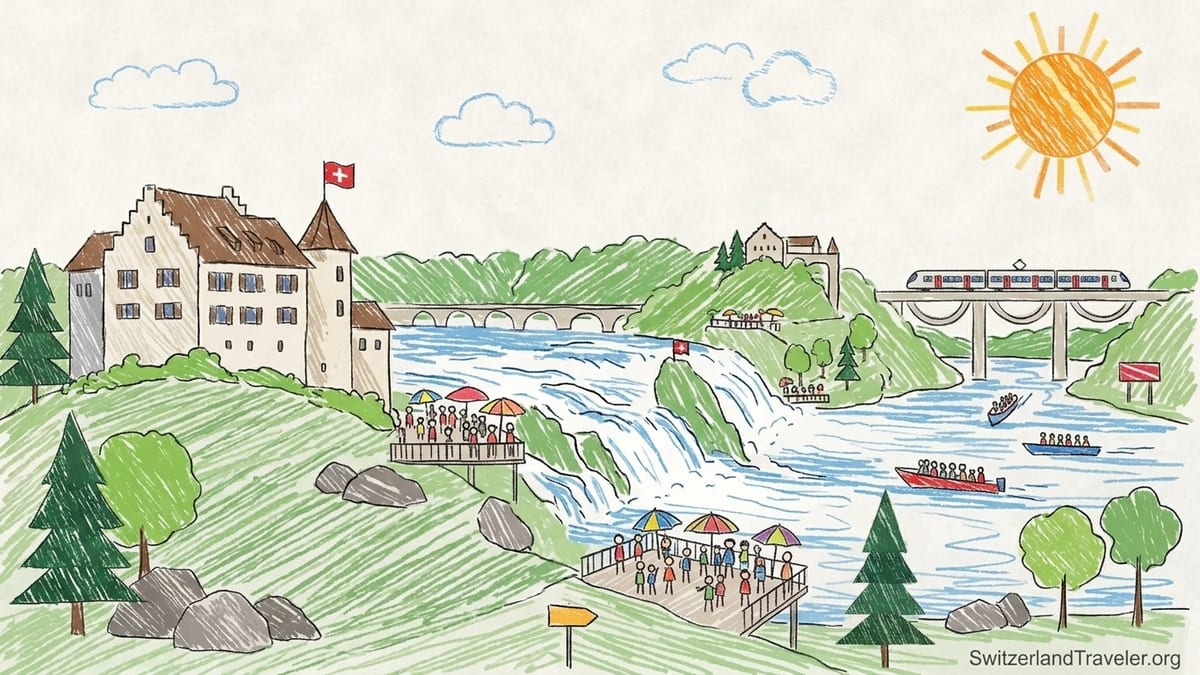
Getting There From Zurich: A Scenic Ride That Ends In A Crush Of People
I started from Zurich Hauptbahnhof on a late June Saturday, taking a Zurich S Bahn train to Schloss Laufen am Rheinfall on the south bank. Direct S12 and S33 services connect Zurich with Schloss Laufen roughly once an hour, with a journey time of about 50 minutes and a route that arcs through Winterthur and the gentle slopes of Zürcher Weinland, the city’s nearby wine country. From the train window, I watched tidy vineyards and farmhouses roll past and felt like I was heading toward a quiet corner of northern Switzerland, not one of the country’s busiest tourist magnets.
The illusion of quiet vanished the moment the doors opened at Schloss Laufen am Rheinfall station. The small platform was packed with day trip groups, families with strollers and several large coach parties funneled down from the parking lots above. Announcements in German and English were almost drowned out by suitcase wheels and tour leaders raising colored umbrellas. Signs for “Schloss Laufen” and “Rheinfall” pointed in multiple directions, with a steady stream of people flowing toward the castle entrance.
From the platform, it is only a couple of minutes on foot to the castle complex, but that short walk already felt like a theme park approach. There is a tunnel under the tracks, then a choice between a footpath up to the castle courtyard or a glass elevator that whisks visitors straight to the visitor center level. Both were lined with signage listing ticket prices and pointing out viewpoints, restaurants and souvenir shops. The castle itself, with its stone walls and tower, is authentic and atmospheric. The way you move through it as a visitor, however, is very much designed for volume.
Entrance Fees, Turnstiles And First Impressions
Access to the dramatic south bank viewing platforms below Schloss Laufen is not free. At the visitor center I joined a queue for tickets behind several coach groups. As of mid 2026, the posted price for the “experience” ticket at Schloss Laufen was 5 Swiss francs for adults, with a reduced rate for children. That fee covers the panoramic glass elevator, the Belvedere trail and several cantilevered platforms close to the water, but it does not include any boat trips.
The process felt more like entering a mid size attraction than visiting a wild river. There were waist high turnstiles, barcode scanners for pre booked tours, a staffed counter selling printed day tickets and an automatic machine for individual visitors. Multi language boards highlighted “must see points” like the Känzli platform and “selfie spots.” To one side, a well stocked souvenir shop sold everything from fridge magnets with falling water to stuffed marmots and cow print umbrellas. None of this is unusual for a major site, but if you arrive expecting something more low key, the commercial tone hits quickly.
Passing through the turnstile, though, the first glimpse of the falls is still arresting. The path leads to a terrace above the drop where the Rhine, broad and green upstream, suddenly explodes over a band of limestone into a boiling basin below. Even from high up, the roar is a physical presence, a continuous low thunder that makes conversation feel slightly raised. Any frustration about turnstiles faded in that first moment because the sheer volume of water is difficult to convey until you are standing above it.
Walking The Castle Side: Viewpoints, Stairs And Bottlenecks
From Schloss Laufen, a signed “Erlebnisweg” or adventure trail descends toward the river. It is a zigzag of paved ramps, stone stairs and wooden walkways built into the cliff. Along the way, there are several balconies and platforms that jut out over the churning water. The most striking are the lower decks, where you are level with the spray and can look straight into the main cascade.
This is also where the crowds concentrate. On my visit around midday, the main platforms were busy enough that moving from one rail to another meant shuffling in line. Families took turns lining kids along the edge for photos, while tour guides tried to cluster their groups for explanation breaks. At times, it felt like watching the falls through a sea of phones. There were polite but constant requests to trade places at the railings. If you want unobstructed photos from this side in high season, patience is part of the experience.
That said, the sensory impact on these lower platforms is undeniable. The vibration of the rock underfoot, the cool mist drifting up, the way the sound closes around you, all made the falls feel closer to a living machine than a picturesque backdrop. I stayed on one platform long after my photos were done, just to watch individual logs and foam patterns get sucked over the edge and atomized in the plunge pool. It was the most powerful part of the visit, yet it was also the most congested stretch of the castle side trail.
Climbing back up, the bottlenecks around staircases and narrow bends slowed everything to a gradual procession. This is not an ideal setup for anyone with mobility issues or a low tolerance for crowds. There are benches and a few slightly quieter pockets along the way, but for the most part the castle side in the middle of the day operates on a one way loop with a steady, dense flow of people.
Boat Rides: Worth It For The Thrill, Not Essential For The View
The other defining feature of a Rhine Falls visit is the fleet of small boats that scurry through the basin below. These boats, run by operators on the north bank near Schlössli Wörth, follow color coded routes that include short scenic circuits, crossings between banks and, most famously, the “rock ride” to the central rock outcrop. From Schloss Laufen, you see the boats constantly crisscrossing the spray, sometimes disappearing momentarily behind waves of mist.
To reach the boats from the castle side, I crossed the railway bridge on foot to the north bank, following signs for “Schlössli Wörth” and “Boat trips.” The path over the bridge offers another strong vantage point, with trains passing behind you and the falls framed between arches. On the far side, a riverside promenade was lined with ticket kiosks, outdoor restaurant terraces and an ice cream stand. Here, the atmosphere felt even more like a resort strip, complete with loudspeaker announcements for departing rides.
Boat prices in 2026 varied by route and duration, and I opted for a mid priced rock ride that involved a short cruise, a drop off at the central rock and time to climb to the top platform before returning. Exact fares change periodically and there are separate rates for groups and students, but the walk up adult price for that particular trip sat in the range of a modest restaurant meal in Zurich. Advance booking was not required for the departure I chose, but there was a queue of about 20 minutes at midday, stretching along a roped corridor under the sun.
Once on board, packed shoulder to shoulder with life jackets on, the experience swung back toward the raw power of the place. The pilot steered us into a position where the boat rocked noticeably in the turbulence, and within seconds a fine mist coated glasses and camera lenses. At the central rock, a narrow metal staircase leads up to a small viewing platform. This perch offers a 360 degree panorama of the falls and both banks, and the sense of being in the middle of the river is exhilarating. However, the platform is tiny for the number of people delivered at once, and time there is limited before the boat horn signals a return. I enjoyed the perspective and the thrill, but in terms of pure views, the castle platforms and bridge walks already delivered most of what I wanted.
Crowds, Commercial Layers And The Loss Of Quiet
What surprised me most about the Rhine Falls was not that it was busy, but how hard it was to find any sense of quiet along either bank during the core of the day. Switzerland Tourism rightly promotes the falls as a signature nature excursion, and many Zurich based bus tours time their half day trips to arrive between late morning and mid afternoon. That means that, in good weather from roughly May to September, the viewing areas and boat docks can feel saturated.
On the south bank near Schloss Laufen, the commercial elements are integrated into the castle complex. There is a restaurant with a terrace overlooking the river, a self service snack area, the souvenir shop by the entrance and branded signage on many walls. None of this is garish, but combined with the controlled entry and the constant stream of tour groups, it undercuts any illusion of stumbling upon a wild corner of the Rhine. You are very clearly moving through a managed experience zone.
The north bank between the railway bridge and Schlössli Wörth has even more of a holiday promenade feel, with multiple cafes and restaurants offering menus tailored to international visitors, from schnitzel and fries to pizza and ice cream sundaes. Loudspeakers called out boat departures, a small tourist train honked its way along the riverside road, and on my visit I counted three different stalls selling souvenir photos taken on arrival. For some travelers, especially families looking for an easy day out, this is part of the convenience. For others seeking something quieter and more natural, it can feel over curated.
What helped was stepping a little away from the immediate viewpoints. A short stroll downstream on the north bank, beyond the main boat jetties, the path thinned out and the noise dropped to the natural soundtrack of water and birds. From here, the falls are partially framed by trees, the castle is a silhouette against the sky and the commercial layer recedes. It was a reminder that the Rhine is a living river beyond its most photographed 150 meters.
How Much Time You Really Need At Rhine Falls
Guidebooks sometimes suggest that you can visit the Rhine Falls as a quick stop of an hour or less. If you are traveling from Zurich, that framing is misleading. The train ride each way takes around 50 minutes, plus transfer time at the main station if you are staying elsewhere in the city. By the time you factor in walking from the station, buying entrance tickets, moving through the castle trail, crossing the bridge, waiting for a boat and perhaps sitting down for a drink, a realistic window on site is closer to two and a half to three hours.
On my visit, I arrived shortly before 11 a.m. and left after 2 p.m. That span included the castle side viewpoints, the walk across to the north bank, the rock ride boat trip and a short pause for a drink facing the water. I did not have time to combine the falls with nearby Schaffhausen or Stein am Rhein, both commonly paired destinations, and I left feeling that the day had been more about managing crowds than drifting spontaneously along the river.
If you only plan to view the falls from one bank and skip the boats, you could compress the onsite time to about ninety minutes, but it would still make sense to treat the outing as a half day once travel is included. This is especially true if you want to avoid feeling rushed at the platforms, where bottlenecks and photo stops naturally slow your progress.
For travelers on a tight Switzerland itinerary, the question becomes whether a half day devoted largely to one concentrated, commercialized stretch of river is the best use of limited time. That is a personal call, but managing expectations helps. The Rhine Falls is not a wilderness excursion. It is a very accessible, highly organized natural spectacle that happens to sit within easy reach of Zurich.
What Impressed Me In Spite Of Everything
In between the queues and the souvenir stands, there were still moments at the Rhine Falls that felt genuinely memorable. The scale of the water, especially in early summer when snowmelt feeds the Rhine, is something your body registers before your mind has fully processed the scene. Standing on the lower castle platforms, close enough to feel the vibration of the bedrock, I was struck by how the river seemed to fold in on itself, white water piling over white water in layers of motion that never repeat exactly the same way.
The noise created its own kind of cocoon. However many people were pressed around me, there were intervals when I tuned them out and focused only on the patterns in the current, the sudden sideways spray as a submerged boulder disrupted the flow, the occasional appearance of birds skimming the surface just above the chaos. I also found the perspective from the central rock platform unexpectedly powerful, not so much for the photo angles but for the feeling of being encircled by moving water, with both banks turned into spectators.
What also stayed with me was the context. Looking back from the falls toward Zurich, it is easy to be lulled by the comfort of frequent trains and tidy infrastructure. Yet historically, this section of the Rhine has been a strategic and economic hinge, a place where the river’s power was harnessed and contested. Seeing heavy volumes of water compressed through the limestone cleft, it was not hard to imagine why this spot captured attention long before international tourism arrived.
Those flashes of raw energy and deeper time made the commercial wrapping feel more like a layer to navigate rather than a complete takeover. You may need to work a little, by choosing your timing or stepping away from the busiest decks, but the underlying natural drama is robust enough to break through the crowds.
How I Would Do It Next Time: Timing And Combining With Zürcher Weinland
If I return to the Rhine Falls, I would do several things differently. First, I would target an early morning train from Zurich, aiming to arrive shortly after the viewing paths open. Based on local transport patterns and tourism promotions, the largest tour buses and organized half day excursions typically converge from late morning onward, particularly on weekends and during school holidays. Being on site before that wave could mean sharing the platforms with individual travelers and local visitors instead of dense tour groups.
Second, I would choose a weekday outside peak school vacation periods. The shoulder seasons of late April and early May or late September and October often bring quieter paths, cooler temperatures that make climbing stairs more comfortable and, in autumn, the added bonus of color in the surrounding vineyards. Water levels can vary across the year, and in late autumn the flow may appear slightly less aggressive than in early summer, but the falls remain substantial and the trade off for elbow room feels worthwhile.
Most importantly, I would not treat the Rhine Falls as an isolated outing. The rail and road routes from Zurich pass directly through Zürcher Weinland, a gentle agricultural region of vineyards and small villages that Switzerland Tourism also highlights. Instead of a simple there and back, I would plan a loop that might include a stop in a village like Andelfingen or a short detour to a local winery for a tasting or walk among the vines. Alternatively, combining the falls with a few hours in the compact medieval center of Schaffhausen would add cultural depth beyond the river.
By anchoring the day in the broader landscape rather than just the main viewpoints and visitor infrastructure, the falls become one chapter instead of the whole story. That shift in mindset matters. It turns a crowded, commercial but still impressive stop into part of a more varied and rewarding excursion through Zurich’s wider region.
FAQ
Q1. Is the Rhine Falls from Zurich still worth visiting if I dislike crowds?
It can be, but only with careful timing. Aim for early morning or late afternoon on a weekday in the shoulder seasons, and consider focusing on one bank to minimize time in the busiest bottlenecks.
Q2. How long should I realistically plan for a Rhine Falls trip from Zurich?
From Zurich Hauptbahnhof, count on roughly half a day. That allows for about two to three hours at the falls plus around an hour and a half of travel time round trip.
Q3. Which side is better, Schloss Laufen or the north bank at Neuhausen?
The Schloss Laufen side offers dramatic close up platforms and a castle setting but charges an entrance fee. The north bank has easier river level access and boat docks, and the overall experience feels more like a riverside promenade.
Q4. Do I need to book Rhine Falls boat trips in advance?
For standard short cruises and the rock ride, advance reservations are usually not required. In busy summer periods, be prepared for queues of 15 to 30 minutes at popular times of day.
Q5. Does the boat ride dramatically change the experience?
The boat adds a fun, immersive angle, especially the rock landing in the middle of the falls. However, if you are mainly interested in views and photographs, the castle platforms and bridge already offer very strong perspectives.
Q6. How expensive is a Rhine Falls visit compared with other Swiss outings?
Entrance to the Schloss Laufen platforms is relatively modest by Swiss standards, but once you add train tickets, a boat ride and food or drinks on site, the overall cost becomes comparable to many other half day excursions from Zurich.
Q7. Is the Rhine Falls visit suitable for young children and older travelers?
Yes, with some caveats. There are lifts on the castle side and shorter paths on the north bank, but many viewpoints involve stairs and can be crowded. Allow extra time and choose quieter periods if mobility is a concern.
Q8. Can I visit the Rhine Falls on a rainy or overcast day?
You can, and the falls will still be impressive. Overcast light can be good for photos, but stairs and platforms may be slippery, and the combination of rain and spray can leave you very wet, so bring appropriate clothing.
Q9. What are good add ons to pair with the Rhine Falls from Zurich?
Popular options include combining the falls with the medieval town center of Schaffhausen, a visit to Stein am Rhein or a stop in Zürcher Weinland villages and vineyards on the way to or from the river.
Q10. Under what conditions would you personally return to the Rhine Falls?
I would return on a weekday in spring or autumn, taking an early train from Zurich, skipping the most crowded midday boat departures and combining the visit with time in nearby wine country or Schaffhausen rather than treating the falls as a standalone photo stop.