


Kyburg Castle appears almost unexpectedly above the Töss valley, a compact cluster of towers and stone walls perched on a wooded spur between Zurich and Winterthur. It is often described as the best preserved feudal castle in northeastern Switzerland and the country’s oldest castle museum, with roots stretching back close to a thousand years. I went not as a medieval specialist, but as a curious traveler with a half-free day in Zurich, to see whether Kyburg is worth the detour, how it feels to walk through its lived-in rooms, and whether it really helps you imagine life inside a Swiss stronghold.
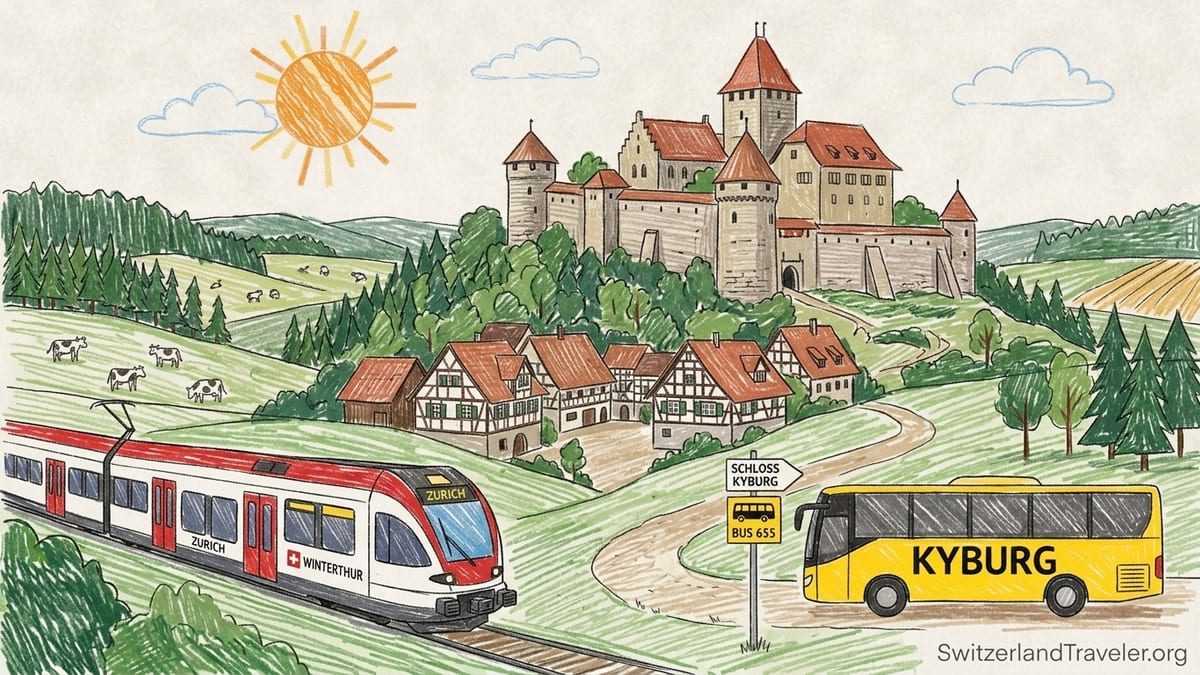
Getting to Kyburg Castle from Zurich and Winterthur
Kyburg sits in the countryside a short distance from both Zurich and Winterthur, but you feel the change from city to village almost as soon as you leave the train. I started from Zurich Hauptbahnhof on a late morning in June, boarding an S-Bahn train toward Effretikon, a small commuter town on the line between Zurich and Winterthur. On most days there are frequent S-Bahn connections and the ride takes around 20 minutes, depending on the line you catch. From Winterthur, Effretikon is even closer by train, usually less than 10 minutes. Both routes are covered by regular ZVV tickets and are straightforward for visitors using a Swiss Travel Pass.
From Effretikon station, Kyburg does not appear immediately on the skyline. Instead, you follow the local signs for bus 655, which is the key public transport link up to the village of Kyburg. The bus stop is just outside the station building, and departure boards clearly list “Kyburg” as the destination. The ride on bus 655 takes about 10 to 15 minutes, first past apartment blocks and then into greener rolling countryside. When I visited, the onboard displays announced “Kyburg” in good time, but it is wise to press the stop button once you see the half-timbered houses and the compact village street.
It is also possible to approach Kyburg as a hike from Winterthur or from the Töss valley, but that turns the excursion into a longer outdoor day. Local tourism offices promote various marked trails that connect Winterthur, Bruetten and Kyburg through forest and farmland, with Kyburg Castle as either the highlight or endpoint. I chose the more relaxed combination of train and bus, saving my energy for the final walk and for clambering up the castle’s stairs rather than climbing the entire hill from the river below.
Whichever direction you arrive from, it is important to remember that Kyburg Castle is a seasonal attraction. According to the castle’s own visitor information, the museum is open from 1 April to 31 October, Tuesday to Sunday, from 10:00 to 17:30. It is closed on Mondays, and outside those months it generally shuts altogether except for administrative work. Planning a visit for a Monday in November would leave you admiring the walls from the outside only.
The Final Walk: From Village Street to Castle Gate
Bus 655 drops you in the village of Kyburg, which feels almost like a backdrop for the castle. From the bus stop, it is a short, clearly signposted walk to the entrance. You follow a narrow street past traditional houses toward a stone gate that frames your first real glimpse of the complex. This last stretch takes no more than five minutes at a slow pace, but it is where modern Switzerland begins to slip away and the medieval setting asserts itself.
The route into the castle is slightly uphill but not strenuous, with a compacted surface that shifts from village paving stones to rougher gravel as you pass into the outer courtyard. The first courtyard is open to the public without a ticket and already offers a sense of the building’s irregular shape. Kyburg is not a single freestanding keep. It is an angled quadrangle around a central space, adapted to a rocky spur about 150 meters above the Töss river. Stone curtain walls, towers with red-tiled roofs, and a timber gallery combine into something that feels defensive and domestic at once.
At the far end of this first courtyard is the ticket office, a small reception area that also serves as a café and museum shop. On the day of my visit, one staff member handled admissions, audio guide distribution and coffee orders, which meant a brief wait when a small group arrived at the same time. It was not bothersome, and the pace actually suited the atmosphere of a place that has seen centuries of slower travel. There are toilets on this level, and a water bowl for dogs in the courtyard. Dogs on leash are allowed in the courtyard and gardens, but not inside the museum rooms.
If mobility is an issue, Kyburg requires some advance planning. The castle is built on a hill and the museum spans several levels connected by stone steps. Official information notes that people with mobility impairments can, by prior arrangement, be driven into the inner courtyard, and that wheelchair users can access the chapel, some ground-floor exhibition rooms, the café, and an accessible toilet. However, the full circuit through the towers and upper rooms is not barrier-free. Even for fully mobile visitors, comfortable footwear is essential, as some staircases are narrow, spiraling, and worn with use.
Tickets, Opening Hours and How Much Time to Allow
At the ticket counter, prices are clearly posted and straightforward. At the time of my visit and according to current visitor information, adults pay 12 Swiss francs for admission to the museum. Students and apprentices pay 9 francs, and children from 6 to 16 years old pay 5 francs. People with disabilities benefit from reduced rates, roughly half the adult price, and children with disabilities up to 16 years of age can enter free of charge, with accompanying persons also admitted for free. Group and school class rates apply from 15 people upward, provided the visit is booked in advance.
Audio guides are available as an optional extra for 3 francs per person. They are offered in four languages, including English, German, French and Italian, and cover selected areas such as the counts’ hall and knights’ hall. Visitors who hold passes such as the Swiss Museum Pass, Swiss Travel Pass, Winterthur Museum Pass or certain bank membership cards can enter without paying the standard ticket price, although an additional fee still applies for the audio guide. It is worth checking your wallet before you arrive, since a Swiss Travel Pass, for example, can turn a spontaneous decision into a very affordable excursion.
As to how long you should plan, Kyburg can easily absorb two to three hours if you engage with the exhibitions and linger in the courtyard and garden. I spent just over three hours from the moment I stepped through the gate to the moment I walked back to the bus stop, including a brief break in the café. Rushing through in under 90 minutes would be possible, but it would reduce the visit to a sequence of rooms and staircases without allowing the historical threads to connect. For most travelers, allocating at least half a day from Zurich or Winterthur, including transport, is realistic and comfortable.
The castle closes its doors at 17:30, and staff gently direct visitors toward the exit around closing time. On quieter afternoons in June, I found no crowd pressure. But on weekends in high summer or during school holidays, families and small groups may fill the courtyards and exhibition spaces. If you prefer a more contemplative visit, starting in the morning and catching an earlier bus up from Effretikon or Winterthur can help you enjoy the rooms before they become busy.
Walking Through the Museum: Displays, Atmosphere and Audio Guide
Kyburg’s museum is self-guided, and the route spirals through different wings of the castle. I picked up the English audio guide, which begins with an introduction to the architecture and the counts who gave the castle its name. The commentary avoids excessive dates and focuses instead on how the building expanded from a fortified seat of regional counts into an administrative center under the Habsburgs and, later, the city of Zurich. The guide felt helpful without being intrusive, and you can pause it whenever a particular room invites a longer look.
The early rooms immediately show why Kyburg is often praised as unusually intact. Thick stone walls are left visible, and wooden ceilings with heavy beams carry the weight of upper floors. In one chamber, a short film runs on a loop, summarizing the castle’s history and the succession of powers that controlled it. The film is light in tone, with accessible visuals, clearly aimed at a broad audience. It is particularly useful for travelers who may not know much about Swiss medieval history and prefer a narrative overview rather than reading long text panels.
One of the most memorable spaces for understanding medieval everyday life is the reconstructed kitchen. Long wooden tables, wide hearths, iron pots and practical tools are arranged not as isolated museum objects, but as if a meal might begin at any moment. The accompanying material explains how food was stored, how smoke was managed, and how staff and lords occupied different corners of the space. Standing there, you can visualize servants carrying water and tending fires in a way that is often missing from more sanitized castle museums. Here, the audio guide added detail without overwhelming the senses, pointing out subtle features such as drainage channels and niches.
Another room that brings the era to life is the dungeon and justice section. Some of the displays include shackles, copies of punitive instruments and drawings of interrogation scenes. There are clear warnings and explanations that torture instruments are presented as part of a historical narrative, not as a spectacle. For visitors, this section is where Kyburg feels particularly honest about the harsher side of feudal rule. The audio segment here is more sober and might be intense for very young children, but for older kids and adults it succeeds in linking the castle’s imposing walls with the power dynamics they embodied.
Interiors, Courtyard and Garden: Where the Castle Feels Most Alive
Kyburg’s interior sequence includes grander halls as well as more intimate chambers. The counts’ hall and knights’ hall are the showpieces, with high ceilings, painted or paneled walls and displays of weapons and armor. Some of the armor pieces are replicas that visitors are invited to touch or even try on, an obvious hit with children. The audio guide in these rooms balances explanations of ceremonial functions with anecdotes about particular events and personalities. Personally, I found the atmosphere less evocative here than in the kitchen and service areas, perhaps because the halls are curated more like classic museum galleries, with objects in cases and panels instead of traces of daily mess.
More subtle but deeply effective are the rooms that show how later Zurich bailiffs lived when Kyburg shifted from purely military stronghold to administrative seat. Here you find tiled stoves, modest but comfortable furniture and documents connected to taxation and local justice. These spaces bridge medieval and early modern life, making it easier to imagine not just knights and counts but also clerks, scribes and their families moving through the corridors. The sense of continuity from rough medieval stone to more refined early modern interiors is one of Kyburg’s strengths.
Stepping back outside into the main courtyard, the atmosphere changes again. The space is irregular and partially shaded, with views toward the surrounding walls and towers. Children were playing near a simple playground structure by the baroque garden entrance during my visit, while adults sat at café tables with drinks and snacks. The courtyard is open to all ticket holders and serves as a central hub. From here, paths lead to the garden, the panoramic wall walk, and the various wings that house exhibitions. The courtyard is also accessible to visitors who may not wish to climb all the internal stairs, making it a social and visual focal point.
The baroque garden, arranged on a terrace, adds another layer to the experience. Instead of ornamental flowerbeds alone, the beds include vegetables and medicinal herbs, labeled and organized in rows. The design reflects the practical and symbolic functions of a noble garden in earlier centuries, where aesthetics, sustenance and medicine intersected. On a warm day, this is a pleasant place to pause and absorb the long view over the forested slopes that tumble down to the Töss valley far below.
Panoramic Path and the Landscape Above the Töss
From the garden, signs indicate the circular path along the outer walls, sometimes referred to as the ringmauerweg. This panoramic path is one of Kyburg’s highlights. It leads you along the defensive perimeter, occasionally narrowing where the wall hugs the cliff-like drop toward the river. In many sections you walk on a secure, fenced route with railings, looking out over dense woods that fill the valley. On clear days, official descriptions note that you can see very far, across the Töss and toward more distant mountain ranges. During my visit, low cloud limited the long-range panorama, but the sense of height above the river and the isolation of the hilltop site were unmistakable.
The path also lets you appreciate the castle’s architecture from odd angles: a half-timbered upper story protruding over raw stone, a small tower squatting at a corner with its own conical roof, arrow slit windows that now frame peaceful greenery. Short interpretive panels explain how the walls were extended and reinforced over time. This is also where Kyburg’s role as an early museum comes into view. Historical notes recall that the castle’s then owners opened it to the public in the 19th century as what is regarded as Switzerland’s first castle museum, a significant shift from private stronghold to shared heritage site.
If you wish, you can extend your walk beyond the castle walls into the surrounding countryside. From the village and nearby parking area, hiking trails descend toward the Töss river and link to regional paths. On my trip, I limited myself to a short extension beyond the main gate, following a track into the forest for about 15 minutes before looping back to catch the bus. Even this brief wander was enough to feel how the castle relates to its landscape: out of sight from major roads, surrounded by trees, and commanding not only the valley below but also the routes across the plateau between Zurich and Winterthur.
For serious hikers, Kyburg can be combined with longer routes that start in Winterthur or Effretikon and reach the castle on foot, then continue along the valley. In that case, the museum visit becomes the cultural centerpiece of a day that is otherwise about forest trails and river views. For many travelers, though, the panoramic path alone will provide sufficient nature to complement the historical interiors.
For Families, History Lovers and Casual Visitors: What Works Best
Kyburg clearly positions itself as a castle for all ages, and my experience reflects that mixed audience. Many rooms include interactive stations and playful elements designed with children in mind. For example, there are spots where kids can follow a “dragon hunt” through the building, play simple tactile games or peek through small openings that reveal hidden scenes. There is also a modest playground near the garden, which offers an outlet after concentrating on museum content. These touches mean that families are unlikely to feel they have dragged their children somewhere purely academic.
At the same time, sections such as the justice and administration displays, the chapel with its mural remains, and the information on the castle’s role in regional politics have real depth for history enthusiasts. Text panels may not dive as deeply into historiographical debates as a specialist monograph would, but they offer enough context to connect Kyburg with larger Swiss narratives, such as the rise of the Habsburgs and the power of the city of Zurich in the late Middle Ages and early modern period. For visitors who already enjoy castles like Chillon on Lake Geneva or Thun Castle in the canton of Bern, Kyburg provides another piece of the puzzle, with a stronger focus on governance and daily life than on pure military display.
Some exhibitions, however, feel more geared toward specialists or particularly motivated visitors. Detailed genealogical charts of the Kyburg counts and later noble families, for instance, are informative but visually dense, with many names clustered on a single board. I noticed more casual visitors glancing at them briefly before moving on. Likewise, certain small rooms feature focused displays on topics such as archaeological findings from specific phases of construction. These are rewarding if you already care about stratigraphy and dating techniques, but they may be skipped by families with limited attention spans.
As a whole, Kyburg succeeds best when it shows lived spaces and tangible objects that illustrate daily routines: kitchens, storerooms, servant corridors, the bailiff’s office, and the path along the walls. Those are the parts that made medieval and early modern life feel comprehensible, even for someone who does not go out of their way to study castle architecture. The more specialist or text-heavy sections function as optional deep dives rather than requirements. This balance is likely deliberate, and it means that different members of a group can focus on what interests them without losing the overall thread of the visit.
Using the Audio Guide: Helpful Companion or Extra Weight?
I chose to pay the additional 3 francs for the English audio guide, curious whether it would genuinely enhance the visit. The device was a simple handheld unit with a keypad and headphones. You enter the number shown on signs in each room and listen to short segments, most running two to four minutes. The narration is calm and clear, and the content is tightly edited. In the best sections, such as the introduction to the kitchen or the explanation of the baroque garden, the audio guide draws attention to details you might not otherwise notice, like soot patterns on beams or the symbolism of certain plants.
In some rooms, though, I found that the physical displays and written panels already provided enough information, and the audio added only a slight layer of elaboration. For example, in the knights’ hall, where the visual impact of the space is strong, I sometimes turned off the commentary to simply stand and absorb the room. The device itself is small and light, but it is one more object to manage as you negotiate narrow staircases and occasionally low doorways. Removing and replacing headphones repeatedly can also become mildly tiresome.
Overall, I would recommend the audio guide if you enjoy structured storytelling and prefer to have a narrative companion. It is especially useful if your German is limited and you want access to more details than the English text panels provide. For budget-conscious travelers or those who dislike audio devices, the museum is still perfectly understandable without it, thanks to bilingual or multilingual signage and the strong visual character of the rooms. If I were to return, I might skip the audio and instead invest that attention in reading a few panels more carefully and spending extra time on the panoramic path.
Families with younger children may find the audio guide less essential. Kids are more likely to be drawn to interactive stations and costumes than to sustained listening. On the day I visited, most families seemed to move through the rooms guided by curiosity and by the trail of dragon-themed activities, rather than by the numbered audio stops. Conversely, solo travelers and history lovers visiting on a quieter weekday may appreciate the audio guide as a way to deepen the experience without needing a scheduled group tour.
The Takeaway
Kyburg Castle turned out to be more than a photogenic diversion above the Töss valley. As Switzerland’s oldest castle museum, shaped over centuries from feudal stronghold to administrative center to public monument, it offers a layered picture of how power, daily life and landscape intersected in this part of the country. The practicalities are straightforward: from Zurich or Winterthur, the combination of S-Bahn to Effretikon and bus 655 to Kyburg, followed by a short walk, makes the castle easy to reach without a car. Tickets are reasonably priced by Swiss standards, and the optional audio guide adds value without being indispensable.
Is Kyburg worth a dedicated half-day? In my view, yes, if you are already staying in Zurich or Winterthur and have an interest in historical places. Allowing around three hours for the castle itself, plus transport time, creates an outing that feels neither rushed nor overlong. However, if your time in the region is very limited, Kyburg also pairs naturally with a few hours in Winterthur, which has its own museums and a pleasant compact center. You could spend a morning exploring Winterthur’s old town or one of its art collections, then take the short train-and-bus journey to Kyburg for the afternoon, returning to Zurich in the evening.
As for who I would recommend it to, Kyburg is an excellent choice for families, provided children are comfortable with stairs and a few darker historical themes such as justice and punishment. The playful elements, dragon hunt, and hands-on armor balance the more serious exhibits. History lovers will appreciate the depth of interpretation and the way the museum emphasizes lived experience as much as grand political narratives. Casual visitors who simply enjoy atmospheric places and panoramic views will find enough charm in the courtyards, garden and wall walk, even if they skim the written material.
In a country rich with castles, Kyburg may not have the lakeside drama of Chillon or the mountain backdrop of certain Bernese fortresses, but it compensates with intimacy and coherence. Walking through its stone corridors, standing in its kitchen, and looking down over the forested Töss valley, you sense a place that was never just a stage set, but a working center of power. For travelers willing to step slightly off the main tourist circuits of Zurich, Kyburg repays the journey with a grounded and surprisingly vivid journey into Switzerland’s medieval and early modern past.
FAQ
Q1. How do I get to Kyburg Castle from Zurich by public transport?
From Zurich Hauptbahnhof, take an S-Bahn train to Effretikon, which takes around 20 minutes, then transfer to bus 655 toward Kyburg and ride about 10 to 15 minutes to the village stop. From there it is a signed five-minute walk uphill through the village to the castle gate.
Q2. How much is the entrance ticket and audio guide at Kyburg Castle?
Current admission is 12 Swiss francs for adults, 9 francs for students and apprentices, and 5 francs for children aged 6 to 16. People with disabilities pay a reduced rate and some children and accompanying persons may enter free. The optional audio guide costs an additional 3 francs per person.
Q3. How much time should I plan for a visit to Kyburg Castle?
Most visitors are comfortable with two to three hours inside the castle, which allows time to see the main exhibitions, walk the panoramic wall path and relax briefly in the courtyard or garden. Including transport from Zurich or Winterthur, it works well as a half-day excursion.
Q4. Is Kyburg Castle suitable for children and families?
Yes. The castle offers interactive elements, a castle-themed “dragon hunt,” hands-on armor pieces and a small playground near the garden, which make it appealing for children who can manage stairs. Some sections on justice and punishment are more serious, so parents may wish to guide younger children through those rooms.
Q5. Is the castle accessible for visitors with limited mobility?
The castle is only partially accessible due to its historic architecture and many staircases. With prior arrangement, visitors with mobility impairments can be driven into the inner courtyard, and wheelchair users can access the chapel, some ground-floor rooms, the café, accessible toilets and the ticket office. Upper floors and the full wall walk are not wheelchair accessible.
Q6. What are the opening months and hours of Kyburg Castle?
Kyburg Castle is generally open from 1 April to 31 October, Tuesday to Sunday, from 10:00 to 17:30. It is closed on Mondays during the season and usually closed to the public during the winter months, so checking dates before you travel is important.
Q7. Do I need to book in advance or can I just show up?
Individual visitors can normally arrive without a reservation and buy tickets on the spot. Groups of 15 or more people and school classes are asked to register in advance so staff can manage capacity. There is no mandatory timed-entry system for regular visitors as of the latest information.
Q8. Is the audio guide at Kyburg Castle worth using?
The audio guide adds context in English, German, French and Italian and is especially helpful in the kitchen, justice sections and main halls. Many visitors find it enriches the experience, though the museum can also be enjoyed without it thanks to multilingual signage and strong visual displays.
Q9. Can I combine Kyburg Castle with a visit to Winterthur in one day?
Yes. A common plan is to spend a morning in Winterthur’s old town or museums, then take a short train ride to Effretikon and bus 655 to Kyburg for an afternoon at the castle. From Kyburg you can return to Winterthur or continue directly to Zurich in the evening.
Q10. Is Kyburg Castle worth visiting if I have already seen larger Swiss castles?
Kyburg offers a different experience from grand lakeside or mountain castles. It is more intimate, with a strong focus on everyday life, administration and the evolution of a feudal stronghold into an early museum. If you appreciate atmospheric interiors and a well-preserved hilltop setting, it is a rewarding addition even if you have visited other Swiss castles.