


On a warm July afternoon in Zurich, I walked past office workers on Bahnhofstrasse carrying towels instead of briefcases. Ten minutes later I was standing barefoot on a wooden deck above the blue surface of Lake Zurich, watching people in bathing suits queue calmly for espresso and Aperol Spritz. This was Seebad Enge, one of the city’s classic lakeside badis, and within a few hours here it became clear why Zurich Tourism insists that swimming, lakeside lidos and picnicking are not a side activity in summer, but part of everyday urban life.
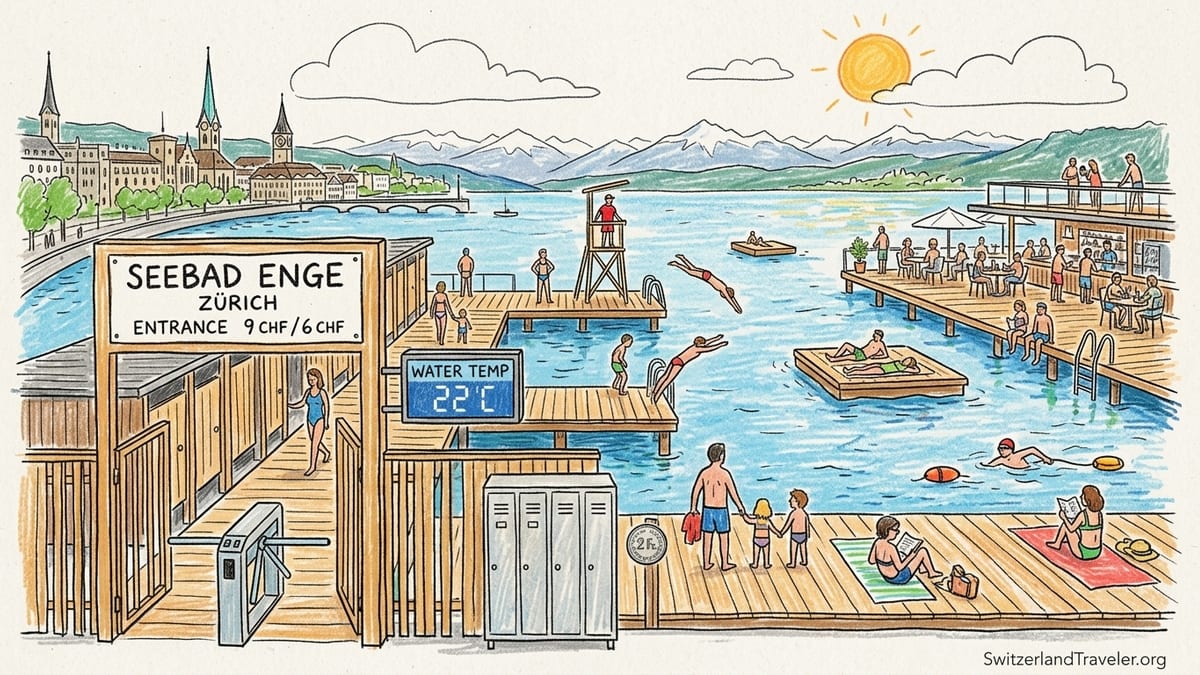
Arriving at Seebad Enge: A Lake Zurich Classic
I chose Seebad Enge for my badi day partly because it is central, just a few minutes’ walk from Enge train station, and partly because it is a local favorite rather than a resort showpiece. From the street, the facility looks modest, with low wooden buildings and flower boxes facing the promenade. Only when you step through the turnstile and onto the timber decking does the setting open up, with Lake Zurich spreading out toward the Alps and the city’s quays curving away on both sides.
At the entrance a board listed the 2026 prices: 9 Swiss francs for a single adult entry, reduced to 6 francs after 6 p.m., with cheaper rates for children, youths and pensioners. Payment was straightforward in cash or by card. There are season passes for locals, but for a visitor with one spare afternoon, the day ticket felt reasonable, especially given what is included once you are inside: direct lake access, changing cabins, showers, toilets, lifeguards, sunbathing platforms and a full bar-restaurant.
There is nothing resort-like about the arrival process. You do not pass through landscaped gardens or marble lobbies. Instead you follow a narrow wooden corridor flanked by simple changing cabins, hearing the slap of wet feet and the clink of coffee cups from the lakeside bar. The atmosphere is functional and unpretentious, more neighborhood pool than beach club, but the first glimpse of the water at the end of the passage feels undeniably special.
Just beyond the entrance, a digital board showed the lake temperature logged that morning by the canton’s hydrological service. On my visit in mid-July it read 22 degrees Celsius, which is warm by Swiss lake standards but still cool enough to be bracing on first contact. Most locals glanced at the number only briefly, as if checking the time, then walked straight to the ladders and dove in.
Changing Rooms, Lockers and Feeling Secure
Seebad Enge’s facilities are simple, but they are exactly what you need. Immediately inside, a row of gendered indoor changing rooms opens off the main corridor, with benches and hooks. The doors close fully, and the spaces are clean, if a little basic, with tiled floors that stay surprisingly dry considering the traffic. There are also small wooden cabanas along the side decks, some of them reserved by regulars for the whole season, with their names printed on plaques.
For day visitors, the key detail is the lockers. Seebad Enge has a block of coin-operated metal lockers at the rear of the changing area and a second set beside the toilets closer to the lake. On my visit a medium-sized locker cost 2 francs to close, with the coin returned when you reopened it. The lockers are narrow but tall enough to store a daypack with a camera and a laptop. I put my passport, wallet and electronics inside and kept only a towel and a paperback with me on the deck.
Zurich has a reputation for low petty crime, and that was reflected in people’s behavior. Many swimmers left bags unattended on the wooden planks or lawns while they swam several hundred meters out into the lake. At first this felt unnerving as a visitor, but after an hour of watching families and solo swimmers do the same, I started to relax. I still chose to lock away anything I would truly miss. For travelers, that remains the sensible approach: use the lockers for valuables, keep a small amount of cash and a phone within reach, and enjoy the rare luxury of not constantly watching your bag.
Showers and toilets are plentiful for the size of the facility. Cold outdoor showers stand near the lake ladders, where people rinse quickly before and after swimming, and there are hotter indoor showers in the changing rooms. None of this feels luxurious. It is municipal infrastructure doing its job quietly, which fits the understated spirit of the place.
Decks, Lawns and Platforms Instead of Sand
The first surprise for many visitors is the total absence of sand. Seebad Enge is a floating wooden structure moored to the lakeshore, with the swimming areas fenced off in the open water. Instead of a beach, you move around on multi-level decks and ramps that frame a rectangular basin on the city-facing side and open water access at the far edge. For anyone expecting palm trees and loungers, it is a very different visual language, but it suits Lake Zurich perfectly.
Inside the fence, there is also a small but well-kept grass area near the entrance, shaded by trees. Here, office workers stretched out in their lunch break, couples shared takeaway sushi, and students read novels with their bikes leaned against the fence. Towels, picnic blankets and reusable water bottles were the dominant design elements. Unlike a resort, where sunbeds are lined up in military order, the layout here is organic. People find their own patch, often claiming a corner of deck with nothing more than a folded towel and a paperback.
The real draw, though, is the series of swimming platforms. On the lake side of Seebad Enge, two low wooden floats sit a little way out in the water, anchored in place. During my visit teenagers colonized one of them, taking turns to jump and dive, while older swimmers stopped briefly to rest before continuing their lengths parallel to the shore. These platforms are essential furniture in Zurich’s bathing culture. They create gathering points and waymarkers in a body of water that has no painted lane lines.
Because there is no sand, the experience is cleaner and, in some ways, more practical. There is nothing to stick to your skin. You walk barefoot across smooth boards, lower yourself down steel ladders and emerge without grit in your towel. Children adapt quickly, using the steps and roped-off shallows, and parents appreciate not having to shake sand out of everything later.
Into the Water: Temperature, Depth and Serious Swimming
Standing on the lower deck looking down, the first impression of Lake Zurich’s water at Seebad Enge is its clarity. On the inner city side, inside the fenced rectangle, I could see the pale lakebed sloping away, spotted with stones. The depth there starts at around waist height for an adult near the ladders and then drops quickly. Within a few meters, most swimmers could no longer stand. On the outer, open lake side, the water deepens fast beyond the last rung of the ladder, which is why strong swimming skills are essential once you venture past the enclosed section.
That 22-degree reading translated in practice to a brief shock followed by comfortable, sustained swimming. After a few strokes, the water felt cool rather than cold, and I could stay in for twenty minutes at a time without thinking about temperature. Experienced locals were in much longer, using brightly colored tow floats and goggles, heading diagonally out toward the middle of the lake. It was obvious that for many, this was not just a quick dip, but a training session woven into their daily routine.
In the roped-off area inside the badi fence, the atmosphere was more relaxed. People swam slow breaststroke laps between the ladders. Parents held children on their hips in the shallows. A few visitors, wary of depth, stayed near the sides. Lifeguards in red shirts watched from a central tower and from the decks, occasionally blowing whistles at children climbing railings or at swimmers edging too close to the barriers.
Water quality is regularly tested by the authorities, but from a purely personal perspective the lake felt clean and fresh. There was a faint natural smell typical of mountain-fed lakes and a very slight slick of pollen and organic matter near the surface in some corners, but no litter, oil sheen or noticeable algae near the swimming zones that day. My skin felt lightly tight and refreshed afterwards, more like after a river swim than a dip in a chlorinated pool.
Diving Boards, Crowd Mix and the Social Life of a Badi
On the inner side of Seebad Enge, a low diving platform juts out above the deepest part of the enclosed basin. It is modest in height compared with some of Zurich’s other badis, but high enough to attract a steady line of teenagers and twentysomethings testing their courage. People jumped, flipped and occasionally backed away at the last moment, greeted each time by a good-natured wave of encouragement from the deck.
The crowd at Seebad Enge that afternoon was a clear snapshot of Zurich in summer. Office workers came down in shirts and dresses over swimsuits, changed quickly, and swam hard for twenty minutes before returning to their desks. Groups of friends in their twenties treated the decks as an open-air living room, with speakers playing quietly beside reusable water bottles and paperback novels. Families with small children arrived in waves from mid-afternoon, pushing strollers along the promenade and unfolding sun hats and inflatable arm bands.
Tourists were present but very much in the minority. Most people spoke Swiss German. Snatches of French, Italian and English floated past, but the feel remained distinctly local. This matters if you want to understand Zurich’s lake culture. You are not in a cordoned-off resort enclave catering only to visitors. You are sharing public infrastructure that locals use repeatedly over the course of the season.
That local character shapes behavior. There is little posing or performance, despite the undeniably beautiful setting. People read newspapers, play cards, scroll their phones or simply lie on their backs looking at the clouds over the Uetliberg ridge. Swimmers give each other space in the water. Children are loud, but generally well supervised. It feels like a community park that happens to float on one of Europe’s most photogenic lakes.
Food, Drinks and Picnics by the Water
The culinary heart of Seebad Enge is its bar-restaurant, a casual counter-service operation with a shaded seating area and more tables out on the deck. The menu on my visit offered espresso and cappuccino, soft drinks, wine, beer on tap, Aperol Spritz, salads, grilled vegetables, sausages, burgers and a daily special, along with a small selection of cakes and ice creams. Prices were what you would expect in Zurich: around 5 francs for a coffee, 6 to 7 francs for a beer, and 16 to 22 francs for a main dish.
The food is cooked in a compact open kitchen, and the line at the counter moved steadily. Sun-browned regulars ordered with the efficient ease of experience, carrying trays back to their usual tables. Many families and students, though, bypassed the kitchen entirely and unpacked picnics instead. Badi culture is very picnic-friendly. You see Tupperware boxes of homemade pasta salad, supermarket sushi, crusty bread with local cheese, sliced watermelon and thermos flasks of coffee.
This coexistence of bar service and bring-your-own is part of what distinguishes a Zurich badi from a classic resort beach, where outside food is often discouraged. At Seebad Enge nobody batted an eyelid if you spread out a simple picnic on your towel, as long as you cleaned up afterwards and avoided glass near the water. The bar adds convenience and sociability without trying to control the entire food experience.
Throughout the afternoon a soundtrack of quiet conversation, cutlery and the clatter of glasses mixed with the slap of feet on wet wood. There was no amplified music from the venue itself, which kept the mood relaxed. It would be easy to spend many hours here, alternating swims with snacks and drinks, without ever feeling pressured to vacate a lounger or order another round.
How a Swiss Badi Differs from a Resort Beach
Spending a full afternoon at Seebad Enge made the differences between Swiss badi culture and a conventional resort beach very clear. The most obvious is the physical environment. Instead of sand that blurs the boundary between land and water, you have wooden decks, metal ladders and lawn. Access to the lake is vertical rather than horizontal. You do not wade out slowly through shallows. You step down a ladder and are suddenly afloat in deep, cool water.
That depth and structure encourage a particular kind of swimming. In resort settings, many people never go beyond waist height, content to splash or float near the shore. At Seebad Enge and other Lake Zurich badis, a significant proportion of visitors swim serious distances. Throughout my visit, sleek silhouettes in goggles moved back and forth along imaginary open-water lanes between the platforms and the fence line. Some wore GPS watches and tow buoys, pacing themselves as if on a training run, then climbed out, showered and headed straight back to work.
The overall tone is less about escape from daily life and more about integrating water into it. Resorts are often designed as sealed worlds where guests briefly suspend reality. A Zurich badi, by contrast, is stitched directly into the city’s fabric. Trams rattle past. Church spires and office towers remain in sight. On the deck you see neighbors, colleagues and classmates rather than anonymous tourists on week-long breaks.
There is also a different attitude toward space and possessions. Without private hotel loungers or rental cabanas, people negotiate for shared surfaces and accept a degree of proximity. A family might lay towels next to a pair of students revising for exams or an older couple reading newspapers. Bags lie unattended for stretches of time, not because theft is impossible, but because the cultural norm is trust. It is an urban, communal version of lakeside living, quite distinct from the privatized experience of many resort beaches.
What to Bring, What to Leave and Comparing Options
After a day at Seebad Enge, my packing list for a Lake Zurich badi visit is clear. Bring a swimsuit that is comfortable for real swimming, not just posing, because you will be tempted to go farther than you planned once you feel the water. Pack a quick-drying towel, sunscreen, a hat and a light cover-up for the deck. Simple flip-flops are useful for moving between the changing rooms, bar and lake ladders, though many people go barefoot on the wooden planks.
For comfort, a thin mat or sarong can make lying on the boards or grass more pleasant. Goggles are worthwhile if you enjoy swimming proper lengths, since the water is clear enough that visibility adds to the experience. Strong swimmers considering heading beyond the enclosed badi area might bring a tow float for visibility, which is increasingly common on the lake, especially later in the day when more boats are on the water.
What you probably do not need to carry are large valuables. With coin-return lockers available, it is easy to store passports, laptops and most of your cash. I kept my phone with me to take a few photos and use the badi’s posted QR codes for menu information, but I would have been comfortable leaving even that locked away between swims. The overall feeling, for me, was that personal belongings were as secure here as in a quiet neighborhood café.
Having now tried a paid lakeside badi, I would still be curious to balance it with other options around Zurich. Free lakeside access spots, such as the grassy banks near the Arboretum or patches of shoreline further along the promenade, offer the same water without the entry fee, but lack lifeguards, structured ladders and facilities. River swimming in the Limmat, for example at Oberer Letten, provides a livelier current and a different urban backdrop, with the current carrying you downstream as you float. Each has its appeal, but for a first or second-time visitor who values both safety and local atmosphere, a paid badi like Seebad Enge strikes a very appealing middle ground.
The Takeaway
Swimming in Lake Zurich from a proper badi is not a novelty add-on to a city break. It is a window into how Zurich residents actually live in summer. At Seebad Enge, everything is arranged around facilitating straightforward, repeated contact with the lake. Wooden decks replace sand, ladders replace shorelines, and platforms replace buoys, but the essence is the same that you find in any beloved neighborhood swimming hole: a place where people of all ages can cool off, move their bodies, socialize and briefly step outside their routines.
What surprised me most was how seamlessly serious swimming and relaxed leisure coexisted. On the same deck, you see triathletes timing their crossings, elderly couples easing down the steps for a gentle dip, office workers fitting in a fast kilometer of freestyle between meetings, and children launching themselves from low platforms with shrieks of joy. No one form of using the water dominates. Instead, the structure of the badi makes room for many.
If I had to choose how to swim in Zurich on my next visit, I would again pay the modest entry for a lakeside badi like Seebad Enge. The lifeguards, ladders and changing rooms offer peace of mind, the decks and platforms make open-water swimming both accessible and inviting, and the mix of locals ensures that you are seeing real Zurich life rather than a curated stage set. After that, I would be tempted to try a free lakeside patch or a river badi, but only as a complement, not a replacement, to the anchored, communal charm of a classic Lake Zurich badi day.
FAQ
Q1. Which exact badi is described in this article?
Seebad Enge on the western shore of Lake Zurich, a wooden lakeside bathing facility a short walk from Zurich Enge train station.
Q2. How much does it cost to enter Seebad Enge?
On my 2026 visit, an adult day ticket cost 9 Swiss francs, with a reduced evening rate of around 6 francs after 6 p.m., and discounts for youths and seniors.
Q3. Are there secure lockers for valuables?
Yes, there are coin-return metal lockers near the changing rooms and toilets. I stored my passport, wallet and electronics there and felt comfortable leaving them.
Q4. Is there any sand or beach area at Seebad Enge?
No, there is no sand. The facility is built from wooden decks over the lake, with ladders into the water and a small grass sunbathing area near the entrance.
Q5. How deep is the water and is it suitable for non-swimmers?
Inside the enclosed area it starts around waist deep and quickly becomes too deep to stand. Confident swimmers are fine, but non-swimmers should stay very close to the ladders and rely on flotation aids and supervision.
Q6. What kind of people use Seebad Enge?
The crowd is mostly local: office workers on breaks, students, families with children, groups of friends and some tourists. Ages range from small children to retirees.
Q7. What is the typical water temperature in summer?
On my mid-July visit, the lake temperature at Seebad Enge was 22 degrees Celsius, cool on first entry but comfortable for sustained swimming once you get moving.
Q8. Can I bring my own food and drinks?
Yes, many people bring picnics, water bottles and snacks. There is also an on-site bar-restaurant serving hot meals, drinks and coffee throughout the day.
Q9. What should I bring for a badi day on Lake Zurich?
Bring a swimsuit for real swimming, a towel, sunscreen, hat, flip-flops, perhaps goggles and a light mat or blanket. Use the lockers for passports and valuables and carry only what you need by the water.
Q10. Would you recommend a paid badi, free lakeside spot or river swimming?
For a first-time visitor, I would recommend a paid lakeside badi such as Seebad Enge for its facilities, safety and local feel, then consider free lakeside spots or a river badi like Oberer Letten as additional experiences once you are familiar with the city.