


If you are planning a first trip into the heart of the Swiss Alps, two names rise to the top of almost every itinerary: Zermatt under the Matterhorn, and the Jungfrau region around Grindelwald, Wengen, Mürren and Lauterbrunnen. Both are spectacular, both are expensive, and both can easily fill a week on their own. The harder question for many travelers is not which one to visit, but how to split precious nights between them. This guide looks at concrete, real-world factors to help you decide where to spend more time.
Big-Picture Overview: Two Different Alpine Worlds
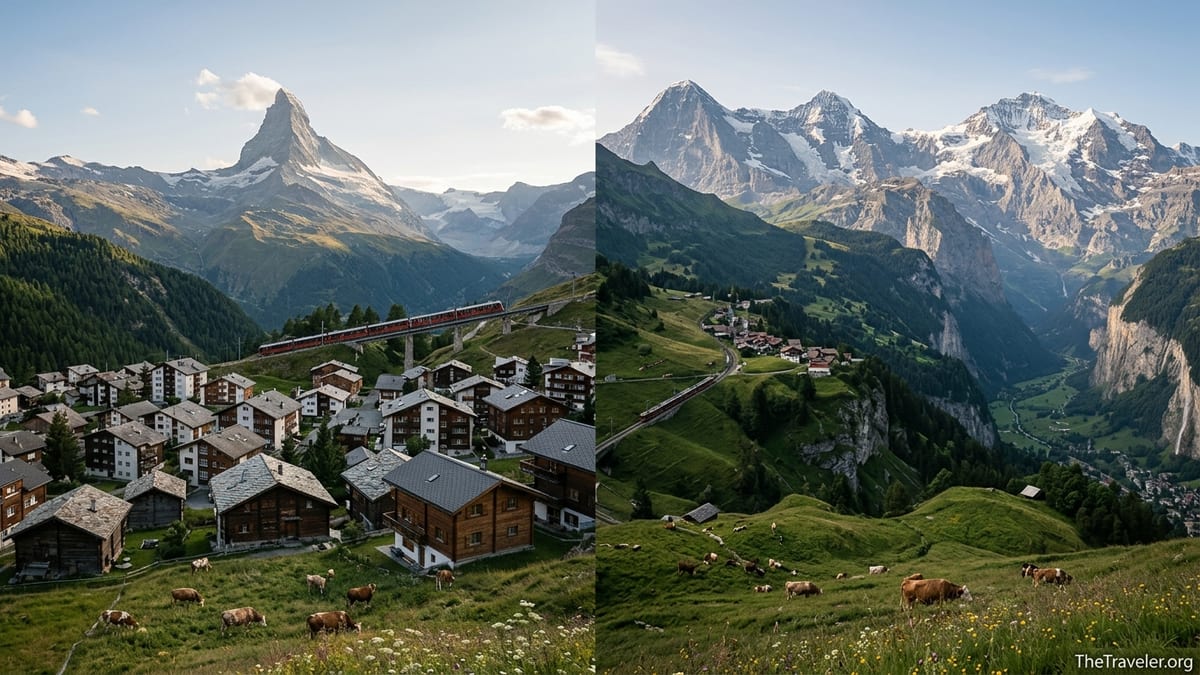
In broad strokes, Zermatt is a compact, high-mountain resort dominated by one peak: the Matterhorn. The Jungfrau region is a whole Alpine playground spread across two valleys, framed by the Eiger, Mönch and Jungfrau, with multiple villages and viewpoints. Zermatt tends to suit visitors who want a strong sense of place, dramatic glaciated scenery and a polished resort feel. The Jungfrau region generally works better for those who like variety day to day, different villages to explore and a wider network of mountain excursions.
From a logistics perspective, Zermatt is the terminus of a single rail line that climbs from Visp and Brig; the village itself is car-free, with small electric taxis and hotel shuttles taking you from the station to your accommodation. The Jungfrau region, by contrast, fans out from the rail hub at Interlaken. From there you can reach Grindelwald and Lauterbrunnen by train in about 30 minutes, and then continue up to traffic-free Wengen or Mürren on rack railways and cable cars. That web of connections makes it easier to “mix and match” bases or do day trips between villages.
In practical terms, many itineraries end up splitting time something like four or five nights in the Jungfrau region and two or three in Zermatt for a 7-night trip. This is not a rule, but it reflects the simple fact that there are more distinct valleys, lakes and viewpoints to sample around the Jungfrau. Zermatt excels as an intensely scenic base for a shorter, focused stay with a strong visual payoff.
Matterhorn vs Eiger–Mönch–Jungfrau: Choosing Your Mountain Backdrop
Iconic scenery is often the emotional tiebreaker. In Zermatt, almost everything orients toward the jagged pyramid of the Matterhorn. On a clear evening, you might watch it glow orange from the terrace of a midrange hotel like Hotel Bellerive, or from the wooden bridge over the Vispa river near the village center. Classic viewpoints include the Gornergrat railway summit, where you stand at over 3,000 meters with the Matterhorn and a ring of glaciers in view, and the 5-Seenweg (Five Lakes Walk), where the peak is reflected in alpine tarns.
The Jungfrau region’s drama is broader and more layered. Stay in car-free Wengen, for instance, and you look straight across at the massive wall of the Jungfrau, with the Lauterbrunnen Valley dropping away below. From Mürren, you face the notorious north face of the Eiger almost head-on. Instead of one solitary icon, you get a skyline of 4,000-meter peaks and hanging glaciers above farm pastures and waterfalls. A ride to Schilthorn, with its revolving restaurant and James Bond history, or to Jungfraujoch, the saddle between Mönch and Jungfrau, gives you long-range glacier views that feel more expansive than anything at Zermatt, even if the Matterhorn silhouette is arguably more recognizable.
If you dream of that single, perfect postcard with one unmistakable mountain, Zermatt usually wins. If you prefer layered scenery with multiple peaks, deep valleys and waterfalls like Staubbach and Trümmelbach, the Jungfrau region gives you more variety over a week. For many travelers, this variety is a key reason to allocate extra nights there.
Where You Sleep: Hotels, Chalets and Atmosphere
Zermatt’s hotel scene skews upmarket, with many four- and five-star properties. Budget-tracking sites that aggregate hundreds of properties suggest that the average hotel price in Zermatt often sits in the mid-300s US dollars per night, with high season averages significantly higher and top luxury options easily exceeding 800 dollars per night for suites with direct Matterhorn views. In practice, a midrange couple in July might pay around 300 to 450 Swiss francs per night for a stylish but not ultra-luxury room, for example at places like Hotel Sonne, Hotel Europe or the Cervo Mountain Resort’s smaller rooms when booked early with some flexibility.
In the Jungfrau region, there is a broader spectrum. Interlaken has large, traditional hotels and budget hostels; Grindelwald offers many midrange and upscale chalets and spa hotels; Wengen and Mürren are heavy on atmospheric, classic mountain hotels, some with wooden balconies and 19th-century dining rooms. A comfortable double room in Wengen or Grindelwald in summer often runs closer to 220 to 320 Swiss francs per night if booked a few months ahead, while simple guesthouses or apartments can bring costs down further, especially in the shoulder seasons of May, June and late September.
Atmospherically, Zermatt feels more like an international Alpine resort. The main street is lined with brand-name outdoor shops, cocktail bars and high-end restaurants, mixed with traditional chalets on side lanes. It is lively into the evening, particularly in ski season, and English is widely spoken in hotels and on the street. Wengen and Mürren feel sleepier and more traditional, with fewer late-night venues and a stronger sense of being in a small mountain village. Grindelwald sits between those extremes, with a clear resort feel but less density than Zermatt’s core.
Hiking and Summer Activities: How Many Days Can You Fill?
In summer and early autumn, both regions are hiking powerhouses, but the scale differs. Around Zermatt, a typical three-night stay gives you two full hiking days plus travel days that can include shorter walks. Many visitors combine the Gornergrat area on one day with the Rothorn and Five Lakes Walk on another, then perhaps squeeze in an easy stroll in the Gorner Gorge or a visit to the Glacier Paradise on Klein Matterhorn. Serious hikers can add routes like the Hörnli Hut approach or the Europaweg sections, but these require better fitness and often more time.
The Jungfrau region can easily absorb five or more hiking days without repetition. A common mix for a four- or five-night base might include the classic Männlichen to Kleine Scheidegg ridge walk above Wengen, the Eiger Trail near Kleine Scheidegg and Grindelwald, a day on Schynige Platte’s panoramic circuit with views over Lake Thun and Lake Brienz, and a loop starting from Mürren to Allmendhubel and on toward the higher pastures. Each of these areas involves different starting lifts or trains, so they feel like separate “mini-trips” even if you sleep in the same village every night.
Outside hiking, both regions offer summer adventure activities. In Zermatt, this could mean guided glacier trekking, via ferrata routes above the village, or mountain biking on signed trails from Sunnegga and Gornergrat. The Jungfrau region counters with canyoning and paragliding out of Interlaken, zip lines and mountain carts at Grindelwald First, and family-friendly playgrounds at mountain stations like Männlichen and Allmendhubel. If you want a single base that offers easy, varied day trips for four to six consecutive days, the Jungfrau region generally has the broader menu.
Skiing and Winter: Pistes, Snow and Lift Access
In winter, Zermatt’s combined ski area with Cervinia across the Italian border offers one of the largest and highest-altitude ski domains in Europe. Much of the terrain sits above 2,500 meters, and the glacier skiing near Klein Matterhorn often operates well into late spring, which gives Zermatt a reputation for reliable snow. A typical visitor staying four nights could easily ski three full days without repeating too many runs, especially if they cross into Italy for long red pistes above Valtournenche. Lift passes are priced at a premium, but many skiers accept that given the vertical drop and season length.
The Jungfrau ski region is more fragmented but still extensive, with main areas around Grindelwald–Wengen and Mürren–Schilthorn linked by a common lift pass. Skiers based in Wengen can ride the cog railway up to Kleine Scheidegg, then drop into a network of pistes under the Eiger and Mönch. From Grindelwald, the modern Eiger Express gondola speeds you to Eigergletscher in minutes, while another gondola from the village center accesses the First area. A week-long ski pass valid across Grindelwald, Wengen and Mürren–Schilthorn is priced to match big Alpine resorts, with multi-day adult passes often totaling several hundred Swiss francs.
For pure snow reliability and high-altitude terrain into late season, Zermatt often gets the nod, particularly for advanced skiers who want long glacier runs. The Jungfrau region, however, offers more traditional Alpine charm on the slopes: picture long blue and red runs weaving past farm buildings, with railways and mountain restaurants at regular intervals. For mixed groups with both skiers and non-skiers, the Jungfrau area may be the better base because non-skiers can still ride up to viewpoints, visit lakes, or explore Interlaken without feeling stuck in a single resort bubble.
Mountain Excursions and Ticket Costs
One of the biggest hidden costs in both regions is mountain transport. Trains and cable cars to high viewpoints are rarely cheap, and even holders of national rail passes often get only partial discounts on the very top segments. Zermatt’s headline trips include the Gornergrat railway and the Klein Matterhorn cable car to the Glacier Paradise. A return journey to Klein Matterhorn for an adult can run to well over 100 Swiss francs in peak season, with discounts for holders of a Swiss Travel Pass or Half Fare Card. Gornergrat is similarly costly but often cited as a must-do because of its exceptional Matterhorn and glacier panorama.
In the Jungfrau region, Jungfraujoch is the flagship excursion. A return ticket from Grindelwald or Wengen via Kleine Scheidegg is typically one of the most expensive single-day rail trips in the country, often well above 150 Swiss francs per adult even after some regional discounts. Schilthorn is usually a bit less expensive but still substantial. Many travelers manage costs by choosing one “hero” excursion, then focusing other days on more moderately priced lifts like Männlichen, Schynige Platte or Grindelwald First, each of which still runs to dozens of francs per person for return rides.
National rail passes matter if you plan multiple excursions. A Swiss Travel Pass in second class, available for 3, 4, 6, 8 or 15 consecutive days, gives unlimited regular train travel and sizable discounts on many mountain railways, with certain segments fully covered and the highest stretches discounted. Prices run from the lower-200s Swiss francs for the shortest durations to well over 400 francs for longer passes, with youth discounts for travelers under 25. Whether this is good value depends heavily on how many high-mountain days you plan in both Zermatt and the Jungfrau region and how far you are traveling across Switzerland before and after.
Couples vs Families: Atmosphere, Activities and Practicalities
For couples, Zermatt has a clear romantic pull. Many hotels build their entire identity around cozy spa facilities and candlelit dining rooms with Matterhorn views. A couple celebrating a honeymoon might book a junior suite with balcony in a four-star superior hotel for 600 to 800 Swiss francs per night in high season, then spend days alternating between scenic hikes and time in the wellness area. Evening strolls through the village, with the Matterhorn lit faintly in the background on clear nights, add to the sense of being in a classic Alpine resort.
The Jungfrau region can be equally romantic but feels more spread out. A couple staying in Mürren or Wengen may value the quieter evenings and the lack of through-traffic, but nightlife options are thinner and restaurant choices more limited than in Zermatt. On the positive side, a longer stay here can include easy day trips to Lake Brienz or Lake Thun for boat cruises, walks through Lauterbrunnen’s waterfall-filled valley, or coffee on a terrace above Grindelwald while watching paragliders float down to the valley floor.
Families often find the Jungfrau region more practical for a week. There are more midrange apartments and family rooms, more playgrounds and themed trails at mountain stations, and more gentle walks where younger children can ride cable cars up and walk mostly downhill. A family of four might buy a regional or national pass, then use the included or discounted rides daily without feeling they have to “maximize” a single expensive excursion. In Zermatt, the high costs of flagship lifts and the steeper terrain can make it slightly harder to build a week of low-intensity, budget-friendly family outings, though there are excellent family-friendly routes like the themed Marmot Trail near Sunnegga.
Costs and Value: Where Your Budget Stretches Further
Neither Zermatt nor the Jungfrau region is cheap, so the question is more where your money buys more experiences. Zermatt’s hotel rates are generally higher at similar quality levels, and dining can be notably expensive on the main street, where a simple main course in a midrange restaurant may run 30 to 45 Swiss francs before drinks. Ski pass and excursion prices also tend to sit at the top end of the Swiss range, reflecting the resort’s international cachet and the high costs of running year-round glacier infrastructure.
In the Jungfrau region, accommodation and food can still be pricey but often come with slightly more flexibility. Staying in Lauterbrunnen or Wilderswil instead of Wengen or Grindelwald, for example, can trim nightly costs by a noticeable margin while still giving you access to the full regional network. Self-catering apartments in Grindelwald or Mürren make it easier to cook some meals, reducing the need for daily restaurant spending. Mountain transport is still a major line item, but the sheer number of mid-priced lifts and trains means you can mix big-ticket days like Jungfraujoch with cheaper ridge walks starting from passes like Kleine Scheidegg or Männlichen.
If budget is a serious concern and you still want to experience both areas, a pragmatic approach is to base more nights in the Jungfrau region in a midrange village, then book a shorter, tightly planned stay in Zermatt where you focus on one or two key excursions and moderate hotel standards instead of peak-luxury rooms.
How Many Nights: Practical Splits for Different Travelers
For most first-time visitors with 6 to 8 nights for the Alps, a common recommendation from experienced travelers and local experts is to spend more nights in the Jungfrau region than in Zermatt. A practical split might look like five nights in the Jungfrau area and two nights in Zermatt for a 7-night trip, or four Jungfrau nights and three in Zermatt if you prize the Matterhorn highly and are visiting in peak summer when all lifts and trails are open.
This “Jungfrau-heavy” approach reflects the way excursions cluster. From a base in Wengen, Grindelwald or Mürren, you can dedicate separate days to Jungfraujoch, Schilthorn, Schynige Platte, Grindelwald First, Männlichen–Kleine Scheidegg and the Lauterbrunnen valley floor, plus at least one weather-buffer day. In Zermatt, core highlights such as Gornergrat, Rothorn and the Glacier Paradise, plus one or two major hikes, can be realistically covered in three full days, especially for travelers who are comfortable with early starts and full walking days.
If your trip is shorter, such as four or five Alpine nights in total, consider whether you really want to split bases at all. For instance, five nights solely in the Jungfrau region let you see a wide cross-section of the Bernese Oberland without spending half a day changing hotels and trains. Travelers who are determined to see the Matterhorn might then add Zermatt on a future trip or accept a quick two-night dash that prioritizes one signature excursion and a single big hike.
The Takeaway
When you strip away the glossy photos and focus on real-world logistics and costs, a pattern emerges. Zermatt is the ultimate “wow” shot, with a resort-like atmosphere, high-altitude skiing and a tight cluster of big-ticket excursions centered on the Matterhorn. The Jungfrau region is a broader Alpine landscape where multiple valleys, peaks, lakes and villages unfold over a week, offering more day-to-day variety and usually slightly better value for longer stays.
For most travelers, that means the Jungfrau region deserves more nights. It offers the density of different hikes, viewpoints and easy excursions that justify a five- or six-night base, especially for families and hikers. Zermatt, in turn, shines as a concentrated highlight of two to three nights focused on the Matterhorn, whether you add it before or after the Bernese Oberland. There are exceptions: dedicated skiers chasing altitude or couples seeking a purely romantic, spa-centered stay might weight Zermatt more heavily. But if you are looking for one Alpine base to linger in, watch the weather, and choose a different spectacular outing each day, the Jungfrau region is usually where your nights stretch furthest.
FAQ
Q1. If I only have four nights in the Swiss Alps, should I split them between Zermatt and the Jungfrau region?
With just four nights, it is usually better to pick one base, most often in the Jungfrau region, to avoid losing a half day to changing hotels and trains.
Q2. How many nights do most travelers spend in the Jungfrau region vs Zermatt?
For a week-long trip, many visitors choose about four to five nights in the Jungfrau region and two to three nights in Zermatt, depending on interests and season.
Q3. Which area is better for families with children?
The Jungfrau region generally suits families better, with more playgrounds, gentle walks, varied villages and a wide choice of midrange apartments and family rooms.
Q4. Is Zermatt significantly more expensive than the Jungfrau region?
Hotel and restaurant prices in Zermatt tend to be higher at comparable standards, and its flagship mountain excursions are also among the most expensive in Switzerland.
Q5. Where is snow more reliable for late-season skiing?
Zermatt usually wins for late-season snow thanks to its glacier terrain and higher-altitude slopes, which can remain open when lower resorts start to close.
Q6. Can I visit Jungfraujoch and the Matterhorn area in one trip without breaking the bank?
Yes, but you will need to budget carefully, possibly limit yourself to one or two major high-mountain excursions in each area, and consider a rail pass to soften transport costs.
Q7. Which base is better for non-hikers who still want big Alpine views?
Both work, but the Jungfrau region offers more variety of viewpoints and easier, shorter walks, while Zermatt offers a compact set of very dramatic but sometimes steeper outings.
Q8. Is it easy to get between Zermatt and the Jungfrau region by train?
Yes. Most routes connect via Visp and Spiez or Bern, and the journey usually takes around three to three and a half hours with one or two changes.
Q9. Should couples on a honeymoon favor Zermatt or the Jungfrau region?
Couples seeking a classic spa resort atmosphere and Matterhorn views often favor Zermatt, while those wanting quieter villages and more varied day trips tend to choose the Jungfrau region.
Q10. In which region will my money buy more distinct day trips over a week?
The Jungfrau region typically offers more different valleys, peaks and lakes to experience from a single base, so most travelers feel their nights stretch further there.