


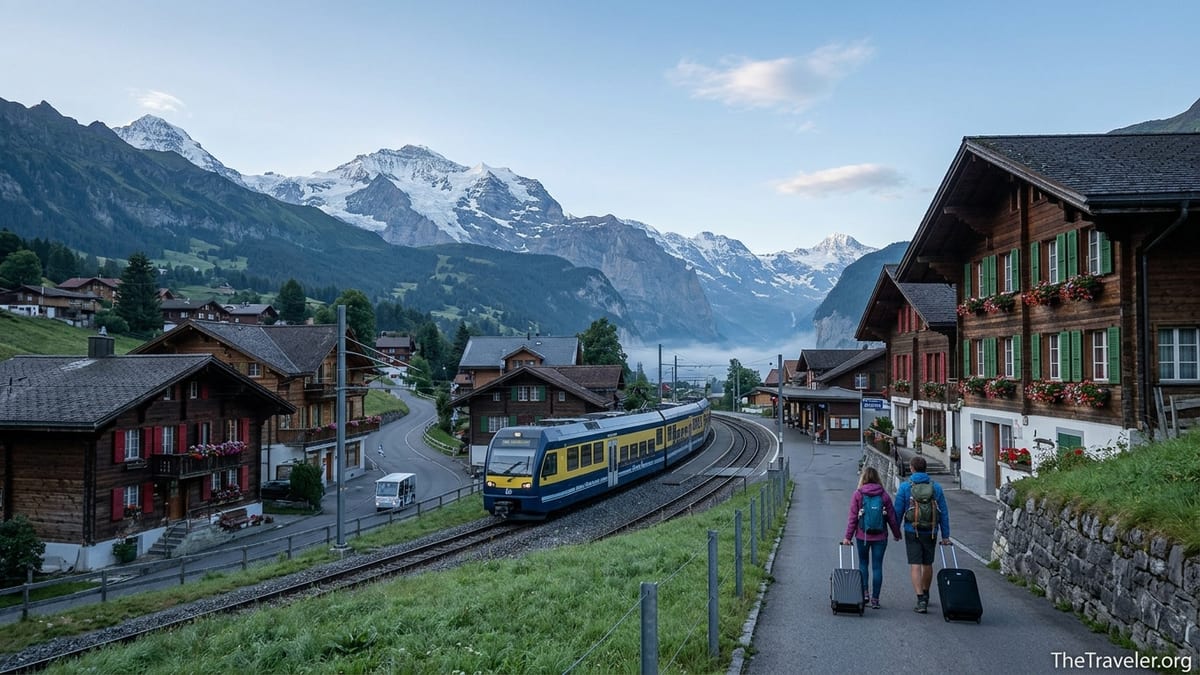
Switzerland is one of the few places where you can design an entire mountain holiday around public transport and never once miss a car. Trains glide straight into high valleys, buses thread through villages, and cable cars and cog railways lift you into the snowfields. With smart planning, you can wake to cowbells in a car-free village like Zermatt, Wengen or Mürren, ride trains and lifts all day, and come back to your hotel without ever touching a steering wheel or worrying about parking.
Why the Swiss Alps Work Brilliantly Without a Car
Switzerland has spent more than a century building a mountain transport network that feels like it was designed for modern visitors who do not want to drive. Intercity trains from Zurich, Geneva and Basel feed into regional lines that run straight up into the Alps, such as the Bernese Oberland Railway from Interlaken to Lauterbrunnen and Grindelwald. From those valley hubs, narrow-gauge railways and cable cars continue to villages and high viewpoints, often with timed connections that cut waiting to just a few minutes.
For travelers used to renting a car in Europe, it can be disorienting to discover that some of Switzerland’s most famous resorts, including Zermatt and Wengen, are legally car-free. Private combustion-engine vehicles must stop at parking terminals in Täsch for Zermatt or in Lauterbrunnen for Wengen and Mürren, leaving the final stretch to mountain railways and cableways. This is not a compromise; it is part of the appeal. Streets are quieter, air is cleaner, and many hotels sit a few steps from the station rather than a windy mountain road.
Because railways and lifts are integrated, you can realistically plan a week where every activity, from a glacier excursion to a lakeside stroll, is reached by train, bus, cable car or on foot. A typical summer day might start with a train from Wengen up to Kleine Scheidegg, then on to Jungfraujoch, followed by an afternoon hike down to Wengernalp and a cogwheel train home for dinner. In winter, ski lifts and mountain trains often double as your daily commute between slopes and hotel.
Costs are the main concern for many visitors, but even here the system is designed for travelers. A Swiss Travel Pass, for example, gives unlimited travel on most trains, buses and boats nationwide for a fixed number of days, with discounts on many mountain railways. Regional passes such as the Berner Oberland Pass can also be excellent value if you concentrate on one area like the Jungfrau Region.
Choosing Your Main Train Base: Interlaken, Lucerne or Chur
Before you dive into car-free villages, it helps to pick one or two rail-accessible bases that work as your “hub.” These are towns with major stations, frequent services and good supermarket options where you might stay for three to five nights. For many first-time visitors, Interlaken, Lucerne and Chur are the most practical choices, each anchoring a different part of the Alps.
Interlaken sits between Lake Thun and Lake Brienz and acts as the main gateway to the Jungfrau Region. Intercity trains from Zurich Airport take roughly two and a half hours with a simple change in Bern, and from Interlaken Ost you can roll straight onto local trains up to Lauterbrunnen, Grindelwald and beyond. Staying in Interlaken puts you close to supermarkets and a wider choice of mid-range hotels and guesthouses, and it keeps travel times short to Bern and Thun for city or castle excursions.
Lucerne is a compact lakeside city that combines medieval streets with immediate mountain access. From the main station, you can be on the cogwheel railway to Mount Pilatus or the boat-and-train route to Mount Rigi within minutes. As a base, Lucerne works well if you want a mix of culture and alpine day trips without moving hotels too often. A traveler might spend four nights here and take day trips by train and boat to Engelberg, Stoos or Titlis, then shift to a higher-altitude base such as Wengen for the second half of the trip.
Farther east, Chur is the oldest town in Switzerland and the starting point of iconic panoramic trains. It is the gateway for the Bernina Express and a common transfer point for the Glacier Express heading toward Zermatt or St. Moritz. Using Chur as a base suits travelers focused on the Graubünden region, including Arosa, Lenzerheide and the Engadine. Trains to these resorts tend to be frequent but slower, so building a few nights in Chur into your itinerary can keep travel days reasonable while you explore different valleys by rail.
Sleeping in the Mountains: Car-Free Resorts like Zermatt, Wengen and Mürren
Once you have a rail hub in mind, the real magic happens when you stay overnight in one of Switzerland’s car-free or near-car-free mountain villages. Zermatt, Wengen and Mürren are among the best known, and all three are reached entirely by public transport. Their streets are lined with chalets, hotels and bakeries rather than parking lots, and children can walk or toboggan through the village without dodging traffic.
Zermatt, in the Canton of Valais, is perhaps the most famous. To reach it, you normally take a standard-gauge train to Visp or Brig and transfer to the narrow-gauge line that climbs up the valley. The train glides directly into Zermatt’s central station, where you step off beside small electric taxis and hotel shuttles. From many three- and four-star hotels, it is an easy walk with wheeled suitcases. Visitors who prefer not to handle bags on arrival can use services offered via the national railway, which will transport registered luggage from your previous station or address to Zermatt for collection later that day or the next morning.
In the Jungfrau Region, Wengen sits on a sunny terrace perched above the Lauterbrunnen Valley. You reach it by taking the train from Interlaken Ost to Lauterbrunnen, then continuing with the cogwheel Wengernalp Railway. The village has a central platform ringed by hotels, cafes and rental shops. Many rooms face the valley cliffs or the summits of the Jungfrau and Mönch, and the absence of private cars gives Wengen an almost storybook atmosphere. Apart from a handful of small service vehicles, movement is by foot or electric cart, and most ski and hiking lifts start within a short walk of the station.
Mürren offers a slightly wilder feel on the opposite side of the Lauterbrunnen Valley. To get there without a car, you usually take the train to Lauterbrunnen and cross the street to the cable car that rises to Grütschalp, then transfer to a small mountain railway that continues along the cliff edge to Mürren. The entire sequence is scheduled as a single connection, so you step from train to cable car to train in a smooth flow. Once in Mürren, wooden chalets, narrow lanes and sweeping views of the Eiger, Mönch and Jungfrau make it easy to forget that the valley floor is hundreds of meters below.
How to Build a Fully Rail-Based Itinerary
Designing a Swiss Alps itinerary without a car starts with sketching out your long-distance train days, then layering in mountain excursions and rest days. A classic one-week trip for a first-time visitor might start in Zurich or Geneva, continue to Lucerne for two nights, move on to the Jungfrau Region for three or four nights in Wengen or Mürren, and finish with one or two nights in Zermatt before returning to the airport by train.
Practically, that could look like this: Day one, land in Zurich and take an intercity train directly from the airport to Lucerne. Day two, ride the boat and cogwheel railway loop around Mount Rigi, then wander Lucerne’s old town in the evening. Day three, travel by train to Interlaken Ost and connect to Wengen, timing your arrival so you reach the village by mid-afternoon, when check-in typically opens. Days four and five, use the network of cog railways and cable cars to visit Kleine Scheidegg, Jungfraujoch or Schilthorn, planning backup options in case of cloud or wind.
On day six, take the train from Wengen down to Lauterbrunnen, then on to Interlaken and via the Lötschberg route to Visp, where you transfer to the mountain railway up to Zermatt. With an early departure, you can arrive in Zermatt around lunchtime, giving you the afternoon to explore the village or ride the Gornergrat Railway for a Matterhorn sunset. On the final day, travel by train from Zermatt back to your departure city, such as Geneva or Zurich, allowing a buffer in case of delays or missed connections.
Throughout this process, using the official timetable app or website of the Swiss Federal Railways simplifies planning. You can enter “Zurich Airport” as your starting point and “Wengen” or “Mürren” as your destination, and the system will automatically include the correct mix of trains and lifts. If you are using a Swiss Travel Pass or regional pass, you simply show the digital or paper pass to staff and only pay extra when a specific excursion, like a high alpine cable car, requires a supplement.
Understanding Swiss Rail Passes and What They Really Cover
Because you will rely on public transport for almost everything, understanding the main ticketing options is essential. The Swiss Travel Pass is the best-known product for international visitors. It comes in versions from three to fifteen consecutive days and includes unlimited travel on most regular trains, buses and boats throughout the country, plus museum access and discounts on many mountain railways. As of the mid-2020s, a three-day second-class pass for adults typically costs in the mid-200s in Swiss francs, with prices increasing for longer durations and first-class upgrades.
For a trip focused heavily on the Bernese Oberland, the Berner Oberland Pass can be attractive. It covers a defined regional network that includes Interlaken, the lakes, and much of the Jungfrau Region’s mountain transport, with travel days that can be spread across a longer period. Visitors sometimes pair this regional pass with point-to-point tickets or a separate long-distance ticket from the airport to Interlaken if they are not crossing the whole country.
There are also flexible strategies for budget-conscious travelers. One widely used approach is combining a Swiss Half Fare Card with Saver Day Passes purchased in advance for the most expensive travel days. The Half Fare Card offers roughly 50 percent off most public transport for a month across Switzerland, while Saver Day Passes give unlimited nationwide travel on a specific day at a discounted price if bought early. This mix can be cheaper than a Swiss Travel Pass if your itinerary includes several days staying mainly in one area, walking or taking only short rides.
Whatever you choose, check the fine print about what is fully covered versus discounted. For example, major routes like Zurich to Interlaken or Visp to Zermatt are generally fully included on passes, while cable cars up to viewpoints such as Schilthorn or the final section to Jungfraujoch often require either a supplement or are offered at a reduced rate. Planning your most expensive mountain excursions on days when your pass is valid can significantly lower overall costs.
Luggage Strategies: Traveling Light, Transfers and Door-to-Door Services
One of the biggest psychological hurdles to going car-free in the mountains is handling luggage. Swiss trains and cable cars are designed with baggage in mind, but a little planning can turn awkward hauls into easy transitions. Almost all intercity and regional trains have large racks near the doors and overhead shelves above seats. On the narrow-gauge mountain lines to Zermatt, Wengen or Mürren, locals routinely bring suitcases, skis and hiking gear, so you will not be the only one with big bags.
If you want to minimize dragging suitcases through stations, the national railway offers luggage transport services. With the station-to-station option, for a per-item fee, you can check bags at one staffed station in Switzerland and collect them at another later the same day or following morning, depending on distance and timing. There is also a door-to-door option inside Switzerland and Liechtenstein that picks luggage up at your hotel or apartment and delivers it to your next address, which is useful if you are changing bases often or traveling with children and sports equipment.
In car-free resorts specifically, these services can be a game changer. For instance, you might hand over two large suitcases at Zurich main station and travel with just a small daypack to Wengen, collecting your luggage at the Wengen station later that afternoon. Many hotels in Zermatt and Wengen also provide small electric shuttles that meet trains on request. Guests commonly roll wheeled suitcases from the platform to their accommodation in five to ten minutes, but if your hotel sits uphill, booking a pickup through the hotel reception can save energy.
As a rule of thumb, try to limit each traveler to one medium suitcase and one smaller bag or backpack. Soft-sided luggage handles stairs better than very large hard-shell cases, especially on older station stairways or inclined village lanes. If you are planning high-level hut walks or multi-day treks, consider leaving your suitcase in a station locker in a base city like Lucerne or Interlaken and taking only a trekking backpack into the mountains, then retrieving the suitcase when you return to valley level.
Navigating Trains, Buses and Cable Cars Like a Local
Once you start using the system daily, a few habits make life easier. Arrive at the platform five to ten minutes before departure so you can position yourself near the carriage that matches your reservation or class. Electronic displays on platforms show where first and second class will stop, and carriages are clearly marked. On popular scenic routes such as the Glacier Express or certain panoramic cars to Zermatt, reservations may be mandatory or strongly recommended in high season, even if your pass covers the basic fare.
On regional trains and most cog railways, reservations are unnecessary. You simply board, sit where you like in the correct class, and be ready to show your ticket or pass on request. Buses and postbuses connect smaller villages and trailheads to the rail network, and drivers accept the same passes and tickets as the trains. In rural areas, these buses can be infrequent, so photographing the return timetable at the stop as you arrive helps you avoid long waits after a hike.
Cable cars and gondolas in Switzerland function almost like vertical buses. In places like the Lauterbrunnen Valley, you might step off a train and walk a few meters to a cable car station where cabins run every few minutes. Staff often scan passes or tickets at the turnstiles. For large cable cars with fixed departure times, such as the lift from Lauterbrunnen to Grütschalp or the big cabin from Mürren to Schilthorn, arriving at least fifteen minutes early on busy days gives you a better chance of boarding your preferred run without crowding.
Weather is another practical factor. High alpine routes are vulnerable to wind and storms, and it is not uncommon for certain lifts to close temporarily. The good news is that lower-level trains and buses are very reliable, so if a lift to a peak is not operating, you can usually pivot to a different valley or viewpoint the same day. Many visitors keep a flexible plan with two or three possible excursions and choose each morning based on cloud levels and wind forecasts posted at stations.
Sample No-Car Week: Jungfrau Region and Zermatt
To see how all of this comes together, consider a concrete seven-night itinerary built entirely around public transport. A couple landing in Zurich in early summer could start with one night in Lucerne to break up the journey, then spend three nights in Wengen and three nights in Zermatt, relying on a Swiss Travel Pass or a mix of Half Fare Card and Saver Day Passes.
On day one, they land in Zurich mid-morning, roll their suitcases onto the direct train from Zurich Airport to Lucerne, check into a hotel near the station, and stretch their legs along the lakeside promenade. Day two, they ride a morning train from Lucerne to Interlaken Ost, connect to the Bernese Oberland Railway to Lauterbrunnen, then board the cogwheel train to Wengen. After checking in, they stroll through the car-free streets and enjoy the view down the valley as the lights come on.
Day three is devoted to the Jungfraujoch excursion, reached by a combination of mountain trains. They leave Wengen early, ride up to Kleine Scheidegg, then ascend inside the Eiger to the “Top of Europe” station. After a few hours exploring the ice tunnels and viewing platforms, they descend via Grindelwald and return to Wengen by late afternoon. Day four, with the weather less certain, they choose a lower-level plan: cable car and train via Lauterbrunnen and Grütschalp to Mürren, lunch on a terrace, then an easy walk to Gimmelwald and a cable car back to the valley, all without touching a car.
On day five, they check their larger suitcases at Wengen station using station-to-station luggage service bound for Zermatt. With only daypacks, they ride down to Lauterbrunnen, connect to Interlaken, continue through the Lötschberg tunnel to Visp, and catch the mountain train to Zermatt. Late that afternoon, they collect their bags at Zermatt station, walk a few minutes to their hotel and take an evening stroll through the village. Days six and seven are filled with rides on the Gornergrat Railway and gondolas toward the Matterhorn Glacier Paradise, plus valley walks and cafe stops. On day eight, they take the early train from Zermatt back to Zurich Airport, arriving with enough buffer before their flight.
This kind of itinerary shows how the Swiss system allows you to cover a lot of ground with minimal stress. Every segment is booked as a through journey in the timetable, so you do not need to figure out separate tickets for buses or cable cars included in the route. At each stage, luggage strategies and car-free village design keep your focus on scenery and experiences instead of driving logistics.
The Takeaway
Planning a Swiss Alps holiday without a car is not a compromise; it is often the most rewarding way to experience the country’s landscapes and villages. Major hubs like Lucerne, Interlaken and Chur connect seamlessly to car-free resorts such as Zermatt, Wengen and Mürren, where railways, buses and cable cars take you to trailheads, viewpoints and ski slopes. With a thoughtful choice of rail pass, a realistic packing list and occasional use of luggage services, you can move between valleys and summits with surprising ease.
The key is to embrace the rhythm of public transport rather than fight it. Build your itinerary around train times, plan a few flexible days to work around alpine weather, and treat each journey as part of the experience rather than a chore. When your final memory of the trip is the sound of a cogwheel train climbing toward sunset-lit peaks, not a last-minute parking scramble on a mountain road, you will understand why so many travelers return to the Swiss Alps determined never to drive there again.
FAQ
Q1. Can I realistically visit the Swiss Alps without renting a car at all?
Yes. The Swiss rail and mountain transport network is designed so you can reach major resorts, small villages and high viewpoints entirely by train, bus, cable car and cog railway. Many of the most iconic destinations, including Zermatt, Wengen and Mürren, are actually car-free and only accessible by public transport.
Q2. Which is the best car-free village to use as a base: Zermatt, Wengen or Mürren?
All three are excellent, but they offer slightly different experiences. Zermatt is larger, busier and ideal if you want many restaurant choices and Matterhorn views. Wengen is quieter, family friendly and well positioned for Jungfraujoch and Kleine Scheidegg. Mürren feels more remote and dramatic, with huge cliffside views and easy access to Schilthorn. Many visitors combine two in one trip.
Q3. Do I need a Swiss Travel Pass, or can I just buy individual tickets?
It depends on how intensively you will use the network. If you plan several long train days and multiple mountain excursions within a short period, a Swiss Travel Pass or regional pass can provide convenience and good value. If your itinerary includes more relaxed days and only a few big journeys, a Half Fare Card with Saver Day Passes and point-to-point tickets may be cheaper.
Q4. How difficult is it to manage luggage on trains and cable cars?
For most travelers, it is straightforward. Trains have luggage racks and level boarding at many stations, and mountain railways and cable cars are used to handling suitcases and sports gear. If you want to avoid carrying heavy bags during transfers, you can use station-to-station or door-to-door luggage services so your suitcases travel separately and you move with only a small bag.
Q5. Are panoramic trains like the Glacier Express necessary for a car-free trip?
No, they are optional extras. Regular intercity and regional trains already run through beautiful scenery and are fully sufficient for a car-free holiday. Panoramic trains such as the Glacier Express or Bernina Express add a special experience with large windows and commentaries, but they usually require reservations and supplements even if your pass covers the basic route.
Q6. What is the best season to visit car-free resorts if I rely on public transport?
Public transport runs year-round, but the experience differs by season. Summer and early autumn are ideal for hiking, with dense timetables and open lifts. Winter offers skiing and snowshoeing with regular ski trains and gondolas. Shoulder seasons in late spring and late autumn can be quieter and cheaper but may see some lifts and mountain routes closed for maintenance.
Q7. How close are hotels to the train stations in car-free villages?
In places like Zermatt, Wengen and Mürren, many hotels are within a five to ten minute walk of the station. Some higher or more distant properties operate small electric shuttles to meet arriving trains. When booking, check the walking time and elevation and confirm whether your hotel offers luggage pickup or guidance from the station.
Q8. Can I use the same ticket or pass on trains, buses, boats and cable cars?
National and regional passes typically cover regular trains, postbuses and lake boats within their validity area. Many mountain railways and cable cars are either fully included or offered at a discount, but some high alpine lifts require separate tickets or supplements. It is wise to check each major excursion in advance so you know what is covered and what you will pay on top.
Q9. What happens if a cable car is closed due to weather on the day of my excursion?
If a lift is closed, your ticket for that specific segment is usually refunded or not sold in the first place, and you can pivot to a different plan using the rest of the network. Because trains and lower-level routes are very reliable, many travelers keep alternative options ready, such as visiting a lake town or lower viewpoint when high peaks are in cloud or wind.
Q10. Is it worth paying extra for first class on Swiss trains?
First class offers more space, quieter carriages and a higher chance of a window seat, which some travelers appreciate on longer scenic journeys. However, second class is clean, comfortable and used by most locals. If you are watching your budget, second class is usually sufficient, and you can save the difference for mountain excursions or meals with a view.