


I arrived in Zurich with the same photo in my head that appears in almost every tourism brochure: the city spread around the river and lake like a map, backdropped by a flawless wall of snowy Alps. The caption is nearly always the same too, promising that this is the view “from Uetliberg.” So I set out to see what that panorama really looks like in 2026, on my own legs, in real weather, and with the honesty that seldom makes it into marketing copy.
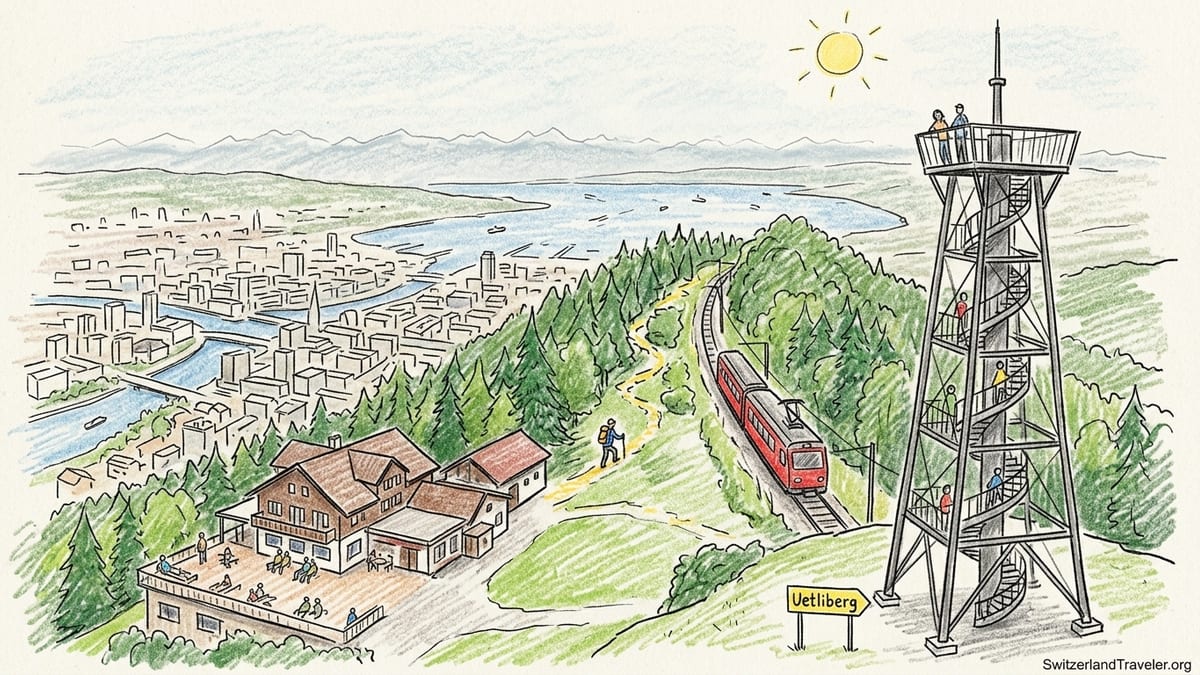
Getting Above the City: How I Actually Reached Uetliberg
I wanted to feel the transition from dense city to forested ridge, so I decided to hike at least part of the way instead of simply riding the train all the way to the top. On a clear early autumn morning in October 2026, I started near Zurich Hauptbahnhof and followed the Sihl river south, cutting through the neighborhoods around Wiedikon and Triemli. From the tram stop at Triemli the mountain finally feels close. Apartment blocks give way to gardens, then to the first steep streets and a strip of woodland that announces the beginning of the real climb.
The classic local option is the S10 train operated by SZU, which runs from the underground platforms at Zurich HB up to Uetliberg in roughly 20 minutes, with two to three departures an hour. Because of renovation work in 2026, the dedicated SZU platforms under the main station have temporary routing via Zurich Selnau, which means some travelers may find it more convenient to hop on tram 3 or 14 to Stauffacher and connect to Selnau before joining the S10 uphill. The train remains the easiest route for anyone short on time or traveling with children, strollers, or heavy luggage, and a standard ZVV ticket for the central city zones plus Uetliberg’s zone 155 is sufficient for the journey.
I chose a hybrid approach. From Triemli I ignored the inviting S10 platform and instead picked up one of the signed hiking paths, marked in yellow and pointing toward Uetliberg. This section is where the character of the excursion changes. The sound of trams and traffic fades surprisingly quickly, replaced by birds, the occasional dog walker, and the soft clank of the S10 passing somewhere above on its own climb. It felt like stepping through a curtain between urban Zurich and its backyard mountain, and it allowed me to earn the view rather than simply arriving at it.
From the edge of the city to the summit area at Uto Kulm, I spent about 1 hour and 15 minutes on the trail, including a couple of short photo stops and a pause to catch my breath on one of the steeper segments. If you prefer to skip most of the ascent, riding the train to Uetliberg station and walking the final 10 to 15 minutes to the summit hotel is enough to experience the ridge without a serious workout.
Trail Conditions, Steepness and How the Climb Feels
The lower part of the route from Triemli alternates between broad forest roads and narrower dirt paths, all well signposted. The elevation gain from the city edge to the summit is roughly 400 meters, and most of that is compressed into a few sustained ramps. The grade often sits between 10 and 15 percent, which does not sound intimidating on paper but starts to bite when the surface shifts from gravel to root crossed dirt. I passed several local joggers who were powering up the hill, but for an average hiker the pace naturally slows in these sections.
The ground was dry on my October visit after several sunny days in a row. Under those conditions, sturdy sneakers were enough, and I saw plenty of people in casual shoes making the climb. In wetter periods the same rooty sections clearly become slick, especially under the beech and fir trees that shade much of the path. It is not an alpine ascent, but anyone with knee issues should be prepared for a sustained uphill and perhaps consider taking the train up and walking down to reduce strain.
As the trail gained height, the city kept appearing and disappearing through gaps in the trees. Every now and then I could glimpse a slice of Lake Zurich and the orderly grid of streets, but this is not a hike of constant panoramas. The real payoff is reserved for the ridge itself. The final approach to Uetliberg station is gentle, following a broad path parallel to the tracks, before a last climb of around 10 minutes up a gravel lane to the cluster of buildings around the Uto Kulm hotel. Here the forest finally opens and the summit plateau reveals itself as a mix of terraces, low fences, and the spike of the steel observation tower.
In total, from central Zurich to the foot of the observation tower, using my combination of city walking and the full forest ascent from Triemli, the outing took just under two hours at a relaxed pace. Less time conscious hikers can easily turn this into a half day by adding one of the ridge walks toward Felsenegg or by stopping for a longer meal at the top.
Weather, Haze and What the Panorama Really Looked Like
Zurich Tourism images often show the Uetliberg panorama on a crystal clear winter day, when cold air has swept out humidity and the Alps look almost close enough to touch. My reality on an October afternoon was different. When I reached the summit, the city was bathed in soft sun, but a light milky haze hung over the distant horizon. The outlines of the Glarus Alps and the central Swiss peaks were visible as a row of pale silhouettes rather than sharp, snowy ridges. I could distinguish individual massifs, but there was none of the high definition clarity promised by brochure photos.
Directly below, however, the view was superb. The bends of the Limmat river were easy to trace, and the full length of Lake Zurich stretched into the distance like a silver arrow. Ferries and small boats etched white lines on the surface. From the main viewpoint beside the hotel, the city unfolded in a clear fan shape, from Oerlikon’s modern towers across the old town to the airport in the far distance. Clouds moved quickly, but they stayed high enough that no fog inversion formed along the ridge during my visit. On truly foggy winter days, Uetliberg often rises above a sea of low cloud that buries the city, but I did not experience that phenomenon myself and cannot pretend otherwise.
Haze is the honest wildcard here. Even on a pleasant, dry afternoon, the combination of autumn humidity and urban air meant that the Alps never sharpened fully. Several visitors near me expressed gentle disappointment. One couple who had come up specifically for “the legendary photo” of snow peaks was surprised by how faint the mountains looked. Uetliberg still offered a rewarding sense of height and perspective over Zurich, but if your main goal is an Instagram worthy alpine backdrop, you will want to time your visit carefully around cold fronts and clear winter air masses.
For me, the more interesting part of the panorama was the immediate sense of geography. From the tower and the terraces you can see how Zurich is cradled between ridges, how the Sihl valley cuts south, and how Lake Zurich narrows as it approaches Rapperswil. Even without pin sharp Alps, it felt valuable to understand the city this way, from above, and to match the tram lines and neighborhoods I had walked through with their place in the wider landscape.
Climbing the Observation Tower: Steps, Height and Was It Worth Paying
Zurich Tourism often highlights the “70 meter observation tower with 178 steps” at Uetliberg, but the technical reality is that the steel structure reaches around 70 meters in total height, while the open viewing platform for visitors sits closer to 30 meters above ground. The entrance is next to the Uto Kulm hotel complex and looks modest: a turnstile, a small payment terminal, and a short notice about opening times. When I visited, the entry fee posted at the base of the tower was 2 Swiss francs, payable by coins or contactless card. The system was unmanned and simple. I tapped my card, the turnstile clicked, and I started counting steps.
The 178 metal stairs spiral up through an open lattice of steel beams. Between the tower and the natural summit you gain only an extra 30 meters of elevation, but the experience is more dramatic than the number suggests because there is no solid ground directly underfoot, only an airy view through the grating down to the trees and paths below. Anyone with a fear of heights will feel exposed, especially on the outer side of the staircase where the railings are transparent. On a calm day the tower felt stable, but in stronger winds it is easy to imagine a slight sway adding to the sense of drama.
From the main, free viewpoint near the hotel you already enjoy a broad panorama over Zurich and the lake. Climbing the tower adds two important things. First, it clears nearly all remaining trees and roofs, so the horizon becomes a clean 360 degree circle. The airport, the Pfannenstiel ridge, and the distant Jura hills step into view. Second, the elevation exaggerates the ridge’s drop toward the Sihl valley, creating a startling sense that Zurich sits on a ledge between lowlands and mountains. On the day of my visit, the Alps remained hazy even from the platform, but they were easier to distinguish from surrounding hills than from the ground because of the unobstructed line of sight.
For me, the 2 franc fee and the mild exertion of 178 steps were well worthwhile. The climb took less than five minutes, including pauses to let other visitors pass on the narrow staircase. By separating those willing to make the effort from the casual crowd that stops at the terrace, the tower also offered a calmer experience. There were maybe a dozen people up top on a sunny afternoon, compared with several hundred scattered around the restaurants and paths below. If your budget is extremely tight or you dislike exposed staircases, you will still get a very good sense of the city from the free viewpoint. But if you have come all this way for perspective, the tower feels like an essential final step rather than an optional extra.
Eating at the Top: Uto Kulm, Prices and What Lunch Was Like
The Uto Kulm complex dominates the summit zone with its hotel, terraces and several dining areas. I chose to sit on the main panorama terrace for a late lunch. On a sunny day seating fills quickly, but turnover is steady as hikers finish their meals and head down the ridge. Menus are available in German and English, and they frame the experience directly as “Top of Zurich” dining. The setting lives up to that ambition. I found a spot with a view straight down the lake, the kind of table that makes even a simple drink feel like an occasion.
Prices at Uto Kulm reflect the location. On the autumn 2026 menu, main courses such as a venison sirloin with red cabbage and spätzli were listed at around 50 Swiss francs, and a vegetarian autumn plate with spätzli, roasted pumpkin and chestnuts around the low 40s. Desserts like chestnut vermicelles with cream were around the mid teens. These figures are in line with upscale Zurich restaurants, and on par with what you might pay for a good dinner in the city center rather than a casual mountain hut. It is important to arrive expecting that level of pricing rather than imagining a rustic, budget friendly alpine inn.
I ordered a plate of rösti with mountain cheese and a mixed salad, along with a small draft beer. The total, including service, came to just under 40 francs. The rösti was crisp on the outside, soft inside, and generously topped, and the service was efficient despite a busy terrace. The food quality matched the price: not experimental fine dining, but solid, carefully prepared Swiss classics executed with an eye on international visitors.
For travelers on a tighter budget there are alternatives. Around the summit are several benches and informal picnic spots, and the viewpoint itself is public, so it is perfectly acceptable to bring your own sandwiches or snacks and simply order a coffee or nothing at all. At the base of the mountain, back in the city neighborhoods, more modest restaurants like those near Triemli offer full meals closer to 20 to 25 francs. My choice to eat at Uto Kulm was less about value for money and more about extending the feeling of being above Zurich for an extra hour, watching slow moving boats and trains far below as the light shifted.
Season, Snow and Why Clear Winter Days Are Special
I visited Uetliberg in early autumn, with no snow on the ground and only a faint suggestion of winter in the air. The forest was a mix of late green and the first yellow leaves, and the paths were entirely free of ice. That means I cannot claim any first hand experience of tobogganing or deep snow conditions on the mountain. However, talking with Zurich locals on the trail and reading posted information at the summit made one thing clear. For the sharpest long distance views, winter is king, especially on days after a cold front has scrubbed the air clean.
On certain winter mornings the city of Zurich sits under a lid of low cloud while Uetliberg rises into brilliant sunshine. Photographs displayed around the summit show this familiar Swiss phenomenon, with only church spires and tower blocks poking through a white sea. In such an inversion, the famous Alps backdrop is often at its best, because the haze that muted my October view tends to condense into that lower cloud layer. From the ridge and the observation tower, you look out over a band of white toward snow covered peaks, and the scene aligns much more closely with brochure expectations.
Those same conditions, though, can make paths icy, especially where snow has been compacted by many feet. The main routes from Uetliberg station to the summit and along the ridge are maintained and commonly walked in winter, but they can require proper footwear with good tread, and in cold snaps trail runners or light boots with spikes are advisable. There is also a toboggan run that descends from near the summit toward the Sihl valley in snowy periods. Because my own visit did not coincide with snow, I did not ride it and will not pretend otherwise. Anyone planning a midwinter trip should check current trail status and snow depth before expecting a full sledding experience.
If you have flexibility in your schedule, consider pairing an Uetliberg visit with a promising winter forecast. Cold, windy days that sound unappealing at lake level often produce the clearest skies over the mountains. A sunny summer afternoon, by contrast, may give you heat and vivid colors close by but a washed out alpine horizon. My autumn day fell between these extremes, with enjoyable conditions on the trail but a diluted long range panorama.
When the Famous View Disappoints and Why the Hike Still Matters
It is important to say this plainly: Uetliberg’s panorama can be underwhelming if you arrive on a hazy or cloudy day expecting postcard perfect Alps. I met several visitors whose disappointment was visible. Some had only a single day in Zurich and had timed their trip based purely on free hours in their itinerary rather than weather. When they discovered that the mountains were faint or even completely hidden, the mood at the viewpoint was a mix of resignation and forced cheer.
Yet even on such days, the experience of climbing above the city retains value. For me, the hike itself was as meaningful as the view. Watching Zurich shrink through the trees, hearing the gradual fade of city noise, and arriving on a ridge where the geometry of the region suddenly made sense were rewards that did not depend entirely on alpine clarity. On the trail I passed families with small children, groups of teenagers sharing jokes in Swiss German, and solitary runners using the ascent as a personal fitness test. Uetliberg is not just a scenic overlook; it is also Zurich’s shared backyard, woven into local routines in a way that glossy images rarely capture.
From the observation tower, even with hazy mountains, the city’s own features took center stage. I could trace tram routes I had ridden the day before, spot the football stadium, and follow rail lines toward winter ski regions. The lake, with its ferries and clusters of sailboats, became a living map. It helped me orient myself for the rest of my stay in Zurich, turning later walks through the old town and along the quays into parts of a larger mental picture anchored by that bird’s eye view.
If your primary travel joy comes from ticking off bucket list photographs, then yes, Uetliberg on a day of poor visibility may feel like a missed opportunity. If, however, you enjoy understanding how a city sits in its landscape, the mountain remains worth your time. You might simply adjust your expectations, treat the view of Zurich itself as the main attraction, and see any glimpse of the Alps as a bonus rather than the whole point.
Next Time: The Route and Time of Day I Would Choose
Having now hiked and climbed Uetliberg once, I left the mountain thinking carefully about how I would structure a repeat visit. First, I would still walk at least part of the way up. The transition from city streets to forested flank is a key part of the experience, anchoring the panorama in the effort it took to reach it. Starting from Triemli and following the signed path worked well and took just over an hour. For a second visit, I would likely keep that ascent but extend the day by continuing along the Panoramaweg ridge trail toward Felsenegg before descending by cable car to Adliswil and returning to Zurich by S-Bahn. That would turn Uetliberg from a simple up and down into a fuller day in the hills.
Timing wise, I would aim either for an early morning arrival at the summit or a winter afternoon with the potential for clear skies after a cold front. Reaching the tower platform shortly after opening, before the main crowds arrive, would allow quieter time to absorb the view and more freedom to move around the narrow walkway. On my October visit around midday, the terrace was lively but not unpleasantly crowded, yet the light over the lake was already a little harsh, flattening details on the water and in the distant hills.
In an ideal scenario, my next Uetliberg day would fall on a crisp winter morning with overnight fog still clinging to the city below. I would take the S10 up early, hike the short final climb to Uto Kulm, assess visibility, and then pay again to climb the observation tower if the Alps were crisp. Lunch could be simpler the second time, perhaps with a thermos and picnic at one of the benches along the ridge, reserving restaurant meals for evenings back in the city where prices are similar but ambience more varied.
Regardless of season, I would always budget both time and a small sum of cash or card credit for the observation tower. Even on a day with imperfect visibility, the additional 30 meters of height and the circular perspective justify the 178 steps and modest fee. If the weather disappoints again, I will at least know that I experienced Uetliberg as fully as it allowed, from city streets to forest trail, from summit terrace to the steel lattice hovering above Zurich.
The Takeaway
Hiking Uetliberg in 2026 is not a journey to pristine wilderness, nor is it a guaranteed ticket to flawless alpine views. It is something more subtle and, in many ways, more interesting. It is a short but meaningful climb out of a major European city into a pocket of forest and open sky, a place where local life and tourism mix on the same paths and terraces. On a clear winter day the panorama can indeed match the brochures, with snow covered peaks lining the horizon behind Zurich and Lake Zurich. On a hazy autumn afternoon like mine, the Alps recede to a bluish line, but the city, lake and folds of the surrounding landscape still make the visit worthwhile.
If you go, arrive with realistic expectations and a flexible plan. Choose at least one leg of the journey on foot if your fitness allows, budget time for the observation tower, and decide in advance whether a terrace lunch at Uto Kulm fits your budget or whether a picnic suits you better. Accept that haze or cloud may blunt the famous view, and treat any clear glimpse of distant peaks as a bonus rather than a right. Above all, see Uetliberg not just as a platform for a single postcard photo, but as a vantage point from which Zurich itself finally makes complete sense.
FAQ
Q1. How long does it take to hike from Zurich up to Uetliberg?
From the city edge near Triemli, the hike to the summit area around Uto Kulm typically takes around 1 to 1.5 hours at a moderate pace, with about 400 meters of elevation gain.
Q2. Is the trail to Uetliberg very steep or dangerous?
The main routes are steep in places, especially through forest sections with roots, but they are not exposed or technically difficult. They are suitable for reasonably fit walkers with sturdy footwear.
Q3. Can I take a train instead of hiking, and how often does it run?
Yes. The S10 train operated by SZU runs roughly every 20 to 30 minutes from Zurich toward Uetliberg, with a journey time of about 20 minutes from the city to Uetliberg station, followed by a 10 to 15 minute walk to the summit.
Q4. Do I have to pay to enjoy the view from Uetliberg?
No. The main viewpoints near the Uto Kulm hotel and along the ridge are public and free. You only pay if you choose to climb the separate steel observation tower.
Q5. How much does it cost to climb the Uetliberg observation tower?
On my October 2026 visit, the posted entry fee at the base of the tower was 2 Swiss francs, payable at an automatic turnstile by coins or contactless card.
Q6. Is the observation tower really worth the extra climb and fee?
If you are comfortable with heights, the tower is worthwhile. It adds around 30 meters of elevation above the summit, clears nearby trees and roofs, and offers a 360 degree panorama that feels more expansive than the free viewpoint.
Q7. What are food and drink prices like at the Uto Kulm restaurant?
Main dishes on the 2026 menu are generally in the 40 to 50 franc range, with desserts in the mid teens. A simple meal with a drink can easily cost around 30 to 40 francs per person.
Q8. When is the best time of year to see the Alps clearly from Uetliberg?
Clear winter days, especially after a cold front or during fog inversions, usually offer the sharpest alpine views. Summer and mild autumn days can be hazier, making the distant peaks appear faint.
Q9. Can I experience snow or tobogganing on Uetliberg?
In winters with sufficient snow, Uetliberg has a toboggan run and snowy forest paths. Availability varies each season, so it is important to check current conditions before planning sledding specifically.
Q10. If I only have a few hours in Zurich, is Uetliberg still worth visiting?
Yes, if you plan carefully. Taking the S10 up and back, walking the short path to the summit and climbing the tower can fit into a half day, giving you a strong sense of Zurich’s landscape even on a tight schedule.