


Rapperswil appears everywhere in Zurich tourism materials as the classic Lake Zurich excursion: castle on a hill, medieval alleys, lakefront promenade and the romantic label “City of Roses.” I went to see whether it actually lives up to the promise, and, just as importantly, whether it is worth precious Zurich time if you only have a few days in the city.
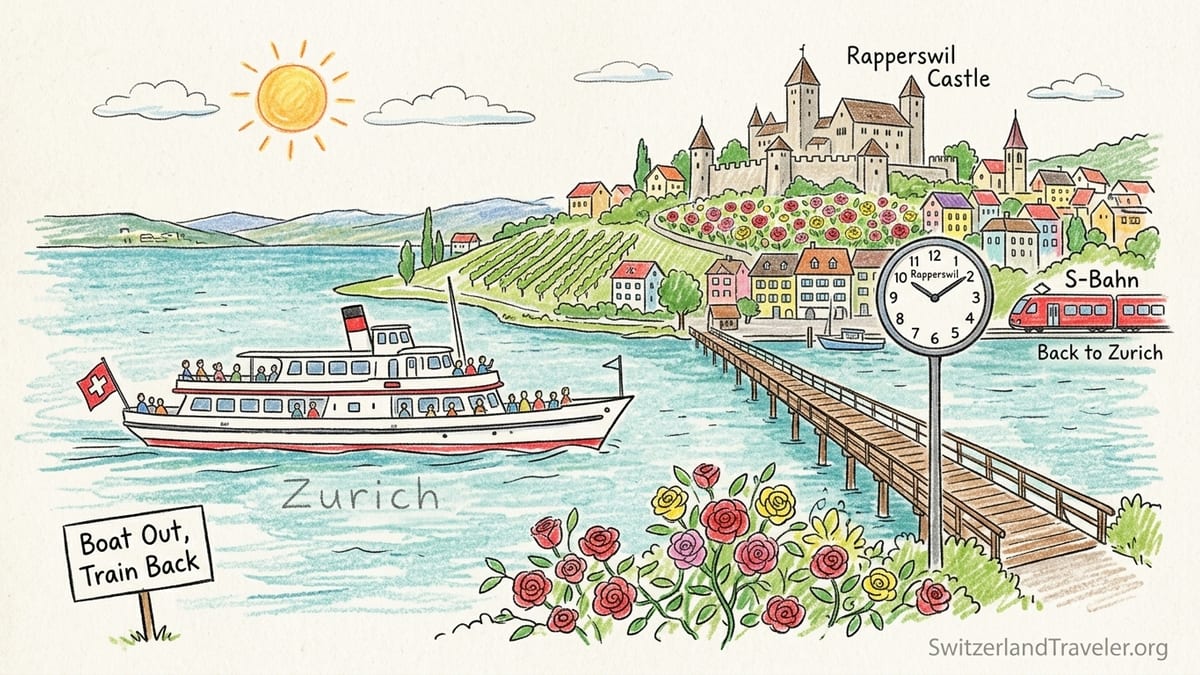
Getting to Rapperswil from Zurich: Boat Out, Train Back
I visited Rapperswil in early July, at the height of rose season, starting with the classic long boat ride from Zurich Bürkliplatz and returning by S-Bahn train. From central Zurich, the large white Lake Zurich Navigation Company boats leave from Bürkliplatz, a short walk from Paradeplatz. On the summer timetable, the full lake crossing to Rapperswil takes about two hours, passing lakeside villages such as Küsnacht, Meilen and Stäfa before the castle hill of Rapperswil comes into view across the water.
The boat counts as public transport within the Zurich regional network. At the time of my visit for the 2024/25 timetable period, a standard ZVV ticket covering all the necessary zones cost around the mid-20 francs range in second class for an adult without discounts. Holders of a Swiss Half Fare Card, Swiss Travel Pass or Interrail typically pay roughly half for the lake leg, and a ZVV 9 o’clock day pass is often the simplest option if you are also using trams and trains that day. Tickets can be bought at Bürkliplatz, at machines, or directly on board.
Arriving in Rapperswil by water is undeniably scenic. For the last half hour the town is framed by vineyards, the castle walls and the long wooden footbridge that stretches across the narrow end of Lake Zurich toward Hurden. The harbor is directly beside Rapperswil railway station, so it is easy to switch later to a quick S-Bahn back to Zurich Hauptbahnhof. Fast trains to Zurich usually take about 35 minutes and a one-way second-class ticket runs in the low teens in Swiss francs, depending on the exact service and time of day.
If you come only by train, Rapperswil is firmly a half-day proposition rather than an all-day epic. The two-hour boat ride each way, by contrast, turns the excursion into a slower, more contemplative day, which some travelers will love and others will find too drawn out. I chose boat out and train back, and that felt like the right compromise between scenery and efficient use of time.
First Impressions: A Compact Medieval Town, Not a Theme Park
Stepping off the boat, Rapperswil feels distinctly different from Zurich within minutes. The harbor opens onto a short promenade and then into the small old town, which climbs tightly up the castle hill. There are no skyscrapers, and very few cars thread the narrow streets. The scale is intimate, with pastel townhouses, stepped gables and stone fountains rather than grand monuments.
It is also immediately clear that Rapperswil is small. You can cross the central area around the main square, Herrenberg and the lakeside in a matter of minutes. Compared with larger excursion towns such as Lucerne or Zug, there are fewer obvious “sights,” which can be a positive or a negative depending on your expectations. I found the modest scale refreshing after big-city Zurich, but it is important to arrive knowing you are coming to a town that is pleasing in detail rather than packed with block‑buster attractions.
On my July weekday visit, there was a gentle summer buzz around the harbor and the café terraces off the main square, but the back lanes were quiet enough that I often walked alone. It felt like a lived-in lakeside town that happens to receive visitors, not a pure resort built around souvenirs. That authenticity is a large part of its appeal, but it also means that in shoulder seasons or on drizzly days it can feel sleepy.
For orientation, the old town climbs in terraces from the lakeshore up to the castle. The main lanes to remember are Fischmarktplatz and Hauptplatz near the water, the stairways leading to Lindenhof and the castle, and then the lanes that cross the hillside such as Herrenberg and Hintergasse where some of the rose gardens and smaller museums sit.
Walking the Old Town: How Long It Really Stays Interesting
Zurich Tourism describes the medieval old town of Rapperswil as a place of “small and quaint alleys” with window-shopping opportunities and cafés. That matches reality, but only up to a point. The centre can be walked in less than an hour, including a lap around the main squares and up one of the stairways to the upper streets. I spent about two and a half hours in the old town itself, including café stops, which felt like enough without stretching things.
A typical walking sequence starts at the harbor, heads up to Fischmarktplatz, then cuts into the alleys to find the steps up to Lindenhof and the castle. From there you descend on the opposite side via Hintergasse, looping back toward the lakeshore. Along the way you pass small clothing and design boutiques, a few wine shops, bakeries and ice cream counters. Prices are comparable to Zurich: a cappuccino by the main square cost me just under 6 Swiss francs, a scoop of gelato on the lakefront around 4 francs, and a slice of cake in a café about 7 francs.
I found that the charm of the old town lies in the layered views rather than in any single must-see building. Looking down narrow lanes to the water, watching trains slide along the causeway while church towers frame the skyline, or pausing at a fountain with geranium-filled balconies above feels quietly cinematic. However, once you have walked each of the main lanes once or twice, there is not much else to “discover” unless you decide to enter specific museums or linger at a restaurant.
In concrete terms, if you arrive around late morning, a relaxed old-town loop, an hour for lunch, a short stroll on the lakeshore and a castle visit will comfortably fill four to five hours. Beyond that, the town starts to feel repetitive unless you add a swim, a boat rental, or a longer walk, for instance over the wooden bridge toward Hurden.
Castle Hill and Views: The High Point of the Visit
The castle hill is the visual anchor of Rapperswil. From the harbor, you climb a set of stone steps past terraced gardens and vineyards to reach Lindenhof, a tree-lined plateau below the castle walls. The ascent takes less than ten minutes but changes the mood of the visit. Up here, the sound of traffic fades and you begin to appreciate why a castle was built on this spur in the first place: it commands the narrowest part of Lake Zurich and the routes toward the Alps.
Rapperswil Castle itself houses a Polish museum and various exhibitions. The courtyard and parts of the grounds can be accessed without a heavy time commitment, and the combination of fortifications, towers and rose plantings feels satisfyingly storybook without becoming kitsch. The terrace has a monument known as the Polish freedom pillar and looks out over the town rooftops, the causeway and the wooden footbridge. On a sunny day, this is where Rapperswil feels most “postcard-perfect,” and it was the spot where I spent the longest continuous stretch simply taking photographs and watching the light change on the lake.
Entry to the museum is relatively modest for Switzerland, around the low teens in francs for adults, though prices can shift slightly year to year. If you are deeply interested in Polish history or in castle interiors, you may spend an hour or more inside. If not, a quick look around the courtyard, terrace and outer walls is still rewarding and can be done in twenty to thirty minutes, making it a good option even on a tight schedule.
What impressed me more than the castle rooms was the variety of perspectives you get from different points on the hill. One minute you are looking along the lakeshore toward Zurich, the next you are gazing across to the wooden bridge and small islands of Lützelau and Ufenau. The compact scale makes it easy: you can zigzag across the hilltop on lanes like Herrenberg and emerge at small viewing platforms with benches. For photography-minded travelers, this hill alone justifies the trip on a clear day.
The “City of Roses” in Season: How Visible Is the Identity?
Rapperswil’s official branding as the “Town” or “City of Roses” hinges on its concentration of rose gardens. Switzerland Tourism and Zurich Tourism highlight more than 16,000 to 20,000 rose bushes in and around the old town, typically flowering from May to October. In early July, that reputation felt authentic. Roses climbed pergolas, filled formal beds, and even appeared along the lakeshore, and it was obvious that the plantings are an integral part of local identity rather than a thin marketing slogan.
The main public rose gardens are spread out rather than collected in a single park. There is a garden at the foot of the vineyard near the Capuchin monastery, another near the Einsiedlerhaus, a Mainau garden on Hintergasse with tiered beds, and a special fragrant rose garden on the Schanz designed to be accessible for blind and visually impaired visitors. Smaller plantings are tucked beside the castle, at the lakeside promenade and on Lindenhof. During my visit, almost all of these spaces were in full bloom, with labels naming varieties and benches encouraging you to linger.
Crucially, the roses are not confined behind fences. On the way up to the castle you pass bushes brushing against stair rails; in side alleys, trellised roses frame doorways. Cafés spill out near some of the rose beds, and wedding parties stop for photographs. Even if you are not a gardening enthusiast, it is hard not to be drawn into the rhythm of pausing, smelling and moving on. In this particular season, the “City of Roses” label felt grounded in reality.
Out of season, especially in late autumn or winter, the experience must be very different. Without blooms, the gardens become more about structure and stone than about colour and fragrance. If your main motivation is roses, aim for late May through early July for the highest chance of abundant flowers, and be aware that an April or October visit will feel more subdued. In winter, Rapperswil is probably better appreciated for its castle and lakeside setting than for its floral displays.
Lakeshore, Wooden Bridge and General Atmosphere
Back at water level, the character of Rapperswil shifts from medieval hill town to leisurely lakeside resort. A paved promenade lined with trees, benches and a few restaurant terraces runs along the shore from the harbor toward the wooden bridge. Locals sit reading newspapers; cyclists roll through; children chase ducks. On my July weekday there were open seats on most benches and no sense of crowding, even in mid-afternoon.
The wooden bridge toward Hurden is one of the more distinctive features of the area. Rebuilt as a modern interpretation of a historic crossing, it stretches just under a kilometre across the shallow end of the lake, used by walkers and pilgrims following sections of the Way of St. James. You can step onto the bridge from near the lakefront in Rapperswil and walk a portion of it simply for views back to the castle and along the causeway, or cross the whole span if you have an extra hour. I walked about a third of the distance, which was enough to feel suspended above reeds and water while watching trains pass on the nearby causeway.
The lakeshore also offers chances to swim or rent small boats in summer. Public bathing areas near Rapperswil and neighbouring Jona often charge a modest entry fee, roughly in the single-digit franc range, for access to changing rooms, lawns and ladders into the water. Pedal boats and rowboat rentals, where available, tend to start somewhere around 20 francs per hour. These extra activities can easily fill another one to two hours if the weather cooperates.
Overall, the atmosphere along the lake struck me as pleasantly calm. It never felt deserted, yet there were stretches where the loudest sounds were lapping waves and distant train horns. For some travelers, that level of quiet will be perfection. For others expecting a lively boardwalk with street performers and constant energy, it could feel too low-key.
Restaurants, Cafés and What a Meal Costs
Rapperswil’s dining scene reflects its size: there is enough variety for a day trip, but not so much that you would treat the town as a culinary destination. Within a short walk of the harbor and main square you can find Italian trattorias, Swiss restaurants serving rösti and lake fish, casual pizzerias, ice cream parlours and a few slightly more upscale hotel restaurants with lake views.
In practical price terms, a sit-down main course in a mid-range restaurant in the old town tends to start around the mid-20 franc mark and often runs up to 30 or a little more for fish or meat dishes. A simple margherita pizza can be found from the high teens to low 20s in francs. At the budget end, bakeries and take-away counters sell sandwiches for around 8 to 10 francs and slices of tart or cake from roughly 5 francs. Coffee is in line with Zurich, usually 4 to 6 francs depending on style and location.
For my visit, I chose a lakeside restaurant just off the promenade for lunch. A plate of grilled perch with potatoes and salad cost just under 30 francs, and a small soft drink added another 4 francs. Service was unhurried but friendly, and the premium you pay for sitting with a water view felt acceptable compared with Zurich. There are, however, very few truly low-cost options beyond supermarket snacks from the Migros or Coop branches near the station.
Reservations are rarely necessary at lunchtime on a weekday, but on warm summer weekends, especially during events such as the local rose festival or Christmas market, terrace tables can fill quickly. If you plan to arrive by the long lake boat on a sunny Saturday, consider eating slightly earlier or later than the core noon window to avoid waiting for a table.
How Quiet Is Too Quiet? Liveliness, Events and Seasonality
One of the key questions for any day trip from Zurich is whether the town feels alive once you step off the train or boat. On my July weekday, Rapperswil landed somewhere between tranquil and modestly lively. The main square, harbor and a handful of streets around them had a steady flow of people: families with strollers, retirees on a stroll, small tour groups with guides. Shops were open, café umbrellas were up, and you could hear clinking cutlery and conversation on terraces.
A few minutes away in narrower side alleys, the atmosphere changed quickly. Some sections of the old town, especially the upper lanes above Hintergasse, were almost silent in mid-afternoon. Shutters were closed on several houses, and I occasionally wondered if I had drifted into a purely residential corner. This contrast is important for expectations: Rapperswil does not offer the consistently bustling street life of Zurich’s Niederdorf or Lucerne’s riverfront. Its activity is concentrated in a few pockets, with very quiet residential stretches in between.
Quietness here is not a flaw but a defining trait. It makes Rapperswil particularly suitable if you want to decompress after city sightseeing. You can hear birds over the rose gardens and conversations from just one or two nearby tables, and it is easy to find a bench without sharing it with others. The only time the town is likely to feel crowded is during specific events: for instance, summertime rose festivals, the autumn slowUp Zurichsee car-free day, or the December Christmas market, when several hundred stalls and special lighting draw visitors into the medieval centre.
If you come in winter outside the Christmas season or on a grey November weekday, be prepared for a much sleepier experience. Some rose gardens will be bare, lakeside terraces may be closed, and the overall feel will be one of a lakeside town catching its breath. That can still be rewarding if you enjoy misty water views and castle silhouettes, but anyone looking for an energetic atmosphere and long lists of indoor attractions might be better served with another Zurich-region excursion.
How Long to Spend and Is It Worth It from Zurich?
Weighing everything up, the core question remains: is Rapperswil worth the time from Zurich, and for how long? Based on my visit, I see Rapperswil as a very good half-day destination that can be stretched into a satisfying three-quarter-day outing when combined with the long lake boat one way. The town itself, with its old town loop, castle, rose gardens and lakeside stroll, kept me engaged for roughly four to five hours including coffee and lunch. After that, the lack of additional layers such as multiple major museums or varied neighbourhoods became more noticeable.
If you include the two-hour boat ride from Zurich and a thirty-five-minute train back, the entire excursion will take in the region of seven to eight hours door to door. That felt like a pleasant, unhurried day with a clear shape: slow scenic approach by water, compact town exploration, and quick efficient return. Spending a full day in Rapperswil without either the long boat leg or additional outdoor activities such as extended hikes or swims would, in my view, be harder to justify, especially if your overall time in Switzerland is limited.
Financially, the outing sits in the mid-range for Swiss excursions. With public transport passes or half-fare discounts, your combined boat and train costs can often be kept under 40 francs for the day. Add a sit-down lunch and a couple of coffees and you might end up in the 70 to 90 franc bracket per person for a comfortable day trip, excluding any museum entry fees or special activities.
Compared with bigger-name trips, Rapperswil is gentler and more modest than, say, a full Lucerne and Mount Pilatus day or an outing into the high Alps. It is less of a headline experience and more of a soft-focus interlude. For many visitors, especially those already planning more intense mountain days elsewhere, that balance can be exactly what they need between longer rail journeys.
The Takeaway: Who Should Go, Who Might Skip, and Best Ways to Visit
So, is Rapperswil worth visiting from Zurich? For certain types of travelers, absolutely. For others, it may feel underpowered compared with what else is on offer in Switzerland. Clarity about your own priorities will shape whether this trip becomes a highlight or a footnote in your itinerary.
You are likely to enjoy Rapperswil if you appreciate slow travel, lakeside scenery and compact historic centres. If the idea of wandering through rose gardens, sitting on a bench with a takeaway coffee watching boats and trains, and gently climbing to a castle terrace appeals to you, Rapperswil delivers exactly that experience. It suits couples, solo travelers, photographers and anyone prone to sensory overload in big cities. Families with younger children may also appreciate the manageable distances and attractions like the nearby children’s zoo, which lies within a short walk of the station.
On the other hand, if you have only one spare day in Zurich and want maximum variety of sights and activities, you may be better served by classic alternatives. Lucerne offers a larger old town, major museums and immediate access to big mountain excursions. Schaffhausen and the Rhine Falls provide dramatic natural spectacle. Even staying in Zurich and combining its neighbourhoods with a shorter lake cruise and a mountain like Uetliberg can pack more “wow moments” into a single day.
For those who do choose Rapperswil, I strongly recommend the boat-out, train-back combination. The long lake cruise turns the journey itself into an experience, but doing it in both directions stretches the calm into something some travelers may perceive as dull. Arriving by water provides the photogenic first impression, while the swift train returns you to Zurich before the day feels too long. Framed that way, Rapperswil becomes what it is best at: a serene, rose-scented pause at the end of Lake Zurich rather than an all-day blockbuster attraction.
FAQ
Q1. How long does the boat from Zurich to Rapperswil take, and is it included in public transport tickets?
The classic lake boat from Zurich Bürkliplatz to Rapperswil takes about two hours and is operated as part of the Zurich regional transport network. Many ZVV day passes and national travel passes cover this route, though some visitors with international rail passes may pay a reduced supplement. It is worth checking the current rules on a ticket machine or at a sales counter before boarding.
Q2. How much time should I plan to spend in Rapperswil itself?
Most visitors find that three to five hours in Rapperswil is enough to explore the old town, climb to the castle, visit a rose garden or two, stroll the lakeshore and have a relaxed meal. With less than two hours on the ground, the visit can feel rushed; with more than six hours, it can start to feel repetitive unless you add a swim, a longer hike or a boat rental.
Q3. When is the best season to see Rapperswil’s roses in bloom?
The main rose season in Rapperswil usually runs from late May to roughly early October, with a peak in June and early July when many of the 16,000-plus rose bushes are in flower. Outside this window, the gardens are still pleasant for a walk, but you will not see the full display of colours and fragrances that give the town its “City of Roses” identity.
Q4. Is Rapperswil too quiet for solo travelers or people who like lively places?
Rapperswil is calmer than Zurich or Lucerne, but it does not feel abandoned. The harbour, main square and lakefront typically have a steady trickle of people, especially on sunny days, while the back streets can be very peaceful. If you need constant buzz, you may find it a bit subdued; if you like reflective solo time in pretty surroundings, the quiet is a significant part of the appeal.
Q5. Are there affordable food options in Rapperswil, or is it as expensive as Zurich?
Prices in Rapperswil are close to those in Zurich, but you can manage costs by choosing bakeries, supermarkets and casual cafés. Expect to pay around 8 to 10 francs for a sandwich from a bakery, 4 to 6 francs for coffee, and from the high teens to low 20s for a simple main dish in a sit-down restaurant. Lakeside terrace meals with fish or meat tend to be more expensive than those in side streets.
Q6. Is Rapperswil a good choice with children?
Yes, for many families Rapperswil works well. Distances are small, there are few cars in the old town, and the lakeshore promenade offers space to run and feed ducks. The nearby children’s zoo is an additional attraction for younger kids. However, teenagers looking for intense activities or shopping might prefer a larger city or a mountain excursion.
Q7. Can I combine Rapperswil with another destination in the same day?
It is possible, especially if you travel by train both ways. Some travelers visit Rapperswil in the morning and then return to Zurich for an afternoon museum or neighbourhood walk. Others might combine a half-day in Rapperswil with a short hike or swim nearby. If you take the full two-hour boat each way, though, your day will be largely dedicated to the lake and Rapperswil alone.
Q8. Is it worth going to Rapperswil if I am already visiting Lucerne or other lakeside towns?
If you are visiting Lucerne or another major lake town, Rapperswil may feel gentler and more low-key by comparison. It can still be worth it if you are staying several days in Zurich and want a calm, easily accessible outing with roses, castle views and a long lake cruise. With only one or two spare days in the whole country, however, many travelers will prioritise the larger, more varied destinations.
Q9. Do I need to book the boat or train to Rapperswil in advance?
For regular daytime boats and S-Bahn trains between Zurich and Rapperswil, advance reservations are not usually necessary. You simply buy a valid ticket before or when boarding. Very busy summer weekends, special event days or evening dinner cruises may have capacity constraints, but for a standard day trip, turning up with a valid pass or ticket is normally sufficient.
Q10. Is it better to go to Rapperswil by boat or by train?
The ideal combination for many visitors is to go by boat and return by train. The two-hour cruise offers scenic approach views and a relaxed start to the day, while the thirty-five-minute train ride gets you back to Zurich efficiently once you have finished exploring. If you are short on time or prone to seasickness, taking the train both ways is perfectly fine and still gives you the essence of Rapperswil as a compact lakeside town.