

Choosing where to stay in Italian-speaking Switzerland is less about finding the single “best” town and more about matching your base to the trip you want. On my own recent stays in Lugano, Locarno, Ascona and Bellinzona, what mattered most was not star ratings or rooftop pools, but how each place felt when I stepped out of the hotel door: how quickly I could reach the lake, whether I had a choice of restaurants within five minutes’ walk, what the streets felt like at 10pm, and how easy it was to catch an early train or a postbus into the valleys the next morning. This guide focuses on those practical, real-world details to help you decide which base fits a first-time visit, a romantic escape, a lake-focused holiday or a valley-heavy hiking trip.
Understanding the Four Bases: What Each Town Does Best
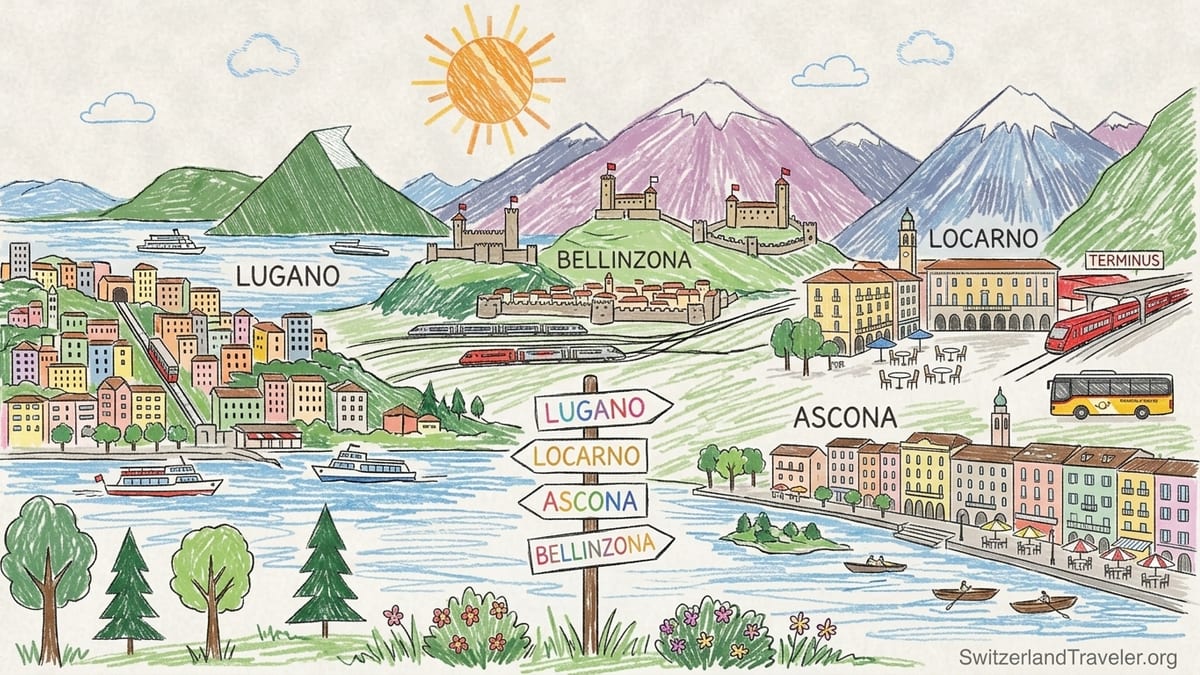
Before booking anything, it helps to think of these four towns as very different tools in the same Swiss toolbox. Lugano is your big, polished city on the lake, with the busiest transport connections and the widest choice of places to eat and drink. Locarno sits on Lake Maggiore with a compact center, a train terminus and quick access to multiple valleys in different directions. Ascona is all about lakeside atmosphere and slow, holiday rhythms, with a promenade lined by pastel facades and restaurant terraces right on the water. Bellinzona, slightly inland, trades lake views for castles, a more local feel and excellent rail connections up and down Ticino.
In practice, that means Lugano works well if you want urban energy with lake access, Locarno if you plan to ride postbuses deep into the side valleys, Ascona if your priority is lingering by the water in the evenings, and Bellinzona if you value practicality and price over a postcard setting. During my stays, I found myself using Lugano and Locarno when I had full sightseeing days planned, while Ascona and Bellinzona were the places where I most noticed how it felt to simply stroll out in the evening and be “home.”
All four are well-connected by Swiss standards, with regular trains or buses between them. Distances are short: Lugano to Bellinzona is around 20 minutes by direct train, Bellinzona to Locarno around 20 to 25 minutes, and Locarno to Ascona about 15 to 20 minutes by bus. That makes it possible to choose one base and still sample the others on day trips, but your main overnight base will still shape your days in subtle but important ways.
Hotel prices also influence the choice. In recent searches for 3 to 4 star hotels in high season, standard doubles in Lugano and Locarno often started in the region of 220 to 280 Swiss francs per night, while lakefront 4 star properties in Ascona frequently ranged from about 260 to over 400 francs depending on date and demand. Bellinzona, by contrast, tends to have more options under 200 to 220 francs, especially just off the main street or near the station. Those differences add up quickly on a week-long stay.
Lugano: City Energy and Easy Lake Access
Lugano is the largest of the four and feels it as soon as you arrive. The main SBB station sits on a hillside above the city, with regional and long-distance trains stopping frequently throughout the day. From the platforms you can roll your suitcase into the station atrium and straight to the Lugano Città–Stazione funicular, a short, steep ride that drops you near the center in a couple of minutes. That funicular link from station to city is a real quality-of-life perk if you are arriving with luggage or catching early trains.
Once down in the center, Lugano’s lakefront is only a few minutes’ walk away. Staying close to the waterfront and Parco Ciani meant that within five minutes of my hotel I could be on the lakeside path, with views across Lake Lugano to Monte Brè and Monte San Salvatore, and rental boat kiosks offering small motorboats for a few hours on the water. The passenger boats to villages like Gandria and Morcote leave from piers close to the center, so you can easily combine a morning at a museum with an afternoon cruise without ever needing a car.
Restaurants and evening atmosphere are where Lugano shines as a base. In the streets between the station funicular and the lakeshore, places like Via Nassa, Piazza della Riforma and the lanes around the LAC cultural center stay active well into the evening in summer. You find everything from simple pizzerias and gelato stands to higher-end spots in historic buildings or hotel dining rooms. On a typical night, I could decide at 8pm whether I wanted a casual plate of pasta outdoors or a longer, multi-course dinner, and I never had to walk more than 10 minutes from my hotel to find something open.
Hotel prices in Lugano tend to be on the higher side, especially for properties directly on or just above the lake. Midrange 3 star hotels in central areas often come in somewhere around 220 to 260 francs in busy months, with 4 stars and lake-view rooms climbing above that. The trade-off is that a car is rarely necessary. Between the funicular, dense city buses and frequent boats, I was happy using public transport and my feet. Drivers may prefer hotels up in the Besso or Paradiso districts, where access to the autostrada is easier, but for most first-time visitors, a car in Lugano would sit unused in a garage while you walk or ride public transport.
Locarno: Transport Hub for Valleys and Cross-Border Lake Adventures
Locarno sits at the northern end of Lake Maggiore, and if you are looking at a map of Ticino’s valleys, it is the town that seems to have lines radiating out in all directions. The railway from Bellinzona ends here, so most long-distance arrivals change at Bellinzona and continue to Locarno on a short regional run. From the station area it is about a 10 minute walk to Piazza Grande and the old town, slightly downhill toward the lake. During my stay I timed it with a small suitcase and it felt practical even on departure day.
Locarno’s value as a base comes from how easy it is to launch day trips into the surrounding valleys without changing towns constantly. Buses leave from near the station and from stops a few minutes into town, heading into the Verzasca Valley, the Maggia Valley and up toward Orselina and the Madonna del Sasso sanctuary. A typical morning for me was as simple as grabbing a coffee near the station, walking two minutes to a bus stop and riding 40 minutes upstream for a hike along emerald-green river pools, then returning in the late afternoon in time for an aperitivo on Piazza Grande.
The lakefront is slightly more separated from everyday hotel life here than in Ascona. Unless you book directly on the waterfront, you usually walk five to ten minutes from your accommodation to reach the promenade and small beach clubs. That said, the walk passes shops, bakeries and supermarkets, and the compact center meant I never hesitated to go back out at night. In the evenings, Piazza Grande has a distinctly local buzz, with outdoor tables filling and people meeting for drinks. Locarno also hosts major events like the Locarno Film Festival each August, which can dramatically raise hotel prices for those dates and make availability tight.
In terms of accommodation costs, I found Locarno broadly comparable to Lugano in standard 3 to 4 star ranges, with central doubles typically in the 220 to 280 franc region in high season, but there are more modest pensions and apartment-style options a little uphill that reduce costs if you are willing to walk 10 to 15 minutes down to the center. A car is helpful only if you plan very specific valley itineraries or want to reach trailheads at odd hours. For most classic valley excursions, the combination of trains and PostAuto buses is reliable and frequent enough that driving becomes more hassle than help, especially when you factor in parking near the lakefront.
Ascona: Lakefront Promenade and Holiday Atmosphere
Ascona lies only a short bus ride from Locarno but feels like a different world when you arrive. The bus from Locarno station to the stop Ascona Centro usually takes around 15 to 20 minutes, and from there the lakefront promenade, or lungolago, is a short walk through cobbled streets. On my first evening stay I arrived just as the light was turning golden; the row of colorful facades along the water, restaurant terraces full of clinking glasses and the distant outline of mountains across Lake Maggiore created an instant holiday mood that none of the other towns matched in quite the same way.
Hotel geography in Ascona is important. Many properties cluster either right on the lakefront promenade or in the narrow lanes of the old town just behind it. Staying here meant that I could leave my room and be at a waterside table in under two minutes. Other 4 star hotels sit slightly higher on the slopes toward Monte Verità, where you gain quieter surroundings and often a wider lake view in exchange for a 10 to 15 minute downhill walk to the lungolago. Both setups worked well for me, but if your trip is about waking up and strolling immediately along the lake, it is worth paying for that front-row location.
Ascona’s restaurant scene concentrates heavily along the water, which gives evenings a very particular rhythm. Around dinner time, the promenade fills with people choosing between pizzerias, fish restaurants and hotel dining rooms with outdoor terraces. One night I ate at a long-standing harborfront restaurant that still serves plates of pasta and pizza to both locals and visitors, and on another I opted for a slightly more refined menu in a hotel restaurant a block back from the lake, where the atmosphere was quieter but still within easy walking distance of the evening buzz. There are a few options tucked into side streets and up the hill, but compared with Lugano or Locarno, Ascona’s choice is narrower and more focused on relaxed, sit-down meals rather than a mix of bars and quick eats.
Lake proximity is Ascona’s main asset as a base. Passenger boats to islands and neighboring towns on Lake Maggiore leave from piers directly in front of the promenade, which meant I could finish breakfast, stroll 200 meters and board a boat without checking bus timetables. Beach access is also straightforward, with lidos and swimming areas a pleasant walk away along the shore. For a stay built around water views, swims and slow evenings, I found I had no reason to consider a car. Parking is limited close to the center and many of the most atmospheric streets are pedestrian. Even travelers arriving with a vehicle may prefer to park it for the duration and move primarily on foot and by boat.
Ascona is, however, one of the pricier bases. Recent price surveys for 4 star hotels along the lakefront show common nightly rates starting around 250 to 300 francs and climbing to 400 francs or more in peak periods for lake-view rooms, especially in popular spa or design properties. Even simpler 3 star hotels close to the lungolago often price higher than equivalents in Bellinzona or more inland parts of Ticino. You are paying both for the setting and for the limited amount of prime lakefront real estate. For a special romantic trip or a short lake-focused break, that premium can feel worthwhile. For a longer, budget-conscious trip, you may decide to base in Locarno or Bellinzona and come to Ascona for repeated evening or day visits instead.
Bellinzona: Castles, Rail Junction and Practical Pricing
Bellinzona is often overlooked by first-time visitors intent on the lakes, yet as soon as you step out of its station the logic of using it as a base becomes clear. The main SBB station sits almost in the middle of the canton, with frequent trains up to the Gotthard route, down toward Lugano and Chiasso, and across to Locarno. From my hotel opposite the station, I could be on a direct train to Lugano in about 20 minutes or to Locarno in a similar time, which made it easy to set up day trips in either direction without changing hotels.
Walk south from the station along Viale Stazione and in under 10 minutes you reach the heart of the old town, with its arcaded streets and, above it, the walls and towers of the three castles that make Bellinzona a UNESCO World Heritage site. Standing on the grassy ramparts of Castelgrande, looking down at the town and across to the other fortifications on their hilltops, I understood immediately why some travelers choose to sleep here rather than just passing through for a few hours. The castles are open to visitors for much of the day in season, and a small tourist train connects the lower town with the higher fortresses for those who prefer not to climb.
Evening atmosphere in Bellinzona is gentler and more local than in the lakeside towns. Around the main piazzas you find wine bars, traditional grotti-style restaurants and a handful of contemporary spots, but the streets are quieter later at night, especially on weekdays. That can be an advantage if you are planning early starts on trains or simply prefer a less touristy feel. The Saturday market, which spreads through the center with food and crafts stalls, gives a different energy and is one of the more enjoyable regular markets I have stumbled into in Switzerland.
Hotel pricing is Bellinzona’s trump card. Because it is not on a lake and has a more workaday role as a regional center, average nightly rates tend to be lower than in Lugano, Locarno or Ascona. On recent checks, 3 star hotels near the station or in the old town often appeared under or around 180 to 220 francs even in busier months, with simpler guesthouses below that. During my own stay, I found that I could book a comfortable, modern room opposite the station for what a more basic pension might cost in Ascona. From a practical point of view, that freed up budget for castle entries, valley excursions and restaurant meals.
As a base, Bellinzona works particularly well if you intend to move around a lot on trains, want to sample several lakes and valleys on day trips, or are combining Ticino with northbound travel toward Zurich or Lucerne. A car can be useful if you are targeting specific mountain villages, but with the main rail junction and local buses radiating outward, I managed fine without one. Parking inside the historic center is limited, so many drivers choose hotels slightly outside the core or near the station where garages are available.
Do You Need a Car in Ticino for These Bases?
One of the most common questions I hear from travelers planning a trip to Italian-speaking Switzerland is whether to rent a car. After sequential stays in Lugano, Locarno, Ascona and Bellinzona, my answer is that a car is optional for most itineraries centered on these towns, and often more of a complication than a help, especially in the lakeside areas.
Lugano and Locarno are both rail termini or major stops with frequent long-distance connections, and both have dense networks of city buses and lake boats. From a centrally located hotel in Lugano, I never needed a car to reach the Monte Brè funicular, boat piers or museums, and I appreciated not having to worry about city-center parking rules. In Locarno, the combination of trains and PostAuto buses took me comfortably into the Verzasca and Maggia valleys, and I was glad not to be searching for legal parking spaces near river swimming spots.
Ascona and Bellinzona present slightly different questions. In Ascona, the problem is not whether you can drive there. It is what you will do with the car once you arrive. Many of the most attractive streets are pedestrianized, lakeside parking is limited and often metered, and hotels with central locations usually charge extra for garage spaces or rely on nearby public lots. I found that arriving by bus from Locarno spared me the stress of threading a car through narrow lanes and let me enjoy the promenade on foot instead.
Bellinzona is friendlier to drivers in some respects, with properties opposite the station or along the approach roads offering on-site or nearby parking, but even there I made more use of the frequent trains. Having Bellinzona as a car-free base allowed me to do day trips to Lugano and Locarno without paying for parking at each destination. The main case for a car is if your itinerary focuses less on the towns and more on remote trailheads or small villages higher up the valleys, where bus frequencies drop outside peak periods. Even then, you might choose to rent a car just for those days, rather than for the entire stay.
How I Would Choose for Different Types of Trips
After living with each of these bases, my choices have become quite clear depending on the type of trip. For a first visit to Italian-speaking Switzerland, I would personally base in Lugano. The reasons are straightforward. The station funicular makes arrivals and departures easy, the lake is only a short walk from most central hotels, and the restaurant and bar scene gives you options every night without planning ahead. From Lugano you can take classic excursions to Monte Brè or Monte San Salvatore, ride boats to lakeside villages, and still squeeze in a day trip by train to Bellinzona or even across the border to Italy if you wish.
For a romantic trip, especially one of three to five nights, I would choose Ascona. Sleeping either directly on the lakefront or in a hillside hotel with terraces views over Lake Maggiore changes the entire mood of the stay. Simple rituals like walking hand in hand along the promenade after dinner or having breakfast with an open view of the water felt more intimate here than in the larger towns. The fact that Ascona is a little removed from mainline rail traffic and reached most easily by bus or boat adds to that feeling of being tucked away.
For a lake holiday built around swimming, boat trips and slow days in flip-flops, Ascona again gets my vote, with Locarno as a close second if you value slightly easier train access. Ascona’s compact shape means water is always close: beach clubs, swimming areas and boat piers all sit within an easy walk of many hotels. Locarno offers more varied urban life but its main lakefront lido, small beaches and cruise departures are still close enough to reach on foot from most central accommodations in 10 to 15 minutes.
For a valley-focused trip centered on hiking and exploring the Verzasca, Maggia or more remote side valleys, I would base in Locarno or Bellinzona. Locarno is ideal if you want to hop on and off valley buses frequently, minimizing transfers. Waking up a short walk from the station and main bus stops made it easy for me to react to the weather and choose a valley each morning. Bellinzona suits a broader, rail-based trip where you are mixing valleys with castle visits and perhaps travel further north. Its central location on the rail network keeps journey times flexible and often slightly shorter when you are making longer day trips.
The Takeaway
There is no single right answer to the question of where to stay in Italian-speaking Switzerland. Lugano, Locarno, Ascona and Bellinzona each offer distinct combinations of lake access, transport convenience, evening atmosphere, hotel pricing and scenery. Having stayed in all four, I no longer think in terms of “best” but in terms of “best for this particular trip.”
If you are planning your first visit and want a strong all-rounder with city comforts and lake access, Lugano is hard to beat. If your heart is set on watching the sun set over Lake Maggiore from a restaurant table just meters from the water, Ascona is worth the higher room rates. If you dream of catching early buses into green valleys and returning to a lively piazza in the evening, Locarno is your friend. And if you are balancing budget with the desire to explore widely by train while sleeping under the walls of medieval castles, Bellinzona deserves more than a quick transfer.
Whichever base you choose, the beauty of Ticino is that distances are short and public transport is efficient. You can sleep in one town and still taste the others on day trips. The key is to be honest about what you want most from your front door each morning. Picture yourself stepping out of your hotel at 8am and again at 9pm. If what you see in your mind is a station forecourt with trains fanning out across the canton, Bellinzona might be right for you. If it is a palm-lined promenade along the lake, glowing with restaurant lights, then your answer is probably waiting in Ascona.
FAQ
Q1. Is Lugano, Locarno, Ascona or Bellinzona best for a first trip to Italian-speaking Switzerland?
For a first trip I would lean toward Lugano, because it combines a major train station with a quick funicular into the center, easy lake access, and a broad choice of restaurants and evening activities, while still allowing simple day trips to the other three towns.
Q2. Which town has the easiest access to train and bus connections without a car?
Bellinzona is the most practical hub for rail, since it sits on the main north–south line and connects quickly to Lugano and Locarno, while Locarno and Lugano both work very well for bus and boat connections if you prefer to stay directly by a lake.
Q3. Where should I stay for the best lakefront atmosphere and romantic evenings?
Ascona offers the most atmospheric lakefront, with a continuous promenade of colorful facades, restaurant terraces right on the water, and a slower, more intimate feel in the evenings than the larger towns.
Q4. Which base is most convenient for visiting the Verzasca and Maggia valleys?
Locarno is the most convenient for valley excursions, since many of the main bus lines into the Verzasca and Maggia valleys start near the town and can be reached on foot from central hotels in the morning.
Q5. Is it cheaper to stay in Bellinzona than in the lakefront towns?
On average, yes. Bellinzona generally has lower hotel rates than Lugano, Locarno or Ascona, especially for midrange properties near the station or in the old town, which makes it attractive for longer stays on a tighter budget.
Q6. Do I need a car to enjoy these parts of Ticino?
You can comfortably enjoy Lugano, Locarno, Ascona and Bellinzona without a car, using trains, buses and boats, and a vehicle mainly becomes useful only if you plan to visit remote villages or trailheads beyond regular public transport routes.
Q7. Which town has the liveliest nightlife and restaurant scene?
Lugano has the liveliest and most varied nightlife, with bars, wine bars, gelato spots and restaurants spread through the center and along the lakefront, while Locarno offers a more compact but still active scene around Piazza Grande.
Q8. How far is Ascona from Locarno, and is it realistic to stay in one and visit the other?
Ascona is only about 15 to 20 minutes from Locarno by bus, so it is entirely realistic to base in one town and make repeated visits to the other for walks, meals or boat trips on different days.
Q9. Which base works best if I want to visit Bellinzona’s castles?
If the castles are a highlight for you, staying in Bellinzona itself is ideal, since Castelgrande and the other fortifications are within walking distance of the station and central hotels, allowing you to visit at different times of day without rushing.
Q10. If I have one week, should I split my stay between two towns or choose a single base?
For a one-week trip I would usually choose a single base to avoid moving luggage, but if you want contrasting experiences, a split such as three nights in Lugano and four in Ascona, or a combination of Bellinzona with one lakeside town, can give you both practicality and lakeside atmosphere.