


I thought I was well prepared for a day trip from Locarno into Valle Verzasca. I had seen the photos of glassy green water under the stone arches of Ponte dei Salti, skimmed a few transport timetables and figured a full day would be plenty to ride the bus from Locarno, swim in the river, walk between villages and be back in town in time for dinner on Piazza Grande. What actually happened was more complicated, more beautiful and a lot more tiring than I expected. Here is exactly how the day unfolded, what I misjudged about distances and timing, and what I would do differently if I went back.
Planning the Day Trip from Locarno
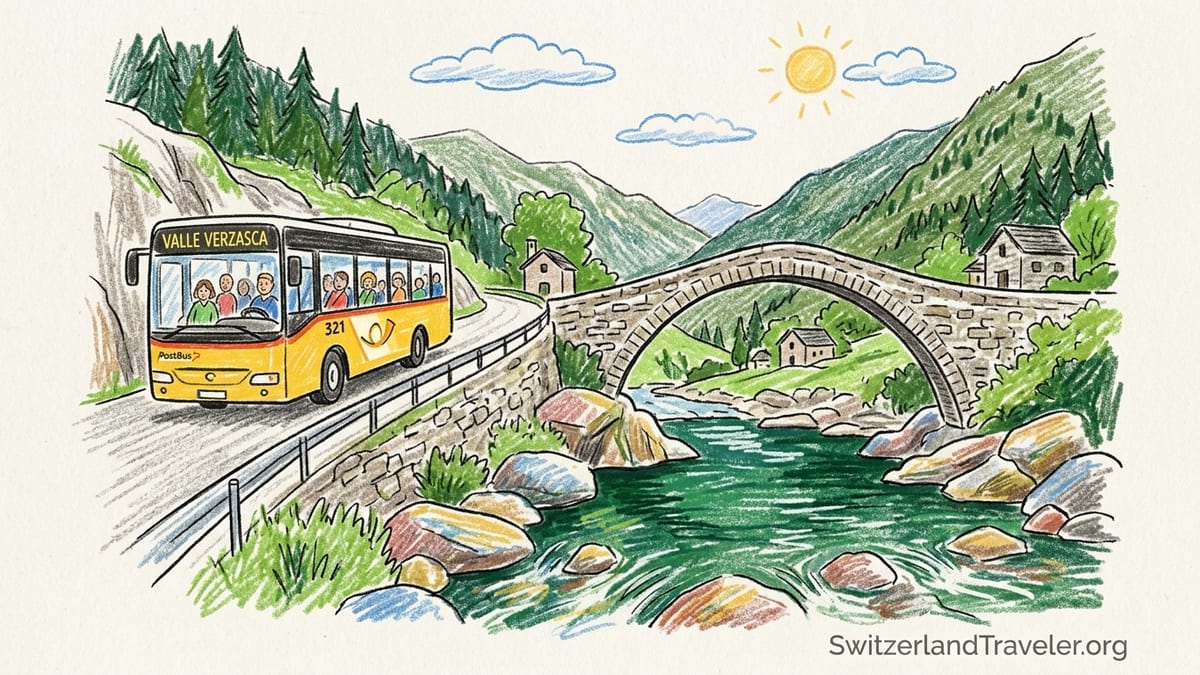
I based myself in Locarno, a practical starting point because the yellow PostBus line 321 to Valle Verzasca leaves from Locarno, Stazione, right in front of the main railway station. In 2026 the 321 runs from Locarno through Tenero and up the valley to Sonogno in just over an hour, with dozens of intermediate stops including the Verzasca dam, Vogorno, Corippo junction, Lavertezzo and Brione. Morning departures in summer start around 7:00 and then run roughly every hour, with more frequent buses at peak times. I checked the official timetable the evening before and decided that catching a bus around 9:00 would give me enough time without getting up at dawn.
That was my first mistake. A Saturday in warm weather meant I was traveling on what is effectively "rush hour" for the valley. By the time I walked from my hotel near Piazza Grande to Locarno, Stazione, the 9-ish departure already had a small queue of hikers, families with inflatable rings and a few people with picnic coolers. There was still space on the bus, but the driver had to turn later arrivals away at intermediate stops because every seat and most standing room was already taken. If you want a stress-free ride and a choice of seat, aim for an earlier bus from Locarno, ideally around 8:00, especially on weekends or during school holidays.
For costs, in 2024 and 2025 travelers reported a Locarno to Sonogno return on the 321 around 25 to 30 Swiss francs without discounts, and that was consistent with what I paid in 2026 with a regional day ticket. Holders of a Swiss Travel Pass or Saver Day Pass have the ride included, but you still need to plan around the timetable. In hindsight I would have bought my ticket in the SBB app the night before and set an alarm for the earlier departure so I did not start the day already behind.
My rough plan was to ride from Locarno to Lavertezzo, spend a few hours around Ponte dei Salti for swimming and photos, then continue to Sonogno for a short walk to the La Froda waterfall and a late-afternoon bus back to Locarno. On a map this looks compact. In reality the combination of winding roads, packed buses and slow movement between villages without a car made the day feel much shorter.
The Exact Route: Locarno to Lavertezzo and Onward
From Locarno, Stazione the 321 bus heads east through Minusio to Tenero, passing shopping centers and apartment blocks before turning north into the valley. We rolled past the train station at Tenero, then followed the road above the blue strip of the Verzasca River as it widens into Lago di Vogorno, the reservoir held back by the 220 meter dam that once hosted a famous bungee jump. The bus stopped at "Diga Verzasca" for those heading to the dam viewpoint, then continued through small villages like Vogorno and the junction for tiny Corippo before reaching Lavertezzo.
I got off at the stop marked "Lavertezzo, Paese," which is the most convenient for Ponte dei Salti. From the bus stop it is only a few minutes on foot down a narrow lane to the stone church and then to the bridge area. This short connection is very straightforward: you do not need a map, just follow the flow of people toward the river. The whole ride from Locarno to Lavertezzo took about 40 minutes, a bit longer than the timetable suggested because boarding at popular stops took time. By the time we arrived, around 9:50, the rocky slabs below the bridge already had people setting up towels.
Later in the afternoon I planned to continue up the valley to Sonogno. From Lavertezzo, Paese, you simply stand at the same roadside stop and catch the next 321 heading toward Sonogno. Buses northbound and southbound share the same narrow road but have clearly marked directions on the front display. According to the 2026 planning data for the 321 route, the journey from Lavertezzo to Sonogno is roughly 30 to 35 minutes, but it can stretch to about 40 when boarding at multiple villages. All told, getting from Locarno to Sonogno with a swimming stop in Lavertezzo means close to 1 hour 15 minutes of pure riding time each way, plus waiting.
This matters if you dream of hopping between several villages in one day. I thought I would quickly explore the dam, swim at Lavertezzo and still have time to wander Brione or Gerra before Sonogno. On the ground, I realized that each extra stop could easily consume an hour once you add waiting for the bus, walking to the river and then back up to the road. Without a car, you have to treat each bus leg as a commitment, not an easy five-minute repositioning.
First Impressions and River Conditions at Ponte dei Salti
The images of Ponte dei Salti do not exaggerate the drama of the setting, but they flatten an important detail: the valley feels steeper and tighter in person. The stone bridge arches over a narrow gorge, with polished rock slabs dropping straight into deep green pools. On my visit in mid-summer after a mostly dry week, the Verzasca River here was relatively low and very clear. Even standing on the bridge, I could see individual rocks on the riverbed several meters below, and near the shore the water had that almost unreal turquoise tint that draws so many visitors.
Despite the clear water, the current in the central channel was stronger than beginners might expect. Under the bridge and just downstream, the river funnels between rock walls and accelerates. I watched several confident swimmers test the flow before committing to crossing the main current. Local safety warnings emphasize that conditions in Valle Verzasca can change quickly after rainfall or upstream dam releases, and that there have been serious accidents in spots that look benign in photos. At the time of my visit, the water level markers near popular entry points showed safe levels, and there were no red flags or active restrictions posted, but I still treated the river with caution.
I swam only in the broader pool slightly upstream from the bridge, where families were entering from gently sloping rocks. The water was cold enough to take my breath away at first but not painfully frigid. After a minute of movement it became comfortable, though I would not have stayed in longer than ten minutes without a wetsuit. Visibility was excellent, and I could see my hands and feet clearly in the green light. I avoided the temptation to jump from higher rocks or from the bridge itself; unofficial cliff jumping still happens, but local authorities periodically remind visitors that it is risky and not recommended.
One important surprise was how quickly shaded areas lost warmth. The valley walls are steep, and by late morning some of the slabs that were sunny earlier fell into shadow. I had imagined spending hours lazing by the water, but once the rocks cooled it became less pleasant to sit around in wet swimwear unless you stayed in full sun. If you plan to swim, bring a dry layer you can pull on immediately, even in high summer.
Crowds, Sun Exposure and the Reality of a "Relaxing" Day
By about 11:00 the Lavertezzo area felt crowded. The main slabs near Ponte dei Salti filled with mixed groups: local families, international visitors who had come up from Milan for the day, and hikers passing through on the riverside trail. It was not a chaotic party scene, but finding a flat rock big enough for two towels took some scouting. People queued politely for the popular photo spots on the bridge and on a prominent rock shelf just downstream. If you want a more contemplative atmosphere or photographs without many people, arriving before 9:00 makes a noticeable difference.
Another thing I misjudged was sun exposure. At Lavertezzo the valley is still relatively open, and in midsummer the sun can feel very strong, with a lot of reflected light off the pale granite. There is virtually no natural shade right by the water except behind large boulders. Sunscreen and a hat felt mandatory, especially during the midday hours when the rocks themselves became hot to touch. Yet at the same time, the water is cold, and a breeze can come up the valley; when a cloud passed over, I found myself shivering quickly. It is a place of contrasts: hot rocks, cold river, surprisingly chilly air in the shade.
The combination of sun and crowds also made me more conservative about how long to stay on the rocks. After about two hours, including two short swims and time spent watching daring jumpers, I was ready to move. If I had known how long repositioning by bus would take, I might have committed to either a longer swim break in Lavertezzo with no plan to go further, or a quick photo stop followed by more hiking in the quieter upper valley. Trying to do both felt like rushing.
Food and water access at Lavertezzo was better than I expected. There are small cafes and a grotto within a few minutes’ walk of the bridge where you can buy espresso, basic sandwiches, cold drinks and gelato. Prices are on the typical Swiss mountain side of expensive: around 5 to 6 francs for a coffee and 8 to 12 francs for a simple sandwich. I had filled a reusable bottle in Locarno, but I was glad to top up with bottled water from a kiosk, especially after sitting in full sun. There are also public fountains in the village where locals refill bottles, though if you have a sensitive stomach you may prefer sealed water.
Moving Between Villages Without a Car
The most useful lesson from the day was how hard it is to improvise without your own wheels in Valle Verzasca. On a map, the stretch from Lavertezzo to Sonogno is only about 16 kilometers, with villages appearing in quick succession. I had read that there is a marked valley trail and assumed that walking sections between bus stops would be easy and quick. In practice, the path undulates more than I expected, the distances are longer when you include side detours to the water, and in hot weather it can feel demanding even for reasonably fit walkers.
After lunch at Lavertezzo I considered walking to Brione and then catching the bus from there. A local information board showed that the walk would take around two hours at a steady pace, often exposed to the sun. With afternoon temperatures rising, that would have left little time for Sonogno. I chose instead to wait for the bus at Lavertezzo and ride all the way to the terminus. This decision preserved energy but meant another stretch of standing in a crowded aisle as hikers and swimmers boarded at every stop. Buses are reliable, but you are bound to their rhythm, which in peak season can mean full vehicles that occasionally pass smaller stops without taking new passengers.
In Sonogno, the lack of a car mattered less because the village is compact. From the Sonogno bus stop, the trail to the La Froda waterfall begins near the edge of the settlement, and it takes only about 20 to 30 minutes on foot to reach the falls on an easy path. What I underestimated was how tired I would feel by the time I arrived. The mental load of timing buses, heat exposure at Lavertezzo and standing for nearly an hour on the bus from Lavertezzo to Sonogno caught up with me. I shortened my planned exploration of the village and skipped a side trail I had marked on my map.
If you want to see multiple villages in one day without a car, a more realistic strategy is to choose a single linear hike and then use the bus only at the start and end: for example, ride to Sonogno in the morning, hike downstream as far as you comfortably can, and then catch the bus back from wherever you end up. Constantly alterning between walking and short bus rides, as I tried to do, makes the day feel chopped up and reduces the sense of immersion that Valle Verzasca deserves.
Swimming Safety and the Specific Conditions I Encountered
Before my trip I read many descriptions of the Verzasca’s "crystal clear" water and saw photos of people lounging deep in the gorge. It would be easy to assume that these are typical, near-guaranteed conditions. On the day I visited, the water was indeed exceptionally clear between the dam and Sonogno, but I noticed visible differences even between Lavertezzo and Sonogno. Near Sonogno, where the river braids and shallows slightly, the water was more milky green after a brief overnight shower upstream, and the current in narrow sections near small cascades felt punchy even where it looked smooth from the bank.
At Lavertezzo the canton’s warning boards note that sudden releases from the dam can raise levels quickly, and that rock formations create hidden currents and siphons. Conversations with two Swiss visitors I met on the rocks reinforced that perception. They told me they avoid the central channel under the bridge unless the water is visibly low and calm and that they do not consider the gorge suitable for weak swimmers or for young children without close supervision. They both commented that the river had been visibly higher and much wilder just a few days earlier after a spell of rain, even though the sky was clear on my day.
The specific conditions I experienced were relatively benign: stable, moderate water level, clear visibility, and air temperatures in the mid-twenties Celsius. Under those exact circumstances, slow, cautious swimming in the wider pools near the edges felt safe enough for a confident adult swimmer who stays close to shore. I still kept my swims short, always entered the water feet first, and avoided any section where I could not see the bottom or gauge the current. I would not take the same approach a day or two after heavy rain or if local notices warned of releases from the dam; the same rocks can create dangerous hydraulics when the flow increases.
Up near Sonogno, I chose not to swim at all. The river there looked inviting, with shallower channels over rounded stones and children paddling in ankle-deep water. Yet in the mid-afternoon shade, the air felt cooler, and the water, when I tested it with my hand, felt distinctly colder than at Lavertezzo earlier in the day. I also noted that the riverbed here had more slippery algae on stones. Without neoprene shoes and with a bus schedule to watch, I decided it was not worth the risk of a fall or a minor injury in a relatively remote setting. The clear moral of the day was simple: make your swimming decision based on what you see and feel in the moment, not on photos from someone else’s trip.
Food, Water and Practical Comforts Along the Valley
On paper Valle Verzasca looks well served, with cafes and small grotti scattered through the main villages. In practice, relying on them without a backup plan can leave you hungry or thirsty at awkward times. My mistake was to assume that I could easily pick up a proper lunch in Sonogno after a late breakfast and morning swim. By the time I arrived in the village, it was well after the main lunch window, and the two places I had mentally bookmarked were finishing service or had long waits for hot food. I ended up with a simple plate of cheese, cured meat and bread at a grotto terrace, which was delicious but not especially filling after the hours in the sun.
Prices in Sonogno and Lavertezzo were similar, with main dishes often in the 20 to 30 franc range and simpler plates or salads in the mid-teens. This is entirely in line with Swiss mountain pricing, but if you are watching your budget or want to maximize time by the river, packing your own picnic from a Coop or Migros in Locarno or Tenero can be a smart move. There are plenty of places to sit on the rocks or on grassy patches near the villages, as long as you respect private property and pack out all rubbish.
Water access is better than I expected. Traditional village fountains are common, often fed by local springs. I saw residents filling bottles at several of them, and the water tasted clean where I tried it. That said, in hot weather you drink more than you think, and it is not hard to go through a liter between bus rides and short hikes. I was glad to have started the day with about 1.5 liters in my backpack, then topped up both in Lavertezzo and Sonogno. Dehydration sneaks up quickly when much of your walking is on reflective rock and tarmac rather than in forest shade.
Other comforts to consider include footwear and clothing. I had worn light trail shoes, which worked well on the mixed terrain of village lanes, rough riverside sections and cobbles. Many people in flip-flops looked uncomfortable picking their way over uneven rocks. A small quick-dry towel and a light long-sleeved shirt to protect from the afternoon sun turned out to be more important than I thought. In the bus, where windows were often open and a breeze funneled in, having a dry shirt to pull on after swimming kept me from getting chilled.
Timing Mistakes and Whether I Would Stay Overnight
Looking back, the structure of my day in Valle Verzasca was sound but compressed. I left Locarno on a mid-morning bus, arrived in Lavertezzo just before 10:00, spent around two hours there, reached Sonogno in the mid-afternoon, and caught an early evening bus back to Locarno that got me into town around 19:00. On paper this is a full ten-hour window, but the combination of waiting for buses, slow boarding at popular stops, heat-induced fatigue and detours to viewpoints made it feel like the day vanished in a blur.
The biggest thing I misjudged was how much time to budget for each movement. I mentally treated moves between villages as 15-minute affairs; in reality they were usually closer to 45 minutes or an hour once you factored in walking to the stop, waiting, and the actual ride. This made my initial idea of Lavertezzo swim, Brione stroll, Sonogno hike and dam stop almost comically over-ambitious. In the end I had to choose, and Sonogno got less time than it deserved.
The other mistake was underestimating how draining a "relaxed" day could be. Constant sensory input from dramatic scenery, crowds at Lavertezzo, standing on buses and the temperature swings between water and sun all added up. By the time I returned to Locarno I felt more tired than after some mountain hikes with far more elevation gain but steadier rhythm.
If I returned, I would seriously consider staying overnight in the valley, either in Sonogno or in one of the smaller villages such as Brione or Gerra. An overnight stay would open up two important advantages. First, you could enjoy the early morning and late evening light in near-empty villages, when day-trippers have not yet arrived or have already left. Second, you could structure your hikes and swims around cooler hours without constantly watching the return bus schedule. A simple one-night stay in a guesthouse or small hotel might cost more in Swiss francs, but it would reduce the sense of rushing that a single summer Saturday can create.
The Takeaway
A day trip from Locarno to Valle Verzasca is absolutely possible and thoroughly worthwhile, but it is not the effortless half-day dip that social media sometimes suggests. The 321 bus makes the valley accessible without a car, yet you are tied to its schedule, and you need to treat each leg as a significant block of time. Crowds concentrate at Ponte dei Salti, where the scenery is at its most iconic, and the combination of strong sun and cold water demands more respect than a normal river beach.
What I wish I had known is how important it is to choose a focus. You can shape your day around swimming and people-watching at Lavertezzo, or around quieter hiking and village exploration further up the valley, but trying to fully experience both on a single summer Saturday leaves everything slightly rushed. Leaving Locarno earlier in the morning, packing more food and water from town, and being honest with myself about walking distances would have made the day feel more spacious.
Most of all, Valle Verzasca is a place where conditions matter. The clear green water that drew me in looked completely different just a few days earlier and a few days later, when rain changed river levels. Any swimming advice needs to be grounded in what you see and feel on the day you are there, not in the promise of endlessly safe, still pools. Go with humility, a flexible plan, and enough time to sit in one spot and let the valley sink in. Whether you stay a day or a night, it deserves more patience than a quick check-the-box stop between other Swiss highlights.
FAQ
Q1. Is a Valle Verzasca day trip from Locarno realistic without a car?
Yes, it is realistic using the 321 PostBus from Locarno, Stazione to villages like Lavertezzo and Sonogno, but you should treat it as a full-day excursion and expect some crowded buses and longer-than-expected transfers.
Q2. What time should I leave Locarno to avoid the worst crowds?
Based on my experience and current timetables, catching a bus around 8:00 from Locarno on a summer weekend gives you a much calmer ride and quieter river banks at Lavertezzo than leaving after 9:00.
Q3. Which bus stop is best for visiting Ponte dei Salti?
The most convenient stop is Lavertezzo, Paese on line 321. From there it is only a few minutes’ walk down to the stone church and on to the bridge and main swimming area.
Q4. How long does the bus take from Locarno to Sonogno?
In 2026, the 321 bus runs from Locarno, Stazione to Sonogno in a little over an hour if you stay on the bus the whole way, though boarding at popular stops can add a few extra minutes.
Q5. Is it safe to swim in the Verzasca River?
It can be safe for confident swimmers in calm conditions, especially in broader pools near the edges, but currents change quickly with rainfall and dam releases, so decisions should be based on the actual water level, posted warnings and your own ability on the day.
Q6. Can I easily walk between villages like Lavertezzo, Brione and Sonogno?
There are marked trails linking the villages, but the distances are longer and more undulating than they look on a map, with a lot of sun exposure, so combining long walks with multiple bus hops in one day is more tiring than many visitors expect.
Q7. Are there places to buy food and drinks in the valley?
Yes, you will find cafes and grotti in main villages such as Lavertezzo and Sonogno, along with village fountains, but prices are high by international standards and opening times are not continuous, so bringing at least some picnic food and plenty of water from Locarno is wise.
Q8. Do I need any special equipment for swimming?
On the day I visited, a swimsuit, small towel and sturdy water-friendly footwear were enough, but the cold water and slippery rocks made me wish for neoprene shoes and a light layer to pull on immediately after getting out.
Q9. Would you recommend staying overnight in Valle Verzasca?
After doing it as a day trip, I would seriously consider an overnight stay in Sonogno or another village next time to enjoy early and late light, avoid rushing between buses and structure walks and swims around the cooler parts of the day.
Q10. How much cash should I bring for a day in the valley?
Card payments are widely accepted, but having some Swiss francs helps for small purchases and bus tickets; for a day with coffee, a simple meal and drinks, I would budget at least 40 to 60 francs per person, more if you plan to eat at a grotto.