


I went to Bellinzona with one clear mission: visit all three UNESCO fortresses in a single day and figure out whether the 2026 Fortezza Pass was really worth its 28 Swiss francs. By the time I trudged back down from Sasso Corbaro in the late afternoon, shoes dusty and camera full, I had my answer, along with a very clear idea of how first time visitors should structure their own castle day, what to skip on a short visit, and how much time to budget if you want more than just a postcard view.
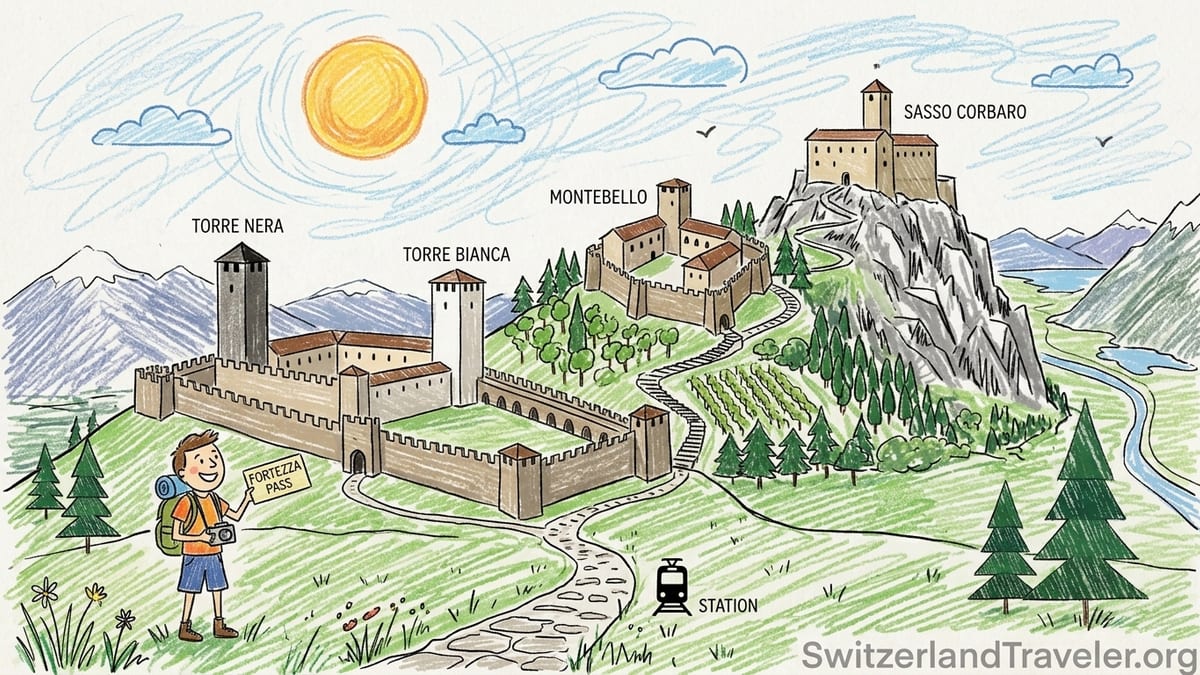
Starting At Castelgrande: The Best First Stop With The Fortezza Pass
I decided to begin at Castelgrande, the lowest and largest of the three castles, because it sits directly above Bellinzona’s historic center and is the easiest to reach from the train station. From Bellinzona station it took me about 10 minutes on foot to reach the modern lift entrance tucked behind Piazza del Sole. Stepping out on the top platform felt like walking onto the ramparts of a stone aircraft carrier, with the old town spread out below and Montebello and Sasso Corbaro stacked up the hillside beyond.
Buying the Fortezza Pass here was straightforward. At the ticket desk the staff confirmed the 2026 price I had seen in advance: 28 Swiss francs for adults for the combined ticket, valid from 28 March to 8 November. That single pass covers entry to all three castles, the museums, exhibitions, walls and towers. If I had bought individual tickets on the same dates it would have been 15 francs for Castelgrande, 10 for Montebello and 15 for Sasso Corbaro, a total of 40 francs. The discount is real, especially if you know you want to see all three sites properly in one or two days.
Inside Castelgrande I spent just over 90 minutes. Most of that went into the museum in the Arsenale and Cantinone areas, where the exhibits walk you through the long history of the fortress, from Roman roots and medieval expansions to the period when Bellinzona became a key defensive point on the north south routes through the Alps. There are archeological remains under glass floors, models of the fortifications and a useful sequence of maps that make sense of why three castles were needed at all. Even if you are not a museum person, this is the one to prioritize because it gives context to everything you see later at Montebello and Sasso Corbaro.
Walking the outer walls and climbing the towers added about another half hour. The long grassed ramparts are surprisingly peaceful, and this is where the Fortezza Pass starts to feel more than just a museum ticket. You are not only paying for rooms of objects, but for the right to wander a fortified landscape that still dominates the valley. From certain stretches of wall you can look straight up to Montebello, already plotting your route to the next fortress.
Climbing To Montebello: Short But Steep From The Old Town
From Castelgrande I dropped back down to the old town, cutting through the narrow streets to Piazza Collegiata. The official information panels mention that Montebello is about a 10 minute walk from the square, with roughly 80 meters of elevation gain. That estimate matched my own pace fairly well. The path starts beside the church and turns quickly into a steady uphill push on a combination of stone steps and paved walkway. It is not technically difficult, but it is noticeably steep, and if you are traveling in summer you will feel the heat bouncing off the walls.
I am reasonably fit and still needed a couple of photo stops on the way up. Families with small children or anyone with knee issues should factor that in. If you prefer not to walk, you can reach Montebello with local bus line 4 toward Sasso Corbaro, which connects the station and the castle area, or by the seasonal Artù tourist train that loops from the historic center to Montebello and Sasso Corbaro. The train takes around an hour for the full circuit with short stops and costs extra, but it can be a good compromise if you want views without the climb.
At Montebello my Fortezza Pass was scanned again and I headed straight for the inner courtyards and the Archeologia Montebello exhibition route. I gave myself about an hour inside. Compared with Castelgrande, Montebello feels more compact and defensive, a tighter cluster of walls with a dry moat and walkways looking down onto the town and over to Castelgrande’s terraces. The archeological exhibition here focuses more on how the fortress evolved and on material finds from the surrounding region. It is lighter and easier to skim than the museum at Castelgrande, which makes it ideal if you are starting to get museum fatigue.
One of my favorite sections was simply walking the ring of ramparts. From here you can see the full north south axis of the valley and clearly understand how the castles and town walls once formed a complete barrier. The visual line from Montebello up to Sasso Corbaro is especially striking. It looks close, but the path between them is significantly steeper than what you have just done.
From Montebello To Sasso Corbaro: The Hardest Stretch Of The Day
For the final leg I decided to walk from Montebello to Sasso Corbaro in order to judge the difficulty honestly. Official descriptions suggest about a 30 minute walk with around 150 meters of additional elevation gain, and that was accurate for my visit. The path begins innocently enough through a mix of woodland and roadside sections, but it soon turns into a fairly sustained uphill, especially in the last third where it joins the main access road.
By this stage my legs were feeling the combined effect of several hours on my feet and the previous climb to Montebello. I would describe the walk as moderate but tiring if you are not used to uphill walking. Good shoes are essential and in hot weather you will be grateful for water and a hat. Halfway up I passed a couple who had started from the station and regretted not taking bus line 4 for at least one section. If you are planning to visit all three castles in a single day and are not keen on steeper ascents, I would strongly consider taking the bus or the tourist train up to Sasso Corbaro and then walking down instead.
Arriving at Sasso Corbaro is rewarding precisely because of that effort. The castle stands on a rocky spur about 230 meters above the city, separated from the urban fabric below. The courtyard opens out to wide views in both directions: north toward the Riviera valley and south toward the basin leading to Lake Maggiore. This is where I finally sat down for a drink and a late lunch, using the quiet stone benches along the wall and simply watching the small trains snake along the valley floor while the afternoon clouds moved over the peaks.
Inside, Sasso Corbaro has fewer rooms than Castelgrande but a more intimate feel. There are several exhibition halls used for permanent and temporary shows, which are also covered by the Fortezza Pass. On my visit a photography exhibition occupied the largest hall, and upstairs a series of small rooms explored the castle’s history as a Sforza era fortress. I spent about 45 minutes wandering between the rooms and climbing the internal staircases to reach the watchtower for the highest accessible viewpoint of the day.
How Long It Really Took To Visit All Three Castles
Door to door, my full castle day ran from just after 10:00 to a little after 17:00, with only minimal dawdling. I entered Castelgrande shortly after opening time, at around 10:15, and left just before noon. The walk down through the old town, short coffee stop on Piazza Collegiata and climb to Montebello got me through the gate at about 12:30. After an hour at Montebello I set off for Sasso Corbaro at around 13:45, reached it around 14:15 or 14:20, then stayed until close to 16:00 before walking back down and catching a late afternoon train out of Bellinzona.
In raw numbers, that means I spent approximately three hours inside the castles and their museums, and about two hours in total walking between them and through town, counting short breaks. It is possible to compress this into half a day if you are brisk and skip some exhibits, but a realistic comfortable visit to all three fortresses is a full day once you add lunch and a little time to enjoy the views. This is especially true if you are visiting between March 28 and November 8, when all three sites are fully open from 10:00 to 18:00 and it is tempting to linger on the terraces and lawns.
In winter, from November 9 to mid March, only Castelgrande remains fully open, with shorter hours from 10:30 to 16:00 and last entry at 15:30, while Montebello and Sasso Corbaro are limited to their outer and inner courtyards. That seasonal pattern has held steady into 2026. If your trip falls in that period you could visit the courtyards of all three in half a day quite easily, but you would not need the full Fortezza Pass for museums. My own visit took place in the main season, which is when the value of the combined ticket is clearest.
If you travel as a couple or family, the time math also applies to cost. A family Fortezza Pass for two adults and up to three children is listed at 70 francs, with a reduced family price of 54 francs for one adult with up to three children. Students, children from 6 to 16 and seniors over 65 can access a reduced Fortezza Pass for 18 francs. Those prices can change over time, so it is worth checking at the InfoPoint or castle ticket desks when you arrive, but they provide a good baseline for planning a full day around the fortresses instead of treating them as a quick photo stop.
Was The 2026 Fortezza Pass Worth 28 Swiss Francs?
Looking back at my receipts and the time I spent, the Fortezza Pass justified itself without much debate. At individual 2026 prices during the main season, entry is 15 francs for Castelgrande, 10 for Montebello and 15 for Sasso Corbaro. If you walk up and only pay on the doors separately, a full visit to all three with museums and exhibitions comes to about 40 francs per adult. The pass at 28 francs saves roughly 12 francs while also removing the small mental friction of having to decide at each castle whether you want to pay again.
Value is not only about the raw discount. For me, the pass also encouraged a slower pace. Because I had already paid for all three and knew the museums and walls were included, I did not feel the need to rush through Castelgrande or skip rooms at Sasso Corbaro. I felt free to follow the entire Archeologia Montebello route and climb every accessible tower, knowing I was making full use of something already paid for, instead of debating whether a second or third separate ticket was worthwhile.
The pass does not cover transport, which is worth emphasizing. The Artù tourist train, for instance, charges its own fare for the one hour loop that visits Montebello and Sasso Corbaro from the city center. At the time of my research, adult tickets were in the low double digits in francs with discounts for children and holders of certain local passes, but they did not include castle admission. Likewise, bus line 4 is part of the regular public transport system. Depending on where you stay, your hotel may offer a regional ticket that discounts or covers local buses, but that is separate from the Fortezza Pass.
If your budget is tight and you know upfront that you only want to go into one castle, you may be better off buying a single ticket. Castelgrande at 15 francs is the obvious candidate because it has the most extensive museum, the largest grounds and good views. On the other hand, if there is even a moderate chance that you will be tempted to continue up to Montebello once you see it perched above the town, the Fortezza Pass is the safer choice from the start.
What I Would Skip On A Short Visit To Bellinzona
If you only have two to three hours in Bellinzona, for example on a tight rail itinerary between Zurich and Milan, you will need to be selective. Having seen all three castles in one day, my recommendation for a short visit is to focus on Castelgrande and then choose between Montebello and Sasso Corbaro based on your energy and transport options.
On a very short stop of under two hours, I would skip the climb to Montebello and Sasso Corbaro entirely and stay at Castelgrande. Take the lift up from Piazza del Sole, walk the main ramparts, pop into the museum for the highlights and spend a moment on the lawns looking up at the higher fortresses. You will still understand why Bellinzona’s fortifications became a UNESCO World Heritage Site, and you will not risk missing your onward train because you are halfway up a hillside path.
With three to four hours and a bit of energy, I would keep Castelgrande and add Montebello, but consider skipping Sasso Corbaro. The extra climb or bus ride for the third castle is rewarding, but it is not essential for understanding the overall system. Montebello already gives you a sense of the layered defenses and provides fine views back down over Castelgrande. In this scenario I would not buy the Fortezza Pass; instead I would pay the individual 15 francs for Castelgrande and 10 for Montebello, unless you had a strong interest in exhibitions at Sasso Corbaro that day.
Only when you have a full day in Bellinzona does Sasso Corbaro become an obvious addition. Its elevated vantage point and quieter atmosphere are a highlight if you enjoy photography or simply want a tranquil place above the town. For hikers, the walk between all three castles can be part of the attraction, turning the visit into a mild urban mountain excursion as much as a heritage tour.
Practical Tips: Routes, Walking Difficulty And Seasonal Details
In terms of walking difficulty, I would rate the overall day as moderate. None of the paths require special equipment, and most are well paved or clearly marked with signs indicating the castles. The steepest sections are the climb from the old town to Montebello and the final part of the route up to Sasso Corbaro. If you are comfortable with several flights of stairs and some sustained uphill walking, you will be fine. Visitors with mobility challenges should plan to use the bus or Artù train to gain height and keep walking within castle precincts.
The simplest route if you want to minimize climbing is to start in the old town, take bus line 4 or the tourist train up to Sasso Corbaro first, then walk downhill via Montebello and finally Castelgrande. That way you always move from higher to lower fortresses, reducing strain on knees and lungs. The trade off is that you will see the castles in reverse historical and interpretive order; I liked beginning at Castelgrande because its museum frames everything, but it did make the day more physically demanding.
Season matters. From March 28 to November 8, 2026, all three castles operate on broadly consistent hours from 10:00 to 18:00, with last entry usually at 17:30. That gives you ample time to space out visits and even return to a favorite terrace for sunset. Outside those dates, only Castelgrande is fully open and Montebello and Sasso Corbaro are limited to their courtyards. In that winter season you could still walk the paths and enjoy the views from outside the walls, but the museums, exhibitions and interior rooms that make the Fortezza Pass valuable would not all be accessible.
Finally, remember that Bellinzona sits on a major north south rail axis, which makes it easy to slot this fortress day into a broader Swiss itinerary. I met travelers who stopped between Lucerne and Lugano, and others who broke the faster Zurich to Milan route with a long lunch and a couple of castles. The Fortezza Pass does not require advance booking for individual travelers in normal conditions, so you can often make a spontaneous decision on arrival, check the weather, and choose whether to commit to all three fortresses or just enjoy Castelgrande and its ramparts.
The Takeaway
Spending a day walking the chain of castles above Bellinzona turned abstract facts about a UNESCO World Heritage site into something much more vivid. Starting on the lawns of Castelgrande, threading uphill to Montebello and finally standing on the rocky outcrop of Sasso Corbaro gave me a tangible sense of how the valley was once fortified, and of how the town below still lives in the shadow of its own walls and towers.
From a purely practical point of view, the 2026 Fortezza Pass proved to be good value for anyone committed to visiting all three castles between late March and early November. The savings over individual tickets are clear, and the pass simplifies your day by turning the whole fortress complex into one integrated experience rather than three separate decisions at three separate ticket desks. With roughly five to seven hours, comfortable shoes and a bit of uphill tolerance, it is entirely feasible to see everything without rushing.
If your time or energy is limited, prioritize Castelgrande and consider adding Montebello before deciding whether to push on to Sasso Corbaro. The third castle is the icing on the cake rather than the cake itself, a quieter lookout for those who have already bought into the longer story of Bellinzona’s defenses. Either way, knowing the timetables, seasonal opening dates and the concrete cost of the Fortezza Pass in advance will let you design a visit that suits your schedule rather than the other way around.
FAQ
Q1. How much does the Fortezza Pass cost in 2026 and what does it include?
The Fortezza Pass costs 28 Swiss francs for adults in 2026 and covers entry to all three Bellinzona castles, including museums, exhibitions, walls and towers, during the main season from late March to early November.
Q2. Can I visit all three Bellinzona castles in one day?
Yes, you can realistically visit all three in a single day. Plan around five to seven hours to include museum visits, walking between the castles, photo stops and a lunch break.
Q3. Which castle should I visit first as a first time traveler?
Starting at Castelgrande works well because it is closest to the train station and its museum explains the history of the whole fortress system, making Montebello and Sasso Corbaro easier to appreciate later.
Q4. How difficult is the walk between the castles?
The walk from the old town to Montebello is short but steep, with roughly 80 meters of elevation gain, and the stretch from Montebello to Sasso Corbaro adds around 150 meters more, making the full route moderately demanding for most visitors.
Q5. Are there public transport options to avoid the steep climbs?
Yes, local bus line 4 connects Bellinzona station with Montebello and Sasso Corbaro, and a seasonal tourist train called Artù runs from the historic center up to both hilltop castles, allowing you to walk mostly downhill.
Q6. Is the Fortezza Pass still worth it in winter?
In winter only Castelgrande is fully open, while Montebello and Sasso Corbaro are limited to their courtyards, so if you visit between early November and mid March it is usually better to pay only for Castelgrande.
Q7. How long should I plan if I only want to see one or two castles?
For just Castelgrande allow 90 minutes to two hours, and for Castelgrande plus Montebello plan three to four hours, including walking time and short breaks between the old town and the hilltop fortress.
Q8. Do I need to reserve tickets for the Bellinzona castles in advance?
Individual travelers typically do not need advance reservations for the Fortezza Pass or single castle tickets in normal conditions, and passes can be purchased on arrival at the InfoPoint or at the ticket desks.
Q9. Are the Bellinzona castles suitable for children and less experienced walkers?
Yes, the sites are family friendly, but families and less experienced walkers may prefer to use the lift to Castelgrande and public transport to the upper castles to avoid the steepest sections of the paths.
Q10. If I have very limited time, which castle should I prioritize?
With less than two hours, prioritize Castelgrande, which combines easy access from the old town, a substantial museum, broad lawns and impressive views of the entire Bellinzona fortress system.