


I thought I knew Lugano after several trips by train and bus. It was only when I finally boarded a scheduled boat on Lake Lugano in the 2026 navigation season that the region’s geography, rhythms and border-straddling character really clicked into place. Seen from the water, Ticino feels less like a collection of lakeside towns and more like one long amphitheater of mountains, villages and grotto restaurants, all stitched together by the white wakes of the lake boats.
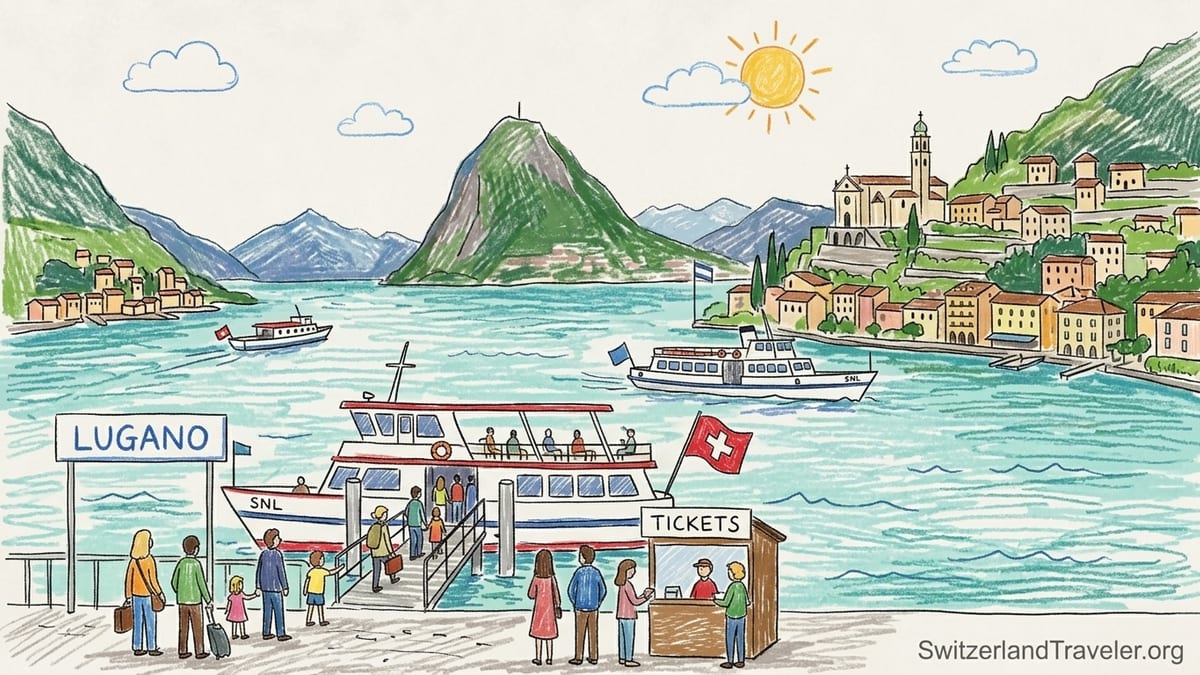
Boarding in Lugano: How the 2026 Boat Season Works
My Lake Lugano day started at the main boat pier in Lugano, a few minutes’ walk from the railway station via the funicular and the lakefront promenade. The Società Navigazione del Lago di Lugano, usually shortened to SNL, runs the scheduled boats here as part of the official 2026 navigation season. For 2026, regular tourist navigation is published from 29 March through 18 October, with timetables clearly posted at the pier and on printed leaflets in Italian, German, French and English.
Even early in the season the pier felt busy, but it was an orderly kind of bustle. A digital display cycled through departures such as Lugano to Gandria, Lugano to Morcote and a cross-border route to Porto Ceresio in Italy. Loudspeakers announced boats a few minutes before boarding, and SNL staff checked tickets at a small kiosk near the gangway. Buying a ticket was straightforward: there was an SNL counter right on the lakefront where I could choose between a simple point-to-point fare and a day pass valid for the Swiss part of the lake.
Because accommodation in Ticino often includes the regional Ticino Ticket, I showed mine at the counter. The Ticino Ticket offers a 20 percent discount on day passes for the Swiss basin of Lake Lugano, which meaningfully reduces the cost if you plan to stay on the water for several hours. Some fellow passengers in line used the SBB Mobile app to purchase their boat tickets, while others flashed railcards and passes such as the Swiss Travel Pass, which also grants benefits on many Ticino boat routes. The practical result is that you do not have to commit far in advance: it is easy to wake up, check the weather and buy whatever ticket fits the day.
For this trip I opted for a day pass for the Swiss side, taking advantage of the Ticino Ticket discount, and then added a supplement for the international leg into Italy. The flexibility of the pass was the main appeal. I knew I wanted to get off at Gandria and Morcote, and possibly continue to Porto Ceresio if time allowed. With the pass, I could hop on and off without recalculating fares at each stop.
The Route: Lugano to Gandria, Morcote and Across the Border
The boat I boarded mid-morning followed one of the core tourist routes that SNL has run for decades, linking Lugano with the village of Gandria, then looping down the lake toward Melide, Morcote and, on specific runs, Porto Ceresio on the Italian shore. The timetable in 2026 shows several daily departures on this axis, with some boats acting as shorter shuttles between Lugano and Gandria and others continuing all the way to Morcote or across the border.
We left from “Lugano Centro” pier, slid past Parco Ciani’s trees and lawns, and in a few minutes glided by the separate pier at Paradiso, where more passengers boarded. Paradiso itself is connected to Lugano by frequent suburban trains and buses, yet the lake stop remains active not only for tourists but also for locals heading to places that are awkward to reach by road. From here the route curved east toward Gandria, the mountains tightening around the water so that the lake began to feel more like a river canyon lined with stone houses and terraces.
Later in the day my boat continued south past Lugano again and under the shadow of Monte San Salvatore, then threaded between Caprino and the impressive highway viaduct, with a brief stop at Melide near the Swissminiatur theme park. From Melide we hugged the lakeshore to Morcote, widely advertised in Ticino tourism materials as one of Switzerland’s most beautiful villages, with its terraced cemetery and the church of Santa Maria del Sasso watching over the harbor. A smaller number of scheduled boats extend beyond Morcote to Porto Ceresio in Italy, where lake services interlace with Italian regional trains and buses. On this run the Italian leg functioned more as a scenic add-on than a commuter corridor, although historically the cross-border line has also carried workers and shoppers in both directions.
Riding this entire arc in a single day revealed how navigation on Lake Lugano is both sightseeing and connective tissue. Standing at the rail as the boat crossed the invisible Swiss-Italian border, I could see not only the change in flags on the quays but also subtle shifts in architecture and signage along the shore. It drove home how the lake is one continuous space, even as it straddles national jurisdictions.
On Board: Seating, Comfort and the Feel of the Journey
The vessel that carried me for most of the day was typical of the SNL fleet. It had an enclosed lower salon with large windows and a mix of padded benches and simple chairs, and an open upper deck with rows of plastic seats. Early in the morning, with mild air and a thin cloud layer, almost everyone made a beeline for the upper deck. There were no reserved seats. You simply walked on, found a spot and, if you boarded in Lugano, had your pick of the railings for the best photos.
The atmosphere felt closer to a regional train than to a private sightseeing cruise, with school groups, retirees with folding maps, and locals reading the newspaper all sharing space. There was a small bar counter offering coffee, soft drinks, beer and simple snacks, priced comparably to a mid-range café in Lugano. Many people, especially those with Ticino Ticket or rail passes, treated the boat as just another form of public transport and used it without ceremony. At the same time, the open decks and the slow pace turned even a basic transit ride into a de facto cruise.
The weather gave the day a distinct rhythm. In the late morning the sky brightened and sunlight began to pick up detail on the mountainsides, but a cool breeze funneled down the lake, so I alternated between the windier bow and a more sheltered seat against the superstructure. By early afternoon the air warmed, jackets came off, and the lake showed a deep blue-green typical of Ticino’s pre-alpine waters. Reflections of the villages on the surface were clear enough that the houses themselves seemed to float. Near Gandria, where the shore is steep and partially forested, the boat’s low wake produced a fine lace of ripples against the rocks, a visual reminder of why navigation speed is moderated in these narrow sections.
Compared with a bus or train, the boat naturally took longer. Lugano to Gandria by road can be around twenty minutes, while the boat spins that into roughly half an hour with intermediary pauses and a more relaxed speed. Yet that extra time felt like the point. The physical sensations of the hull turning, the smell of the lake and the changing breeze gave the journey a texture impossible to experience behind a windshield or a train window.
Stopovers Worth Your Time: Gandria, Melide and Morcote
Among the many piers the boat touched during the day, three stops stood out as genuinely worth leaving the boat for, rather than simply viewing from the deck. The first was Gandria, a small village that clings almost implausibly to the steep northern shore. From the water you see a tight cluster of pastel and stone houses rising directly from the lake, with narrow lanes and steps threading between them. Getting off at Gandria’s lakeside landing, you are immediately in the heart of the village; there are no large car parks, and road access is limited above the settlement, which is part of why the boat and lakeside footpaths remain so important.
I allowed a full boat interval at Gandria, around one and a half hours on the spring timetable, enough time to climb up through the alleys, visit the small church and find a table at a lakeside grotto restaurant. Here the lake boats demonstrate their dual role. At lunchtime the terrace filled with a mix of day trippers from Lugano and hikers arriving on foot from the Sentiero di Gandria, a panoramic path that follows the shore. Many planned to return by boat purely because it was more pleasant than retracing their steps or squeezing onto the bus on the road high above.
Further south, Melide is a practical but worthwhile stop if you are traveling with children or if you are curious about the Swissminiatur park, an outdoor miniature Switzerland laid out within a few minutes’ walk of the pier. The boat timetable lists Melide frequently enough that you can comfortably combine a visit there with either Gandria or Morcote in a single day, especially in high season when extra services run. I used Melide more as a waypoint than a destination, hopping off briefly to see the view back toward Lugano and then rejoining a later boat to continue toward Morcote.
Morcote, at the southern bend of the lake before the Italian border, felt like the natural climax of the route. The village rose in terraces from the water, a stack of arcades, staircases and cypress trees culminating in the sanctuary of Santa Maria del Sasso high above. Boats dock right in the center, where a stone promenade runs alongside cafés and ice-cream counters. I disembarked here for several hours, climbing the broad stairway through the old cemetery to the church. From the top, the lake opened up in both directions, with boats tracing white lines across the surface and the Italian shore just discernible. This is one of those viewpoints that is easiest to appreciate when you have actually arrived by boat, because you can retrace your own wake with your eyes.
Transport or Sightseeing: How Locals Actually Use the Boats
One of the most interesting discoveries of the day was that the boats on Lake Lugano are not only tourist toys, nor are they purely utilitarian. They fall somewhere in between. SNL officially operates as a navigation company integrated into the regional tariff community, which means its scheduled services are recognized as public transport for ticketing purposes in many cases. The timetables are structured to allow commuting patterns, and several of the older lakeside communities have limited road access, so boats remain a logical way to get around.
On the morning run to Gandria, I noticed older residents carrying shopping bags and workers in casual office clothes getting off at intermediate stops like Caprino and Cantine di Gandria. Some of them chatted with the crew by name, and the way they disembarked briskly, without taking photos, made it clear that they considered the boat the normal way to reach their homes. At the same time, the upper deck was dotted with visitors from across Europe and beyond, many photographing every curve of the shore.
This blend of uses gives the service a more authentic feel than a dedicated tourist cruise. You are not captive to a fixed commentary or a choreographed loop. Instead, you are simply making use of the same boat that locals rely on, which incidentally happens to offer spectacular views and a relaxed pace. The schedule is also more generous than a typical sightseeing line, with early and late services useful for those who want to stretch their day in Gandria or Morcote.
On the international leg toward Porto Ceresio the balance tilted more toward leisure. Since cross-border services are more complex in terms of fare integration, many commuters now use alternative connections, and the international boat felt like a scenic extension of the Swiss route rather than a central transport link. Still, the fact that you can glide from a Swiss village to an Italian lakeside station in one continuous journey gives the lake an appeal that goes beyond pure scenery.
Practicalities: Tickets, Discounts and Planning a 2026 Boat Day
Planning a Lake Lugano boat day in 2026 requires only a modest amount of advance thought, but knowing the main ticketing options helps you get better value. If you are staying in a hotel, hostel or campsite that participates in the Ticino Ticket program, you will be given a digital or printed Ticino Ticket on check-in. This grants free use of most regional public transport in Ticino for the duration of your stay, and a 20 percent discount on day passes for navigation on the Swiss side of Lake Lugano. The discount applies when you buy a full-day lake card rather than single segments, which encourages you to structure your exploration around a loop on the water.
SNL also sells thematic day products labeled on its ticketing platform as offers such as “Classic Tour,” “Scenic Tour” or combinations including Morcote and Porto Ceresio. Prices advertised for the 2026 season show the basic Lake Lugano day pass at just under sixty Swiss francs, with packaged scenic tours priced slightly below or above that figure, depending on mileage and any included extras. Holders of Swiss public transport discount cards, such as the Half Fare Card or regional Arcobaleno season tickets, can obtain reduced rates on many of these products. Families should check whether children travel at a reduced rate or free of charge within certain age brackets, as policies can vary slightly over time.
Boats follow a published timetable that is valid throughout the 2026 season, although there can be slight differences between spring, high summer and autumn schedules. Morning sailings generally begin from Lugano around eight to nine o’clock, with a cluster of midday departures tailored to leisure travelers and afternoon returns from popular stops like Morcote and Gandria. In high season extra sailings are often added on weekends and holidays. Most travelers can safely plan with a half-hour to hourly frequency on the main Lugano to Gandria and Lugano to Morcote axes, but it is always wise to check the same-day timetable at the pier or through digital channels before setting off.
Because the 2026 navigation period runs from late March to mid-October, shoulder season days in April, May and October can feel very different from peak summer. On cooler days you will be grateful for the enclosed salon and a warm drink at the bar. In July and August, by contrast, shade on deck becomes a premium commodity and sunscreen and a hat are essential. If your priority is photography and quiet, a weekday in early June or late September may offer the best blend of reliable weather and manageable crowds, while still benefiting from the full seasonal timetable.
Boat vs Train and Bus: Is the Cruise Worth the Time?
Given that Ticino’s rail and bus network is dense and well integrated, the obvious question is whether devoting a day to the lake boats is really worth it. Measured purely in speed and cost, trains and buses usually win. The regional railway and bus lines linking Lugano with places such as Melide or Porto Ceresio can be significantly faster than the equivalent lake journey, and if you already hold a pass covering public transport, adding separate boat tickets can feel like an unnecessary extra.
However, the calculus changes when you think in terms of experience rather than simple transport. On my own trip, the day on the lake provided a continuous narrative of the region that no road itinerary could match. From the water you see how villages like Gandria and Morcote cling to their slopes and why roads there are limited. You perceive the shifts in geology, from the steeper, rockier stretches around Cantine di Gandria to the broader bays near Lugano and Melide. You also feel how the lake mediates daily life, with fishermen, stand-up paddlers and private boats all sharing space with the SNL fleet.
In terms of value for money, the combination of Ticino Ticket discounts and the possibility of using a day pass intensively makes the lake particularly appealing for those willing to commit to several segments in one day. For example, a loop that starts in Lugano, calls at Gandria for lunch, continues via Lugano down to Melide for a brief stop, then reaches Morcote for the afternoon before returning by bus or train can easily fill ten to twelve hours without feeling rushed. If you tried to stitch together the same set of viewpoints and walking routes by road, you would likely spend more time transferring between buses than actually absorbing the scenery.
There are, of course, edge cases where the boat does not make sense. If you have only a few hours in Lugano and want to squeeze in a mountain excursion, or if the weather on the lake looks unsettled while the peaks remain clear, a train or cable car may be the wiser choice. The boats are also more vulnerable to weather disruptions than underground tunnels or highways. Yet in balanced conditions, especially on a first or second visit to Ticino, giving at least one full day to the lake is a decision that repays itself in memories and a deeper understanding of the region’s layout.
The Takeaway
By the time my boat eased back into Lugano in the golden slant of late afternoon light, I realized that the day had reset my internal map of Ticino. Locations that had previously been pins on a rail diagram had acquired shorelines, coves, bell towers and individual trees. I could see, almost physically, how the canton wraps itself around its lakes, and why navigation has been a crucial part of everyday life here since the nineteenth century.
Exploring Lake Lugano by scheduled boat in the 2026 season proved to be more than a pleasant outing. It was an experiment in slowing down and accepting that movement could be not just a means to an end but a meaningful part of the journey. The boats served as both public transport and floating terrace, connecting Swiss and Italian shores while giving space to watch, breathe and think. The weather, the unhurried pace and the ease of hopping on and off at Gandria, Melide and Morcote all combined to create a day that felt complete in itself, not just a set of transfers between attractions.
If you are considering whether to dedicate a precious holiday day to Lake Lugano’s navigation services, it may help to frame the choice less as “cruise versus train” and more as “linear transit versus circular experience.” Trains and buses will always be the fastest way to get around Ticino’s valleys and ridges. The lake, by contrast, invites you to view the region from the outside in, with every bend of the shoreline offering a new combination of water, stone and light.
My own conclusion, after one long day stitched together from multiple boats, is that the time trade-off is not a trade-off at all. In a canton where public transport is already so efficient, the real luxury is buying time that does not need to be optimized. A Lake Lugano boat trip does exactly that, revealing Ticino as a lived-in, cross-border landscape best understood, and most gently appreciated, from the water.
FAQ
Q1. When does the official Lake Lugano navigation season run in 2026?
The regular tourist navigation season in 2026 is scheduled from 29 March through 18 October, with boats operating on a published timetable during that period.
Q2. Where is the easiest place to board a Lake Lugano boat in Lugano?
The most convenient starting point is the main pier in central Lugano, a short walk from the railway station via the city funicular and the lakeside promenade.
Q3. Do I need to reserve seats in advance for SNL boats?
For standard scheduled services, reservations are usually not required. Seats are unassigned, and you simply buy a ticket and choose a place on the open deck or in the salon.
Q4. How does the Ticino Ticket help with boat costs?
If you stay in participating accommodation, the Ticino Ticket gives free travel on most regional public transport and a 20 percent discount on day passes for navigation on the Swiss part of Lake Lugano.
Q5. Which stops are most worth getting off at for sightseeing?
Gandria for its car-free lakeside alleys, Melide for access to Swissminiatur, and Morcote for its terraced village and panoramic church are particularly rewarding stopovers.
Q6. Are Lake Lugano boats mainly sightseeing cruises or public transport?
They function as both. Timetabled services are integrated into the regional transport network and used by locals, but they also serve as relaxed scenic cruises for visitors.
Q7. How long does a boat trip from Lugano to Gandria or Morcote take?
Travel times vary by service, but Lugano to Gandria is usually around half an hour, while Lugano to Morcote often takes about one and a quarter to one and a half hours with intermediate stops.
Q8. Is the lake boat worth it if I already have a train or bus pass?
If your priority is speed, trains and buses are faster. If you value scenery and a slower pace, using a discounted lake day pass for several segments can offer excellent experiential value.
Q9. What should I bring for a comfortable day on the lake?
Bring layers for wind, sunscreen and a hat in summer, comfortable shoes for village stopovers, and a camera or phone for photographs from the open deck.
Q10. Can I combine a Lake Lugano boat trip with hiking?
Yes. Popular combinations include hiking the lakeside path to or from Gandria and using the boat in one direction, or pairing village walks in Morcote with a return by bus or train.