


Choosing where to base yourself in German-speaking Switzerland is less about finding the single “best” city and more about matching your priorities to the map. On my most recent trips I split my overnights between Zurich, Lucerne, Bern and the Bernese Oberland, with shorter stays in Basel and Appenzell, and kept notes not on thread counts and spa menus but on walk times from stations, luggage hassles, evening atmosphere and how much time each base actually saved once I was on the ground.
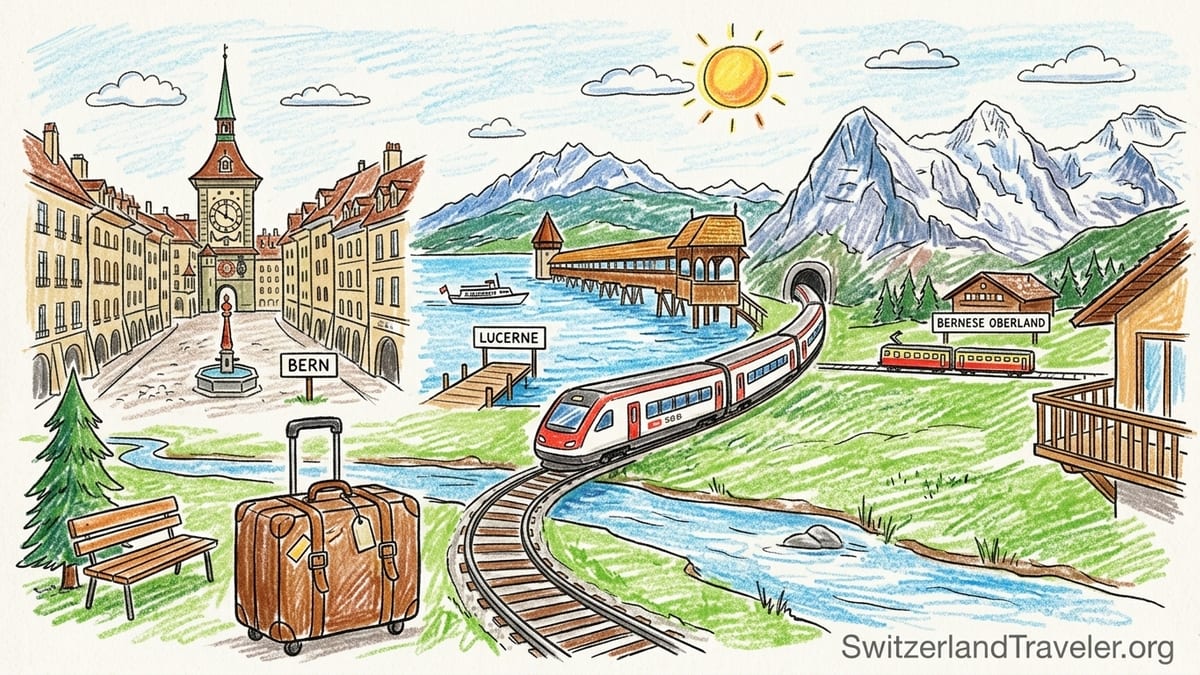
How I Structured My Bases Across German-Speaking Switzerland
Across several trips, including a two-week loop in 2025 and follow-up visits in 2026, I stopped treating Swiss cities as day-trip targets and instead used them as bases. In practice, that meant three nights in Zurich for international arrival and big-rail connections, three in Lucerne for lake and mountain excursions, two in Bern for historic-city atmosphere and day trips, and four in the Bernese Oberland split between Interlaken and Grindelwald for direct Alpine access. I added one-night stops in Basel, St. Gallen and Appenzell only when they fit a logical rail line and did not create extra luggage moves.
That pattern came out of trial and error. Earlier, I tried staying only in Zurich and day-tripping everywhere by fast train. On paper, ninety minutes to Lucerne or Bern looked harmless. In reality, repeated early departures, platform changes and late-evening returns after dinner left me feeling as if I were commuting rather than traveling. Shifting at least some nights into Lucerne, Bern and the Alps reduced daily train time enough that the higher hotel prices in multiple cities still felt worth it.
In every base I picked accommodation within a ten-minute walk of the main station or right on a tram line with direct service to it. That choice, more than star rating, determined how each place felt. Rolling a suitcase over a few hundred meters of flat pavement in Zurich or Lucerne is a very different experience from navigating a steep alley with cobblestones in Bern’s old town or the uphill streets of Grindelwald after a long hiking day.
What follows is not a ranking of hotels but a location-first look at how each base actually worked: where I walked, what I saw out the window, how much I paid for a basic double room, and how much time I gained or lost by sleeping there rather than somewhere else.
Zurich: International Gateway and Rail Hub
Zurich is where most international itineraries in German-speaking Switzerland begin or end, and that alone makes it a logical base for at least one or two nights. From inside Zurich Airport, I have routinely wheeled my suitcase straight onto an escalator down to the airport rail station and onto a train into the city center. Trains run roughly every few minutes, and the ride to Zurich Hauptbahnhof, known locally as Zurich HB, takes around ten minutes. I have measured the door-to-door time from plane exit to hotel check-in near the station at about one hour when queues are light, which is hard to match elsewhere in the country.
Staying within a five- to eight-minute walk of Zurich HB makes the city feel smaller than it looks on the map. On one stay I used a mid-range hotel facing the station and could walk from my room to an evening train to Basel in under ten minutes, platform included. Another time I stayed in Zurich West, two tram stops away, and immediately noticed that returning from day trips with a suitcase meant one more transfer and ten more minutes when I was already tired. For a short Swiss itinerary of four to five days, that difference matters.
The trade-off for such convenient access is price. Survey data in 2025 and 2026 consistently put Zurich hotel rates among the highest in Europe for centrally located three-star doubles. For my own bookings between spring and autumn, I rarely found a decent double under roughly 220 to 260 Swiss francs for advanced nonrefundable rates near the station, with chain properties and design hotels often between 280 and 350 francs on busy nights. That pushed me to stay in Zurich only as long as I needed its connectivity, then move on to cheaper bases once the jet lag and long transfers were out of the way.
In the evenings, Zurich can feel surprisingly calm away from the nightlife pockets. Around the station and along Bahnhofstrasse, commuters stream past until early evening, and by 21:00 many side streets are quiet. I often walked from the old town back to my hotel around 22:30 without feeling rushed, but the atmosphere was more about people heading home than lingering on terraces. For a late arrival night when my priority is a quick meal, hot shower and uninterrupted sleep before an early InterCity train to Lucerne or Chur, that suits me perfectly. If I want extended strolls through medieval lanes after dinner, I would rather be based in Bern or Lucerne.
Lucerne: Lakefront Charm and Efficient Mountain Access
Lucerne is the place where I most clearly felt the payoff of moving my base instead of day-tripping from Zurich. The direct InterRegio trains take around 45 minutes between Zurich HB and Lucerne, which looks trivial in a timetable. On the days when I stayed in Zurich and day-tripped to Lucerne for a lake cruise or a run up Mount Pilatus, I spent about an hour and a half on trains plus station time, which compressed the mountain day. On later trips, when I booked three consecutive nights in a mid-range hotel five minutes’ walk from Lucerne station and two minutes from the lakefront, my days felt longer because I could be on a boat or mountain railway within minutes of finishing breakfast.
Lucerne’s main station sits right on the lake, so the logistics from train to excursion are about as smooth as I have experienced in Switzerland. I could arrive from Zurich on an early train, wheel my suitcase 300 meters over flat pavement to my hotel, drop bags, and be back at the boat pier ten minutes later for a cruise to Vitznau or Alpnachstad. For the classic Golden Round Trip loop up Mount Pilatus, I walked from my hotel to the pier, sailed to Alpnachstad, took the steep cogwheel train up the mountain, hiked for several hours, and then descended by cable car and bus directly back into town, all without touching my luggage again until evening.
Hotel prices in Lucerne were lower than Zurich but still solidly Swiss. For simple, centrally located three-star doubles I usually paid around 190 to 240 francs in shoulder season, with lake-view or boutique options running higher. When I splurged once on a partial lake-view room, it changed the feel of the stay: instead of squeezing views into day-trip windows, I watched the light shift over the water from my own balcony in the early evening. Even in more modest rooms set one or two streets back from the lake, I could step outside after dinner and be on the Chapel Bridge within a five-minute stroll.
Evenings in Lucerne felt friendlier than Zurich for travelers who like to wander without an agenda. The riverfront and old town squares had a steady but not overwhelming buzz until about 22:00 in summer, with families and couples circling the waterfront, buskers playing and restaurant terraces full but not frantic. That atmosphere, combined with direct access to lake cruises and mountain railways, convinced me to use Lucerne as my main central Switzerland base on future trips. Day trains to Zurich still made airport departures easy, but without sacrificing my mornings and evenings to commuting.
Bern: Historic Atmosphere and Central Swiss Positioning
Bern tends to be overlooked as simply the political capital, but as a base it topped my list for combining atmosphere with practical geography. The main station is compact and sits at the edge of the UNESCO-listed old town, which stretches along a ridge above a loop in the Aare River. On my most recent stay, I stepped off a train from Lucerne, rolled my suitcase out of the side exit and climbed gently for about five minutes to reach a small hotel facing one of the famous arcaded streets. The route had cobblestones but no brutal hills, and I did it comfortably with a wheeled medium suitcase.
From that base in Bern, I could reach other key cities in under an hour by direct train: roughly 30 minutes to Thun, 50 to Interlaken, similar times to Fribourg, Biel or Burgdorf. Zurich and Lucerne sat just over an hour away, and Basel about another hour in the opposite direction. That meant I could plan day trips in almost any direction while still returning to the same room each night instead of repacking. On one week-long trip I used Bern as my only city base and ran day trips to Thun and its lakes, a long excursion into the Emmental, and a quick afternoon in Fribourg, all on straightforward direct connections.
Hotel rates in Bern for equivalent quality ran a bit lower than in Zurich and often similar to Lucerne. For a mid-range double under the old town arcades within ten minutes of the station, I tended to pay in the 180 to 230 franc range in spring and autumn. Many buildings are historic, so rooms may run smaller or with less dramatic views than Lucerne’s lakefront or Zurich’s modern towers. My trade-off was character. Looking out at green-painted shutters and sandstone facades each morning felt very different from a business district stay, and stepping outside put me immediately among arcades lined with small shops, cafes and bakeries instead of international brand stores.
Evening atmosphere in Bern suited me when I wanted a relaxed, local-feeling city between more intense mountain days. After dinner, I often walked across the Nydegg Bridge to watch the river and the bears’ enclosure before looping back through quieter back streets. There were bars and student spots, but nothing like Zurich West’s late-night scene. Because the city is smaller and its old town compact, I felt comfortable returning on foot after a late train from Interlaken or Thun. For travelers who like to stay in one place for several nights and prefer historic streets over big-city gloss, Bern rewards being used as a base instead of a quick stop.
Interlaken and Grindelwald: Sleeping in the Alps, Not Commuting to Them
The Bernese Oberland, with Interlaken as its gateway and Grindelwald higher in the valley, is where my base choices had the most dramatic effect on how much I could actually see. Early in my Swiss travels I tried visiting Lauterbrunnen and Grindelwald on a very long day trip from Zurich, spending close to four hours on trains plus multiple mountain connections. I saw beautiful scenery but spent nearly as much time sitting as walking. On later trips I set aside four or five nights in the region itself, splitting them between Interlaken and Grindelwald, and the experience changed from a box-ticking excursion to a genuine mountain stay.
Interlaken works as a rail and bus hub, with its two main stations, Interlaken West and Interlaken Ost, tied into connections heading up the Lauterbrunnen and Grindelwald valleys. On one stay I booked a small hotel a short block from Interlaken Ost because almost all the mountain connections I needed left from there. That meant I could roll my suitcase off the train from Bern and be at reception in under five minutes on flat ground, which mattered after a long day. From that base I used the first morning train up to Kleine Scheidegg and on toward Jungfraujoch without having to cross town or factor in a transfer from West station.
Grindelwald, higher up the valley, gave me something different. When I stayed for three nights within a ten-minute walk of the village station, my view shifted from a busy resort town to the Eiger’s north face filling my balcony. Morning logistics were still straightforward; I walked from the hotel to the new terminal for gondolas up to First or the Eiger Express toward Jungfraujoch in under fifteen minutes, even with a small daypack. The trade-off was steeper streets. Pulling a rolling suitcase up from the station to a hillside hotel felt longer than the distance looked, especially in light rain, so I started prioritizing properties either on the station side of the main road or with a shuttle offered for arrivals.
Prices in the Oberland varied more with season than in the cities. In shoulder seasons like late May or early October, I found doubles in Interlaken around 160 to 220 francs and slightly higher in Grindelwald. In peak summer or during winter ski weeks, the same hotels could be closer to or above 300 francs for well-located rooms. What I gained in exchange was direct access to hikes and viewpoints. Instead of racing for the last cable car down to catch a long train back to Zurich, I could stay on the trail above Mürren or First until mid-afternoon and still be on my guesthouse terrace by early evening.
The biggest saved cost in time rather than money was avoiding ultra-long day trips to Jungfraujoch from cities like Zurich or Lucerne. By staying in Interlaken or Grindelwald, I turned what would otherwise be a 12-hour urban-to-alpine excursion into a focused mountain day, leaving my room around 07:30 and getting back by late afternoon, with energy left for a simple dinner and an early night.
Smaller Stops: When Basel, St. Gallen and Appenzell Made Sense
I added Basel, St. Gallen and Appenzell to my itineraries only when they naturally fit a larger loop, and I limited them to one-night or even same-day stops to avoid extra luggage work. Basel, for example, slotted neatly into a journey between Paris and central Switzerland. I arrived on an international train, walked about ten minutes along level streets to a mid-range hotel near the station, and spent the afternoon on foot among the old town and riverfront. Hotel prices were similar to Bern’s for comparable quality. The city’s tram network made it easy to reach museums without touching my suitcase again until I walked back to the station the next morning for a direct train to Zurich Airport.
St. Gallen entered the mix on a trip focused on eastern Switzerland. I came from Zurich on a direct train that took a bit over an hour, stepped out into a smaller station and walked under ten minutes to a guesthouse on the edge of the old town. The draw here was the UNESCO-listed Abbey library and the city’s carved and painted bay windows. Because the old town is compact, it worked well as a one-night pause rather than a base. I could explore fully in an afternoon and evening, sleep nearby and continue to Appenzell the next morning without feeling rushed.
Appenzell itself felt closest in spirit to a village stay in the Bernese Oberland, with painted wooden houses and easy access to hiking trails and the Alpstein range rather than high alpine glaciers. In practical terms, getting there with a suitcase meant factoring in one or two changes from mainline trains to regional services. I found that tolerable for a two- or three-night stay, but not something I would repeat just for a brief look. Hotel prices in Appenzell were often lower than in the big cities for family-run inns and guesthouses, but choices were more limited and some properties closed in shoulder seasons. For most travelers, using these smaller towns as short additions rather than main bases keeps luggage moves manageable.
What all three smaller stops taught me was to respect the cost in energy of each station departure board. Every time I slept somewhere for only one night, I handled my suitcase more, checked in and out, and had to orient myself to a new set of streets. Unless a place clearly offered something I wanted to linger over, I found it better to pass through on a day trip from a main base like Zurich, Bern or Lucerne instead of splitting my nights too finely.
Comparing Bases by Time Saved, Not Just Distance
On paper, Switzerland’s rail network makes almost any city pairing look easy. In practice, the difference between a 45-minute direct train and a 90-minute route with a change halfway can reshape your day. Between Zurich and Lucerne, for example, the frequent direct trains mean that basing in either city for excursions to the other is workable. I have happily done Lucrene as a day trip from Zurich when my time was limited and airport access was the priority. However, when my itinerary leaned heavily on lake cruises and mountain trips like Pilatus or Rigi, moving my suitcase once to Lucerne and staying there for several nights gave me more actual hours on trails and boats.
The same logic applied between Bern and the Bernese Oberland. Bern to Interlaken by direct train took me roughly fifty minutes. From Interlaken, reaching Lauterbrunnen or Grindelwald required another half hour or so. That made Bern a practical base for occasional lake days or short mountain excursions but less ideal for multiple early starts and late returns if I wanted a week of hiking. By contrast, sleeping in Interlaken or Grindelwald cut my morning transit time to a single valley leg, which added up to several more hours on the ground across a four- or five-night stay.
Luggage handling also factored into my decisions. Stations like Zurich HB, Lucerne and Bern are compact and well-signposted, but crowds at peak hours can slow you down. I noticed that arriving into Zurich HB with a heavy suitcase around 08:00 meant moving against a river of commuters, while arriving mid-afternoon felt calm. When planning base changes, I started booking mid-morning or early-afternoon trains to avoid both rush-hour crowds and the stress of racing to a new hotel before reception staff took their afternoon break. Choosing properties with check-in desks walking distance from the station further reduced the friction of each move.
Finally, evening atmosphere influenced where I wanted to be after those train days. For lively bar-hopping and a wider choice of international restaurants, Zurich or Basel made sense. For historic streets that still felt active but not noisy after dark, Bern and Lucerne were my favorites. For quiet nights where the dominant sound was river or cowbell rather than traffic, villages like Grindelwald or Appenzell delivered. Matching that mood to my energy level on each trip did as much to shape my experience as any timetable.
The Takeaway
Choosing where to stay in German-speaking Switzerland is less about finding a single perfect city and more about sequencing the right bases for what you want to do. Zurich excels as an arrival and departure point, with its airport trains dropping you at the main station in minutes and onward rail lines fanning out across the country. Lucerne rewards anyone focused on lakes and accessible mountains, its station and boat piers working almost like one integrated terminal. Bern gives you a historic center with easy day trips in every direction, a good choice if you like to unpack once and live between city and countryside.
For the high Alps, the biggest decision is not which village is prettiest but how many hours of your limited days you want to spend on trains. Interlaken and Grindelwald cost more than some cities in high season, yet they repay those francs in extra time on trails and terraces instead of commuter-style returns after every excursion. Smaller towns like Basel, St. Gallen and Appenzell are best treated as targeted additions on routes you would travel anyway, not as extra bases that fragment your nights and inflate your hotel count.
Across all my trips, the pattern that worked best was simple: land in Zurich and stay long enough to adjust, shift to Lucerne or Bern for several nights depending on whether water or stone appealed more, then head into the Oberland for at least three or four sleeps within sight of the peaks. Within that framework, focus less on shaving a few francs off each hotel bill and more on where your suitcase will sit still while you go out and use the Swiss transport network as it was designed to be used, with you standing on decks, trails and promenades rather than platforms.
FAQ
Q1. Is it better to stay in Zurich or Lucerne for a first short trip?
For a very short trip of three to four days with international flights in and out of Zurich Airport, basing in Zurich keeps airport transfers simple and gives you quick rail access to other cities for day trips. If you can spare five or more nights and want more time on lakes and mountains, spending at least two or three of those nights in Lucerne will put you closer to excursions like Mount Pilatus and Rigi while still allowing an easy final train back to Zurich Airport.
Q2. How many nights should I spend in the Bernese Oberland instead of day-tripping from cities?
If your goal is to hike or ride mountain railways on more than one day, plan on at least three, and ideally four or five, nights in bases like Interlaken, Grindelwald, Wengen or Mürren. That reduces long daily commutes from cities such as Zurich or Bern and lets you pick your mountain days based on actual weather instead of a fixed ticket date booked far in advance.
Q3. Are hotels near Zurich main station worth the higher price?
For early departures, late arrivals or itineraries with multiple rail day trips, staying within a five- to ten-minute walk of Zurich HB saves time and energy, especially with luggage. The nightly rate is usually higher than in neighborhoods further out or in Zurich West, but the convenience of avoiding extra tram rides at the beginning and end of long days often justifies the cost, particularly on short stays.
Q4. Is Bern a good base even if I am mainly interested in the Alps?
Bern works well if you want a mix of city atmosphere and occasional Alpine or lake days. Direct trains to Thun and Interlaken make day trips straightforward. However, if most of your planned days involve early starts for hikes or high mountain railways, staying directly in the Bernese Oberland will cut your daily travel time and give you more flexibility to respond to changing weather in the mountains.
Q5. Should I stay in Interlaken or Grindelwald for Jungfraujoch and surrounding hikes?
Interlaken offers easier rail connections and flatter streets, which is helpful with larger luggage and onward trains. Grindelwald sits higher in the valley with closer access to gondolas and trailheads and more immediate mountain views, but involves steeper walks between the station and many hotels. If luggage simplicity matters most, choose Interlaken. If you prefer waking and sleeping with the peaks right outside your window and do not mind uphill streets, Grindelwald is the better base.
Q6. Are smaller towns like Appenzell and St. Gallen worth overnight stays?
They are worthwhile when they fit naturally into your rail route and you have enough total nights to justify another unpacking and packing cycle. Appenzell is attractive for hikers and those interested in rural culture, while St. Gallen appeals to architecture and history fans. For shorter trips, consider visiting them as day trips from a main base like Zurich or Lucerne instead of adding extra hotel changes.
Q7. How much should I budget per night for mid-range hotels in these bases?
Recent bookings and industry reports suggest that centrally located three-star doubles in Zurich often run from roughly 220 to over 300 Swiss francs per night depending on season and demand. Lucerne and Bern are usually a bit lower, often in the 180 to 250 franc range for comparable properties. In the Bernese Oberland, Interlaken and Grindelwald may be around 170 to 260 francs in shoulder seasons and higher in peak periods, with smaller towns sometimes slightly cheaper but with fewer options.
Q8. Will I need a rental car if I split my stay between cities and the Alps?
For most travelers, a rental car is unnecessary and can even be inconvenient in this part of Switzerland. The rail and boat networks cover the routes between Zurich, Lucerne, Bern and the Bernese Oberland with frequent, reliable services, and many mountain villages either restrict cars or charge high parking fees. Traveling by train lets you step off directly in city centers and mountain gateways without worrying about parking or alpine driving conditions.
Q9. How should I plan my route if I want to see Zurich, Lucerne, Bern and the Alps in one trip?
A common and efficient sequence for a week to ten days is to arrive in Zurich and stay one or two nights, move to Lucerne for two or three nights, continue to the Bernese Oberland for three or four nights, then finish with one or two nights in Bern or back in Zurich before departure. This minimizes backtracking, keeps most train legs under two hours and gives you time in each base without constant repacking.
Q10. Is it realistic to visit Jungfraujoch or similar high alpine viewpoints as a day trip from Zurich?
It is technically possible to reach Jungfraujoch on a very long guided day trip from Zurich or Lucerne, but you will spend a large share of the day on trains and connecting mountain railways. If visiting high alpine viewpoints is a priority, plan at least one or two nights in the Bernese Oberland so you can travel up and down at a more relaxed pace and choose your day based on local weather rather than a fixed schedule tied to a distant city base.