


Across three separate trips to Switzerland between 2023 and 2026, I deliberately based myself in Lucerne, Zurich and Bern on different nights, paid real hotel bills, dragged my suitcase through each old town and watched how every city felt once the day‑trippers and tour groups went home. This is not a theoretical comparison. It is what actually worked for me when I booked rooms, chased mountain views, looked for dinner after 9 pm and tried to squeeze lake swims and museum visits around tight train schedules.
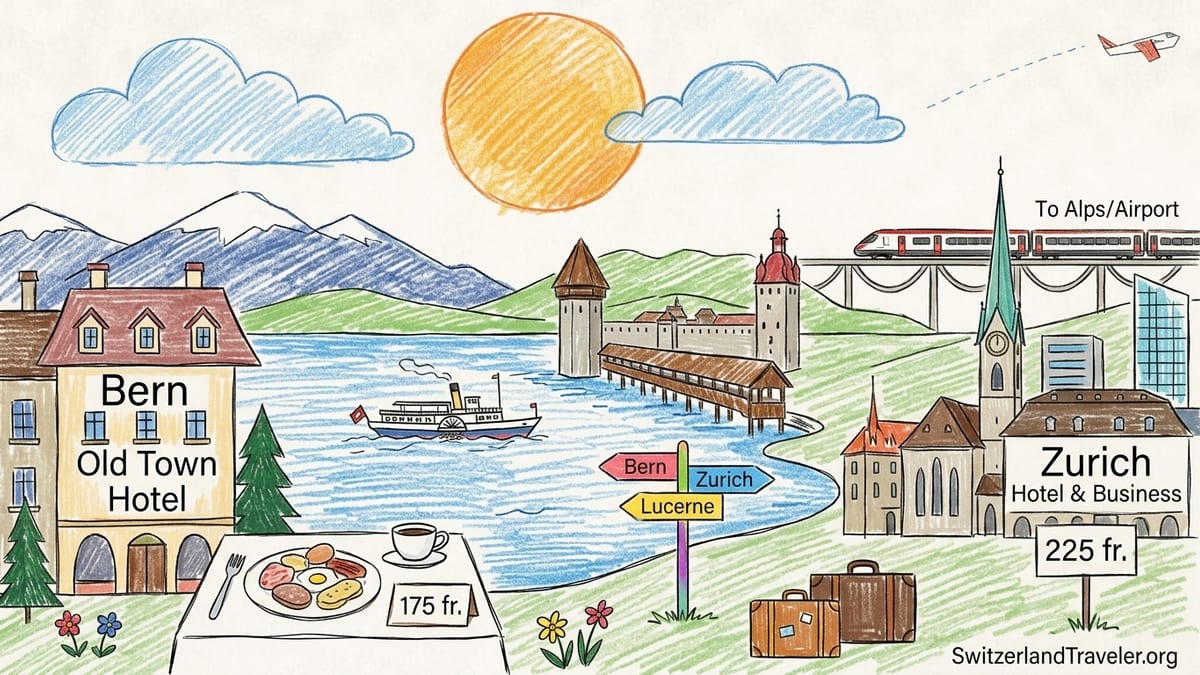
What I Actually Paid To Sleep In Each City
On my most recent visit in late September 2026, Zurich was clearly the most expensive place I slept. For a midweek night near Zurich Hauptbahnhof, in a clean but compact business‑style hotel with a 10–12 minute walk to the station, I paid just under the local median: 225 Swiss francs for a small double without breakfast. A rate snapshot that same week showed the median asking price across the city at the equivalent of a little over 230 US dollars per night, which matched what I saw scrolling through booking engines for anything central and decently rated. My receipt felt very typical for Zurich: polished, efficient, not remotely luxurious at that price point.
In Lucerne, my costs dropped slightly while the setting improved. I based myself twice near the river, roughly five minutes on foot from the railway station and Chapel Bridge. In spring 2024, I paid 210 francs for a bright corner room in a three‑star hotel overlooking a side street, with a glimpse of the Musegg Wall from the window and breakfast included. In autumn 2025, at a different property a block from the Reuss, a similar standard room cost 195 francs on a Sunday night. So in my own bookings, Lucerne consistently came in a notch below Zurich for similar comfort, especially if I avoided Saturdays and booked a few weeks ahead.
Bern was where my hotel budget finally exhaled. On a two‑night stay in July 2023, I chose a small family‑run hotel just beyond the Zytglogge clock tower, inside the arcaded old town. My rate was 175 francs per night for a double, including a simple but generous breakfast and a Bern city transport card. The room was plain, with soft beds and heavy curtains, but the location let me reach the river in six or seven minutes and the station in about ten. When I priced Bern again in 2026 out of curiosity, central three‑star options still tended to sit below comparable Lucerne and Zurich rooms, especially on weeknights.
Across all three cities, what surprised me was how much more my money “felt” worth it in Lucerne and Bern. In Zurich I paid a premium for being in the country’s economic hub and flight gateway. In Lucerne I could justify the price because I looked out of my window and saw water, mountains and frescoed facades in under five minutes’ walk. In Bern, the lower bill let me stay an extra night and slow down, which changed how the city landed with me.
Old‑Town Atmosphere: Where I Liked To Wander After Dark
Lucerne is the place where I kept putting the camera away and just walking. My clearest memory is a late May evening when a light rain had just stopped. I crossed Chapel Bridge around 9 pm, after most tour groups had left, and suddenly had long stretches almost to myself. The wooden beams smelled faintly of damp resin, the painted panels above my head glowed softly in the lamplight, and the Reuss below was dark except for reflections from the Jesuit Church across the water. Within five minutes I could slip off into tiny squares like Weinmarkt and Hirschenplatz, where frescoed facades leaned over cobblestones and only a handful of people lingered at outdoor tables. Lucerne’s old town is compact, but it feels like a stage set built specifically for slow evening wandering.
Bern’s old town, by contrast, felt lived‑in rather than staged, and that was exactly its charm for me. I remember walking down Kramgasse early on a July evening: trams humming through the middle, fountains splashing in the median, locals cutting across on their bikes and ducks of light under the sandstone arcades. Nothing about it was pristine. The sandstone blocks were worn and slightly darkened, shop windows displayed everything from cheese to second‑hand books, and below street level the vaulted “cellar” doors were opening into bars and small theaters. When I climbed up to the Rose Garden just before sunset and looked back across the Aare loop, Bern’s old town appeared as a dense wedge of tiled roofs and tower tops wrapped in forest and river. It felt like a real capital that happened to be beautiful, not a destination curated primarily for visitors.
Zurich’s old town took longer for me to warm to. My first evening I walked the classic route along the Limmat, crossing from one side to the other, and my first impression was of a pleasant but patchy riverfront with churches interrupting rows of shops and offices. The charm clicked later, around 10 pm on a Thursday, when I cut up into the narrower alleys between Grossmünster and Niederdorfstrasse. There, the jumble of tall houses, lanterns and tucked‑away bars finally gave me that sense of urban density and history. Zurich’s Altstadt felt less cohesive than Lucerne’s and less self‑contained than Bern’s, but it had an undercurrent of city energy I did not get elsewhere.
If I had to choose one old town to revisit on a quiet, atmospheric evening, I would pick Lucerne for romance and Bern for texture. Zurich’s old town is the one I would choose if I wanted those cobbled lanes plus the option to segue into a more modern nightlife scene without a long walk.
Eating Out, From Lakefront Dinners To Late‑Night Snacks
Lucerne was where I most enjoyed the simple act of going out to dinner. On my first stay, I arrived hungry after a long train ride and ended up at a small restaurant just off Kornmarkt, the kind of place with checkered tablecloths and maybe 40 seats. I ordered a plate of rösti topped with melted local cheese and onions and a small draught beer. The bill came to just under 40 francs, which felt fair given the central location and Swiss prices. Another night, I took a table beside the Reuss with a view of Chapel Bridge, paid around 55 francs for a main course of lake fish, a glass of white wine and coffee, and happily watched paddle steamers glide past.
Zurich, though, was where my food options widened out. On one visit I spent almost an entire day grazing. Breakfast was at a bakery café near Bahnhofstrasse where a cappuccino and a croissant ran close to 9 francs. Lunch was a plate at a vegetarian buffet chain that set me back around 25 francs but left me so full I skipped dessert. That evening, in Zurich West, I sat in a converted industrial hall sharing small plates and local craft beer with friends; our individual bills were around 60 francs each for food and drinks. Zurich is where I found tight natural‑wine lists, Southeast Asian street‑food stalls, classic Swiss knödel and high‑end tasting menus within a few tram stops of each other. If I wanted culinary variety without over‑planning, this was the city that delivered.
In Bern, my eating revolved around hearty lunches and relaxed, mid‑priced dinners. One midday I ducked into a restaurant under the arcades and ordered a plate of Bernese platter style meats and potatoes with a small beer. The bill, just over 30 francs, included a front‑row view of people sheltering from a sudden rain under the sandstone arches. Another evening, after swimming in the Aare, I joined a quieter crowd in a riverside beer garden where grilled sausages, salads and beer for two came to about 70 francs. Bern did not wow me with cutting‑edge cuisine, but it did match my idea of unfussy Swiss city eating at slightly friendlier prices than Zurich.
For travelers who define a trip by its restaurants, I would direct them to sleep in Zurich and day‑trip to Lucerne and Bern. From my own bookings and meals, Zurich simply had more depth and range. For those who prefer a smaller menu of solid, atmospheric options in walkable surroundings, Lucerne and Bern both worked very well, with Lucerne taking the edge for its riverside and lakeside tables.
Nightlife And How Each City Felt After The Sights Closed
Lucerne at night followed the rhythm of its size. On my spring stay, I noticed that many cafés and quieter bars near the old town squares wound down around 10 or 11 pm. But certain spots stayed lively. One Friday, I sat at an English‑style pub near the river, watching football on the screens with a mix of locals and visitors while Chapel Bridge glowed outside. The pub kept going until after 1 am, and on my walk back I passed a couple of late‑night kebab places doing steady trade. On another trip, a jazz‑leaning bar just off the river provided a small but energetic scene with live music and a mixed crowd. Lucerne’s nightlife never felt wild to me, but if I wanted one or two late drinks after a day on the lake or in the mountains, I could find them within a 10‑minute walk.
Zurich is where Switzerland’s “night city” stereotype made sense. On a Saturday night I followed the tram lines toward Langstrasse and found the density I had not seen elsewhere: cocktail bars with lines at the door, casual corner pubs, basement clubs, shisha bars and late‑opening takeaways. Around midnight, the sidewalks were busy in a way that reminded me of much larger European cities. Another evening in Zurich West, old factory buildings had been carved into bars and music venues, and I slipped between a wine bar, a live‑music space and a modest club without once checking a timetable. The key difference was simply that I did not have to plan. In Zurich, I could choose a neighborhood, show up after 10 pm and trust that something would be happening.
Bern occupied a middle ground that surprised me. Because many bars and cultural spaces are tucked under the street level in vaulted cellars, the city can look sleepy from above while quite a bit is going on below. One Thursday, after a sunset at the Rose Garden, I walked back into town expecting everything to be winding down. Instead, I dipped into a cellar bar near the Zytglogge where a local band was playing to a full room, and later into another smaller venue with an open‑mic night. Closing times skewed earlier than Zurich’s club scene, and on weeknights Bern never felt crowded, but it also did not shut down with the office lights.
Measured purely by nightlife, Zurich was the strongest base for me. Lucerne was the easiest place to add a sociable drink or low‑key live music to a day of sightseeing and mountain excursions, while Bern offered just enough underground culture to keep two or three evenings interesting without ever overwhelming the old town’s calm.
Lake And River Access: Where I Actually Got In The Water
The most immediate contact I had with water was in Lucerne. My hotel on one trip sat so close to the Reuss that I could hear the sound of the weir from my window with it cracked open. Within five minutes’ walk I could be on the riverside promenade, and another few minutes put me on a boat. One afternoon I boarded a classic paddle steamer from the pier opposite the station and rode out as far as Weggis, watching the city fall away behind us while Pilatus and Rigi shifted in the background. The round trip, about two and a half hours, was included under my Swiss Travel Pass that year, which meant there was no extra ticket stress. I did not swim directly in the lake at Lucerne, but knowing that public lakeside baths were a short walk or bus ride away was part of the appeal.
In Bern, I did swim, and it redefined how I thought of an urban river. On a hot July afternoon, I joined locals at one of the Aare access points upstream from the old town. People left their clothes and towels under the trees, put their valuables in waterproof pouches and stepped into the fast, cool water. I eased in cautiously, gripped the rail until I felt comfortable, then pushed off and let the current carry me past stone embankments and under a bridge, with the arcaded old town up on the ridge. Ten minutes later I climbed out using another set of stairs, heart racing and completely refreshed. That evening I walked back along the same stretch of river, now quiet and golden in the low sun, and realized that the Aare was not just scenery in Bern. It was the city’s summer living room.
Zurich’s relationship with water grew on me more slowly. Early one morning I watched commuters on bikes detour past the Limmat to take a quick look at the river before heading into offices. Later in the day, families and office workers alike filtered into the lake baths at the edge of Lake Zurich. I spent an afternoon at one of these lakeside facilities, paying a modest entry fee for access to platforms, changing rooms and a café. Swimming out a short distance, I could turn back and see church spires, low‑rise blocks and, faintly, the contours of the Uetliberg hill. For a city of its size and economic weight, Zurich is remarkably comfortable letting people into its central water spaces.
For water lovers, Bern gave me the single most vivid memory, Lucerne gave me the easiest and most scenic lake cruise, and Zurich showed how well a serious city can integrate swimming into everyday life. If you want to swim a river loop one day and take a storybook lake cruise the next, staying in Bern with a day trip to Lucerne, or vice versa, worked well for me.
Rail Connections, Day Trips And My Preferred Mountain Base
All three cities are well tied into Switzerland’s rail grid, but I found they played different roles when I used them as bases. Zurich was my international gateway. Landing at Zurich Airport, I could be on a train to Zurich Hauptbahnhof in about 15 minutes and then step straight onto onward services. From the main station, trains fan out to the rest of the country at dense intervals. When I needed to catch early morning long‑distance services or juggle flights and trains on the same day, Zurich felt unbeatable for pure logistics.
For mountain excursions, though, I personally preferred Lucerne as a base. From Lucerne’s lakeside station, I could walk directly from my hotel, cross one road and be on a platform for the boats and mountain railways. One day I did the classic round trip to Mount Pilatus, combining a lake boat, the steep cogwheel railway and the cable car back down. I left after breakfast, stood in a cool wind above the clouds just before noon, and was back on the riverfront in time for an early dinner. Another day I took a boat to Vitznau and connected to the cogwheel train up Mount Rigi, spending the afternoon on easy walking paths with wide lake views. Both days worked as relaxed, single‑day outings without fine‑tuning timetables, which is exactly what I want from a mountain base.
Bern put me in comfortable reach of a different set of landscapes. Trains from Bern reach the Bernese Oberland, including Interlaken and onward connections to Lauterbrunnen and Grindelwald, in about an hour or so. On one trip I used Bern as a base for a day up to the Jungfrau region. I left on a morning train, switched at Interlaken and was stepping out into high‑alpine air before lunchtime. The return involved more changes and took a bit longer than equivalent trips from Interlaken or Lucerne would have, but it let me come back to the same familiar city bed each night rather than checking in and out of another mountain town hotel.
If I were planning a first Swiss trip today focused on mountain excursions, Lucerne would still be my recommended base among these three, with Bern as an alternative if your sights are set on the Jungfrau area. Zurich, for me, remains the place to sleep near a big transport hub when I have flights or long train days at either end of the trip.
How Each City Felt Once The Main Sights Closed
The hours between 7 pm and 10 pm often decide whether I like a city, and in Switzerland that window can feel quiet compared with southern Europe. In Lucerne, evenings after the main sights closed were my favorite part of the day. Tour buses pulled out, day trippers to Pilatus and Rigi vanished, and the old town shrank back to near silence in its side alleys while the riverfront kept a soft murmur. I remember sitting on a low wall by the Reuss one night, sharing a takeaway gelato, with Chapel Bridge lit up across the water and only the sound of footsteps and quiet conversations around me. It felt safe, unhurried and just social enough. I never struggled to find a bar or café still serving, but I also never had to push through crowds.
In Zurich, evenings divided more sharply between busy pockets and quiet streets. Around Bahnhofstrasse and the immediate old town, many shops pulled their shutters well before 8 pm, which could make the area feel oddly empty. But if I walked ten or fifteen minutes in the direction of Langstrasse or Zurich West, the energy flipped. One Wednesday at around 9:30 pm, I walked out of a near‑empty riverfront into a dense corridor of cafés and bars where I could barely move without brushing someone’s stool. In Zurich, then, the enjoyment of the post‑sightseeing hours depended on whether I was willing to seek out those pockets. When I had the energy, the city rewarded me; when I did not, it could feel a little cold.
Bern’s evenings felt closest to how I like to travel. After dark, the arcades and sandstone facades absorbed the day’s heat, and people drifted along the streets rather than rushing. I could walk from the Federal Palace to the river in under 15 minutes and feel the mood shift from institutional to almost village‑like. One night, after dinner, I wandered through the Nydegg area and down toward the Bärengraben bear park, with just a handful of other people on the path. The city felt deeply calm without being abandoned. When I wanted company, the cellar bars and a few river‑adjacent spots provided it, but I never felt obliged to “go out” to enjoy Bern after dark.
Measured against my own preferences for relaxed but not empty evenings, Lucerne and Bern both suited me better than Zurich. Zurich was exciting on the nights I went looking for its energy. Lucerne excelled when I wanted a gentle riverfront stroll and one last drink. Bern shone when I wanted to drift through a beautiful capital that never felt like it was trying to entertain me.
Which City Worked Best For Different Types Of Trips
Across multiple stays, I found myself turning to each city for different reasons. For mountain excursions, Lucerne was clearly my preferred base. Being able to walk from my hotel to the boat pier or the Pilatus bus stop in five minutes meant mountain days felt like an extension of the city rather than separate expeditions. The Swiss Travel Pass tying together trains, lake boats and some mountain railways made the logistics even smoother when I used it, and the visual link between old town, river and looming peaks anchored the whole experience.
For a first Swiss trip, especially for someone flying into Zurich and anxious not to overcomplicate things, my ideal pattern based on experience would be one or two nights in Lucerne and one night in Zurich at the end. Lucerne gave my first‑time companions the “postcard” impression they were hoping for: Chapel Bridge, painted facades, lake boats and easy side trips into the mountains. Zurich at the end provided big‑city museums, shopping on Bahnhofstrasse, varied dining and a painless trip to the airport. When I traveled with friends who were indifferent to mountains but curious about urban life, we flipped it and spent more time in Zurich, using Lucerne as a day trip instead.
For nightlife and culture, Zurich was my go‑to. It is where I found late‑opening galleries, serious contemporary art collections, edgy performance spaces and the widest range of bars and clubs. When I traveled with a friend who likes to turn one drink into three and see live music on short notice, staying in Zurich and visiting Lucerne and Bern during the day worked perfectly. The trade‑off was higher accommodation and food costs, and fewer of those quiet, scenic evenings by the water that the smaller cities offered.
For slower city travel, especially when I wanted to work a little during the day and wander in the evenings, Bern suited me best. It was large enough to have proper museums and a steady calendar of cultural events, but small enough that I never had to think about public transport inside the center. The old town’s arcades provided shade and shelter, cafés served as my temporary office, and the Aare was always there for a break. When I needed a restorative base between mountain days or long rail legs, Bern gave me a grounded, local feeling without any pressure to tick off a list of “musts.”
The important point for me is that there was no universal winner. Lucerne excelled as a lake and mountain gateway and a first‑timer’s dream base. Zurich dominated when my priorities were nightlife, restaurant depth and cultural variety. Bern quietly became my choice for a slower, more lived‑in Swiss city experience, especially when my budget needed a gentler landing.
The Takeaway
Looking back at my receipts, photos and memories from Lucerne, Zurich and Bern, I do not see one city that “beats” the others. I see three different anchors for different kinds of Swiss trips. In Lucerne, the combination of slightly softer hotel prices than Zurich, walkable lake and riverfront, and direct access to mountains made it my preferred base when the landscape itself was the main event. In Zurich, paying more bought me time and choice: fast airport connections, serious museums, a deep restaurant scene and nightlife that did not end just as I was getting started. In Bern, the lower‑key atmosphere, river culture and friendlier nightly costs encouraged me to stay longer and travel more slowly.
If I were planning another journey tomorrow, I would still mix all three when time allows: start or end in Zurich for logistics and culture, sink into Lucerne’s old town and lake for mountain days, and give Bern at least a couple of nights to feel how a small capital can balance history, politics and easy swims in a glacial river. Rather than choosing a single “best” German‑speaking Swiss city, the most satisfying part of my own travels has been learning what each one is best at and matching that personality to the kind of trip I want.
FAQ
Q1. Is Lucerne, Zurich or Bern better as a base for a first trip to Switzerland?
For my own first‑time companions, Lucerne worked best as a base because it combined a compact old town, lake views and very easy mountain day trips, with Zurich added at the end for museums, shopping and the airport.
Q2. Which city felt most expensive once I added up hotels and meals?
Zurich was consistently the most expensive in my experience, especially for central hotels and restaurant dinners, while Bern usually came in as the most budget‑friendly of the three.
Q3. Where did I find the most atmospheric old town for evening walks?
Lucerne gave me the most “storybook” old‑town atmosphere after dark, with Chapel Bridge, the Reuss river and frescoed squares all within a short, quiet walk.
Q4. Which city had the strongest nightlife when I wanted bars and clubs?
Zurich clearly had the strongest nightlife, with busy areas like Langstrasse and Zurich West offering a dense mix of bars, live‑music venues and clubs that stayed active well past midnight.
Q5. Where did I most enjoy the river or lake itself, not just the views?
I had my most memorable swim in the Aare river in Bern, my favorite scenic lake cruise from Lucerne, and my best urban lake‑bath experience in Zurich, each in different ways.
Q6. Which city worked best as a base for mountain excursions?
For me, Lucerne worked best as a mountain base, because I could reach Mount Pilatus and Mount Rigi with simple boat and train combinations directly from the lakeside station without complicated changes.
Q7. If I want slower city travel and fewer crowds, which city would I choose?
Based on my stays, I would choose Bern for slower city travel, thanks to its walkable UNESCO‑listed old town, calmer evenings and quick access to the Aare for peaceful river walks and swims.
Q8. How did the cities feel after the main tourist sights closed for the day?
Lucerne felt gently lively along the river and very calm in back lanes, Zurich alternated between quiet central streets and energetic nightlife pockets, and Bern settled into a relaxed, neighborhood rhythm.
Q9. Is it realistic to visit all three cities in one trip?
Yes, it has been realistic in my experience. Fast trains link Zurich, Lucerne and Bern in roughly one hour or less, and I have comfortably combined all three over a week by limiting hotel changes.
Q10. How should I choose between these cities if I only have three or four nights?
If I had three or four nights, I would personally pick Lucerne for two nights as a scenic and practical base, then add either Zurich for nightlife and culture or Bern for a slower, more relaxed city feel, depending on my priorities.