

Over several trips to Switzerland, I have used Lucerne, Interlaken and Appenzell as bases for mountain days, lake cruises and slow village wandering. I have sweated up the Pilatus steps above Lucerne, queued for a Jungfraujoch departure from Interlaken Ost and walked into the Alpstein from Appenzell with bells from nearby herds echoing off the cliffs. This guide draws primarily on those firsthand days on the ground and clearly labels the few areas where I rely on current research, such as up to date ticket prices. My goal is not to crown a single winner, but to help you see which base best fits the style of Swiss mountain trip you have in mind.
First Impressions: Three Very Different Mountain Gateways
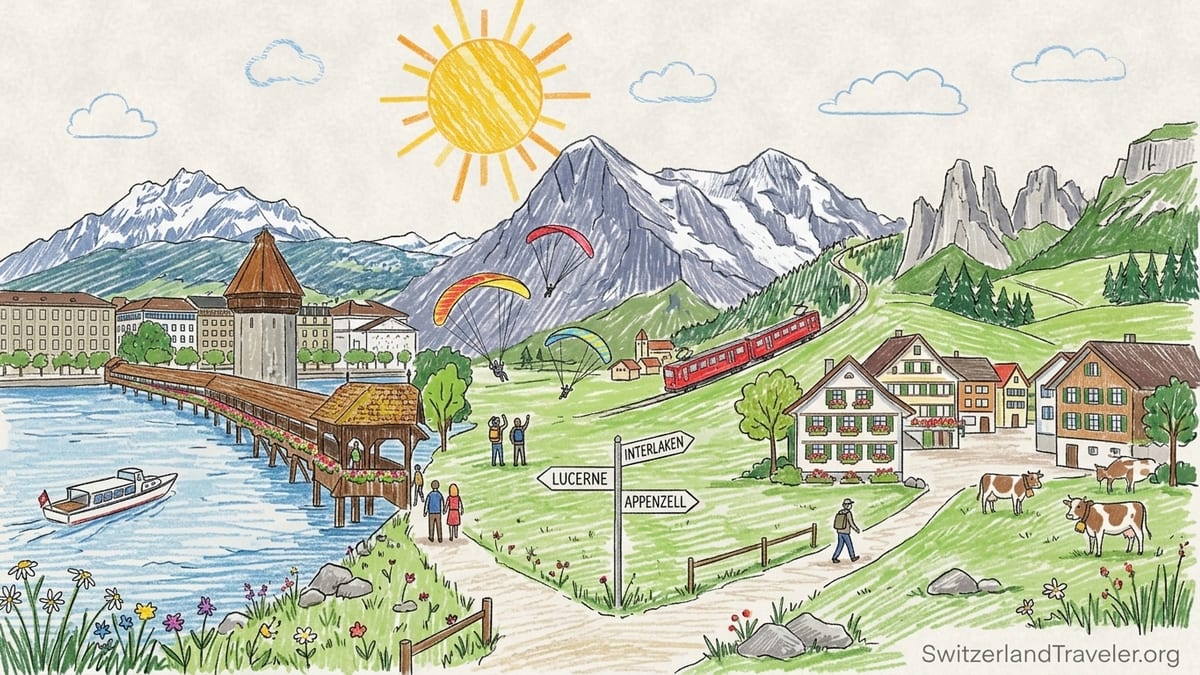
Lucerne feels like an old lake city that happens to have serious mountains at its doorstep. When I first arrived, walking out of the station and straight onto the quay for Lake Lucerne boats, the mix of water, medieval bridges and snow-streaked peaks in the distance felt instantly scenic but not yet “alpine resort.” I based there for four nights and each morning mixed city rituals, like coffee near Chapel Bridge, with quick escapes into the surrounding mountains.
Interlaken, by contrast, is a classic resort town stretched between two lakes with the Jungfrau massif towering beyond. My first time there I stepped off the train at Interlaken Ost and saw backpackers lining up for the early Jungfraujoch departure, paragliders already circling above Höhematte park and souvenir shops opening along Höheweg. It felt purposeful, as if almost everyone in town was here for one reason: to get into high alpine terrain as quickly and as often as possible.
Appenzell is different again. Arriving by local train, I walked from the small station through lanes of painted houses with flower boxes and almost no coach groups. Cows grazed just beyond the last houses. When I used Appenzell as a base for the Alpstein massif, my days began with a quiet stroll to the bakery, not a rush for a cable car queue. The mountains here are dramatic limestone towers, but the base town itself has a village scale and a local rhythm that never felt dominated by mass tourism.
These first impressions matter. If you want a mix of water, historic streets and moderate mountain outings, Lucerne will feel balanced. If you are chasing bucket list high-alpine excursions, Interlaken puts you closest. If you are more interested in quieter hiking culture and pastoral scenery with sharp peaks as a backdrop rather than a constant objective, Appenzell is likely to feel right.
Accommodation, Budgets and Evening Atmosphere
In Lucerne I stayed once in a midrange hotel near the station and once in a guesthouse a short walk over the Reuss. Both times I appreciated being able to reach the lake boats and trains within minutes. Room prices in central Lucerne were noticeably higher than Appenzell and roughly on par with Interlaken for similar quality, based on my bookings and current research. You pay a premium for the lakefront setting and polished city infrastructure, but even simple two and three star hotels were comfortable and efficient rather than luxurious.
Evenings in Lucerne have a distinctly urban feel. After a Pilatus day, I remember coming back on the bus from Kriens, showering and then joining both tourists and locals strolling across Chapel Bridge in the blue hour. Restaurants along the riverfront were busy but not chaotic, with plenty of choice from simple Swiss taverns to more upscale dining. I never struggled to find a table without a reservation outside peak summer weekends, though riverfront spots fill first. Nightlife beyond dinner is moderate: a few bars, some hotel lounges and people lingering by the water rather than a resort-party scene.
In Interlaken I tried one of the larger hotels near Höhematte and later a small family-run place in nearby Wilderswil. The town has a huge range of accommodation, from hostels popular with backpackers to upmarket grand hotels. Prices tend to climb in high season, especially during peak summer and around major events, and my research confirms that Jungfrau region demand keeps many properties near capacity in those periods. Evenings in Interlaken feel busier and more overtly touristy than Lucerne, with groups lingering in front of outdoor gear shops, Korean and Indian restaurants next to fondue places, and tour desks still open after dinner selling the next day’s excursions.
Appenzell is almost the opposite. My base there was a simple inn with traditionally painted shutters, a few minutes’ walk from the station. Room rates were significantly lower than my Lucerne and Interlaken stays for similar comfort levels, which matches current price ranges listed by local tourism. In the evenings, the main square was often quiet by 9 or 10 p.m. A few restaurants and hotel dining rooms stayed open, but there was no sense of a promenade scene. I spent most evenings sitting on a bench watching the light fade on the hills or chatting with locals at a small bar, which is perfect if you prefer early nights and calm over variety.
Mountain and Lake Access: Pilatus, Jungfrau and Alpstein in Practice
From Lucerne, mountain access felt almost effortless. My Pilatus day is still one of the most efficient mountain excursions I have done. I walked from my hotel to the pier in under 10 minutes, boarded a morning boat across Lake Lucerne to Alpnachstad and watched the city fade into forested shores and small coves. From there, the world’s steepest cogwheel railway climbed to Pilatus Kulm in about half an hour, past meadows and rock walls. The classic “Golden Round Trip” that combines boat, cogwheel railway and cable cars is sold as a single ticket, with current official information indicating starting prices for the round trip in the tens of francs range for holders of Swiss discount passes, and higher for full-fare travelers, with half-price reductions for Swiss Travel Pass and Half Fare Card holders.
Lake access from Lucerne is equally straightforward. Regular boats operated by the local navigation company leave from directly outside the station for destinations such as Vitznau and Flüelen. Current tariffs published by the operator show that a day pass valid on regular boats costs around the mid double digits in Swiss francs in 2nd class, with reductions for holders of common Swiss rail passes. On one stay, I used a day ticket to hop off at Weggis for a lakeside walk, then continue to Vitznau before riding back to the city on a later sailing. The combination of frequent departures and inclusion with many rail passes made spontaneous planning feel low-friction.
Interlaken’s mountain access revolves around the Jungfrau region. From Interlaken Ost, I joined early trains to Lauterbrunnen and Grindelwald for various days. My Jungfraujoch excursion started just after 8 a.m., connecting at Grindelwald Terminal to the Eiger Express cableway and then to the Jungfraubahn up to the Top of Europe station. Including the return, I spent a full day on the outing. Current sales materials and fare tables still list round-trip adult prices from Interlaken to Jungfraujoch in the high hundreds of francs for full-fare travelers, with substantial discounts if you hold products like the Half Fare Card, Swiss Travel Pass or region-specific Jungfrau passes. The logistics themselves were clean and punctual, but more complex and costly than my Pilatus day.
Appenzell’s Alpstein access feels more local in flavor. On my first Alpstein day, I took the short train ride to Wasserauen and walked a few minutes to the cable car valley station for Ebenalp. The aerial cableway runs up to a high plateau with wide views over Appenzell and the distant Lake Constance. From there I followed the path past the Wildkirchli caves and down to the Berggasthaus Aescher wedged against a cliff. Official information for the Wasserauen–Ebenalp cableway confirms seasonal operations and shows that return tickets are priced in the lower double digits of Swiss francs for adults, very modest compared with Jungfraujoch or even Pilatus. I also used other lifts like Kronberg and Hoher Kasten, all reachable with short bus or train rides from Appenzell village.
Hiking Styles: High Alpine Thrills vs Quiet Pastures
Lucerne’s hiking from town tends to be moderate. From Pilatus, I followed a ridge path for a couple of hours, with railings in exposed sections but no need for special equipment beyond good footwear. The trails above Krienseregg and Fräkmüntegg felt family-friendly, with forest paths and viewpoints over the lake. Another day I used the boat and cogwheel railway to reach Rigi, where I walked along panoramic paths between Staffel and Kaltbad, passing picnic areas and viewpoints where day trippers sat with takeaway coffee. The sense was of a mountain playground integrated with transport, ideal for first-time hikers or families who want views and short walks rather than committing to long, rugged routes.
The Jungfrau region, accessed from Interlaken, delivered the more intense high-alpine experiences. On a summer day I hiked from Kleine Scheidegg partway toward Wengernalp, with constant views of the Eiger, Mönch and Jungfrau. Another day, I took the train to Lauterbrunnen, then the cable car and train via Grütschalp to Mürren, and followed the North Face trail, where sections required a steady head for heights as the valley dropped away thousands of feet below. Even when I stayed on marked red-white paths, the scale of the terrain felt much more dramatic than around Lucerne.
Alpstein, from Appenzell, gave me something in between. The limestone peaks look severe from a distance, but many routes are accessible for fit day hikers. One memorable loop took me from the top of the Ebenalp cableway along paths contouring the cliffs, down past Aescher and then around lakes like Seealpsee. The soundscape was mostly cowbells and distant waterfalls rather than helicopters or constant train horns. Compared with Jungfrau trails, Alpstein paths felt less engineered and a bit rougher underfoot, yet rarely crowded. Waymarking was clear, and mountain inns dotted the routes so I could stop for soup and cheese without planning every detail in advance.
If your priority is a first introduction to Swiss mountain walking with clear bailout options and well-trodden surfaces, Lucerne’s Pilatus and Rigi network suits that perfectly. If you crave high-altitude drama and are comfortable with longer days and steeper gradients, Interlaken’s Jungfrau access is unmatched. For hikers who want fewer people than Jungfrau but more rugged character than the Lucerne foothills, Appenzell’s Alpstein is an excellent middle ground.
Tourist Crowds, Seasonality and Overall Atmosphere
On my Lucerne stays, crowds primarily concentrated in a few places: Chapel Bridge, the lakefront promenades and the embarkation piers when a big tour group arrived. Once I stepped a few streets back from the river or left on an early boat, the city felt manageable even in August. Pilatus could be busy at the summit on clear weekend days, but I found that taking one of the first boats from Lucerne helped avoid the longest queues. Outside high summer and around major holidays, Lucerne struck me as a working city with a steady flow of visitors rather than a town that exists only for tourism.
Interlaken was different. The first time I walked down Höheweg in July, the pavement was thick with tour groups, paragliding sales reps, chocolate shop displays and coach drivers waiting by the curb. At Interlaken Ost, the platforms for trains into the mountains filled repeatedly through the morning, especially on clear forecast days. Jungfraujoch itself felt like an international airport at altitude, with structured photo points and timed entry to some sections. This energy can be exciting if you feed off momentum and do not mind sharing viewpoints with a lot of others, but it can also be tiring if you prefer quieter experiences.
Appenzell, including peak season weekends, never gave me that feeling. The town hosts traditions and events that bring locals out, and trailheads like Wasserauen do get busy on sunny days, especially close to the cable car or near popular spots like Seealpsee and Aescher. But by comparison with Interlaken, the crowds felt modest. I was able to find empty stretches of trail within half an hour of leaving most lift stations. Even at popular mountain inns, I usually found a table without waiting long, provided I avoided the tightest lunch window in perfect weather.
Season also matters. In spring and autumn, Lucerne remains appealing as a cultural city with nearby low and mid-level walks even when the highest trails remain snowy. Interlaken’s prime season for full access to high routes is narrower, typically late June to September for the most exposed hikes. Appenzell’s Alpstein trails open gradually in late spring; earlier in the year you are more likely to focus on lower pasture walks and cable car viewpoints. In shoulder seasons, I personally find Lucerne and Appenzell more rewarding bases than Interlaken because they offer more to do if weather or snow limits high-alpine access.
Rail Logistics and Costs: How Quickly and How Expensively You Get Around
Staying in Lucerne, I found rail logistics pleasantly simple. The city is a hub in central Switzerland, with direct trains to Zurich, the airport and smaller lakeside towns. For mountain days, I mostly used boats and local buses in combination with cogwheel railways and cable cars. Because Pilatus and other local mountains are only a short ride away, transport times were modest, often under an hour from hotel door to summit station. When I combined these with regional travel passes such as the Tell-Pass or a Swiss Travel Pass on other trips, many of the core legs were either fully covered or heavily discounted, leaving only private mountain railway supplements to pay.
Interlaken required more planning and more budgeting. Just to reach the high sectors of the Jungfrau region, you string together normal SBB trains, regional lines and private mountain railways. My Jungfraujoch day combined multiple legs in each direction, each with its own fare rules. Recent official fare tables still show that a simple return from Interlaken to Jungfraujoch for a single adult without discount products can cost in the high triple digits in Swiss francs. Even with a Half Fare Card or Jungfrau Travel Pass, the day remains a significant expense. On the other hand, regional passes sold by the Jungfrau operators can bundle multiple days of mountain transport, and I have met travelers who based in Interlaken or nearby villages for four or five days and extracted good value by going up the mountains repeatedly.
In Appenzell, rail and lift costs felt lighter on the wallet. Local trains between Appenzell and Wasserauen or nearby villages are standard Swiss regional fares, and Alpine lifts such as Ebenalp, Kronberg and Hoher Kasten are individually priced, but all in the low to mid double-digit range in francs for a return ticket according to current official tariffs. Over several days, this still adds up, but my total outlay for lifts and trains in a three-day Appenzell stay was meaningfully lower than for a single Jungfraujoch excursion, even before discounts. Travel times were short, often 15 to 30 minutes from the village to a mountain transport.
If your budget for transport is tight, it is worth noting that Lucerne and Appenzell let you build satisfying days out with a mix of included public transport and reasonably priced lifts, while Interlaken’s headline high-alpine experiences demand a larger dedicated budget. For car-free travelers, all three bases work well; the whole point of my trips was to rely on rail, boats and lifts, and I never felt constrained in any of them.
Food, Culture and Evening Feel On the Ground
In Lucerne I enjoyed the widest culinary variety of the three. Within a short walk of the station and lakefront, I found traditional Swiss restaurants serving rösti and lake fish, Italian trattorias tucked into side streets and casual Asian spots near the station. After a Pilatus day, I remember ordering a simple plate of Älplermagronen in a wood-paneled restaurant near the river and watching small groups pass outside. Cultural options included a concert hall on the lakefront, museums and occasional events in the old town. If you like to pair mountain excursions with a bit of city culture and food choice, Lucerne serves that combination particularly well.
Interlaken’s food is more focused on international tourism. Along Höheweg and around the station areas I saw menus in many languages, with dishes tailored to visitors from across Europe, Asia and the Middle East. There are still traditional Swiss options and cozy hotel restaurants, but the overall feel is resort-oriented. One evening I ate a simple but good fondue in a side-street restaurant, then walked back along the park as paragliders landed on the grass in front of the grand hotels. It is lively, and for some travelers that is part of the charm.
Appenzell’s dining felt most rooted in local tradition. Many menus highlighted regional cheeses, sausages and seasonal dishes. After an Alpstein hike to Seealpsee, I came back to the village and ordered a plate of Siedwurst with creamy mashed potatoes in a small inn, surrounded by locals speaking dialect. The beer on tap was from nearby breweries, and servers took time to chat. Evening options were fewer, but the sense of place was strong. This is also where I felt most aware of local customs and festivals, from painted houses depicting regional stories to processions advertised on notice boards.
In terms of evening atmosphere, Lucerne balanced gentle city buzz with scenic lighting on the lake. Interlaken leaned into resort energy, with more late-opening venues and people in the streets after dark. Appenzell offered calm, with starry nights and early closures. Think carefully about how you like to end your days before choosing, because the same mountains will feel very different depending on whether you step out of your hotel into a quiet village lane or a buzzing resort promenade.
Which Base I Preferred for Different Types of Swiss Mountain Trip
For a first-time visitor to Switzerland who wants mountains, a lake and an easy introduction to public transport logistics, my personal preference is Lucerne. The combination of accessible excursions like Pilatus and Rigi, frequent boats on Lake Lucerne and a compact old town means you can have big scenery with relatively low stress. I have recommended Lucerne to friends doing their very first Swiss trip, and they have come back happy, particularly those with limited hiking experience or traveling with children.
For dedicated high-alpine excursions, especially if reaching glaciers and very high viewpoints is a priority, Interlaken and the Jungfrau region win in my own planning. When I wanted to stand at over 3,400 meters, walk through ice tunnels and stare directly at the north face of the Eiger, Interlaken was the only logical base of the three. I accepted the higher transport costs and busier environment as part of that choice. If I were designing a trip specifically to tick off Jungfraujoch, Schilthorn and perhaps Grindelwald First, I would base either in Interlaken or in one of the nearby villages like Wengen or Lauterbrunnen, using Interlaken mainly as a rail access point.
For quieter hiking and a deeper sense of local rural culture, Appenzell has become my favorite. The Alpstein massif gave me rugged, satisfying trails without the infrastructure intensity of the Jungfrau hotspots, and the village itself felt lived-in and relaxed. On days when I wanted to walk for hours and end at a simple mountain inn rather than a busy station complex, Appenzell delivered exactly that mood. It is also, in my experience and supported by current accommodation ranges, easier on the budget than the other two bases.
There is no universal winner here. Instead, think of Lucerne as the gentle gateway with water and approachable peaks, Interlaken as the launchpad to headline high-alpine experiences, and Appenzell as the quieter, culturally rich base for hikers who value calm as much as views. On my own future trips, I will keep returning to all three for different reasons: Lucerne when introducing friends to Switzerland, Interlaken when I crave big glacier days, and Appenzell when I want to walk in relative solitude among bells, cliffs and pastures.
FAQ
Q1. Which base is best if I only have three nights in Switzerland and want a mix of city and mountains?
For a short first trip, I would choose Lucerne. You can walk the historic center, cruise Lake Lucerne and do a Pilatus or Rigi day without complex logistics or very long travel times.
Q2. If I want to visit Jungfraujoch, do I need to stay in Interlaken itself?
No. Interlaken is a convenient hub, but many travelers prefer nearby villages such as Wengen, Lauterbrunnen or Grindelwald for atmosphere. You still connect through Interlaken Ost for many routes, but your nightly base does not have to be in town.
Q3. Is Lucerne a good base for serious high-altitude hiking?
Lucerne is better for moderate mountain days than for very high or technical routes. Pilatus and Rigi give superb views and good trails, but if you are focused on demanding high-alpine hikes, the Jungfrau region accessed from Interlaken offers more options.
Q4. How crowded is Interlaken in summer compared with Lucerne and Appenzell?
Interlaken is noticeably busier in peak summer, especially along Höheweg and at Interlaken Ost. Lucerne has concentrated tourist zones but more local life, while Appenzell remains the quietest of the three, apart from busy trailheads on sunny weekends.
Q5. Which base works best for a tighter budget?
In my experience, Appenzell is the most budget-friendly for accommodation and mountain transport, followed by Lucerne. Interlaken itself can be more expensive, especially once you factor in high-alpine excursions like Jungfraujoch.
Q6. Can I do good hiking in Appenzell without being an experienced mountaineer?
Yes. The Alpstein massif has a wide range of marked trails, from gentle walks near cable car stations to longer, steeper loops. With appropriate footwear and awareness of conditions, fit beginners can enjoy many routes.
Q7. If I am traveling car-free, which of the three bases is most convenient?
All three work well without a car. Lucerne and Interlaken are major rail hubs, and Appenzell is connected by reliable regional trains and buses. For the simplest overall network and onward connections, Lucerne and Interlaken have an edge.
Q8. How should I think about weather when choosing between these bases?
Lucerne and Appenzell offer more low and mid-level options when the high mountains are cloudy or closed. Interlaken shines in stable summer weather when high routes and viewpoints like Jungfraujoch are fully open and clear.
Q9. Are there good lake swimming options in all three areas?
Lucerne and Interlaken both have official lakeside lidos and accessible shores for summer swimming. Around Appenzell, swimming tends to be in smaller mountain lakes or trips to larger lakes such as Lake Constance, reached by regional transport.
Q10. If I have a Swiss Travel Pass, does that change which base is best?
A Swiss Travel Pass helps in all three, covering most regular trains, buses and many boats, and giving discounts on private mountain lifts. It particularly helps in Lucerne and Interlaken where you may combine several transport modes in a single day.