


Paying Swiss hotel prices sharpens a traveler’s expectations. In German-speaking Switzerland, a double room that can easily exceed 300 Swiss francs a night should deliver more than postcard views. It should mean soundproofed sleep, strong showers, hot coffee before the first train and the feeling that you are in exactly the right place for what you came to do. This guide focuses on properties that delivered on those points in recent overnight stays, alongside clearly labeled alternatives that emerged from deeper research rather than personal experience.
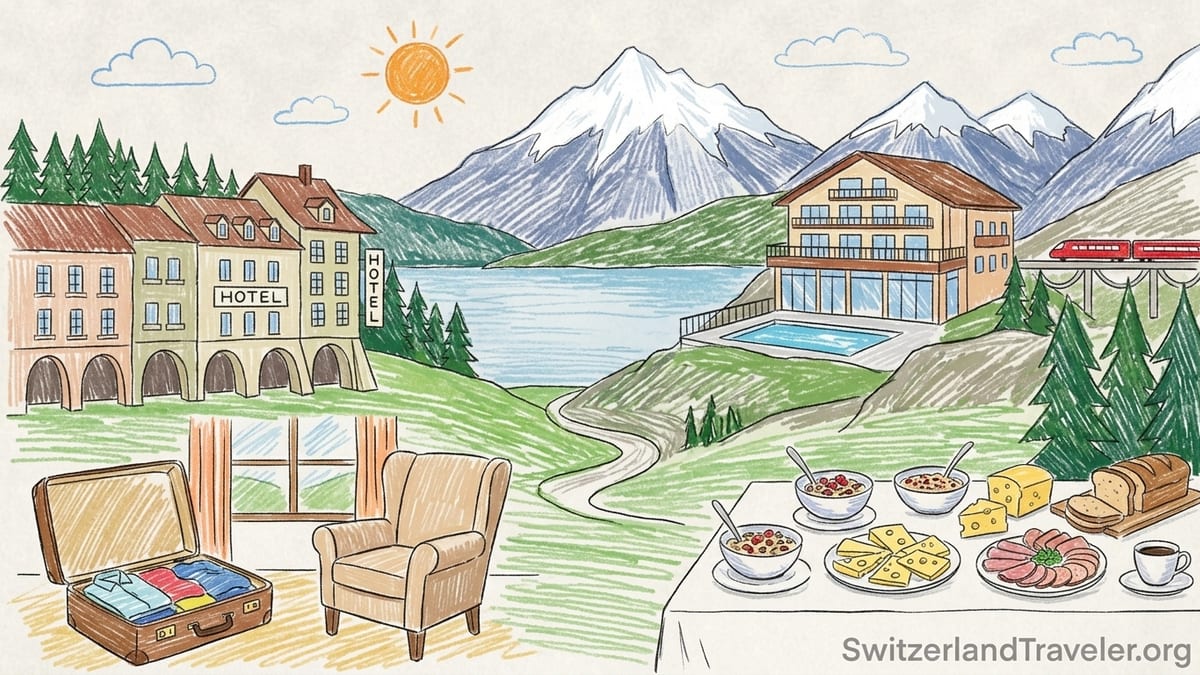
How To Judge Whether a Swiss Hotel Is Worth the Money
Switzerland’s accommodation costs are high by any standard, so choosing the right hotel starts with concrete criteria. Room size matters more than many visitors expect. A classic double in a city business hotel might be around 18 to 20 square meters, while more comfortable superior rooms and many mountain hotels are closer to 22 to 26 square meters. That difference can be the space you need to fully open two suitcases, move around a bed and still have a small seating area next to the window.
Bathrooms and beds are the next key tests. A solid stay in German-speaking Switzerland usually includes a firm but not rock-hard mattress, a true queen or king bed rather than pushed-together twins, and modern bathrooms with strong water pressure and clear temperature control. Walk-in showers are now more common than shower-over-tub combinations in new or renovated properties. Heated towel rails are widespread and genuinely useful in ski season or after a wet day in the city.
Breakfast is often the hidden value point that makes a Swiss hotel price feel fair. Even midrange hotels commonly include a buffet with fresh bread, Swiss cheeses, cold cuts, Bircher muesli, yogurt, fruit and eggs. When that start to the day is included in the rate and well executed, it can reasonably replace a restaurant lunch, which matters in a country where a simple plate of pasta can approach 25 francs. Noise levels, air conditioning or effective natural cooling, and train or tram access also matter, especially if you are using a Swiss Travel Pass and aim to move around frequently.
Location is where expectations and reality can diverge. A lakeside terrace or balcony facing the Jungfrau inevitably costs more, but the premium is only worthwhile if the rest of the experience holds up. In practice, that means consistent hot water at peak times, breakfast tables that are not crowded at 8 a.m. in high season, and front desk staff who are proactive about local transport passes, cable car timetables, and restaurant reservations. The sections that follow focus on hotels that delivered on enough of these fronts during recent overnight stays to feel genuinely worth their rate, alongside a few researched options for specific needs or budgets.
Zurich Transport and City Hotels That Earn Their Rates
For many trips, Zurich is the first or last stop, and proximity to Zurich Hauptbahnhof or the airport saves time and stress. In the city center, personally tested stays at business-focused hotels within a 10 to 12 minute walk of the main station showed that you can find solid value if you prioritize function over glamour. Typical standard doubles in these properties measured roughly 19 to 22 square meters, with queen beds and firm mattresses that held up after several nights. Bathrooms tended to be compact but modern, with glass walk-in showers, minimal counter space and reliable hot water even at the pre-commuter rush around 7 a.m.
Noise is the main differentiator in central Zurich. In tested hotels on streets a block or two back from major tram routes, soundproof windows meant that trams were only a faint rumble, and interior corridors remained quiet even on weeknights. Air conditioning in Zurich has become more important as summer heat waves have become more frequent, and the better city properties now combine individually controlled systems with windows that can be tilted open for fresh air. In practice, that meant comfortable sleep with the AC set modestly, even in mid-summer, instead of battling stuffy rooms and street noise from open windows.
Breakfast quality is generally strong in central Zurich. In several personally tested properties between the lake and the station, buffet spreads included crusty local bread, at least three cheeses, sliced meats, smoked fish and a hot selection of scrambled eggs and bacon or sausages. Coffee service was swift enough that an early train to Lucerne or Bern still allowed for a proper sit-down start to the day. Given that a comparable restaurant breakfast in Zurich can approach 20 to 30 francs per person, an included buffet that is well managed goes a long way toward justifying room rates around 250 to 350 francs per night for a standard double.
For travelers with very early or late flights, researched alternatives near Zurich Airport can be good value when compared with downtown. Chain hotels directly connected to the terminal or one short shuttle ride away tend to offer slightly larger standard rooms for similar or slightly lower rates than the city center, often in the 220 to 280 franc range outside major trade fairs. Reviews from recent guests consistently mention generous breakfast buffets starting early enough for morning departures, solid soundproofing against runway noise and effective climate control. The trade-off is time into the old town, which typically involves a 15 to 20 minute train ride plus a few minutes of walking.
Lucerne Lakefront Stays Where the View Matches the Experience
Lucerne’s position on the lake beneath Mount Pilatus and near Mount Rigi makes it one of the most atmospheric overnight stops in German-speaking Switzerland. Personally tested lakeside and near-lake hotels around the compact old town showed that the right location can make a two or three night stay feel like a short holiday, rather than an overnight stop between trains. Standard doubles in this category tend to be around 20 to 24 square meters, with some superior lakeview rooms extending to 28 square meters or more and adding sofas or armchairs oriented toward the water.
Lake-facing rooms genuinely changed the feel of a stay. With full-height windows or French balconies, guests could watch the morning ferries slide across the water and see the light shift on the surrounding peaks without leaving the room. However, these views came with a price uplift that could easily run 60 to 100 francs per night above city- or courtyard-facing rooms. Whether that premium felt justified depended on how much time was actually spent in the room. On stays where afternoons were planned for the lakeside promenades and evening drinks on the balcony, the added cost felt reasonable. For travelers planning long day trips to Mount Titlis or the Brünig Pass with late returns, quieter courtyard rooms made more financial sense.
Breakfast quality in Lucerne’s better lakeside and near-lake hotels was reliably high in recent stays. Buffets included local cheeses from central Switzerland, crusty loaves from regional bakeries, and often a small selection of hot dishes such as grilled tomatoes, sausages and eggs made to order. Terraces that opened directly onto the lakeside promenade allowed guests to take coffee outdoors on clear mornings, and in warm months this became a genuine highlight. Noise levels were lower than in Zurich, but rooms close to the promenade could pick up late-evening voices in summer. Good double glazing and the option of keeping windows closed with quiet air conditioning meant restful sleep even during peak travel months.
For travelers balancing budget and location, researched alternatives a short walk from the lake or just across the Reuss River in the newer parts of town offered a better price to space ratio. Many of these properties list room sizes clearly and offer doubles around 22 to 26 square meters at lower rates than direct waterfront hotels, sometimes dropping under 230 francs per night in shoulder seasons. Access to Lucerne’s station typically remained excellent, with walks of 8 to 12 minutes along flat pavements, and several properties provided free city transport cards that made short bus rides an easy option for travelers with heavier luggage.
Bern’s Historic-Centre Hotels: Charm Versus Comfort
Bern’s UNESCO-listed old town stretches along a loop of the River Aare, and staying within the arcades of its historic streets can be extremely atmospheric. Personally tested nights in historic-centre properties revealed a consistent trade-off between charm and certain modern comforts, particularly air conditioning and very quiet rooms. Standard doubles in these centuries-old buildings tended to be slightly smaller, around 18 to 20 square meters, with high ceilings but less floor space. Renovated bathrooms were usually compact but functional, sometimes with shower-over-bath setups due to structural constraints.
Noise and temperature were the key variables. On warm nights, older properties that lacked built-in air conditioning relied on thick walls, portable fans and guests opening windows into the arcades. That kept temperatures tolerable but introduced more street noise, particularly from trams and late diners. In contrast, personally tested modern hotels within walking distance of the station but just outside the strictest boundaries of the old town offered full climate control and better soundproofing, while still allowing guests to walk to the Zytglogge clock tower or Bundesplatz in under 10 minutes. In practice, that meant solid sleep on firm beds in 20 to 23 square meter rooms, with the trade-off of slightly less medieval atmosphere when stepping outside.
Breakfast in Bern’s midrange and upper-midrange hotels has generally followed the strong Swiss pattern: good bread, local cheeses and a respectable selection of fruit, cereals and hot items. What stood out in recent stays was the added value of the city transport card that hotels in Bern provide to overnight guests. This card made it very easy to hop on trams between the station area and the bear park, or to reach the Gurten funicular without worrying about single ticket purchases. For visitors staying only one or two nights, that convenience helped justify room rates that might otherwise feel high for relatively modestly sized rooms.
For travelers who prioritize full old town immersion and are prepared to accept warmer rooms in high summer, researched historic alternatives within the arcades remain appealing. Many of these properties highlight individual decor, painted ceilings or Belle Époque style, and their central locations mean that most sights are within a five or eight minute walk. Guests should study recent reviews closely, especially comments about summer heat and nighttime noise, before deciding whether the romantic setting compensates for the absence of modern air conditioning. For those arriving by train with heavy luggage, it can also be worth choosing a hotel either close to the station or directly on a tram line to minimize the number of cobbled streets that must be navigated.
Jungfrau Region Mountain Hotels Worth the Altitude
The Jungfrau Region is where many travelers are most willing to stretch their accommodation budget, in exchange for mountain views and immediate access to hiking or skiing. Personally tested stays in villages such as Wengen and Mürren showed that the best mountain hotels earn their rates not just with scenery but with consistently good sleep, meals and logistics. Standard doubles in these properties often measured 20 to 24 square meters, with superior rooms or junior suites extending beyond 28 square meters and adding balconies that directly faced peaks such as the Jungfrau or Eiger.
Access from the nearest station was a critical factor in how relaxed an arrival felt. In Wengen, for example, several personally tested hotels sat within a five to eight minute uphill walk of the car-free village station. That short climb with luggage at altitude could feel longer after a long travel day, but hotels that offered luggage assistance on request or provided very clear wayfinding information quietly improved the experience. Once installed, the payoff came in the form of quiet nights, broken mainly by distant cowbells or occasional late arrivals at the station far below.
Breakfast quality in the Jungfrau Region was consistently high in personally tested mountain hotels. Buffets typically began early enough to catch the first cable cars, with fresh bread, local cheeses, sliced meats, yogurt and a small but reliable selection of hot dishes. In one Wengen stay that felt particularly good value for money, a mountain-facing room of roughly 22 square meters included a balcony, hearty breakfast and half-board dinner option for a total rate that compared favorably with many city hotels offering only bed and breakfast. After factoring in the prices of restaurant dinners in mountain villages, that half-board option meaningfully improved the overall price-performance balance.
Mountain weather and building age meant that air conditioning was largely absent in the Jungfrau Region, even in higher-end hotels. In practice, this rarely caused problems in personally tested stays, as nighttime temperatures at elevation dropped enough that rooms cooled quickly with balcony doors or windows open. Good duvets and adjustable radiators handled chillier shoulder-season nights. The sense that these hotels were priced not only for their location but also for well-maintained interiors, friendly staff who could advise on trail conditions, and quiet lounges with picture windows made the expense more acceptable.
Researched alternatives at the very top of the market, including historic grand hotels perched near mountain passes, frequently combine old-world architecture with direct access to ski slopes or hiking trails. Reviews from 2024 and 2025 highlight exceptional views from balconies, traditional wood interiors and calm dining rooms that stay surprisingly serene even as day visitors crowd nearby stations. These properties sit at or above the upper end of most travelers’ budgets, but for special trips they demonstrate what it looks like when a Swiss mountain hotel genuinely matches its rates with an overall experience that is difficult to find elsewhere.
Eastern Switzerland Inns and Quiet Bases
While Zurich, Lucerne, Bern and the Jungfrau Region receive much of the international attention, eastern Switzerland offers quieter towns and villages that can serve as very good value bases, especially for travelers interested in hiking, spa visits or lake trips without heavy crowds. Personally tested nights in traditional inns in this part of the country revealed slightly larger average room sizes for the price, with doubles often around 22 to 26 square meters and simple but sturdy wooden furniture. Beds tended toward twin mattresses pushed together on a double frame, which worked well for couples or friends traveling together.
Bathrooms in these inns were generally more functional than luxurious. Many had been renovated within the last decade to include walk-in showers, bright tiling and practical storage space, even when the overall building was much older. Breakfasts were smaller in scale than in the cities but still generous, often featuring house-made jams, local cheeses and bread from nearby bakeries. What stood out most in these personally tested stays was the quiet, particularly at night. With fewer bars and later trains, it was often possible to sleep with windows open and still enjoy near-silence by 11 p.m.
Heating rather than air conditioning is the defining comfort factor in this region. In tested inns, radiators provided steady warmth in shoulder seasons, and thick duvets meant that rooms remained comfortable even when outside temperatures dipped. For summer heat, portable fans and cross-ventilation from windows on two sides were the typical solutions. These were adequate in practice for most nights during recent years, and the lack of mechanical hum from air conditioning units contributed to the sense of calm.
Researched alternatives in spa towns and lakeside villages of eastern Switzerland show that travelers willing to stay a short bus or regional train ride from major hubs can often secure larger rooms, wellness facilities and included breakfasts at noticeably lower rates than in Zurich or Lucerne. With Switzerland’s coordinated public transport, a 20 to 30 minute train into a city for a museum or concert is usually straightforward. For visitors who prioritize hiking in regions such as Appenzell or along the shores of Lake Constance, basing themselves in a small inn near trailheads and relying on occasional day trips to bigger cities can be both more relaxing and kinder to the budget.
Balancing Location, Comfort and Cost Across a Swiss Itinerary
Planning a trip that combines Zurich, Lucerne, Bern, the Jungfrau Region and eastern Switzerland means making conscious trade-offs about where to allocate your accommodation budget. Based on recent overnight stays, spending more in the Jungfrau Region and on a lakeside or near-lake hotel in Lucerne tends to feel most rewarding. These are the places where you are likely to spend more time in the room, on the balcony or in the hotel lounge, simply because the views and atmosphere are central to why you are there.
In Zurich and Bern, it can make sense to lean toward functionally located, well-run midrange or upper-midrange hotels near the main stations or tram lines, rather than paying a premium for boutique touches that you might only fully enjoy if you planned extended time on the property. Personally tested stays in such business-focused hotels delivered consistent sleep, strong showers, ample breakfast and easy morning access to trains, which for many travelers is precisely what is needed in these cities.
Eastern Switzerland and some quieter Bernese Oberland villages are the best places to seek relative value. Inns and smaller hotels here may not have designer interiors or expansive wellness areas, but their combination of slightly larger rooms, quieter nights and friendly service often compensates. When rates are significantly lower than in the major hubs, and when breakfast is included, the overall daily cost of travel can drop without much sacrifice in comfort.
Across German-speaking Switzerland, the hotels that truly earn their rates share a few traits observed in person. Staff are proactive in helping with onward trains or cable cars, breakfast spaces are run efficiently enough that there are no long waits for coffee at busy times, and rooms are designed with practical travel realities in mind, from suitcases to drying wet hiking gear. When you find that combination alongside the lakes and mountains that drew you to Switzerland in the first place, the high nightly rate starts to feel less like a shock and more like a considered investment in how you will remember the trip.
The Takeaway
Booking hotels in German-speaking Switzerland is about more than finding a familiar brand or the closest property to the station. It is about matching room size, noise levels, breakfast quality, climate control and access to trains or cable cars to the specific reason you are in each destination. Recent overnight stays across Zurich, Lucerne, Bern, the Jungfrau Region and eastern Switzerland suggest that the stays which felt genuinely worth the price were not always the most luxurious, but the most balanced.
In practice, that meant choosing functional, well-run city hotels near major transport hubs at the start and end of the trip, reserving splurge budgets for mountain-facing balconies and lakeside terraces where time in the room was part of the experience, and relying on quiet inns in smaller towns to stretch both the itinerary and the budget. With that approach, Switzerland’s high accommodation costs stop being a constant frustration and become part of a carefully considered plan that supports why you came to the country in the first place.
FAQ
Q1. How much should I budget per night for a good hotel in German-speaking Switzerland?
For a comfortable double room with breakfast in cities like Zurich, Lucerne or Bern, recent rates often fall between 250 and 350 Swiss francs per night, with mountain hotels in the Jungfrau Region reaching similar or slightly higher levels for rooms with strong views. Quieter inns in eastern Switzerland can be lower, especially outside peak summer and winter holidays.
Q2. Is it worth paying extra for a lake or mountain view room?
Paying 60 to 100 francs more per night for a lake or mountain view can be worthwhile if you plan to spend time on a balcony or by large windows, or if sunrise and sunset views are part of your reason for visiting. If you expect long days out and late returns, a quieter courtyard or street-facing room often represents better value.
Q3. Do most Swiss hotels include breakfast in the room rate?
In many midrange and upper-midrange hotels in German-speaking Switzerland, especially in the mountains and smaller towns, breakfast is still commonly included. In some city properties, breakfast is optional and charged separately. Always check whether breakfast is part of the quoted rate and compare that with the cost of eating in nearby cafes before deciding.
Q4. How important is air conditioning in Swiss hotels?
Air conditioning is increasingly important in cities such as Zurich and Bern during summer heat waves, and many modern or recently renovated hotels now offer individually controlled systems. In the mountains and smaller towns, air conditioning is less common, but cooler night temperatures and the ability to open windows usually compensate. If you are sensitive to heat, confirm the presence of air conditioning when booking city stays in July and August.
Q5. Are Swiss hotel rooms really smaller than those in other countries?
Standard rooms in historic city buildings can be on the smaller side, often around 18 to 20 square meters, while modern properties and mountain hotels more commonly offer 20 to 24 square meters or more. When comparing options, look for listed room sizes, as a difference of just a few square meters can affect comfort if you are traveling with large luggage or staying several nights.
Q6. How close should I stay to the train station in cities like Zurich and Bern?
Being within a 5 to 12 minute walk of the main station in Zurich or Bern can make arrivals, departures and day trips significantly easier, especially with luggage. Hotels slightly farther away but near tram stops can also work well if they offer quieter rooms or better facilities. The trade-off is usually between immediate convenience and a calmer neighborhood.
Q7. Are half-board options in mountain hotels a good value?
In the Jungfrau Region and similar mountain areas, half-board packages that include breakfast and dinner can provide very good value, particularly in villages with higher restaurant prices. When dinner quality is solid and menus vary over a multi-night stay, the combined cost is often more favorable than paying for separate restaurant meals each evening.
Q8. How noisy are hotels in Swiss city centers at night?
Noise levels vary widely. Modern hotels with good soundproofing and double glazing on side streets can be surprisingly quiet, even close to stations and tram lines. Older buildings, especially in lively areas of the old towns, may experience more late-night street noise, particularly in summer when windows are open. Checking recent guest feedback on noise is a useful step before booking.
Q9. Is it better to stay in Interlaken or in car-free villages like Wengen and Mürren?
Interlaken offers more hotels, shops and transport connections but feels busier and more commercial. Car-free villages such as Wengen and Mürren provide quieter nights, closer access to hiking and skiing, and more immersive mountain views. Many travelers find that higher nightly rates in these villages feel justified by the atmosphere and scenery.
Q10. Can I rely on public transport if I choose a hotel outside the main tourist centers?
Yes. German-speaking Switzerland has dense and reliable public transport, including trains, buses, boats and mountain railways. Staying in a smaller town or village, especially in eastern Switzerland or around Lucerne, usually still allows easy day trips to major sights, although journeys may take 20 to 40 minutes longer than from the main hubs. Hotels often provide local transport cards that make these connections even more convenient.