

The Valais Wine Route between Martigny and Leuk is one of Europe’s most rewarding wine journeys, a 65 kilometre band of stone walled terraces that track the upper Rhône River past medieval villages, irrigation channels and sun soaked slopes. More than four thousand hectares of vines climb the valley sides here, making Valais Switzerland’s largest wine region and a destination where wine tourism is a compelling reason to visit in its own right rather than a side activity tacked onto a ski trip or summer hike.
Why the Valais Wine Route Belongs on Your Wine Travel Map
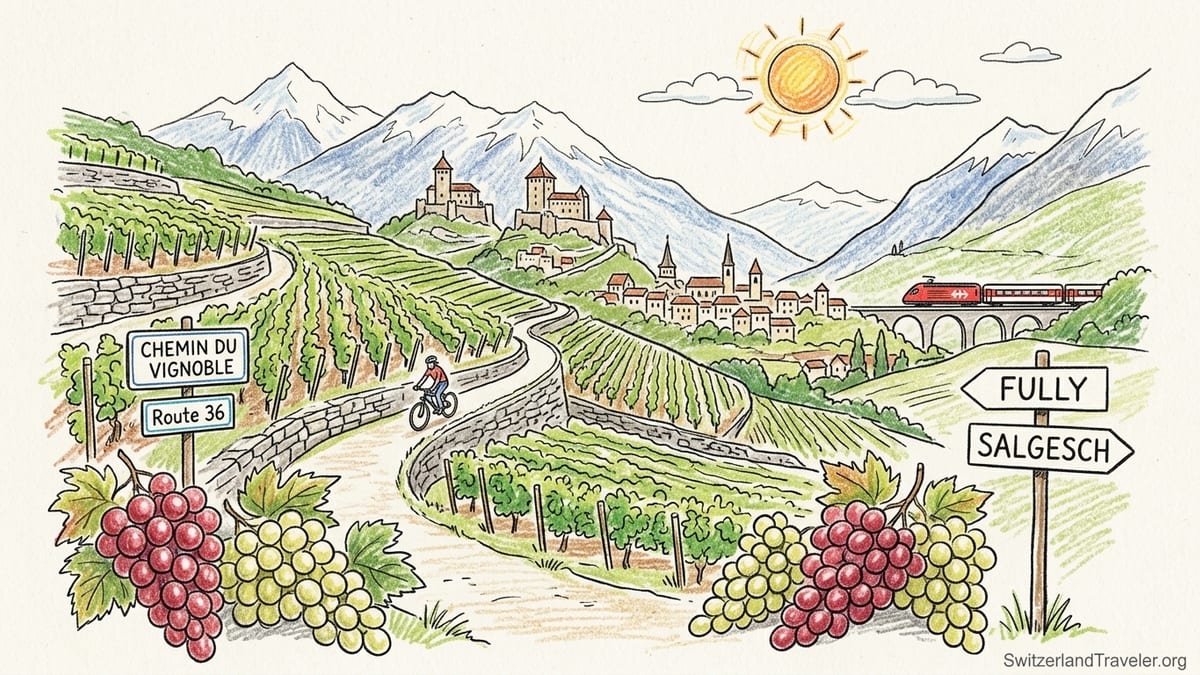
The Rhône Valley in Valais is where Switzerland’s wine story feels most alive. From Martigny to Leuk the Chemin du Vignoble, or Vineyard Trail, threads through around 65 kilometres of almost continuous vineyards, connecting villages such as Fully, Saillon, Sion, Sierre, Salgesch and Visp. Official tourism bodies describe this as the best way to experience Valais wine country, whether on foot, by e bike or by linking stages with trains and buses. The signage uses national route number 36 and is well marked in both directions, so independent travellers rarely feel lost.
Wine is not a minor crop here. Valais accounts for a significant share of Swiss vineyard surface, with roughly 4,500 hectares under vine along the Rhône and its side valleys. Local tourism boards and wine agencies emphasise that more than fifty AOC grape varieties are grown, and although international names like Pinot Noir and Chardonnay appear on labels, the real reason to come is to taste local originals such as Petite Arvine, Cornalin, Humagne Rouge and Amigne. These grapes seldom leave Switzerland in quantity, which means the bottles you find in village cellars are hard to encounter elsewhere.
The landscape makes the experience distinctive. Between Martigny and Leuk, terraced vineyards climb from about 450 metres on the valley floor to well over 800 metres on steep south facing slopes, often supported by dry stone walls that are centuries old. These terraces, combined with Valais’ famously dry, sunny continental climate, create a patchwork of micro terroirs. As you travel east you are not simply moving along one continuous wine region; you are crossing a mosaic of exposures, soils and elevations that shift the taste of the wines every few kilometres.
Practically, the region is easy to reach. InterCity trains connect Geneva Airport with Martigny and Sion in roughly two to three hours, and local Regio services stop in the small wine towns. This rail backbone lets visitors treat wine tasting as a point to point journey without needing to drive. Day passes and Saver Day Passes sold by the national rail operator often bring the cost of a day of unlimited regional travel into a predictable range, which makes building a multi day wine itinerary easier to budget.
Martigny to Fully and Saillon: Gateway to Petite Arvine Country
The western end of the wine route feels almost Mediterranean. Martigny, with its Roman ruins and a cluster of museums, is the practical base for many travellers. Just beyond the town the first official stage of the Chemin du Vignoble, sometimes signposted as the Wine Route Branson Saillon, climbs through old terraces above Branson and Fully toward the medieval village of Saillon. Tourism descriptions highlight old chestnut groves, converted hydroelectric buildings such as La Belle Usine that now host cultural events, and uninterrupted views over the Rhône plain.
Fully, just northeast of Martigny, markets itself as a stronghold of Petite Arvine. Swiss and international wine writers increasingly single out growers here, and one local producer received the first 100 point score from a major international critic for a Petite Arvine wine in 2023. Petite Arvine is a white grape that combines citrusy acidity with a saline, almost grapefruit pith finish, and it pairs especially well with river fish, raclette or tomme cheese. Tasting it in Fully, on terraces that face south toward the valley, helps connect the grape’s crispness with cool nights and strong sun.
Saillon, reached after roughly 10 to 12 kilometres of walking from the outskirts of Martigny depending on the exact route, is a compact medieval village wrapped in vineyards. The tourist office promotes a dedicated vineyard walking trail and positions Saillon as both a stage finish and a starting point for further exploration toward Sion. Visitors often combine a morning hike from Fully or Branson to Saillon with an afternoon tasting in one or two village cellars followed by a return by bus 311 to Martigny or onward to Sion. This pattern keeps walking distances comfortable while allowing relaxed time at tasting counters.
For cellar visits in this western sector, many small family domaines open their doors on Friday afternoons and Saturdays, and some schedule midweek hours by appointment. It is common to pay a modest tasting fee that may be waived with bottle purchases. Because opening hours vary widely between producers and can change at short notice, particularly outside peak season, the safest practice is to email or call at least a few days ahead and request a time, even if a cave advertises walk in hours. In French speaking Valais, a short message explaining that you are travelling along the Chemin du Vignoble and would like to taste Petite Arvine and local specialities is usually warmly received.
Saillon to Sion: Vineyard Trail, Bisse de Clavau and Native Grape Heartland
The official Vineyard Trail stage between Saillon and Sion covers about 21.7 kilometres and is described by local tourism offices as a medium difficulty day of around six and a half hours of hiking. The route crosses the territories of villages such as Chamoson, Ardon, Vétroz and Conthey before descending to Sion. This is one of the most instructive parts of the entire wine route, because you traverse the birthplace of several native grapes and feel how modest changes in elevation and exposure alter the character of the wines poured in tasting rooms.
Near Chamoson and Ardon the terraces broaden, and producers work both classic Swiss grapes like Chasselas and red varieties such as Pinot Noir and Syrah. By the time you reach Vétroz, you are in the birthplace of Amigne, a rare white grape that has become a flag bearer for this village. Official descriptions point out that Vétroz is recognised as the cradle of Amigne, and some producers classify sweetness using one to three bees on the label. Dry versions with one bee work well as aperitif wines or with freshwater fish, while sweeter versions marked with two or three bees pair naturally with fruit tarts or blue cheese.
As you approach Sion, the canton capital, the Vineyard Trail links with one of Valais’ most famous irrigation channels, the Bisse de Clavau. Built in the 15th century to bring water from the Lienne river above Saint Léonard, this bisse runs for about eight kilometres along steep vineyard slopes and is bordered by stone walls. Tourism offices describe it as providing commanding views over Sion and the Rhône valley, with small guérite hut restaurants dotted among the vines serving simple local dishes such as charcuterie platters and raclette with glasses of Fendant or Petite Arvine. Walking a section of the bisse in the late afternoon, when shadows lengthen across the valley, is among the most memorable wine experiences in Valais.
Sion itself offers a more urban style of wine tourism. Several producers maintain cellars or tasting rooms within or just outside town, and the local wine museum often runs exhibitions on Valais viticulture. Here travellers are likely to encounter Cornalin and Humagne Rouge more frequently. Cornalin du Valais, also known as Rouge du Pays, typically produces deep coloured reds with dark fruit and herbal notes that pair with game dishes or hearty meat plates. Humagne Rouge tends to give more rustic, wild aromatics and moderate tannins, often recommended with cured meats and Alpine cheeses. Tasting these side by side in Sion or nearby villages highlights how local reds differ from international benchmarks.
Sion to Sierre, Salgesch and Leuk: From Castles to High Terraces
East of Sion, the Chemin du Vignoble continues through some of Valais’ most scenic vineyard landscapes. The official stage from Sion to Venthône, above Sierre, is promoted as passing the Bisse de Clavau, the underground lake at Saint Léonard and a string of picturesque wine villages. Tourism boards describe it as a discovery walk, with explanatory panels about dry stone walls, fauna and flora. From the path, travellers see the twin castles of Valère and Tourbillon on the hill above Sion, reminders that wine has been part of local life for centuries.
Sierre positions itself as a wine hub, home to a dedicated wine museum and to events that celebrate Valais varieties. A vineyard trail between Sierre and Salgesch links the French and German speaking parts of the canton over around six kilometres, crossing the language border while remaining almost constantly in the vines. The change in exposition and geology becomes apparent here: slopes tighten, and soils include more limestone and alluvial deposits, factors often cited by producers when explaining why their Pinot Noir or Cornalin shows particular freshness or structure.
Salgesch, or Salquenen in German, is one of Switzerland’s best known red wine villages. The terraces above the village capture intense sun, and many producers specialise in Pinot Noir along with native reds such as Cornalin and Humagne Rouge. Cooperative wineries sit alongside small family domaines. While larger coops tend to maintain modern, visitor friendly tasting rooms with regular hours and broad ranges of wines, independent estates sometimes require advance booking and may offer more focused line ups. Prices per tasting flight vary, but visitors can generally expect to pay the equivalent of a light restaurant starter for a structured tasting of several wines, often with the fee offset if bottles are purchased.
Continuing east toward Leuk, vineyards gradually narrow into bands between rockier slopes and cliffs. Leuk itself and nearby villages like Varen are gateways to higher altitude terraces and to excursions into side valleys feeding the Rhône. From here, travellers often turn south toward the thermal baths of Leukerbad or continue by train deeper into Upper Valais, perhaps toward Visp for a side trip to Visperterminen, a village known for steep Heida terraces. Even if your main goal is wine, this eastern stretch of the route underlines how closely viticulture is tied to the mountain environment.
How Terroir and Grapes Change as You Travel East
The Valais wine route is as much an education in terroir as it is a scenic journey. Climatically, the entire Rhône Valley here enjoys high sunshine hours and relatively low rainfall by Swiss standards, thanks to the shelter provided by high Alpine chains to the north and south. Yet differences in wind exposure, altitude and soil are obvious from one village to the next. Western sites around Fully and Saillon sit closer to the bend of the Rhône near Martigny, where the valley opens toward Lake Geneva and can capture slightly milder influences. Terraces are stony and free draining, which suits Petite Arvine and Syrah particularly well.
Moving east between Saillon, Chamoson and Vétroz, the valley narrows slightly and vineyard bands become more continuous. Here fans of white wine dive into Amigne and sometimes Humagne Blanche, alongside more widely planted Chasselas. Producers in Vétroz emphasise that their Amigne can be bottled in dry and sweet forms, reflecting both terroir and picking decisions. Walkers will notice stone walls punctuated with information panels about soils, and in autumn the colour gradient of vine leaves from green to deep yellow can vary within a few metres.
Beyond Sion toward Sierre and Salgesch, the shift to more calcareous and schist influenced soils, combined with slightly cooler nights at similar altitudes, is one reason given for the precision of reds from this sector. Pinot Noir, Cornalin and Humagne Rouge often show firmer tannins and brighter acidity compared with counterparts from lower, warmer plots near the western end of the valley. Visiting several villages in a single day and tasting flights that focus on one grape from different communes is an efficient way to perceive these nuances without needing to be a professional taster.
Another terroir dimension is altitude. Some vineyards in the broader region climb to remarkable heights, but even along the Martigny Leuk corridor it is common to see parcels well above 700 or 800 metres. For visitors, this means that a ten minute detour off the main trail can change both the panorama and the wine style, from richer, sun soaked plots on lower terraces to nervier, aromatic whites higher up. When planning cellar visits, it is worth noting that producers with scattered parcels may be busiest during harvest as they juggle grapes from different elevations that ripen at slightly different times.
Getting Around: Hiking, E Bikes, Trains and Cars
One of the strengths of the Valais Wine Route is the variety of ways to explore it without needing to drive between tastings. The Chemin du Vignoble is laid out in signed hiking stages, and tourism offices suggest breaking the full Martigny Leuk route into manageable days, such as Martigny to Saillon, Saillon to Sion, Sion to Sierre and Sierre to Leuk. Distances vary from about 10 to more than 20 kilometres per stage. Many walkers choose to shorten or adapt stages using local buses that climb from valley floor stations up to villages on the slopes, then walk across to the next village and descend again.
Cyclists and e bike riders have additional options. Valais tourism materials promote a Vineyard Trail for bikes that runs from Martigny to Sion, roughly following the wine route at lower altitude and often using quieter roads or dedicated paths. Some regional schemes such as Valaisroule have offered bike rentals at stations and tourist offices, and commercial rental shops in Martigny, Sion and Sierre hire e bikes suitable for vineyard touring. Rental prices for a day on an e bike typically fall somewhere between the cost of a casual restaurant lunch and a midrange dinner, depending on the model and insurance. E bikes are particularly useful for reaching cellars in hilltop hamlets without arriving exhausted.
Public transport provides the safety net that makes tasting days relaxed. The main Rhône valley line carries frequent trains between Martigny, Fully, Riddes, Ardon, Sion, Saint Léonard, Sierre, Leuk and Visp, with journey times often less than 20 minutes between neighbouring towns. Bus routes, such as the 311 between Saillon, Fully and Martigny or services between Sion and villages on the northern slopes, connect stations to smaller wine communities. With a valid day pass, travellers can mix and match buses and trains freely, hopping off when a village catches the eye or when a pre booked appointment is about to begin.
Driving is permitted on most local roads, but it brings constraints that matter on a wine trip. Many terraces are accessed by narrow, steep lanes with limited parking near cellars, and drink driving limits in Switzerland are strict. Even tasting small pours in several places over a day can push a driver into a grey area. For this reason, most visitors either designate a non tasting driver, focus tastings in one village and walk between producers, or simply rely on trains and buses. The density of public transport along the Rhône makes non driving options more practical here than in many other wine regions.
Cellar Visits, Harvest Season and How Much You Can Really Taste
Understanding cellar culture in Valais helps avoid disappointment. Outside major public open cellar events, most producers are small to medium family operations. Weekday visits often require reservations, and even on Saturdays it is courteous to check ahead. Email addresses and phone numbers are usually listed on producer materials and tourism brochures. When you contact a cellar, it is helpful to specify how many people will come, how much time you have and whether you are mainly curious beginners or experienced tasters. Many wineries can adapt the selection accordingly.
Tasting fees vary, but visitors commonly encounter structures where a fixed price covers several wines, occasionally accompanied by bread or a small plate of local charcuterie and cheese. For example, a cellar might charge an amount similar to a glass or two of wine in a restaurant for a flight of five or six wines, sometimes crediting that cost if you purchase bottles to take home. Payments are widely accepted by card, although it is prudent to carry some Swiss francs for rural venues or roadside guérite huts along walks like the Bisse de Clavau where only simple cash transactions are possible.
Harvest season, typically from early September into October depending on altitude and variety, brings both vivid atmosphere and logistical complications. Vineyards are busy with picking teams, tractors shuttle crates along terrace lanes, and cellar staff focus on fermentations. Some larger estates with dedicated hospitality staff continue to host tastings as usual, and may even offer special harvest themed visits, while smaller producers sometimes reduce or pause visitor hours. Prospective visitors who can only travel during harvest should pay particular attention to advance booking and be prepared for some requests to be declined. In compensation, walking the terraces at this time of year offers colours, aromas and activity that you will not see in spring or early summer.
In terms of daily pacing, most travellers find that three to four serious tastings in one day are the upper limit if they want to stay attentive and enjoy the scenery. A typical pattern might involve a morning cellar visit, a long lunch stop that includes a glass or two with a local dish such as raclette or air dried beef, and two further tastings in the afternoon spaced with walking or a segment of the Vineyard Trail. Trying to stack more appointments often leads to palate fatigue and rushed conversations with producers. For those combining tastings with medium length hikes, two cellars per day can be entirely sufficient.
Food Pairings and Local Specialities Along the Route
Wine tourism in Valais is inseparable from food. The region is known for raclette made from local cheese, air dried beef and pork specialities, rye bread and seasonal dishes featuring Alpine herbs and vegetables. Along the wine route, these appear in both casual guérite huts within the vineyards and in village restaurants. A walk along the Bisse de Clavau, for instance, can be punctuated by a stop at a simple stone hut overlooking Sion for a plate of cured meats and cheese served with a carafe of Fendant or a chilled Petite Arvine.
Petite Arvine tends to pair well with lake fish, seafood and dishes featuring citrus or salty elements, which makes it versatile for menus in Martigny and Sion that combine river fish, mountain cheeses and Mediterranean influenced starters. Cornalin, with its dark fruit and herbal notes, is often recommended with lamb, venison or rich stews, while Humagne Rouge finds its place alongside charcuterie and strongly flavoured cheeses. Amigne in its drier forms can be refreshing with mountain herb salads or simple grilled trout, and in its sweeter versions it harmonises naturally with apricot desserts, a nod to the orchards that share the Rhône plain with vineyards.
Several towns along the route also house wine bars and cooperative cellars where dozens of producers are represented under one roof. In Sierre and Salgesch, for example, visitors can taste flights that juxtapose Petite Arvine from Fully, Amigne from Vétroz and Cornalin from Salgesch without leaving the building. These venues are especially helpful for travellers with limited time, mobility constraints or those visiting in winter when some individual cellars close for holidays and administrative work.
Budget conscious visitors can construct their own pairing experiences by shopping at village butchers and bakeries and assembling picnics to enjoy on marked rest areas along the Vineyard Trail. Respecting local rules about litter and private property is essential; terraces are working vineyards, not open picnic parks. Look out for designated benches and viewpoints where stopping is explicitly encouraged, often signposted along the Chemin du Vignoble.
Who the Valais Wine Route Suits Best
The Valais Wine Route is adaptable to many styles of traveller. Wine beginners who want a gentle introduction can base themselves in one or two towns, such as Sion or Sierre, and focus on cooperative tasting rooms and wine bars that offer clear explanations, maps and flights grouped by grape. Joining a guided tour for a half day, often bookable through local tourist offices, removes the need to navigate public transport or plan appointments and lets a guide choose representative cellars.
Serious wine enthusiasts may prefer to design village by village itineraries that highlight native varieties. A day could focus on Petite Arvine in Fully and Saillon, another on Amigne and Cornalin around Vétroz and Sion, and a third on reds from Sierre and Salgesch, with side trips toward Leuk or Visperterminen for altitude comparisons. For these visitors, making contact with producers weeks in advance is worthwhile, as it opens doors to cellar tours, vineyard walks or vertical tastings that showcase older vintages rarely seen in restaurants.
Walkers and hikers who see wine as an added pleasure rather than the central focus can treat the Chemin du Vignoble like any other long distance trail, carrying only light daypacks and sending their luggage ahead using Swiss rail station lockers or delivery services if needed. They might limit themselves to a glass with lunch in a vineyard restaurant and a relaxed apéro in the evening, using the remaining hours for detours to cultural sites such as Roman remains near Martigny or the castles of Sion. For them, wine tourism becomes a lens through which to read the landscape rather than a checklist of bottles.
Travellers without a car, including many international visitors arriving by train from Geneva or Zurich, arguably have the easiest time of all. With a rail pass in hand, it is straightforward to stitch together a three or four day itinerary: Martigny and Fully on day one, Saillon and Vétroz on day two, Sion and the Bisse de Clavau on day three, and Sierre and Salgesch on day four, for example. Buses fill the gaps between station and cellar, and tasting days end without the need to calculate driving limits. For those with even less time, a single day built around Sion, the Bisse de Clavau and one or two nearby cellars delivers a condensed but authentic taste of the Valais wine route.
FAQ
Q1. When is the best time of year to explore the Valais Wine Route?
The main wine tourism season runs from roughly May to October, when terraces are green, most guérite huts and many cellars are open and hiking paths are clear of snow. Harvest in September and early October brings vivid colours and activity, but some smaller producers reduce visitor hours, so advance bookings are important.
Q2. How many tastings can I realistically fit into one day?
For most travellers, three structured tastings in a day is a comfortable maximum, especially if you are also walking sections of the Vineyard Trail. A good rhythm is one visit in the late morning and two in the afternoon, with a long lunch and plenty of water in between.
Q3. Do I need a car to visit cellars between Martigny and Leuk?
No. The main Rhône valley rail line links Martigny, Fully, Riddes, Sion, Saint Léonard, Sierre, Leuk and Visp, and buses connect stations to wine villages on the slopes. Using trains, buses and your feet is often easier and safer than driving, particularly if you plan to taste in several cellars.
Q4. Is it necessary to reserve cellar visits in advance?
Reservations are strongly recommended, especially for small family wineries and for visits on weekdays or during harvest. Larger cooperative cellars and some village tasting rooms keep regular opening hours, but even there it can be wise to call ahead if you are travelling in a group or outside peak summer months.
Q5. Which native grape varieties should I prioritise in Valais?
Key local grapes along the Valais Wine Route include Petite Arvine, known for its saline, citrusy whites; Cornalin, a structured red with dark fruit and herbal notes; Humagne Rouge, a more rustic, savoury red; and Amigne from Vétroz, which can range from dry to lusciously sweet.
Q6. Can beginners enjoy the route, or is it only for wine experts?
Beginners are very welcome. Many cellars and cooperative tasting rooms offer clear explanations, simple tasting flights and the chance to compare grapes side by side. Walking sections of the Chemin du Vignoble and stopping for just one or two tastings a day can make the experience feel relaxed rather than technical.
Q7. What should I wear and bring for a day of vineyard walking and tasting?
Wear sturdy walking shoes suitable for stony terrace paths, layered clothing for changeable mountain weather, sun protection and a refillable water bottle. A small backpack is useful for carrying purchased bottles, and trekking poles can help on steeper paths between villages.
Q8. Are tastings expensive along the Valais Wine Route?
Tasting fees vary, but many cellars charge a sum comparable to a couple of glasses of wine in a bar for a structured flight of several wines, sometimes waiving or crediting the fee if you buy bottles. Guérite huts in the vineyards usually sell wine by the glass at prices similar to simple local restaurants.
Q9. Is the Valais Wine Route suitable for families with children?
Families can enjoy shorter walks on the Vineyard Trail, visits to castles in Sion or the underground lake near Saint Léonard, and picnics among the terraces. Parents who wish to taste in cellars often combine shorter, kid friendly activities with brief, pre booked visits, and rely on trains and buses rather than driving.
Q10. How many days should I plan for a first visit to the Valais Wine Route?
A focused wine trip benefits from at least three full days, which allows time for Martigny and Fully, the Saillon to Sion sector and the Sion to Sierre and Salgesch area. With a week you can move at a slower pace, include side trips toward Leuk, Visperterminen or Leukerbad and revisit favourite cellars.