

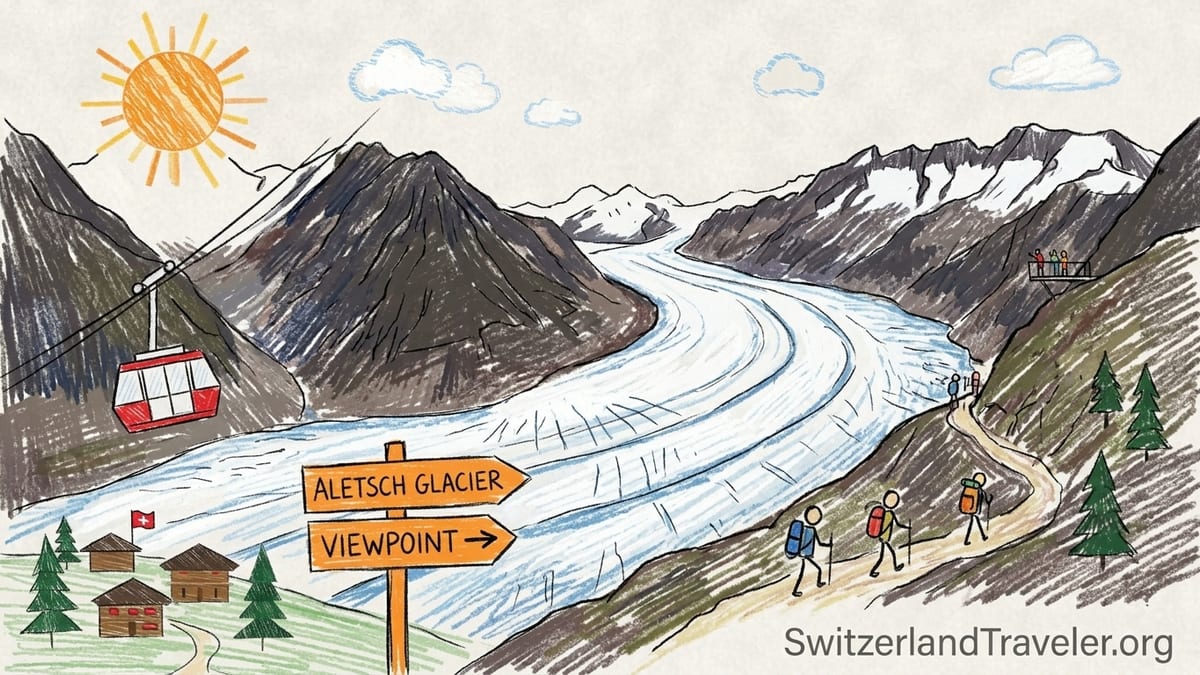
The Great Aletsch Glacier is why most travelers ride up to the car free terraces of Riederalp, Bettmeralp and Fiescheralp. This 20 kilometer river of ice, weighing an estimated 10 billion tonnes, is the visual centerpiece of the Swiss Alps Jungfrau Aletsch UNESCO World Heritage Site. Yet many visitors arrive with only a vague idea of how to actually see it. This guide focuses on viewpoints, cable cars and realistic hiking options so you can choose the best way to experience Valais’s most important glacier attraction, whether you have half a day or several.
Understanding the Great Aletsch Glacier Experience
From the Aletsch Arena plateau the glacier looks surprisingly close, yet there are very different ways to experience it. The majority of visitors simply ride a cable car to a viewpoint platform such as Bettmerhorn, Moosfluh or Eggishorn and spend one to three hours soaking up the panorama, perhaps adding a short walk along a well graded path. A much smaller group book a guided excursion to step onto the ice itself, equipped with helmets, crampons and harnesses. Both approaches deliver powerful memories, but they demand different time, budget and fitness levels.
The glacier itself is the largest in the Alps and dominates the core zone of the Swiss Alps Jungfrau Aletsch World Heritage property. UNESCO highlights the area for its classic glacial landforms and the way it demonstrates high Alpine geological processes. At human scale, what you will notice from the viewpoints is the immense sweep of ice curving between dark rock ridges and the silence that descends once you step away from the lift stations.
For planning, it helps to think in three sectors that line the southern flank of the glacier: Bettmeralp and Bettmerhorn in the center, Riederalp and Moosfluh toward the west, and Fiesch and Eggishorn toward the east. Each has its own character. From Riederalp and Moosfluh you see the lower tongue of the glacier and the forested Massa Valley. Bettmerhorn gives a classic side on view of the long ice river. Eggishorn, at almost 2,900 meters, lifts you high above the most dramatic bend and lets you see far into the Jungfrau massif.
Because this is a high mountain environment, logistics matter. Cable car operating dates and hours can change with weather and maintenance, and the Eggishorn summit lift is scheduled to be closed after mid August 2026 for renovation. Before committing to a sunrise start or late return, check the Aletsch Arena lift timetable and the individual resort webcams on the morning of your visit, especially if clouds are forecast.
Bettmeralp and Bettmerhorn: The Classic Central Panorama
Bettmeralp sits on a sunny terrace above the Rhone Valley at roughly 1,950 meters, reached by cable car from the village of Betten Talstation. Once on the car free plateau you cross the main street of chalets and small hotels in ten to fifteen minutes on foot to reach the Bettmerhorn gondola. A common pattern for day trippers from Interlaken or Brig is to arrive at Bettmeralp by late morning, ride straight up to Bettmerhorn at 2,647 meters, and then spend an hour on the viewing platforms before strolling back through the village.
The Bettmerhorn viewpoint delivers one of the most balanced views of the Great Aletsch Glacier. You stand roughly level with the mid section of the ice, looking north across the full width of the glacier and deep into the Jungfrau region. In clear conditions you can pick out peaks such as the Aletschhorn and Jungfrau on the skyline. Short, fenced paths lead to different angles, and the main terrace is close to the lift station, which makes this one of the easiest options for non hikers and families with small children.
Prices change every season, but as of 2026 official tariff tables suggest that a return ticket from Bettmeralp to Bettmerhorn typically falls somewhere in the middle of Aletsch Arena viewpoint prices, with reductions for holders of Swiss Travel Pass or Half Fare Card. The resort also sells combined “viewpoint” products that include feeder lifts from the valley plus summit gondolas. If your priority is simply to stand in front of the glacier for one to two hours and you prefer gentle walking on prepared paths, Bettmerhorn is an efficient choice.
For those with more energy, Bettmeralp is also a good starting point for longer traverses. A popular full day hike follows the high route toward Märjelen Lake and on to Fiescheralp, hugging the rocky slopes above the glacier. Sections around Bettmerhorn can reach technical mountain hiking grades and may be classified up to T3 or T4 in Swiss trail ratings, which means hands are sometimes needed for balance and the path may cross bouldery terrain. If you want a serious but still non technical outing with constant glacier views, talk with local staff at the Bettmeralp information office about current trail conditions before setting out.
Riederalp and Moosfluh: Easiest Access and Close up Views
Riederalp is the western gateway to the Aletsch Arena plateau, reached by cable car from Mörel in the Rhone Valley. From here a modern gondola climbs to Moosfluh, a viewpoint at around 2,333 meters that overlooks the lower section of the glacier. According to recent viewpoint package information, Moosfluh is marketed as one of three main glacier viewpoints along with Bettmerhorn and Eggishorn, with a dedicated cable car linking Riederalp, the Blausee middle station and the Moosfluh summit.
Moosfluh is often the best option for travelers who want the minimum amount of walking. The gondola station sits close to the main terrace, and within a few minutes you can be looking over the safety rail at the crevassed surface of the glacier below. The perspective here is slightly lower than at Bettmerhorn or Eggishorn, which makes the ice wall feel physically closer. You also see the forested slopes of the Aletschwald below, a protected ancient Swiss stone pine forest that lines the southern side of the glacier.
Families appreciate Moosfluh for the ease of access and the relatively gentle paths that contour along the ridge. You can stroll for twenty to thirty minutes in either direction on well marked trails and then return the same way, with the glacier in view for much of the time. On clear days there are broad grassy spots where children can play while adults take photos. Because the gondola is modern and large, queues tend to move quickly even at busy times in July and August.
In terms of time, most visitors allow three to four hours for a Moosfluh excursion starting and ending in the valley. That includes the cable car ride from Mörel to Riederalp, the connecting gondola to Moosfluh, at least an hour on the summit ridge, and a relaxed drink or snack at one of the terrace cafes back in Riederalp. This makes Moosfluh an excellent choice if you are staying elsewhere in Valais and have only half a day to spare but still want a genuine sense of the glacier’s scale.
Fiesch, Fiescheralp and Eggishorn: The Big Bend and High Alpine Drama
On the eastern side of the Aletsch Arena, the village of Fiesch connects the valley rail line with the high plateau. From the station area it is a short walk to the cable car that rises to Fiescheralp at about 2,200 meters. From Fiescheralp, a second lift continues to Eggishorn, the highest of the standard viewpoints at roughly 2,869 meters. Many hikers and photographers consider Eggishorn the ultimate balcony over the Great Aletsch Glacier, because it reveals the full sweeping bend of the ice as it curves toward the Jungfrau massif.
The Eggishorn panorama is the most dramatic of the three main viewpoints. From the rocky summit ridge the glacier appears almost directly beneath your feet, and you can see its entire S shaped course from the upper accumulation basin to the receding tongue. In good conditions this is the place for wide angle images that capture both the ribbon of ice and the surrounding four thousand meter summits. At the same time, the higher altitude means thinner air, colder temperatures and more exposure to wind. Even in August it can feel wintry on Eggishorn if a front is moving through.
Because of the height and terrain, Eggishorn is slightly less accessible than Bettmerhorn or Moosfluh. There are steps and rocky paths around the summit, and anyone with mobility concerns may find it harder to move between the different viewing terraces. Weather is also more critical. Low cloud often shrouds the ridge even when the plateau at Fiescheralp sits in sunshine. Before paying for the additional lift up from Fiescheralp, check the Eggishorn webcam at the valley station or tourist office to confirm visibility. In 2026, official documents note that the Eggishorn summit lift is due to close after mid August for renovation, so in late season you may only be able to ride as far as Fiescheralp and then hike.
For strong hikers, Fiescheralp is the best base for long glacier edge routes. Classic circuits link Eggishorn with Märjelen Lake and back to Fiescheralp, or traverse toward Bettmeralp along airy ridges. These outings can involve 700 to 1,000 meters of ascent and descent over rocky paths, ladders or short cable protected sections. If you have a full day, stable weather and proper equipment, this corner of the Aletsch Arena rewards effort with some of the most continuous glacier views in the Alps.
Märjelen Lake as a Hiking Extension, Not a Separate Goal
Märjelen, sometimes written Märjelensee or Märjelen Lake, lies in a high side valley above the glacier on the Fiescheralp side. Historically this was a large glacial lake pressed against the ice wall, famous in 19th century travel writing for its intense blue color and dramatic ice cliffs. As the glacier has retreated the lake has shrunk, and today what remains is a smaller body of water and a landscape of smoothed rock and moraine that reveals how far the ice has pulled back.
Modern hiking routes treat Märjelen as one highlight among several on a longer circuit. For example, one common route starts with the cable car to Eggishorn, descends on a mountain trail to Märjelen, then traverses via the Tälligrat ridges and tunnels to finish at Fiescheralp. Another variation uses Bettmerhorn as a starting point and works its way across to Märjelen before ending at Fiescheralp. Descriptions from local hotels and regional hiking portals suggest times in the range of five to seven hours for these combinations, labeled from “difficult” to “alpine” depending on exact line.
Seen this way, Märjelen is best thought of as a side chapter in a glacier day rather than the main story. The lake itself is modest in size, and the real drama lies in the proximity to the glacier rim and the sculpted slabs that show where ice once stood tens of meters higher. If you are a photographer, the contrast of pale rock, milky water and the distant ice can be very effective, especially with hikers or ibex in the frame to suggest scale.
Because the terrain near the glacier edge can be confusing in poor visibility and some variations cross snowfields or debris slopes, route finding skills are important here. Official signposted paths exist and are regularly used in summer, but heavy rain, late lying snow or autumn ice can change conditions quickly. If you are unsure, consider joining a guided hike organized through local hotels in Fiescheralp or Eggishorn, which often collaborate with experienced mountain leaders based in the region.
Cable Cars, Altitude, Weather and Time Planning
Good planning around lifts and weather often makes the difference between an unforgettable glacier day and a frustrating one. All three main sectors Riederalp, Bettmeralp and Fiesch have feeder cable cars from the Rhone Valley, typically running from early morning into late afternoon or early evening in the main summer months. From these car free terraces, secondary lifts continue up to Moosfluh, Bettmerhorn and Eggishorn. Schedules can vary by season, with some lifts closing for maintenance between late October and early December, or opening only on weekends at the margins of summer.
Prices for single trips and combined viewpoints are published each year in official Aletsch Arena tariff lists. As a broad indication in recent seasons, a full excursion from the valley up to one of the high viewpoints and back has often cost in the range of several dozen Swiss francs per adult, with discounts for children and holders of Swiss national rail passes. Since exchange rates and fares can shift between summers, it is essential to confirm exact prices and any family or morning specials shortly before you travel, either at the ticket counter or via official printed material.
Altitude affects both weather and how you feel. The plateau villages already sit around 1,900 to 2,200 meters, and the viewpoints rise to between roughly 2,300 meters at Moosfluh and almost 2,900 meters at Eggishorn. Even if you live at sea level, most people tolerate these heights well for a few hours, but you may notice slightly quicker breathing on steeper sections and a stronger effect from the sun and wind. Layered clothing, including a windproof shell and a warm mid layer, is advisable even on apparent summer days in the valley.
Weather in the Aletsch Arena can change quickly as Atlantic systems cross the Alps. Clear mornings often develop convective clouds by midday, especially in July and August. If your priority is photography or uninterrupted glacier views, consider taking the first or second cable car of the day. Check the resort webcams from the valley before buying your ticket so you can choose the sector with the best current visibility. On days with heavy cloud or thunderstorms in the forecast, it may be prudent to stay on the plateau rather than commit to exposed ridges or remote circuits.
Viewpoints versus Guided Glacier Excursions
Standing on a rock platform above the Great Aletsch Glacier and walking on the glacier surface are fundamentally different experiences. From the viewpoints you remain on solid ground, usually within a few minutes of a lift station or waymarked path. Regular hiking shoes, weather appropriate clothing and basic hill sense are generally sufficient in dry summer conditions. You can look down on crevasses and seracs from a position of safety and appreciate the overall shape of the glacier without needing specialist skills.
Guided glacier excursions, by contrast, involve stepping onto moving ice riddled with cracks hidden beneath snow bridges and debris. Professional guides typically equip each participant with crampons, a climbing harness and helmet, and often rope clients together for safety. Routes are chosen according to recent conditions, and the guide constantly adjusts the line to avoid newly opened crevasses or unstable seracs. Distances that look short on the map can take several hours on the ice because of the need to weave around hazards.
In the Aletsch region, licensed mountain guides and guiding companies based in nearby towns such as Fiesch, Brig or Interlaken offer glacier crossings and introductory ice days. A typical group outing might last six to eight hours, with a price per person that reflects the need for specialized equipment, insurance and a low client to guide ratio. Some packages combine a crossing of the Aletsch Glacier with a night in a high mountain hut, reached either from the Jungfraujoch side or from the Valais terraces, but these demand good fitness and stable weather.
For safety reasons, independent hikers should not attempt to walk onto glacial terrain around the Great Aletsch Glacier without a qualified guide. The presence of footprints or informal tracks on the ice does not guarantee safety. Snow cover can hide deep crevasses even in late summer, and rockfall from surrounding slopes is a real objective hazard near the glacier margin. If your goal is simply to experience the power of the Aletsch landscape, the balcony viewpoints described earlier provide more than enough drama without the additional risk and cost of stepping onto the glacier itself.
Light, Photography and Accessibility Considerations
For photographers, light matters as much as location. Because the Great Aletsch Glacier runs broadly from southwest to northeast, the angle of the sun changes how the ice reads in images. Morning light from the east side tends to rake across the crevasses, sculpting texture and contrast, while late afternoon light warms the rock ridges and sometimes throws parts of the glacier into shadow. On bright days, Eggishorn and Bettmerhorn often work well in the first half of the day, while Moosfluh can be rewarding later as the lower tongue catches directional light.
Cloudy or hazy conditions do not have to be a disappointment. Diffuse light can reduce harsh shadows and help a camera sensor cope with the brightness difference between snow and dark rock. In such weather, look for tighter compositions that emphasize patterns in the ice or layers of ridges receding into the mist. Polarizing filters can help control glare on snow and bring out subtle blues in the ice, but overuse can make skies look unnatural, especially with wide angle lenses around 24 millimeters equivalent.
Accessibility varies by viewpoint. The feeder lifts from the valley to Riederalp, Bettmeralp and Fiescheralp are designed as public transport for resort villages and usually have level boarding, making them suitable for many wheelchair users and travelers with limited mobility. At the viewpoints themselves the situation is more mixed. Moosfluh has relatively short, graded paths from the gondola station to the main terraces, which can work for those who walk with poles or need frequent rests. Bettmerhorn involves some stairs and sloping paths. Eggishorn has the roughest terrain, with rocky steps and narrower ridges that can feel exposed even to confident walkers.
If you or a member of your group has mobility challenges, it is worth asking at the valley ticket office which viewpoint currently offers the smoothest access and whether any construction might affect elevators or ramps. In all cases, avoid planning tight connections between last lifts when mobility is limited. Give yourselves time to move calmly between stations and to sit indoors if weather deteriorates, especially with children or older relatives.
The Takeaway: Matching Viewpoint and Hike to Your Travel Style
With three main sectors and multiple lift combinations, the Aletsch Arena can look confusing on a schematic map. In practice, choosing the right way to see the glacier comes down to a few simple questions about time, fitness and priorities. For a first visit focused purely on scenery, many travelers find it easiest to pick one sector, ride to the main viewpoint there, and resist the temptation to zigzag across the entire terrace in a single day.
First time visitors who want a strong impression without complicated hiking should favor Bettmerhorn or Moosfluh. From either, you can gain an understanding of the glacier’s size, see the sweep of ice in both directions and still be back in the valley in time for dinner. Photographers with a taste for grand, high alpine panoramas will likely gravitate toward Eggishorn, provided weather and lift operations cooperate, while keeping Bettmerhorn in mind as a solid alternative during the Eggishorn renovation period.
Families usually do best with Riederalp and Moosfluh due to the straightforward logistics, gentle paths and quick access to facilities. Strong hikers can treat the Aletsch Arena as a playground of traverses and circuits linking Eggishorn, Märjelen and Bettmerhorn or contouring along the southern slope of the glacier for hours. Travelers with only half a day can still have a satisfying experience by choosing the closest sector to their base, catching a morning or early afternoon lift, and spending concentrated time at a single viewpoint instead of trying to sample everything.
Whatever your profile, a successful Great Aletsch Glacier day shares a few common traits: early checks of the webcams and lift timetable, honest assessment of fitness and comfort with exposure, and respect for the difference between safe balcony paths and technical glacial terrain. With those pieces in place, the reward is one of Europe’s most impressive mountain vistas, framed by peaks and ice that still, for now, dominate this corner of Valais.
FAQ
Q1. What is the single best viewpoint for first time visitors to the Great Aletsch Glacier?
For a first visit, Bettmerhorn is an excellent all round choice. The gondola from Bettmeralp brings you quickly to around 2,647 meters, where several terraces offer a central panorama of the glacier without demanding serious hiking. You see both up toward the high accumulation basins and down toward the lower tongue, and facilities are close at hand.
Q2. Which viewpoint gives the most dramatic bend of the glacier for photography?
Eggishorn provides the most dramatic view of the glacier’s sweeping S shaped bend, thanks to its height of roughly 2,869 meters and its position above the main curve. From the rocky ridge you can frame the entire river of ice between dark ridges and distant peaks. If the Eggishorn summit lift is closed during your visit, Bettmerhorn is the next best option for a long, textured view.
Q3. Is there an easy option for families or travelers who do not hike?
Yes. Riederalp and the Moosfluh viewpoint are particularly suitable. The modern gondola from Riederalp to Moosfluh delivers you close to the main viewing area, and there are short, relatively level paths along the ridge. Many families spend an hour at the viewpoint and then relax in cafes on the Riederalp terrace without tackling longer trails.
Q4. How much time should I plan for a typical glacier viewpoint excursion?
From the Rhone Valley up to a viewpoint and back, most visitors should allow three to five hours. That includes riding the feeder cable car to Riederalp, Bettmeralp or Fiescheralp, transferring to the summit lift, spending at least an hour on the viewing platforms, and factoring in waiting times and a snack break. Longer hikes that include Märjelen or ridge traverses can easily fill a full day.
Q5. Do I need special gear to visit the viewpoints in summer?
For summer visits to Moosfluh, Bettmerhorn or Eggishorn you do not usually need technical equipment. Sturdy walking shoes with good grip, a warm layer, windproof jacket, sun protection and water are sufficient for the standard viewing paths and short walks. If you intend to hike longer alpine routes, consider trekking poles and a small emergency kit, and always check current trail advice.
Q6. Can I walk on the Great Aletsch Glacier by myself without a guide?
No, independent glacier walking is not recommended. The ice is heavily crevassed, with hidden cracks and unstable seracs. Safe travel on the glacier requires a qualified mountain guide, rope techniques, crampons and a careful choice of route according to recent conditions. For most travelers, staying on marked balcony paths above the glacier is the safer and more practical way to appreciate it.
Q7. What is Märjelen Lake like today, and is it worth the hike?
Märjelen Lake is much smaller than the historic glacial lake described in older guidebooks, but the area remains scenic. The appeal lies in the proximity to the glacier edge and the polished rock slabs that show how far the ice has retreated. It is best visited as part of a longer circuit from Eggishorn or Bettmerhorn to Fiescheralp rather than as a stand alone goal.
Q8. How does altitude affect a visit to Eggishorn or Bettmerhorn?
The viewpoints sit between roughly 2,300 and 2,900 meters, which most healthy people tolerate well for short visits. You may notice quicker breathing on uphill sections and stronger sun and wind exposure. Wearing layers, staying hydrated and moving at a moderate pace usually prevent discomfort. If you have known altitude sensitivity or heart or lung conditions, discuss plans with a medical professional before traveling.
Q9. When is the best time of day to photograph the glacier?
Morning light often works well on Bettmerhorn and Eggishorn, with the sun illuminating crevasses and reducing haze. Late afternoon can be rewarding from Moosfluh as warm light catches the lower tongue and valley. On bright days, starting early also helps avoid midday thermal clouds that may build over the peaks and obscure the view.
Q10. What happens if the Eggishorn summit lift is closed during my stay?
If the Eggishorn summit lift is closed for renovation or weather, you still have excellent alternatives. Fiescheralp itself offers good mid level views, and you can focus on Bettmerhorn and Moosfluh, which remain accessible from Bettmeralp and Riederalp. For strong hikers, some Eggishorn access routes are possible on foot from Fiescheralp in stable summer conditions, but these require more effort and careful planning.