


On my last trip to Switzerland’s southernmost canton, I decided to test how far the Ticino Ticket could really take me. This small slip of paper, handed to overnight guests in participating accommodation, promises free public transport across Ticino plus discounts on more than a hundred attractions. Over four days, I used it as my primary ticket for trains, buses and mountain excursions, then compared what I actually rode to the prices I would have paid buying regular tickets. The result was one of the best value-for-money perks I have ever received from a destination’s tourism board, but also a pass with a few practical quirks it helps to understand before you go.
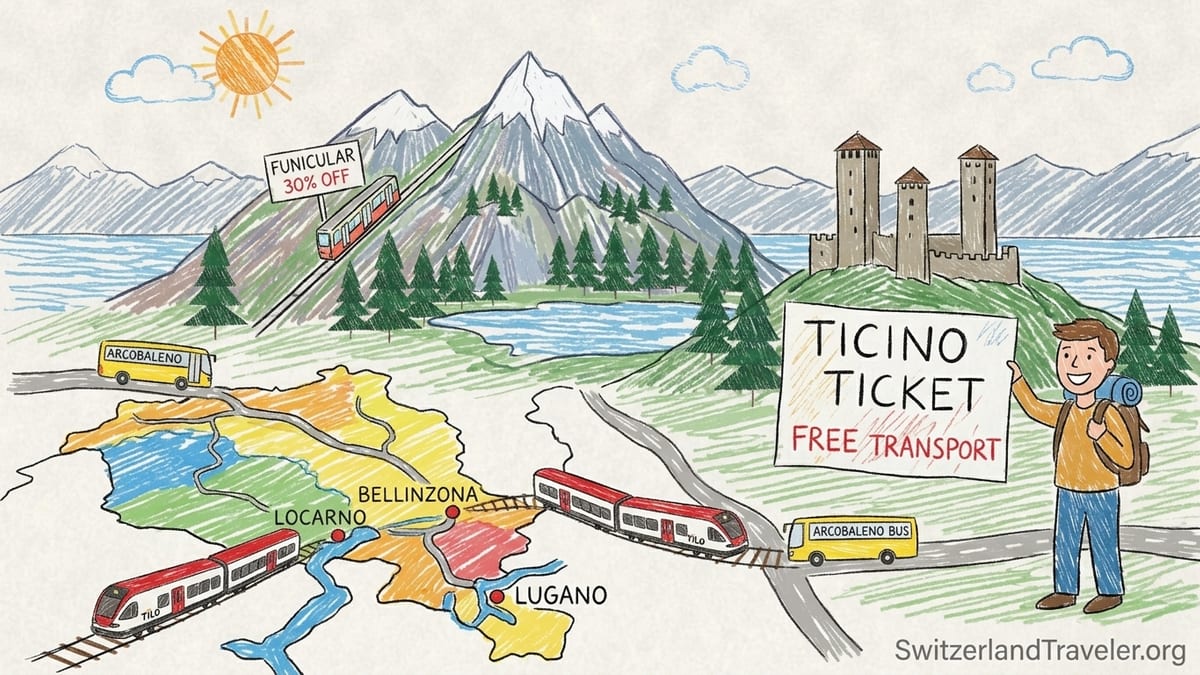
Receiving the Ticino Ticket at Check-in
I based myself in Lugano for this trip, staying at a mid-range hotel close to the lakeside promenade. At check-in, after I signed the registration form and the staff confirmed my passport details, the receptionist slid across a printed Ticino Ticket without me having to ask. The card carried my name, the hotel name, my arrival and departure dates, and a QR code. It was valid from my check-in date through midnight of my check-out day, mirroring what official information describes: free public transport for the duration of your stay for guests paying the local tourist tax in participating hotels, youth hostels and campsites across the canton.
The receptionist briefly explained how it worked. Within the Arcobaleno integrated fare network that covers the whole of Ticino and the adjoining Moesano region, regional trains, most buses and some boats are included as long as the journey is within the defined zones. I was told to keep the ticket with me at all times and to show it whenever ticket inspectors came through the train or bus. No extra stamping or validation was needed. For attractions and private operators, such as mountain railways, I would show the same card at the ticket office to obtain a percentage discount off the regular fare.
Alongside the paper version, I was offered the option to scan a QR code and add a digital Ticino Ticket to my phone. The hotel’s information sheet stated that both formats are equally valid, so I decided to activate the digital one as a backup in case the physical card was lost or damaged. It took less than two minutes and turned out to be useful when my paper copy got damp in a sudden lakeside downpour.
Not every property in Ticino is required to issue the card, but tourism authorities now list more than 500 participating accommodations across the canton. In practice, that means most hotels and formal campgrounds in the main destinations, from Lugano and Locarno to Bellinzona and the valleys, now hand over a Ticino Ticket automatically to overnight guests once the tourist tax has been paid.
Activating and Using the Digital Ticino Ticket
Activating the digital Ticino Ticket was one of the smoother tech experiences I have had with a regional guest card. The paper card included a QR code and a short instruction line in several languages explaining that I could scan it to obtain an electronic version. I used my phone’s camera, which opened a simple web page asking me to confirm my name and the dates of my stay. Within seconds, the digital pass appeared on-screen, complete with the same QR code and personal details as the paper ticket.
There was no need to create an account or download a dedicated app, which made the process straightforward even after a long travel day. The digital version lived as a web-based pass that I bookmarked on my home screen. Offline display worked reliably as long as I had opened it at least once with data or Wi-Fi, something worth doing while still at the hotel. On one regional train between Lugano and Bellinzona, the inspector checked my pass by simply scanning the QR code off my phone.
In terms of daily use, I found it easier to show the paper ticket for quick bus hops around Lugano and Locarno and to keep the digital one as a secure backup. The printed card was slightly larger than a standard credit card, so I slipped it into a transparent sleeve in my wallet. After an unexpected cloudburst walking to the Paradiso funicular station, the ink began to smudge at the edges, but the QR code still scanned. For peace of mind, I was glad to know that even if the paper version became unreadable, the digital ticket would remain valid throughout my stay.
One limitation is that the Ticino Ticket is personal and non-transferable. It shows your name and, if inspected, can be checked against a passport or ID. Each guest in a room receives their own ticket, including older children, but you cannot simply pass yours to a friend or relative staying elsewhere. That is reasonable considering the value on offer, yet it is important for families and groups to ensure everyone collects their individual card at check-in.
Where I Actually Went Using Only the Ticino Ticket
Over four days, I decided to rely almost entirely on the Ticino Ticket within the canton and to see how much of my sightseeing it could cover. My base was Lugano, but I planned day trips to Bellinzona and Locarno, as well as smaller excursions along Lake Lugano and into the nearby hills. All of these journeys fell within the Arcobaleno fare zones that the Ticino Ticket covers on regional services.
On the first full day, I took an early regional train from Lugano to Bellinzona. On the SBB timetable, a standard second-class single ticket on this route currently costs a little under 10 Swiss francs without any railcard reduction, and a day return adds up to roughly 20 francs. With the Ticino Ticket, I boarded without purchasing anything, found a seat, and simply waited for a ticket check that may or may not come. When an inspector did arrive just before Giubiasco, I handed over my card, and he scanned the QR code without comment.
Later the same day, I used the local buses included in the Arcobaleno network to move between Bellinzona’s train station and the lower stops for the Castelgrande and Sasso Corbaro fortress areas. These bus journeys are short, but standard zone tickets can still cost several francs each if bought separately. I rode three different buses in Bellinzona in one afternoon, hopping on and off when the hill grew too steep in the heat, all covered by the Ticino Ticket.
Another day, I headed to Locarno by regional train from Lugano, a journey that, at full price, also falls into the range of roughly 10 to 15 francs one way depending on route and timetable. From Locarno, I used city buses to reach the Cardada cable car valley station and to detour to the Maggia river area. Again, no extra tickets were necessary as long as I stayed within Ticino. Taken together, these itineraries meant that I was using the Ticino Ticket not just for a single out-and-back trip, but as an unlimited day pass across multiple towns and modes of transport.
Understanding What Is Actually Free and What Is Not
The most important practical lesson from using the Ticino Ticket is that it is fully valid only on public transport services that fall under the Arcobaleno integrated fare network. Within that area, it allows free travel on regional trains, post buses and most local buses for the entire duration of your stay. This includes TILO regional trains that run between key Ticino towns such as Bellinzona, Lugano and Locarno, as long as the trip remains within the canton’s boundaries.
On the ground, this means you can treat regional trains between major Ticino stations as if you held a local pass. I used my Ticino Ticket on services like Lugano to Bellinzona and Lugano to Locarno without needing to know the exact zones in advance. However, long-distance InterCity and EuroCity trains that simply pass through Ticino are not fully covered. In practice, I chose to board the slower regional trains, which run frequently and stop at more intermediate stations, ensuring there was no confusion about validity.
For boats and mountain transport, the situation is different. The Ticino Ticket does not make the lake cruises on Lake Lugano or Lake Maggiore entirely free. Instead, it offers percentage discounts with specific partner companies. Likewise, mountain railways and cable cars such as Monte Generoso or Monte Tamaro provide reduced fares for Ticino Ticket holders rather than complimentary rides. During my stay, I experienced this distinction explicitly when planning an afternoon on Monte San Salvatore above Lugano, where the funicular remains a private operator outside the fully free Arcobaleno coverage.
Another nuance is the geographic limit. The Ticino Ticket is not a cross-border pass. The moment you travel into Italy on a TILO service, you leave the area where the card is valid and must buy a separate ticket for the international leg. This matters for popular journeys such as Lugano to Como or Bellinzona to Milan. In my case, I ended my Italian excursion planning at Chiasso, the last major station in Ticino, then purchased a separate ticket when I did cross into Italy after my stay.
Discounts I Used on Attractions and Mountain Transport
Beyond free public transport, the Ticino Ticket gives access to a network of discounted attractions across the canton. Official tourism information states that more than 170 partners participate, including mountain railways, lake cruises, museums and adventure parks. I intentionally sampled a few varied experiences to see how much these reductions were worth in real terms.
My first test was in Bellinzona, whose trio of medieval castles forms a UNESCO World Heritage site. At the ticket counter for the combined fortress pass, I presented my Ticino Ticket and was granted a discount on the regular adult admission price. While the exact amount can change over time, at the time of my visit the reduction translated into several francs off a ticket that already bundles multiple castles. It was a modest saving for a single visit, but meaningful when combined with free transport to and from Bellinzona.
Back in the Lugano area, I used the Ticino Ticket to reduce the cost of the Monte San Salvatore funicular, which climbs steeply from Lugano Paradiso to one of the best viewpoints in the region. Here, the Ticino Ticket functioned like a regional guest card in other parts of Switzerland, offering a fixed percentage discount on the regular round-trip fare. The reduction was again in the order of several francs, enough to cover a coffee at the summit restaurant while I admired the view over Lake Lugano and the distant Alps.
I also noticed that the Ticino Ticket offered reductions on other well-known mountain excursions, such as the cogwheel railway up Monte Generoso or the cable car to Monte Tamaro, as well as on certain lake cruises. Had I added those to my itinerary, the potential savings would have grown quickly. However, one important observation was that the discounts, while welcome, did not reach the 50 percent level that some national passes offer on mountain railways. Instead, Ticino appears to position the card as a generous local perk that combines fully free everyday public transport with modest but broad-ranging savings on classic tourist activities.
How Much Money I Realistically Saved
After four days moving around Ticino with the Ticino Ticket, I sat down to estimate what my journeys would have cost without it. Because Arcobaleno uses a zone-based fare system, exact pricing varies by distance, but current public information on single tickets and day passes provides reliable reference points for typical costs. For this trip, I focused on the specific point-to-point journeys I had taken and the full-fare second-class prices listed in current timetables.
On my first full day, the return train trip from Lugano to Bellinzona alone would have cost roughly 20 francs without any railcard, based on the prevailing fares for this intercity corridor. Adding three or four short bus rides within Bellinzona, each of which would typically be covered by a local zone ticket costing several francs, I estimated that I had already saved somewhere in the vicinity of 25 francs on that day’s transport.
The second major excursion, a return trip from Lugano to Locarno by regional train with several bus connections around Locarno and to the Cardada valley station, would have added another 25 to 30 francs’ worth of tickets at full price. This pushed my cumulative transport savings into the range of 50 to 60 francs after just two days, even before counting smaller hops on Lugano’s urban buses that I made for dinner outings or quick lakefront detours.
When I factored in the attraction discounts, the numbers improved further. A reduced-price ticket for the Bellinzona castle complex and a discounted round-trip on the Monte San Salvatore funicular together shaved off approximately 10 to 15 francs compared with buying those tickets outright. Combined with the free transport, my realistic total saving over four days came close to the equivalent of one night’s hotel city tax for two people, effectively returning the cost of the compulsory tourist tax and then some.
Comparing the Ticino Ticket to Buying Regular Tickets
To understand whether the Ticino Ticket simply feels generous or represents a measurable economic benefit, it helps to compare it to the cost of buying regular public transport tickets or alternative passes for the same days. In Ticino, the Arcobaleno network sells single tickets, multiple-journey tickets and day passes that allow unlimited travel within chosen zones for a set number of hours. For a traveler basing themselves in one city and making only a short trip or two, these products are already convenient. However, the Ticino Ticket essentially upgrades you into a canton-wide day pass for every day of your stay, at no extra charge beyond the standard tourist tax.
On the days when I traveled the most, my pattern looked like that of a commuter with added sightseeing. I took a regional train in the morning, several buses in the afternoon, another train later, and a final local bus for dinner. Were I buying standard zone-based tickets, I would have had to decide in advance whether to purchase a day pass covering multiple zones or rely on individual tickets, each with their own validity window. In practice, I suspect I would have tried to minimize costs and perhaps avoided a spontaneous detour or two.
With the Ticino Ticket, every additional hop felt frictionless. When I realized, for instance, that the walk from Lugano’s historic center back to my hotel in Paradiso was longer in the evening heat than I had anticipated, I simply boarded a local bus rather than hesitating at the cost of a short ticket. That willingness to move around more freely is hard to quantify but adds real value to the overall travel experience.
If I had been traveling without any guest card and choosing to buy the most economical day products available from Arcobaleno, my itinerary across four days would likely have required at least two or three separate zone day passes on top of point-to-point tickets, quickly reaching or exceeding the 80 to 100 franc mark for transport alone. In contrast, with the Ticino Ticket, those travel costs were effectively absorbed by the modest per-night tourist tax included in my room bill.
What the Ticino Ticket Does Not Cover and Practical Tips
Although the Ticino Ticket felt almost like a magic key to the canton’s public transport network, there are clear boundaries that matter when planning. High-speed and long-distance trains passing through Ticino on north-south routes are not automatically included in the way that regional TILO and other Arcobaleno-based services are. When I needed to cover a longer stretch of the Gotthard axis beyond Ticino, I purchased a separate regular ticket for that leg.
Similarly, travel that crosses the Swiss border into Italy is outside the ticket’s free coverage. For those considering day trips to Como, Varese or Milan from Lugano or Bellinzona, the Ticino Ticket will take you comfortably to the last Swiss station, but you will need to buy an international ticket for the remainder. The same applies for premium tourist services and some privately operated mountain railways that lie only partly in Ticino. While they may offer Ticino Ticket discounts, they are not free rides.
In daily use, I also learned a few small but important habits. First, always carry some form of ID that matches the name on the ticket. Inspectors did not routinely ask for it, but they are entitled to do so. Second, keep the paper and digital versions available in case one fails. On a crowded afternoon train between Locarno and Lugano, mobile signal in the tunnel briefly cut out, and I was grateful that my digital pass had been preloaded and did not require a fresh internet connection to display.
Finally, pay attention to your check-out date. The Ticino Ticket is valid up to and including that day, which means you can still use free public transport to travel around or even leave the canton. On my departure morning, I used the ticket one last time to ride from Lugano Paradiso to Bellinzona before connecting to a separate long-distance service out of Ticino. That final regional journey alone would have cost a noticeable amount at full fare, so it was reassuring to know that the guest card’s value extends right to the end of the stay.
The Takeaway
Using the Ticino Ticket as my primary means of getting around the canton transformed the way I planned and experienced this trip. Instead of weighing the cost of every train or bus ride, I was free to think in terms of places and timing. If a village on the map looked appealing, I went. If I felt too tired to walk back from an evening stroll along Lake Lugano, I hopped onto the next bus without hesitation. Over the course of four days, that flexibility translated into savings that were large enough to be noticed in my travel budget, even without obsessively calculating every franc.
Equally important, the card encouraged me to explore beyond my base city. Lugano remained my anchor, but Bellinzona’s castles and Locarno’s lakefront suddenly felt as easy to reach as nearby neighborhoods instead of separate day trips that had to be justified. The discounts on attractions and mountain transport did not rival the deepest reductions offered by some national rail passes, yet they stacked up steadily whenever I took a funicular or visited a major site.
Perhaps the clearest lesson is that, for travelers who plan to stay in Ticino for at least a couple of nights and use public transport regularly, the Ticino Ticket is not a marketing gimmick but a genuinely substantial perk. It makes the canton feel smaller, better connected and more approachable, especially for visitors arriving from countries where local transport can still be a confusing patchwork of tickets and operators. If you are the kind of traveler who values spontaneity and enjoys exploring regional corners without driving, this small, easily overlooked card may end up being one of the most valuable documents in your wallet while you are in Ticino.
FAQ
Q1. How do you receive the Ticino Ticket and do you have to pay for it?
The Ticino Ticket is handed to you at check-in at participating hotels, youth hostels and campsites in Ticino once you have registered and paid the local tourist tax. There is no separate charge for the card itself, but it is linked to your overnight stay and the compulsory tax.
Q2. Is the digital Ticino Ticket as valid as the paper version?
Yes. After scanning the QR code on the physical card, you can activate a digital version that carries the same personal details and validity period. Inspectors accept either paper or digital format, as long as the QR code can be read.
Q3. Which trains are actually free with the Ticino Ticket?
Within the canton of Ticino and the Arcobaleno fare network, regional trains such as TILO services between cities like Lugano, Bellinzona and Locarno are included. Long-distance InterCity and EuroCity trains that simply pass through Ticino are not fully covered and usually require a regular ticket.
Q4. Do buses and local transport count as part of the free network?
Most post buses and city buses that belong to the Arcobaleno integrated fare system are free with the Ticino Ticket as long as you travel within the covered zones. In practice, that includes urban buses in places like Lugano, Locarno and Bellinzona, as well as many regional routes in the valleys.
Q5. Are boat trips on Lake Lugano and Lake Maggiore free with the Ticino Ticket?
No. Lake cruises are generally not completely free. Instead, selected navigation companies on Lake Lugano and Lake Maggiore offer percentage discounts on standard fares to Ticino Ticket holders, which reduce but do not eliminate the cost.
Q6. What kind of discounts does the Ticino Ticket give on attractions?
The card provides reduced admission to a wide range of partner attractions, including castles, museums, mountain railways and adventure parks. In real terms, this often means saving several francs off a standard adult ticket for places such as Bellinzona’s castles or mountain funiculars near Lugano.
Q7. Can you use the Ticino Ticket to travel into Italy?
No, the Ticino Ticket is not a cross-border pass. It is valid only within the Swiss canton of Ticino and the covered network area. For journeys that continue into Italy, such as to Como or Milan, you need a separate ticket for the international leg.
Q8. How much money can you realistically save with the Ticino Ticket?
The exact saving depends on how much you travel. On a four-day trip where I took regional trains between major Ticino cities and several local buses each day, I avoided paying roughly the equivalent of several day passes and multiple single tickets, amounting to dozens of francs, plus additional discounts on attractions.
Q9. Is the Ticino Ticket suitable if you are renting a car?
Even drivers can benefit, especially if they plan to visit car-free centers or prefer to avoid parking in cities. The free public transport makes it easy to leave the car at the hotel on some days, while the discounts on mountain railways and attractions are independent of how you arrive.
Q10. Does every accommodation in Ticino offer the Ticino Ticket?
Not every property participates, but current official information highlights more than 500 hotels, hostels and campsites across the canton that do. It is worth checking in advance whether your chosen accommodation belongs to the program so you can factor the ticket’s value into your travel planning.