


Across more than a decade of repeatedly returning to Italian-speaking Switzerland, mostly in Ticino around Lugano, Locarno and the Verzasca and Maggia valleys, I have learned that timing changes everything. The same lakeside promenade that feels blissfully swimmable in July can feel wind-whipped and empty in late October; a valley that looks Caribbean-green in June can be reduced to a trickle after an August drought; a winter weekend can be transformed by whether a funicular is running every 15 minutes or only once an hour. This guide focuses on the seasons I have genuinely experienced on the ground, and clearly labels anything that is researched rather than lived. It is written for travelers who want concrete, real-world detail about heat, lake-swimming conditions, visibility, water levels and the transport schedules that quietly shape every Ticino trip.
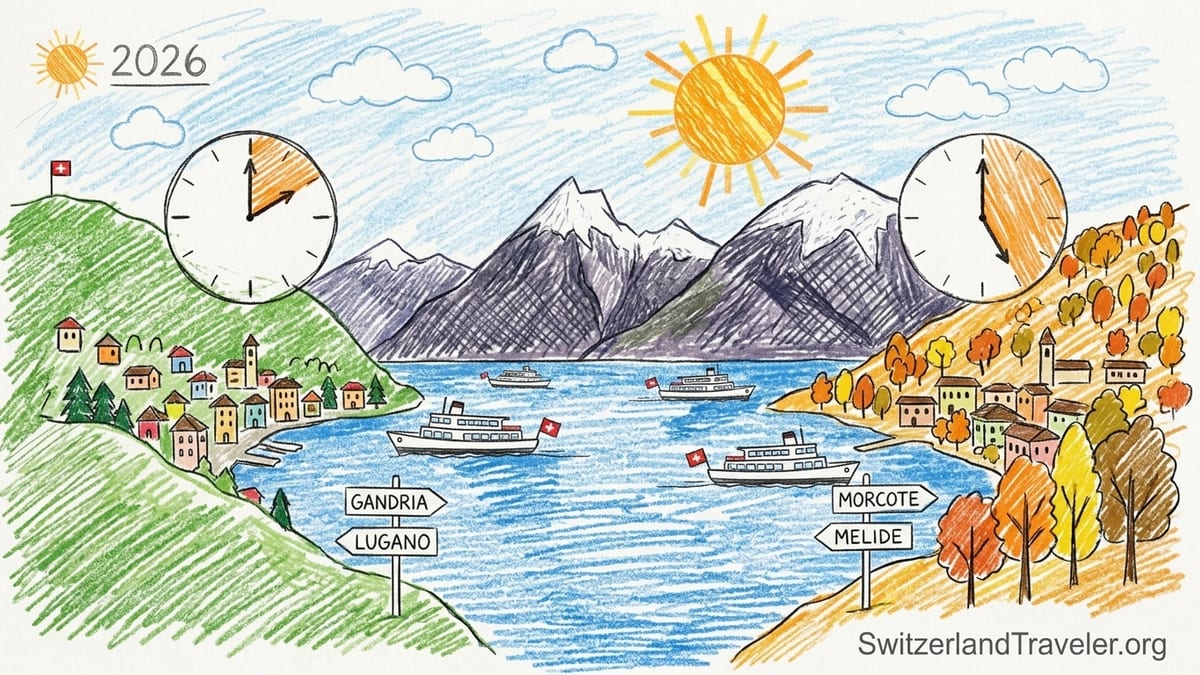
How the 2026 Boat Timetable Shapes a Lake Trip
In 2026, Lake Lugano’s regular boat services operated from 29 March to 18 October, run by the Società Navigazione del Lago di Lugano. On my most recent late-spring and late-summer visits, that window defined what was realistically possible in a day without a car. A July loop from Lugano to Gandria and Morcote felt effortless because boats were frequent, connecting smoothly with regional trains at Lugano and Melide. Outside that March to October window, you have to plan for buses, much longer walking sections or private transfers instead of simply hopping on a mid-morning boat.
On an early October trip, I used the same network very differently. I boarded the first boat from Lugano Centrale to Gandria, had lunch in the village, then walked back along the Olive Trail as afternoon services thinned out. By that point in the season, I was paying close attention to the timetable, because the final boat back toward Lugano came earlier than in high summer. Missing it would have meant a steep climb to the main road to catch a bus. For travelers in 2026 and beyond, the key lesson is simple: if you are coming specifically for lake cruising or want to rely heavily on boats instead of rental cars, you should visit while that March to October schedule is in operation.
This same March-to-October pattern also applied to Lake Maggiore connections I have used between Locarno, the Brissago Islands and Brissago village. On a September stay in Ascona, I took a mid-morning boat to the Brissago Islands for a half-day in the botanical gardens, then continued to Brissago and back to Locarno late afternoon. Outside the navigation season those journeys become a patchwork of buses and taxis. For anyone planning shoulder-season travel, it makes a practical difference: spring and autumn can be wonderful, but only if you are prepared to adapt once the last boat of the year leaves the pier.
In winter, I have stood at the same Lugano pier and watched an empty lake under a pale sky, with only the timetable rack as a reminder that the busy boat network exists at all. If your mental picture of Ticino comes from glossy summer photos of white ferries and sunlit decks, know that from late October until late March you may not see a single passenger boat in service, and you will be planning your days around trains, buses and your own feet instead of crossing the water.
Summer in Ticino: Heat, Water and Late Light
My strongest memories of Ticino are from summer, when heat defines almost every choice. In July and August, Lugano and Locarno routinely feel hotter and more humid than much of German-speaking Switzerland. Walking down from Lugano station at midday, the air wraps around you and the stone steps radiate stored heat from the night before. On several July visits, afternoon temperatures in Lugano felt well above 30 degrees Celsius, particularly during heatwaves, and shade became as precious as any attraction.
That same heat, however, is exactly what makes lake swimming so appealing. At Lugano’s Lido, where I have spent entire afternoons, the lake water in late July has felt warm enough for long, lazy swims, with only a slight cool shock as you first wade in. Locarno’s Lido and Ascona’s lakefront beaches feel similar by midsummer, with locals diving off floating platforms and families picnicking in the shade. By contrast, an early June dip at San Nazzaro on Lake Maggiore left my legs tingling from the much colder water, even on a sunny day. If your dream is to swim comfortably in the lake itself rather than pools, July and August offer the most reliable water warmth, especially after a run of hot days.
Summer is also when I have seen Ticino’s valleys at their most photogenic and, paradoxically, their most strained. In the Verzasca Valley, the famous emerald pools at Lavertezzo glow under the sun, and on a weekday in late June I found the water level comfortable enough for short swims and long stretches of boulder-hopping. Yet when I returned in a particularly dry August, the river felt noticeably lower, with some pools reduced to disconnected basins and more slippery algae on exposed rocks. The Maggia Valley has given me similar contrasts: wide, inviting green pools in early summer, then more exposed stone and slower flow at the end of a hot, dry spell.
Rainfall in summer tends to arrive as short, intense storms rather than days-long drizzle. I have sat under a café awning in Lugano as a black cloud rolled over Monte Brè, dumping torrential rain for 20 minutes, then watched the sky wash back to a sparkling blue. On another trip, a late-afternoon storm in Locarno delayed lake boats and temporarily flooded some lakeside paths, but by evening people were back out eating gelato along Piazza Grande. When you plan summer travel here, make peace with the idea that your bright morning can end in a thunderstorm, but also trust that many of these storms pass quickly and leave behind crystal-clear, low-haze views of the surrounding peaks.
Transport in Summer: Boats, Funiculars and Alpine Escapes
In summer, public transport in Italian-speaking Switzerland feels made for travelers. During my July and August trips I have rarely waited long for a lake boat or missed an evening funicular because operations stopped too early. The Lugano funicular down to the city from the station runs into the night, which has made late arrivals on long-distance trains feel easy. From Lugano lakeside, summer boats link to Gandria, Morcote and across the border to Italian villages, and the long daylight means I can plan a 10-hour day that includes a boat ride, a valley hike and a relaxed dinner back on the lakefront.
Cardada above Locarno is one of my favorite summer escapes. I have taken the funicular from Locarno up to Orselina, then switched to the cable car to Cardada to stand on the viewing platform looking down over Lake Maggiore. In July, the service pattern was dense enough that I never worried about missing the last cable car, but I still checked the posted return times at the top station before setting out on longer walks. By pairing those lifts with a post-hike swim at Locarno’s lakeside lido, I could feel a full Alpine and Mediterranean day without ever touching a car.
Summer weekends are when I have most appreciated reservations and a bit of pre-planning. On a hot Sunday, the regional trains from Zurich to Lugano were packed with day trippers, and the boats from Lugano to Gandria felt close to full as well. Buying my ticket in advance via the SBB app meant I could walk straight to the pier and board. I have also occasionally used tourist passes such as the Ticino Ticket, given by many hotels, to cover local buses and some mountain transports. That little piece of plastic changes decision-making on the ground: suddenly taking an extra post-dinner bus ride to a hillside village or hopping on an earlier funicular feels like a free choice instead of a minor expense to justify.
If you are traveling in peak summer, the rhythm that has worked best for me is to use early mornings and evenings for hiking and town exploring, and reserve the hottest midday hours for shaded restaurant terraces or lake swims. Public transport schedules support this pattern well: morning boats and trains are frequent, midday services keep moving but feel less crowded, and there is usually a convenient return option after dinner, at least while that late-March to mid-October navigation season is running.
Autumn on the Lakes and in the Valleys: Color, Clarity and Quiet
Autumn in Ticino has become my favorite time to return, especially from late September into the second half of October. On an early October stay in Lugano, daytime temperatures hovered in the high teens or low twenties Celsius, warm enough for coffee outside but cool enough that an uphill stroll toward Castagnola no longer meant arriving drenched in sweat. The air felt clearer, with distant ridges appearing sharper than they had in humid July, and the lake surface often lay smooth and glassy in the morning before a light afternoon breeze.
The clearest transformation I have experienced in autumn is the foliage. In the lower valleys near Locarno and Bellinzona, the first yellows appear in late September on individual trees, but it is usually early to mid-October when the hillsides above Ascona and along Lake Maggiore start to shift to full color. On a mid-October hike above Ronco sopra Ascona, chestnut trees dropped polished brown nuts on the trail while the understory glowed gold. A week later in the Verzasca Valley, larches higher up the slopes were brushing into orange while the valley floor still held more green, giving the whole landscape a layered look from summer to late autumn within a single view.
Water levels in the rivers during autumn have varied noticeably between my trips, depending on the preceding summer. After wetter summers, I found the Verzasca and Maggia still lively in October, with good flow and dramatic whitewater sections that contrasted beautifully with orange foliage. After hot, dry seasons, the same spots looked calmer, with exposed rock shelves and gentler cascades. Both conditions are attractive in different ways: higher water adds drama and sound, lower water makes it easier to access certain pools or cross from one bank to another without getting wet.
Lake-swimming conditions change quickly as autumn advances. On a warm afternoon in late September in Ascona, I comfortably swam in Lake Maggiore for several minutes, the water cool but not biting, and dried off in a patch of sun while locals lingered in light clothing. By mid-October in Lugano, the same attempt would have felt bracing at best; I watched a few hardy swimmers near the Lido while I stayed firmly on the promenade in a jacket. If swimming is a priority but you crave autumn color, the last ten days of September and the very first days of October have struck the best balance in my experience.
Autumn Transport: Shorter Days and Thinner Schedules
By autumn, the transport network feels subtly different on the ground, even though most scheduled services still run until mid or late October. On a mid-October trip based in Locarno, I noticed that boats on Lake Maggiore remained in service but with fewer departures than in peak summer. Planning a day to the Brissago Islands meant choosing between a generous late lunch there and a longer stop in Brissago village, because the late-afternoon return options were limited. When I traveled the same route in July, I could be casual, deciding whether to stay for another gelato and catch the next boat an hour later.
In Lugano, regular boats were still crisscrossing the lake in early October, but the timetable felt sharper-edged. I remember stepping off a hiking trail above Gandria, checking the schedule posted at the pier and deciding to walk the Olive Trail back toward Lugano rather than wait an hour for the next boat. The early autumn twilight also forced me to be more conservative: even where services continued running, I did not want to be finishing a lakeside walk in the dark. In practical terms, this meant front-loading my days, starting activities earlier and tying longer valley excursions to clearly noted return buses.
Mountain lifts such as the Cardada cable car and the funiculars around Lugano have, on my autumn visits, generally continued to operate but sometimes at reduced frequency. Instead of departures every few minutes, I have waited up to half an hour between valley and mid-station connections. This has not been a problem when I factored it into my hikes, but it can catch you out at the end of the day. Standing at a chilly upper station at 5 pm in October, watching the sun drop behind a ridge while you wait for the next cabin, feels very different from doing the same in July’s warm, lingering evening light.
The reward for those thinner autumn schedules is space and quiet. Trains between Zurich and Ticino have still been reasonably busy on weekends but nowhere near the crush of high summer, and I have found entire cable car cabins to Cardada or small valley buses with only a handful of passengers. On a cloudy October weekday in the Maggia Valley, my bus from Locarno carried just three people beyond Ponte Brolla, and when I stepped off at Bignasco it felt like having a private shuttle to the mountains. If you are willing to read timetables carefully and accept fewer options, autumn gives you more solitude without requiring winter-level resilience.
Winter in Ticino: Soft Light, Fog and Limited Boats
Winters I have experienced in Ticino, particularly in January and February, feel gentle compared with the high Alps, but they come with their own trade-offs. At lake level in Lugano and Locarno, daytime temperatures on my visits have usually ranged somewhere in the single digits to low teens Celsius. On clear days, terraces along Lugano’s lakeside have been busy with people sipping coffee in their coats while sunlight reflects off the water. On other trips, a thick gray fog has sat across the lake until mid-afternoon, turning the view into a soft monochrome with just the faint outline of Monte San Salvatore visible.
Lake swimming, for me, has been entirely off the table in winter. Even hardy locals I have spoken to described only short dips or cold-water swims in organized groups. Instead, my winter water experiences have involved the indoor and heated facilities at places like the Lido di Locarno, where I have watched steam rise from outdoor pools while the snow line sat partway down the mountains on the far shore. If your heart is set on open-water swimming, winter in Ticino will almost certainly disappoint, but if you enjoy the contrast of warm water and cold air in structured settings, it can still scratch the aquatic itch.
Visibility in winter can swing dramatically within a single trip. I have had mornings in Lugano where low cloud obscured everything beyond the closest buildings, only for the sun to burn through by midday and reveal crisp, snow-dusted peaks beyond the lake. On another January visit, the sky remained stubbornly overcast for days, with a muted, almost pastel light that gave the city a more introspective mood. Photographers may find these conditions rewarding, but those chasing classic postcard views must accept that winter adds another layer of weather-driven uncertainty.
One of the most important practical differences in winter is the near-total absence of regular lake boat services. On my cold-season visits to Lugano, the piers that had been bustling with passengers in October sat empty, with only a few maintenance boats or private craft moving. In Locarno and Ascona, the contrast felt similar. Without those boats, cross-lake excursions I had easily done in summer and autumn became multi-step journeys by bus or train. This reinforces a broader truth about winter in Italian-speaking Switzerland: the landscape is still beautiful, the climate is milder than many Alpine regions, but the easy network of seasonal services shrinks back, and each day trip requires more deliberate planning.
Winter Mountain Access: Researched Notes
Much of my detailed mountain time in Ticino has been in summer and autumn rather than deep winter. I have not personally skied in the region or relied on high-altitude lifts during the coldest months, so what follows about winter mountain access is based on researched information rather than my own direct experience. Several of the main lifts above Locarno and Lugano operate in some form most of the year, but frequencies are often reduced outside peak holiday periods, and some smaller chairlifts and local ski installations may not run at all without sufficient snow or demand.
Travelers I have spoken with who visited Ticino in winter reported that popular lookouts such as Cardada and Cimetta above Locarno remained reachable by combination of funicular and cable car, but that last descents came earlier in the evening than in summer. Around Lugano, the Monte Brè funicular and the San Salvatore funicular have at times operated on winter schedules with longer gaps between departures, especially midweek. This aligns with my own experience of shoulder-season service thinning out, only more pronounced once daylight hours are short and tourist numbers drop.
Because these winter operations can change from one season to the next, and sometimes with relatively little notice depending on maintenance and snowfall, anyone planning a winter trip that relies on specific lifts should check current timetables before locking in accommodation. My own habit when visiting in colder months has been to plan activities that remain viable even if a particular cable car is closed, such as low-altitude hikes on south-facing slopes or town-focused days in Bellinzona, Lugano or Locarno where trains and buses provide the backbone of movement.
What does feel consistent, both from my experience and from comparing official schedules, is that winter favors depth over breadth. Rather than trying to stitch together a complex circuit of lakes, valleys and mountaintops in a single day, I have found it more realistic to choose one focus area and accept that you may spend longer pauses in cafés, museums or on slow strolls along the lakefront while waiting for the next bus or funicular. That slower pace can become a feature rather than a bug if you lean into it, especially in the quieter atmosphere of Italian-speaking towns in January and February.
The Takeaway
Across all my trips to Italian-speaking Switzerland, what has struck me most is how the same places can feel like entirely different destinations depending on the season. Summer offers warm lake water, long days and the fullest web of boat and mountain transport, but it also brings heat and crowds, especially on weekends. Autumn trades some of that heat for color and clarity, along with thinner schedules and cooler lakes that reward walkers and photographers more than swimmers. Winter strips the scene back again, leaving mild but variable weather at lake level, near-empty piers and a slower, more contemplative rhythm in the towns.
If your priority is lake swimming and boat-based exploration, align your visit with the active navigation season and aim for late June through early September, when the water is most inviting and services are frequent. If you value hiking, photography and quieter streets, consider the last week of September through the third week of October, watching how the colors climb from valley floor to ridgeline as the weeks pass. For travelers seeking gentle winter sun, quiet promenades and a sense of everyday life away from the Alpine ski circus, January and February in Ticino can be satisfying, provided you accept limited lake transport and embrace towns and low-level walks over high-mountain adventures.
Ultimately, there is no single best time to visit Italian-speaking Switzerland, only a best time for the trip you want. The key is to be honest about your priorities and understand how heat, water levels, foliage and timetables will shape your days on the ground. With that awareness, you can match your travel window to Lugano’s boats, Locarno’s lifts and the seasonal rhythms of the Verzasca and Maggia valleys, and discover why so many visitors, myself included, keep finding reasons to return in a different season.
FAQ
Q1. When is the best month to swim in the lakes around Lugano and Locarno?
Based on my own trips, late July and August have offered the warmest, most comfortable lake swimming, especially at spots like the Lido di Lugano and the Lido di Locarno.
Q2. Can I still take boat trips on Lake Lugano in October?
Yes, in 2026 regular services on Lake Lugano were scheduled through 18 October, but departures were less frequent than in midsummer, so careful timetable checks are important.
Q3. When do autumn colors usually peak in Ticino’s valleys?
On my visits, noticeable color has appeared from late September, with rich foliage typically arriving between early and mid-October around Ascona, the Maggia Valley and the Verzasca Valley.
Q4. Is winter in Lugano very cold compared with the rest of Switzerland?
In my experience, winter at lake level in Lugano has felt milder than many Swiss cities, often with daytime temperatures in the single digits to low teens Celsius rather than deep freezes.
Q5. Are lake boats running in winter in Italian-speaking Switzerland?
On my winter visits, regular passenger boat services on lakes such as Lugano and Maggiore were largely paused, so I relied instead on trains and buses for getting around.
Q6. Do mountain lifts near Locarno and Lugano operate year-round?
From my experience and research, major lifts like the Cardada cable car usually run in some form most of the year but may have reduced frequency or short closure periods in winter.
Q7. Is it still worth visiting Ticino in November?
My own trips have focused more on October and winter proper, but based on conditions around the edges of the season, November can feel quiet and cool, with limited boats and mostly bare trees at higher elevations.
Q8. How does summer heat affect hiking plans in Ticino?
In July and August, I have often shifted hikes to early morning and late afternoon, avoiding the hottest midday hours and choosing routes with shade or higher elevation to stay comfortable.
Q9. Will I need to reserve train seats to reach Ticino in peak season?
I have found that on busy summer weekends long-distance trains toward Lugano can be crowded, so optional seat reservations, while not always required, can make the journey more relaxed.
Q10. If I want both swimming and autumn color, when should I come?
From my experience, the best compromise is usually the last week of September or very early October, when lake temperatures can still be swimmable on warm days and hillsides are starting to turn.