


Switzerland is built for scenic driving. Snow-dusted peaks, turquoise lakes and slate-roofed villages are stitched together by a network of precise, well-engineered roads that make a road trip here feel effortless, provided you plan it right. This guide focuses on driving the Grand Tour of Switzerland and its classic alpine passes, with clear, current advice on rental cars, vignettes, parking, tolls and when it makes more sense to drive than ride the rails.
Why Drive Switzerland Instead of Just Taking the Train
Switzerland’s rail network is world famous, and for city-to-city travel it is often more convenient than driving. Yet some of the country’s most compelling landscapes lie between stations: balcony roads above Lake Lucerne, the hairpins of the Furka Pass, or hamlets in Graubünden where buses run only a few times a day. A car gives you the freedom to stop at a farm shop near Appenzell, take a detour over the Tremola cobblestones of the Gotthard, or linger at a lakeside lido on Lake Thun long after the last boat has gone.
Driving beats rail when you want to link multiple alpine passes in a single day, reach remote valleys, or travel as a family or small group with luggage and outdoor gear. For example, a summer loop from Andermatt that crosses the Furka, Grimsel and Susten passes in one day is straightforward by car but slow and fragmented by public transport, often requiring several bus changes and careful timetable planning.
Cost can also tilt the balance toward a rental car for two or more travelers. A week-long Swiss Travel Pass for two adults can cost roughly the same as seven days of compact car rental in low season, especially if you book from a major provider at Zurich Airport with basic insurance only. Once you add children, shared fuel costs and the ability to self-cater along the way, the economics of a car become even more favorable.
On the other hand, driving is less attractive for point-to-point city trips such as Zurich to Geneva in high season, where motorway traffic and expensive parking can outweigh the flexibility. This guide will help you decide route by route whether a car is worth it and how to plan around the specifics of alpine driving.
Planning a Grand Tour of Switzerland by Car
The Grand Tour of Switzerland is the country’s flagship driving route, a roughly 1,600 kilometer circuit that weaves through all four language regions, five alpine passes and 22 lakes. The idea is simple: you follow a signposted route that links major highlights such as Zurich, Lucerne, Interlaken, Zermatt’s gateway in the Valais, Lake Geneva, the vineyards of Lavaux, the Bernese Oberland, Ticino’s palm-fringed lakes and the Engadine around St. Moritz.
Most travelers start and finish in Zurich or Geneva because those airports have the broadest car rental choice. A classic 7 to 10 day itinerary might run Zurich – Lucerne – Interlaken – Zermatt (car-free village, so you park in Täsch) – Lausanne or Montreux – Gruyères – Gstaad – Bern – back to Zurich. If you have 14 or more days, you can extend south into Ticino via the Gotthard region and then loop east to the Engadine before closing the circuit via Chur, Heidiland and Lake Walen.
The best driving months for the Grand Tour are typically June to early October. High passes such as Furka, Grimsel and Susten tend to reopen between late May and mid June and close again by late October, although exact dates vary with snowfall. In May and November, expect to use tunnels and car-shuttle trains rather than open pass roads, and build in extra time if you are aiming for scenic routes.
When mapping out your days, keep distances realistic. Swiss roads often look short on a map, but mountain terrain keeps average speeds low. A day that includes Lucerne to Andermatt via the Axenstrasse along Lake Lucerne and then over the Oberalp Pass to Disentis can easily absorb six or seven hours once you factor in photo stops and traffic. Plan fewer hotel changes and spend at least two nights in strategic bases like Interlaken, Andermatt or Lugano to explore regional passes and side valleys without constantly packing and unpacking.
Car Rental, Insurance and Vignette Basics
Most international visitors pick up a car at Zurich, Geneva or Basel airports, where global brands and Swiss operators cluster in the terminal car-rental centers. Compact hatchbacks are usually sufficient for Swiss roads; a small SUV can be useful for extra luggage and slightly higher ground clearance, but you do not need a 4x4 for normal paved routes. If you plan to drive steep village lanes in places like Grindelwald or Lauterbrunnen, a modest engine is still fine, as Swiss roads are well graded.
Check whether your rental includes a motorway vignette, which is mandatory for using Swiss motorways and expressways. Most rental cars registered in Switzerland already have the annual vignette, either as the classic windshield sticker or a digital registration. If you hire from a station just over the border in France or Germany, you may need to buy one separately at customs, a fuel station near the frontier or online as a digital vignette. The vignette covers a full calendar year plus a grace period around it, and applies to cars up to 3.5 tons, including most campervans.
Insurance is another key decision. Basic third-party cover is always included, but consider collision damage and theft protection with reasonable deductibles. The narrow, stone-lined lanes of old villages, plus tight hotel parking garages, make cosmetic scrapes more likely than on wide American roads. Full cover with a moderate excess can be worthwhile peace of mind, especially if you plan to tackle multiple passes where loose gravel and tight hairpins increase the chance of minor damage.
Automatic transmissions are common but still not universal in the lower price categories. If you cannot drive manual, filter search results accordingly and book early in peak months of July and August. Also check cross-border rules if you plan to dip into neighboring Italy, France or Austria. Some Swiss rental contracts allow driving in all EU and Schengen countries, but a few impose surcharges or restrictions for specific regions.
Mountain Roads and Classic Alpine Passes
Switzerland’s high passes are the highlight of any alpine road trip, but they are also the part that demands the most respect. Passes such as Furka, Grimsel, Susten, Nufenen and the Gotthard Pass typically reach elevations between about 2,000 and 2,400 meters and are closed in winter due to snow. As a rule of thumb, most open sometime between mid May and mid June and close again between late October and early November, but weather can bring earlier closures or temporary shutdowns even in summer.
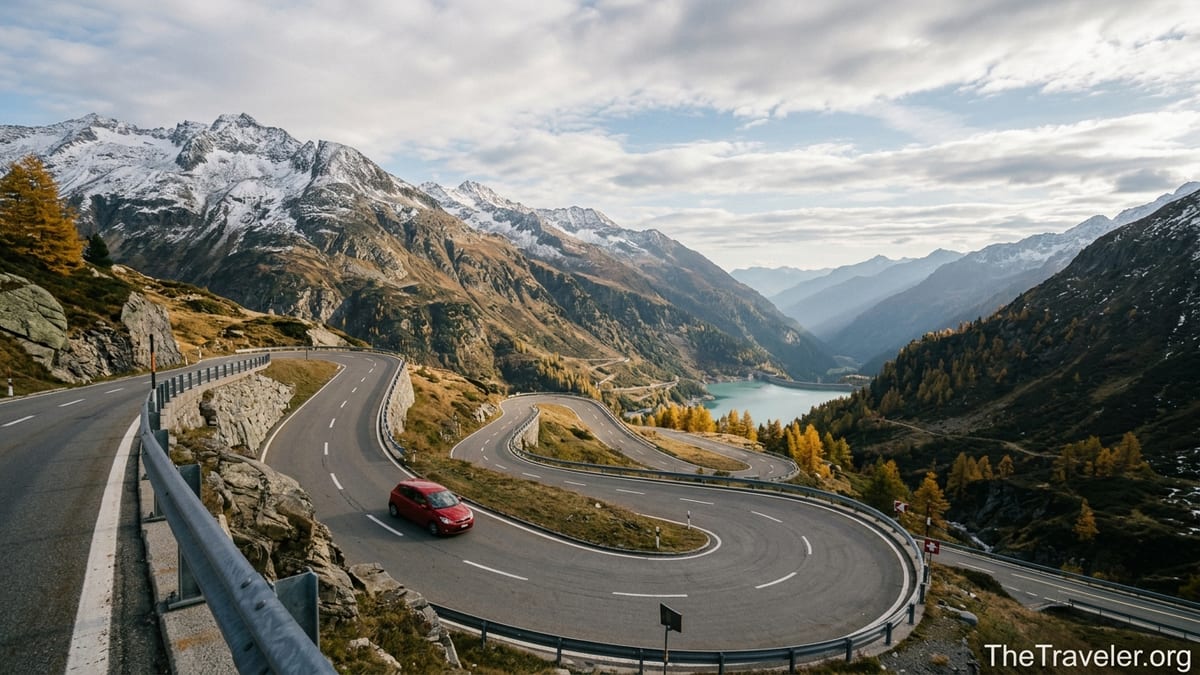
The Furka Pass, connecting Andermatt with the Valais, is legendary for its sequence of tight hairpins and views over the Rhône Glacier. Nearby Grimsel Pass links the Bernese Oberland with the upper Valais, passing reservoirs and bare granite peaks. The Susten Pass offers sweeping bends and long sightlines that many drivers rate as one of the most enjoyable in the country. The Gotthard region, meanwhile, offers a choice between the modern tunnel and the historic pass road via Tremola, where cobblestones and stacked hairpins take you back to the era of early motoring.
Driving these passes requires calm, unhurried technique rather than speed. Use low gears for both ascent and descent to avoid overheating brakes, especially in rental cars that may already have some wear. In summer, grazing animals sometimes cross the road without warning, and sudden fog or rain can reduce visibility. If a local driver catches up behind you, use a lay-by or wider section to let them pass instead of feeling pressured to drive faster than you are comfortable with.
When passes are closed, tunnels and car-shuttle trains keep the country connected. The Gotthard road tunnel remains open year-round, linking the German-speaking north with Italian-speaking Ticino. Between Realp and Oberwald, the Furka car-shuttle loads vehicles onto a train that passes through the Furka Base Tunnel, a useful winter alternative to the high pass road. Similar services operate at Lötschberg and Vereina, allowing you to keep a coherent itinerary even outside the prime pass season.
Lakes, Villages and Scenic Detours
While the high passes deliver drama, Swiss lakes and villages provide the softer side of a road trip. The Grand Tour threads a necklace of lakes including Zurich, Lucerne, Brienz and Thun in the central plateau; Geneva and Neuchâtel in the Romandie; and Lugano and Maggiore in Ticino. Many of these lakes have panoramic shoreline roads that reward slow driving with constant views, such as the Axenstrasse along the eastern shore of Lake Lucerne or the route from Interlaken to Brienz on the turquoise north shore.
Villages add personality to the landscape. In the Bernese Oberland, places like Lauterbrunnen, Wengen’s access point in the valley and Grindelwald sit under steep cliffs and glacier-hung peaks. In Graubünden, Guarda and Scuol show off Engadine houses painted with sgraffito details. Appenzell’s rolling hills are dotted with brightly painted farmhouses, while in Ticino, stone hamlets such as Morcote on Lake Lugano combine palm trees with church towers and arcaded alleys.
Because many of these villages are served by narrow, sometimes one-way lanes, a smaller car is again an advantage. In Zermatt, Mürren and Wengen, private cars are banned altogether, so you park in access villages such as Täsch or Lauterbrunnen and continue by train or cableway. In practice, this hybrid approach works well: the car gets you between valleys and lakes, and local lifts or trains handle the final ascent into car-free zones where the scenery is at its most spectacular.
Scenic detours are where driving really shines over rail. For example, from Lugano you can follow the lakeshore road to Gandria, then climb the short but twisting road to Monte Brè’s viewpoint and loop back via small villages above the lake. From Chur, a day trip by car into the Rhine Gorge, stopping at viewpoints near Flims and in little side valleys, feels relaxed and flexible compared with stitching together local buses. Always allow extra time for unscripted photo pauses; in Switzerland it is common to find a pullout with a bench exactly where the view is best.
Vignettes, Tolls, Parking and Practicalities
Switzerland keeps road pricing simple. Apart from a few special tunnels and mountain roads, there are no individual motorway toll booths. Instead, the annual motorway vignette covers all motorways and expressways for vehicles up to 3.5 tons. For visitors crossing the border by car, border posts and nearby fuel stations sell the vignette, and the newer digital option lets you register your plate number rather than affixing a physical sticker. If you never use the motorways and stay entirely on smaller roads, a vignette is technically not required, but in practice most itineraries use at least some motorway segments.
Special tunnels and passes may have separate fees. The car-shuttle trains at Furka, Lötschberg and Vereina charge per vehicle; you simply drive onto a flatbed carriage, stay in the car during the short transit and pay at the booth or booking office. A handful of private mountain roads, often leading to remote valleys or dams, also charge modest fees collected at unattended machines or small toll booths.
Parking is usually the greater day-to-day cost. In cities such as Zurich, Geneva and Lucerne, central garages can charge hourly rates that add up quickly if you leave the car all day. A common strategy is to book hotels with guest parking included or discounted and then explore compact old towns on foot or by tram. In resorts like Interlaken or Montreux, lakeside hotels often bundle parking with the room, but spaces may be tight in peak season. At trailheads and mountain lifts, expect to pay at meters in larger lots while small village car parks may be free but time-limited.
Blue zones in towns use disc parking systems where you display a cardboard clock set to your arrival time behind the windshield. The allowed stay, usually 30 minutes to a couple of hours, is signposted. Rental cars often come with such a disc in the glovebox; if not, you can buy one cheaply at petrol stations or kiosks. Respect no-parking signs and directional markings, because fines are efficiently enforced and can be forwarded to foreign renters months later.
Seasonality, Weather and Safe Driving Habits
Switzerland’s alpine climate means that the character of a road trip changes significantly with the season. In April and early May, valley roads are generally clear but high passes remain closed, forcing you to use tunnels. Meadows turn green and fruit trees blossom along lakes such as Zurich and Zug, yet lift systems and many mountain hotels close briefly between the winter ski and summer hiking seasons. If shoulder-season quiet appeals to you, focus on lakes and lower passes like the Julier or Lukmanier, which tend to open earlier or remain open most of the year.
July and August bring the most stable weather and the fullest range of open passes, but also the heaviest traffic. Queues at the Gotthard road tunnel are notorious during summer weekends and major holiday changeover days. Leaving very early in the morning or aiming for weekdays can reduce waiting times, and when conditions allow, taking the scenic Gotthard pass road instead of the tunnel can turn a delay into a highlight. In late September, a cooler, quieter interlude often arrives, with larch forests in the Engadine turning gold and the high passes still open but far less crowded.
Whatever the month, pack layers and be prepared for rapid changes in conditions. You could leave warm Lugano under palm trees and reach a chilly, wind-swept Grimsel summit two hours later. Sudden summer thunderstorms can drench pass roads and reduce grip on tight bends, while early autumn snow can prompt temporary closures. Before setting out on a big pass day, check official live road reports or regional tourist information to confirm status, and build a fallback plan via tunnels if the weather shifts.
Basic safe-driving habits matter more in the mountains than on flat motorways. Keep both hands on the wheel in hairpins, brake before the curve rather than in it, and favor engine braking on descents. In villages, watch for pedestrians stepping between parked cars and for cyclists emerging from side lanes. Speed limits change frequently as you pass through built-up areas; in Switzerland, enforcement relies heavily on fixed cameras and fines can be steep by international standards.
When Driving Truly Beats Rail Travel
There are many itineraries where rail and bus perform beautifully. But certain trips are far more rewarding and efficient by car. One example is a multi-pass loop based out of Andermatt. In two days with your own vehicle, you can drive Furka, Grimsel, Susten and Nufenen, pausing at dam walls, lakes and small villages en route. Reproducing this circuit fully by public transport would likely require at least three or four days and strict adherence to seasonal timetables.
Another case is exploring side valleys and hanging villages. From Lugano, reaching rustic valleys such as Val Verzasca and Val Bavona involves sparse bus services and tight connections; by car, you can roll up to trailheads, waterfalls and tiny stone hamlets on your own schedule. Similarly, around Davos and St. Moritz, having a vehicle makes it much easier to visit multiple lakes, passes and small Engadine villages in a single day, especially if you are traveling with children or elderly relatives who appreciate door-to-door convenience.
Driving also shines when you want to mix outdoor sports with flexible timing. A group of hikers based in Interlaken can use a car to reach trailheads in Kandersteg, Grindelwald and the Haslital without worrying about the last bus home. Cyclists can shuttle themselves and their bikes to high starting points or alternative end points that are not well served by trains. In winter shoulder months, a car allows you to chase patches of sun or good snow between nearby resorts rather than committing entirely to one base served by a single rail line.
Finally, if your Swiss trip is part of a longer European journey, a car simplifies border-hopping loops that include neighboring regions such as Italy’s Valtellina, France’s Chamonix valley or Austria’s Arlberg. Swiss rental contracts often permit travel in adjacent countries, allowing you to build a grand alpine arc that would be complex and time-consuming to manage with only trains and buses.
The Takeaway
A Swiss road trip built around the Grand Tour, alpine passes, lakes and villages offers one of Europe’s most rewarding driving experiences. With a little planning around vignettes, parking and mountain weather, even first-time visitors can handle the roads confidently. The combination of precision infrastructure and dramatic scenery means that the logistics rarely get in the way of the views.
Choosing when to drive and when to rely on Switzerland’s excellent rail network is less about one being “better” than the other and more about matching the tool to the job. For crossing the country between major cities, trains often win on speed and simplicity. For stitching together balcony roads, remote valleys, multiple passes and lakeside villages on the same day, a car is hard to beat.
If you time your visit for late spring through early autumn, keep distances modest, and combine a few strategic bases with flexible day trips by car, you can experience the country’s full diversity in a single trip. From cobbled pass roads above Andermatt to quiet lakeshore lanes on Lake Lugano, Switzerland rewards drivers who take it slowly, look ahead and savor the journey as much as the destination.
FAQ
Q1. Do I need a car to enjoy Switzerland, or is the train enough?
For city-to-city travel and classic scenic routes like the Glacier Express, trains are excellent. A car becomes worthwhile if you want to link several alpine passes in a day, explore side valleys with sparse bus service, or travel as a family with lots of luggage and outdoor gear.
Q2. When is the best time of year to drive Switzerland’s high passes?
Most high passes such as Furka, Grimsel and Susten commonly open sometime between mid May and mid June and close again between late October and early November, depending on snowfall. For the widest choice and more stable weather, aim for late June to late September.
Q3. Is driving the Swiss alpine passes dangerous for inexperienced drivers?
The passes are well engineered, signposted and maintained, but they demand concentration. If you are comfortable with narrow, winding roads and use low gears on descents, you should be fine. Avoid driving tired, do not rush, and if conditions feel stressful, use tunnels or lower routes instead.
Q4. Do rental cars in Switzerland include the motorway vignette?
Most rental cars registered in Switzerland already have the annual motorway vignette, either as a sticker or as a digital registration linked to the plate. If you rent across the border in a neighboring country, confirm at the counter and buy a vignette if needed before using Swiss motorways.
Q5. How expensive is parking in Swiss cities and resorts?
Parking costs vary widely but can feel high in central districts of Zurich, Geneva or Lucerne, where multi-storey garages charge by the hour. Many hotels in resorts like Interlaken, Zermatt’s access village Täsch and Montreux offer guest parking, sometimes included or at a reduced nightly rate, which can be better value than public garages.
Q6. Can I drive into car-free resorts like Zermatt or Wengen?
No, private cars are not allowed in these villages. You park in access points such as Täsch for Zermatt or Lauterbrunnen for Wengen and continue by train or cableway. This works smoothly in practice and your car remains available for exploring other valleys on different days.
Q7. What kind of car is best for a Swiss road trip?
A compact hatchback or small SUV with enough luggage space is ideal. You do not need a large 4x4 for paved roads, and a smaller car makes village streets, parking garages and tight hairpins on passes much easier to handle.
Q8. How do I check if a mountain pass is open on the day of travel?
Before setting out, use official Swiss road reports or regional tourist information services, which publish live status for passes and tunnels. In shoulder seasons, also pay attention to local signage at valley junctions, which indicate closures or snow-chain requirements.
Q9. Are there extra tolls beyond the motorway vignette?
Yes, a few. Special car-shuttle trains such as Furka, Lötschberg and Vereina charge per vehicle, and some private mountain access roads may have small local tolls. These are separate from and in addition to the national motorway vignette.
Q10. How does driving compare in cost to a Swiss Travel Pass?
For a solo traveler focused on cities, a Swiss Travel Pass can be better value. For couples or families who share car and fuel costs, a week of compact car rental in low or shoulder season often comes out similar in price to multiple rail passes, with added flexibility to reach remote passes, lakes and villages.