


Switzerland is one of the easiest countries in Europe to explore by public transport. Trains, boats and mountain railways knit together lakeside cities and high‑alpine villages with clockwork precision, making it entirely realistic to plan a complex multi‑stop trip without ever renting a car. This itinerary guide walks through practical 5, 7, 10, 14 and 21 day routes that link Zurich, Lucerne, Interlaken, the Jungfrau Region, Zermatt, Montreux and other highlights, using real train times and overnight allocations that actually work on the ground.
How Swiss train travel works and typical journey times
Switzerland’s national rail network is built around frequent, mostly clock‑face departures and easy transfers. On core routes you rarely need to book ahead and can usually just walk onto the next train. For planning purposes, it helps to know roughly how long the main jumps between classic bases take, because that determines how many times you can sensibly change hotels on a short trip.
As a rule of thumb, Zurich to Lucerne is about 45 to 55 minutes by direct InterRegio train, with at least two departures an hour most of the day. Zurich Airport to Zurich main station is around 10 to 15 minutes, so you can often be on a train south within an hour of landing. Lucerne to Interlaken Ost, via the scenic Brünig line through Meiringen and along Lake Brienz, takes about 2 hours with one straightforward change or a through train on certain departures.
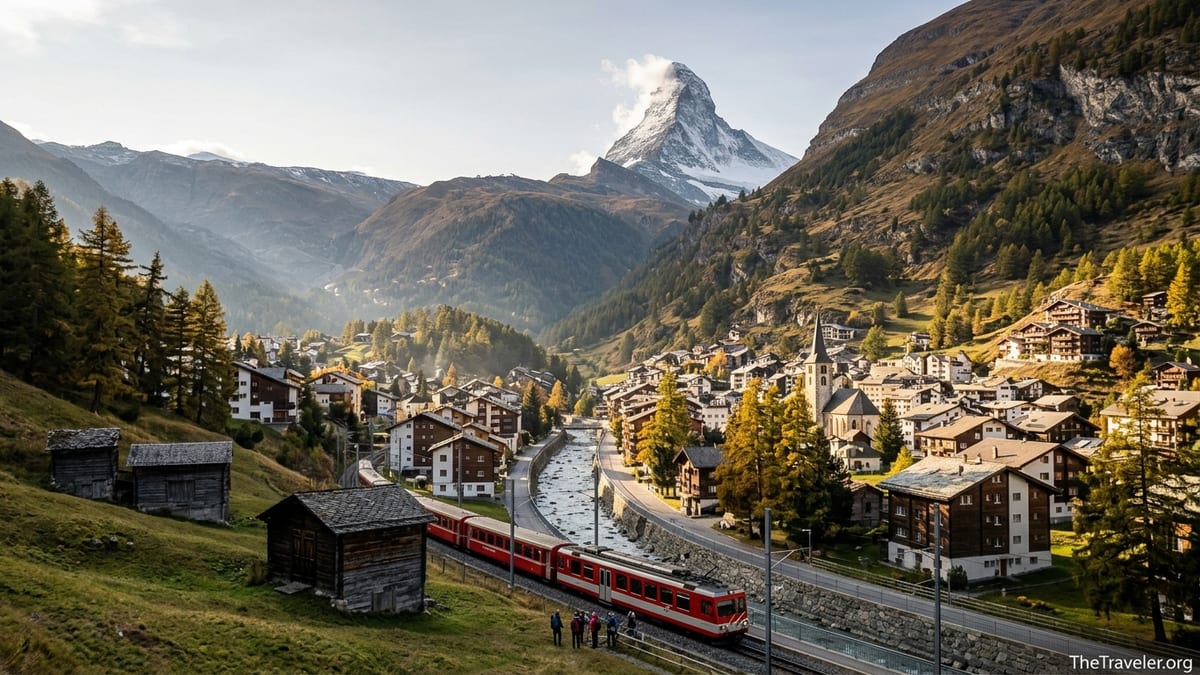
From Interlaken Ost to Zermatt you should allow around 2 hours 15 minutes to 2 hours 45 minutes, typically changing in Spiez and Visp. The last section from Visp up the Mattertal valley is on the narrow‑gauge line to Zermatt, where cars are not allowed. Montreux to Interlaken via the GoldenPass Express panoramic train takes roughly 3 hours 15 minutes, crossing high pastures and traditional villages before descending towards Lake Thun.
Within the Jungfrau Region, distances are short but you rely on slower cog railways and cable cars. Interlaken Ost to Lauterbrunnen is about 20 minutes, Lauterbrunnen to Wengen another 15 minutes, and Lauterbrunnen to Mürren about 20 to 25 minutes by train and cable car in combination. Because these local legs add up, most travellers pick one village base such as Lauterbrunnen, Wengen or Grindelwald for three or more nights so they are not constantly packing and unpacking between mountain excursions.
Rail passes, point‑to‑point tickets and what things actually cost
For an itinerary of 5 to 21 days, you will almost certainly want some kind of rail pass rather than buying every ticket at full fare. The most popular option for visitors is the Swiss Travel Pass, which gives unlimited travel on almost all regular trains, boats and many mountain railways on consecutive days. As of 2026, guide prices for 2nd class are in the region of 250 Swiss francs for 3 days, around 300 francs for 4 days, 400 francs for 6 days, a little over 430 to 440 francs for 8 days and roughly 500 francs for 15 days, with youth discounts for travellers under 25. Exact prices vary slightly with exchange rates and sales channel.
On top of that, the Swiss Travel Pass usually gives free local public transport in many cities and substantial reductions, often 25 to 50 percent, on expensive mountain lifts such as Pilatus above Lucerne, the Jungfraujoch rack railway from Kleine Scheidegg, and the Gornergrat railway in Zermatt. As a concrete example, going up to Jungfraujoch from Grindelwald or Wengen can easily cost more than 200 francs return at the counter, but with a pass you normally pay only the mountain section at a reduced rate, bringing the out‑of‑pocket cost down significantly.
For longer stays or lower‑intensity travel days, another commonly used tool is the one‑month Swiss Half Fare Card, which lets you purchase almost all tickets at half price for about 150 francs for the month from 2026. Many budget‑conscious visitors pair this with Saver Day Passes that can start from the low 50 franc range in 2nd class if bought early, giving you a day of fully flexible travel at a discounted rate. In practice, couples and families often mix and match: perhaps a 6 or 8 day Swiss Travel Pass aligned with the busiest travel days, then half‑fare products or regional passes for quieter stretches.
To see how this plays out in real life, imagine a 10 day trip that includes long‑distance rides Zurich–Lucerne, Lucerne–Interlaken, Interlaken–Zermatt, Zermatt–Montreux and Montreux–Zurich, plus boats on Lakes Lucerne and Thun and at least two big mountain excursions. Point‑to‑point at full fare, the rail portions alone can easily exceed 500 francs per person, even before cable cars. An 8 day Swiss Travel Pass in 2nd class plus one or two discounted mountain tickets and a separate airport transfer day often works out very similar in price, but with a lot more flexibility and simplicity at ticket machines when you are tired and jet‑lagged.
A compact 5 day Switzerland itinerary
A five day trip is essentially a taster, so it makes sense to limit yourself to two overnight bases and a maximum of one long rail day. A realistic pattern that fits typical flight times is two nights in Lucerne, two in the Jungfrau Region with Interlaken as the gateway, and your last night either back in Zurich or as a late return from Interlaken if your departure is in the afternoon.
One practical version looks like this: Day 1, arrive Zurich Airport and take the 10 to 15 minute train into Zurich main station, then connect onto the 45 to 55 minute direct train to Lucerne. Check into a hotel near the lakefront or the old town. Spend the afternoon walking Chapel Bridge, the city walls and the waterfront promenade. On Day 2, stay based in Lucerne but ride a classic lake and mountain combo, for example the round‑trip boat to Alpnachstad and cogwheel railway up Mount Pilatus, returning by cable car and local bus. If the weather is poor, swap in the nearby Rigi excursion or visit the Swiss Museum of Transport instead.
On Day 3, travel from Lucerne to Interlaken Ost on the roughly 2 hour scenic Brünig line, ideally taking a mid‑morning departure to arrive around lunchtime. Check into accommodation either in Interlaken itself for easy logistics or continue straight up into Lauterbrunnen or Wengen if your luggage is manageable. The afternoon can be a gentle warm‑up: stroll to Staubbach Falls, ride the cable car up to Grütschalp and walk the panorama trail to Mürren, then descend via cable car and train.
Day 4 is your single big Jungfrau Region day. If forecasts are clear, go early to Jungfraujoch or Schilthorn. For Jungfraujoch, allow about 2 hours each way from Interlaken Ost including changes in Lauterbrunnen or Grindelwald and Kleine Scheidegg, plus two to three hours on top for viewpoints, ice palace and glacier walk. For Schilthorn, the chain of cable cars from Stechelberg through Mürren usually takes around 45 to 60 minutes each way. Day 5, take a morning train back to Zurich, typically just under 2 hours with a simple change in Bern, and connect directly to the airport if you are flying out the same day.
Classic 7 and 10 day routes linking Lucerne, Jungfrau and Zermatt
With a full week, you can comfortably sequence Lucerne, the Jungfrau Region and Zermatt without rushing. A balanced 7 day itinerary might be two nights Lucerne, three in the mountains near Interlaken and two in Zermatt. This pattern gives you at least two full days for high‑alpine hikes and viewpoints in each mountain base while keeping the number of big travel days manageable.
For example, Days 1 to 3 follow the Lucerne program outlined earlier. On Day 3 afternoon you arrive around Interlaken or Lauterbrunnen. Day 4 might be dedicated to Jungfraujoch if the weather is ideal, or to hiking above Männlichen and Kleine Scheidegg if skies are clearer in the afternoon. Day 5 could feature the Lauterbrunnen valley floor, Trümmelbach Falls and an evening in car‑free Mürren. On Day 6, you ride Interlaken–Spiez–Visp–Zermatt in around 2 hours 30 minutes, checking into a hotel with a partial Matterhorn view if budget allows. Day 7 is all about Gornergrat or the Rothorn viewpoint and easy lakeside walks, possibly flying out the next day or returning to Zurich in about 3 hours 30 minutes via Visp and Bern.
A 10 day trip allows for a more relaxed pace and an extra base such as Montreux or Bern. One widely used structure is two nights Zurich or Lucerne, three in the Jungfrau Region, three in Zermatt and two on Lake Geneva around Montreux or Vevey. The key train legs remain similar, but you now have buffer days for bad weather, laundry and spontaneous detours such as a half‑day in Bern’s old town or an evening in the thermal baths at Leukerbad on the way between Interlaken and Zermatt.
On the ground, this might look like: Days 1 to 3 in Lucerne with at least one mountain day; Days 3 to 6 in Lauterbrunnen or Wengen for Jungfrau explorations; Day 6 rail transfer to Zermatt and an evening stroll through the village; Days 7 and 8 for Gornergrat, the Matterhorn Glacier Trail in season, and maybe a shorter excursion like Sunnegga. Day 9, travel the roughly 2 hours from Zermatt back down to Visp and across to Montreux on Lake Geneva in under 90 minutes more. Day 10, enjoy Castle Chillon, lakeside promenades and hillside vineyards before a final 2 to 2.5 hour train back to Zurich or Geneva for your onward journey.
Stretching to 14 days: adding Montreux, Bern and side valleys
Two weeks in Switzerland lets you slow down, revisit favorite viewpoints in different light and include secondary valleys that short stays often skip. A popular 14 day structure for first‑timers is: Zurich or Lucerne (3 nights), Jungfrau Region (4 nights), Zermatt (3 nights), Montreux or Vevey (3 nights) and a final night back near your departure airport if needed. Each segment is joined by a train ride in the 2 to 3 hour range, so you rarely lose an entire day to transit.
Between Lucerne and Interlaken, you can now afford to step off earlier and explore places like the Aare Gorge near Meiringen or the lakeside town of Brienz. In the Jungfrau Region, four nights give you three full days to spread out classic highlights: one day for Jungfraujoch and Kleine Scheidegg, one for the Schilthorn loop via Mürren and Gimmelwald, and one flexible day for hiking routes like First to Bachalpsee above Grindelwald or the North Face Trail above Mürren. Because mountain weather is notoriously changeable, having spare days dramatically increases your odds of catching at least one crystal‑clear morning at high altitude.
After your stay near Interlaken, head to Zermatt in roughly 2 hours 30 minutes via Spiez and Visp. With three nights, you gain time for both the Gornergrat railway and the cable car system up to the Klein Matterhorn area, branded Matterhorn Glacier Paradise. Many travellers on a 14 day schedule also build in a rest morning here, eating a late breakfast and then taking the easy walk to the Gorner Gorge or through larch forests above town rather than packing in yet another summit.
From Zermatt, continue to Montreux in about 2 hours 30 minutes, normally changing in Visp and perhaps again in Lausanne. Three nights on Lake Geneva allow for a day in the terraced Lavaux vineyards between Vevey and Lausanne, another half‑day at Castle Chillon and a relaxed itinerary of paddle‑steamer cruises and lakeside strolls. To finish, it is straightforward to reach either Geneva Airport or Zurich Airport in 2 to 3 hours by direct or one‑change trains, so your final day can still include one last waterfront walk or café stop rather than being spent entirely in transit.
Grand 21 day itinerary ideas across Switzerland
With three weeks you can weave in eastern and southern Switzerland while still enjoying the core loop of Zurich, Lucerne, Jungfrau, Zermatt and Montreux. A practical 21 day structure might be: Zurich or Lucerne (4 nights), Jungfrau Region (4 nights), Zermatt (3 nights), Montreux or Vevey (3 nights), the Lake Lugano or Lake Como area on the Swiss side (3 nights) and finally 3 nights in the eastern Alps around St Moritz or Davos, using the Glacier Express or Bernina Express routes to link regions.
For example, after Montreux you could route via Visp and the long Lötschberg and Gotthard corridors towards Ticino. Spending three nights in Lugano or nearby Morcote gives a distinctly Mediterranean flavor to your Swiss trip, with palm‑lined promenades, gelato shops and Italian‑influenced cuisine. Train times from Montreux to Lugano are usually around 4 to 4.5 hours with one or two changes, which is long by Swiss standards but comfortable on modern intercity stock.
From Lugano or Locarno, you can then head to Chur and on to St Moritz, perhaps timing your journey to coincide with a panoramic train. The full Glacier Express from Zermatt to St Moritz takes roughly 8 hours, so many travellers instead join or leave it at intermediate points like Chur or Brig to keep the day manageable. In the Engadine valley around St Moritz, trains and postbuses connect to high lakes, small villages and trailheads, so a car remains unnecessary.
At this length, consider splitting your time between city and mountains to avoid fatigue. For instance, two nights in Zurich at the start and two in Bern or Basel in the middle give you access to museums, markets and river swimming spots that contrast nicely with high‑alpine hiking. Because you are staying 3 or 4 nights in each base, you can often negotiate better nightly rates on apartments or family‑run hotels, partially offsetting the higher costs of mountain excursions.
Choosing bases: Zurich, Lucerne, Interlaken and beyond
When deciding where to sleep, it is helpful to think in terms of rail hubs versus scenic satellite villages. Zurich is the main international gateway with a big station directly under the airport. While the city itself offers lakefront swimming, a compact old town and good restaurants, many visitors limit their stay to one or two nights because rail links make it so easy to move on. Lucerne, around 45 to 55 minutes away, feels smaller and more traditionally Swiss, with a walkable center and quick access to nearby peaks.
Interlaken sits strategically between Lakes Thun and Brienz and functions primarily as a transport hub for the Jungfrau Region. The town itself is pleasant but not as atmospheric as the villages higher up. For a 5 day itinerary, staying in Interlaken can make sense because you avoid extra transfers with suitcases and can catch trains or boats in multiple directions. On trips of 7 days or longer, many travellers prefer to sleep in Lauterbrunnen, Wengen, Grindelwald or Mürren, accepting the 20 to 45 minute extra ride up and down the valley for the reward of mountain views outside their window.
Zermatt and Montreux serve rather different roles in an itinerary. Zermatt is a car‑free mountain resort entirely oriented around outdoor activities and Matterhorn views, linked by a roughly 3.5 hour train journey from Zurich with a change in Visp. Hotels here range from simple guesthouses to luxury properties with spas, and many offer baggage transfers from the station. Montreux, on the other hand, is all about the lake, vineyards and a softer climate. Its train station sits above the waterfront, and from here the GoldenPass Express begins its scenic climb towards the Bernese Oberland.
Secondary bases worth considering if you have 10 days or more include Bern, with its UNESCO‑listed old town and fast rail links in multiple directions, and Lausanne, which offers cultural institutions and a youthful atmosphere. Eastern bases such as Chur, St Gallen or St Moritz are natural additions if you plan to ride the Glacier Express or Bernina line, while Lugano and Locarno suit those who want milder weather, palm trees and easy train connections into northern Italy for day trips.
Practical tips for linking routes and managing pace
Across all itinerary lengths, the most important practical rule is to avoid more than one long rail leg on any given day. Although Swiss trains are comfortable, changing three or four times with luggage after an early start quickly becomes tiring, especially for families. In concrete terms, aim for a maximum of about 4 to 5 hours in total travel time on transfer days, which comfortably covers jumps like Lucerne to Zermatt, Interlaken to Montreux or Lugano to Chur.
Whenever possible, check departure times the evening before and pick specific connections rather than just showing up at the station. The national journey planner and station departure boards are reliable, but construction work can sometimes extend travel times or require track changes. If you are using a Swiss Travel Pass or Half Fare Card, remember to budget for the extra step of reserving seats on a few named panoramic trains such as the Glacier Express and sometimes the GoldenPass Express. These reservations are not covered by the pass and must be paid separately, though ordinary intercity and regional trains generally do not require seat reservations at all.
Pacing also matters with mountain excursions. Many visitors try to squeeze in both Jungfraujoch and Schilthorn in a single day, only to discover that queues, transfers and variable weather turn it into a stressful race. A better strategy is to anchor your mountain days around one major summit or hike and one or two secondary activities such as a lakeside boat ride, a village stroll or a short forest walk. On a 10 or 14 day trip, building in at least two lighter days with no major bookings allows flexibility to adjust for rain or low clouds.
Finally, consider how your chosen pass affects spontaneity. A Swiss Travel Pass covering your key travel days means you can easily hop off at places like Thun, Spiez, Brienz or Sion for an unplanned hour by the water without worrying about separate tickets. If you rely on Saver Day Passes, the value is highest when you plan a few long days in advance and then use cheaper point‑to‑point tickets or simply walk and use local buses on shorter days. Both approaches work, but each shapes the feel of your itinerary.
FAQ
Q1. Is a Swiss Travel Pass worth it for a 5 to 7 day itinerary?
For most travellers who plan several intercity train rides plus at least one or two mountain excursions, a Swiss Travel Pass is often close in price to regular tickets while being much simpler. On a 5 or 7 day route that includes Zurich or Lucerne, the Jungfrau Region and possibly Zermatt, the pass usually covers all mainline trains, boats and many local buses, with discounts on expensive lifts. If your trip is mostly staying in one city with only a short side trip, separate tickets or regional passes can sometimes be cheaper.
Q2. How many bases should I choose for a 10 day Switzerland trip?
A practical maximum is three overnight bases for 10 days, such as Lucerne, the Jungfrau Region and Zermatt, or Lucerne, Interlaken and Montreux. This balance gives you time to unpack, enjoy at least two full days in each location and still fit in scenic transfers without feeling like you are living out of your suitcase. Adding a fourth base is possible, but only if two of them are cities connected by a short 1 hour rail hop.
Q3. Can I visit both Jungfraujoch and Schilthorn on a short itinerary?
It is technically possible to see both in one long day, but for a 5 or 7 day trip that approach is usually too rushed. Each excursion involves multiple cable cars or cog railways and benefits from good visibility, so most visitors achieve a better experience by picking one major summit and leaving the other for a future visit. On longer 10 or 14 day itineraries with more weather flexibility, spreading the two viewpoints over separate days works well.
Q4. Should I stay in Interlaken or in a mountain village like Wengen or Mürren?
For very short stays or for travellers with heavy luggage, Interlaken offers easy station access and faster onward connections, which can be useful on a 5 day itinerary. However, if you have 7 days or more and are comfortable making one extra 20 to 45 minute ride up and down the valley, basing yourself in Lauterbrunnen, Wengen, Grindelwald or Mürren usually gives a more immersive alpine feel. Many people split the difference by staying the first night in Interlaken to recover from travel, then moving up to a village for several nights.
Q5. How far in advance do I need to book Swiss trains?
Standard intercity and regional trains in Switzerland generally do not require advance booking, and even in high season you can usually board with a valid pass or same‑day ticket. The main exceptions are named panoramic trains such as the Glacier Express, some services on the GoldenPass route and certain international trains, which require separate seat reservations purchased ahead of time. It is also wise to reserve at busy times if you need guaranteed seating together as a family or group.
Q6. Is 21 days in Switzerland too long, or should I add another country?
Three weeks is not too long if you enjoy hiking, mountain scenery and slower travel, especially if you combine different regions such as the central lakes, the Bernese Oberland, Valais, Ticino and the Engadine. That said, many itineraries naturally pair Switzerland with nearby areas of Italy, France, Germany or Austria because rail links are fast and frequent. If you start to feel that your plan is full of similar mountain villages, consider substituting two or three days in cities like Milan, Lyon or Munich instead of adding yet another alpine base.
Q7. What is a realistic daily budget for trains and mountain lifts?
Costs vary widely, but many visitors who do not use passes are surprised at how quickly individual tickets add up. A single long‑distance ride such as Zurich to Zermatt, a couple of shorter hops and one major mountain excursion can easily reach 200 Swiss francs per person in one day at full fare. Using a Swiss Travel Pass or Half Fare Card typically brings the effective daily transport cost for a packed sightseeing day down into the 70 to 120 franc range, depending on how many premium lifts you include.
Q8. Are Swiss trains suitable for families with children and strollers?
Yes, most intercity and regional trains have low‑floor entrances or ramps, dedicated stroller spaces and family‑friendly compartments. Stations are generally equipped with elevators or gently sloped ramps between platforms, although in some smaller mountain stops you may still encounter stairs. Many families find that the freedom to move around, visit restaurant cars and enjoy scenery from large windows makes long journeys with children more comfortable than driving.
Q9. How should I plan around weather in the mountains?
The higher you go, the more quickly conditions can change, so flexibility is key. A good strategy is to avoid pre‑booking too many nonrefundable mountain tickets far in advance and instead watch forecasts a few days out, slotting your biggest viewpoints and hikes into the clearest windows. At lower elevations, city walks, lake cruises and museums in Lucerne, Bern or Zurich make excellent bad‑weather alternatives that keep your itinerary enjoyable even during a rainy spell.
Q10. Is it easy to travel with luggage on Swiss trains between all these bases?
For most travellers it is straightforward. Trains have racks at carriage ends and overhead shelves suitable for typical airline‑size suitcases, and platforms are level with train floors on many routes. The main adjustment is to pack lighter than you might for a single‑base trip, as you will be lifting bags on and off trains and possibly into smaller mountain trains and cable car cabins. If you have very bulky luggage, station‑to‑station baggage services operated by the railways can transfer your bags for a fee, leaving you free to travel with just a daypack.