

Few countries force the “mountains or cities” question as sharply as Switzerland. With glacier-framed valleys only a few hours from lakeside boulevards and world-class museums, the hardest part of planning is not what to see, but how to divide your time. This guide looks at the trade-offs between the Swiss Alps and urban hubs like Zurich, Geneva, Bern and Lucerne, with practical examples of costs, travel times and experiences to help you design a realistic itinerary.
Mountains vs Cities: The Big Picture
Think of Switzerland as two overlapping trips. One is all about the Alps: car-free villages like Zermatt under the Matterhorn, the Jungfrau region above Interlaken, or Engadine towns such as St. Moritz and Pontresina. The other centers on cities: Zurich’s arts and nightlife, Geneva’s diplomacy and lakefront promenades, Bern’s medieval old town and river swims, Lucerne’s lakeside charm with easy mountain day trips. Most first-time visitors try to sample both, but how you split your days depends on what you value more: scenery and outdoor time, or culture and urban comfort.
In broad strokes, couples and photographers tend to lean toward the Alps, especially in summer and early autumn when hikes and scenic trains are at their best. Families often benefit from at least a few nights in a city for easier logistics, playgrounds and wet-weather options, then shift to a mountain base where kids can ride lifts, toboggans and cable cars. Budget also matters: city hotels can run from around 220 to 350 Swiss francs per night for solid mid-range double rooms, while small mountain resorts sometimes offer better value in shoulder season but climb sharply in top ski weeks.
Transport is another key factor. Switzerland’s dense train network means you can wake up in downtown Zurich, spend the day on trails above Lauterbrunnen or Engelberg, and be back by evening. But the most rewarding Alpine experiences usually come from sleeping in the mountains, not day-tripping from a city. As a rule of thumb, travelers with a week or more should aim to sleep in at least one mountain base and one city to feel both sides of the country properly.
Seasonality will strongly shape your decision. A February visit for skiing or winter scenery will justify spending most nights in the Alps, with perhaps a short stop in Zurich or Geneva on arrival or departure. In June or September, when lakeside cafés and hiking trails are equally appealing, a more even split between cities and mountains works well.
How Many Days in the Alps vs Cities?
For a classic 7-day trip, many visitors end up happiest with something like 4 nights in the Alps and 3 nights divided between one or two cities. A concrete example: fly into Zurich, spend one night there to recover from jet lag and wander the old town, then take the train to the Jungfrau region for four nights in Wengen or Grindelwald, and finish with two nights in Lucerne before flying out. This structure limits hotel changes, keeps travel legs under about 3 hours and gives several full days in mountain scenery.
If your trip is shorter, say 4 or 5 days, you face harder choices. For a 5-day trip with an early-morning arrival in Zurich, you might skip Geneva entirely, spend your first night in Zurich, then go straight to one Alpine base such as Zermatt or Interlaken for three nights, and finish with a final night in Lucerne or back in Zurich for easy airport access. For 4 days, you are often better off choosing either a fully city-focused trip (Zurich and Lucerne with day trips) or a mostly mountain-focused one (for example Geneva plus three nights in the Valais Alps, such as Zermatt or Saas-Fee).
On longer trips of 10 to 14 days, you can comfortably structure the itinerary into thirds: for instance, 4 nights in Zurich and Lucerne combined, 4 nights in the Jungfrau region and 3 nights in Zermatt. Another pattern is “city, lakes, high Alps,” where you spend two nights in Geneva, three around Montreux or Vevey on Lake Geneva, and four in the Jungfrau region. Trains between these areas are straightforward, and scenic routes like the GoldenPass Express between Montreux and Interlaken turn transfers into part of the sightseeing.
Be realistic about travel fatigue. While Zurich to Zermatt by train takes around 3.5 hours with one change in Visp, doing that on consecutive days in different directions quickly eats away at your time. For most travelers, changing bases more than three times in a week makes the trip feel rushed. Choosing just one or two mountain hubs and one city keeps packing and unpacking manageable.
What City Travel in Switzerland Actually Feels Like
Swiss cities are compact, walkable and more relaxed than many European capitals, which makes them appealing even to travelers who do not usually enjoy big cities. In Zurich, you might spend a day strolling the Bahnhofstrasse shopping boulevard, exploring the cobbled lanes of the Altstadt and swimming or paddleboarding off one of the public bath platforms on Lake Zurich in late spring or summer. Museums such as the Kunsthaus or the Swiss National Museum offer solid rainy-day options, and evenings can be spent in neighborhood wine bars around districts like Zurich West.
Geneva has a different flavor, shaped by international organizations and its position on the French-speaking side of the country. A typical day could combine a boat cruise on Lake Geneva, a walk through the Old Town up to St. Pierre Cathedral, and a visit to the Palais des Nations or the Red Cross and Red Crescent Museum. Bern, the federal capital, feels smaller and more intimate again, with arcaded streets, the river Aare looping around the UNESCO-listed old town and local residents floating downstream in summer in their bathing suits before climbing out near the Marzili baths.
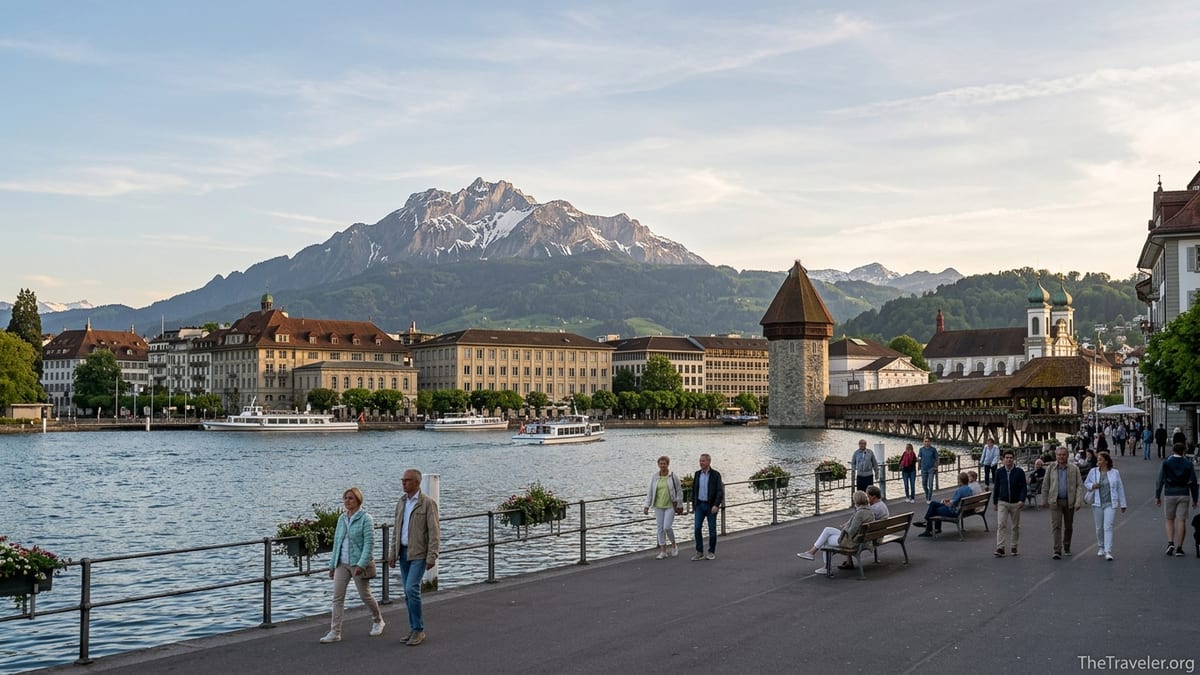
Lucerne is arguably the best city compromise for first-time visitors. It has a walkable medieval core with the Chapel Bridge and water tower, mountain backdrops, and easy day trips up Mount Pilatus and Mount Rigi or around Lake Lucerne by boat. Because of its position, many tourists choose to base there for 2 or 3 nights at the end of a trip, combining soft urban pleasures with lighter mountain experiences. You can have a coffee on the lakeside promenade in the morning and still enjoy a short hike above Rigi Kaltbad the same afternoon.
In terms of logistics, city stays usually mean shorter walks to train stations, supermarkets and restaurants. This appeals to families with strollers and to travelers who want flexibility in poor weather. If low clouds block mountain views, you can spend the day in a city museum or covered arcade instead of sitting in a fogged-in valley.
What an Alpine Base Really Buys You
Sleeping in the Alps changes the rhythm of your trip. In car-free Zermatt, for example, you can walk from a guesthouse near the village center to the Gornergrat Bahn cog railway in minutes, ride up for sunrise over the Matterhorn, then come back down for breakfast before most day-trippers have even reached the valley. In the Jungfrau region, staying in Wengen or Mürren lets you step straight onto mountain trains or cable cars in the morning, cutting out a long commute from Interlaken.
Daily life in these villages is slower and more outdoors-oriented than in cities. You might hike from Männlichen to Kleine Scheidegg in the Jungfrau region one day, ride the First gondola from Grindelwald for a cliff walk and mountain cart tracks the next, then take a boat trip on Lake Brienz or Lake Thun from Interlaken. In winter, skiers can start and end their day almost at the doorstep of many hotels and chalets, especially in resorts like Verbier, Saas-Fee, Arosa Lenzerheide or Engelberg.
Mountain weather is more variable, which is both part of the charm and a planning challenge. It is not unusual to arrive in Zermatt and find the Matterhorn hidden in clouds for two days, or to wake up to rain in the valley but sunshine above a mid-mountain lift station. By basing yourself in the Alps for several nights, you increase your chances of hitting at least one clear day for high-elevation viewpoints such as Jungfraujoch, Schilthorn, Gornergrat or the Titlis glacier above Engelberg.
Mountain villages also tend to quiet down at night, especially outside peak season. Evening entertainment is usually limited to hotel bars, a handful of pubs and the occasional concert, so travelers who thrive on nightlife may prefer to keep those longer evenings in Zurich or Geneva and treat the Alps as early-to-bed, early-to-rise segments of the trip.
Costs on the Ground: Hotels, Food and Passes
Switzerland is expensive by most international standards, and both cities and major ski resorts command high prices. In Zurich and Geneva, a centrally located, well-reviewed 3- or 4-star hotel often runs around 230 to 350 Swiss francs per night for a double room in high season. Bern and Lucerne can be slightly cheaper, with some mid-range doubles between roughly 200 and 280 francs in shoulder months like May or October. Simple city lunches of pasta, salads or daily specials may cost 20 to 30 francs per person, while dinner in a mid-range restaurant with a main course and a drink can easily land between 35 and 50 francs per person or more.
In mountain areas, accommodation prices vary widely by resort and season. A family-run hotel in Grindelwald or Wengen might charge around 220 to 300 francs for a double room including breakfast in summer, but the same property in peak ski weeks can be significantly more. Zermatt and St. Moritz often price higher, especially for ski-in ski-out addresses and upscale spa hotels. On the other hand, smaller, lesser-known areas and shoulder-season dates in late spring or autumn sometimes give better value than cities, especially for apartments or chalets that sleep families or groups.
Transport passes become an important budget tool. The Swiss Travel Pass, available only to visitors, covers nationwide trains, buses and many boats, with additional discounts on most mountain lifts. Recent price schedules indicate that multi-day 2nd class passes typically work out to a ballpark of 50 to 70 francs per day if you choose longer durations, though exact costs depend on validity length and class. Regional passes such as the Berner Oberland Pass or Jungfrau Travel Pass can be attractive if you plan several mountain lift rides concentrated in one area, while the Swiss Half Fare Card lets you buy almost all tickets at 50 percent off for a month.
Ski passes are a separate cost in winter. In major Swiss resorts, an adult day ski pass commonly falls somewhere around 70 to 100 francs, with 3-day tickets in high-profile destinations like Zermatt or Verbier reaching several hundred francs in total. Season passes and multi-resort products exist and can be good value for long stays, but most overseas visitors on week-long trips stick to regular day or week passes bundled with local lift networks. For non-skiers, note that winter mountain railways and cable cars to scenic viewpoints are also pricey; a return trip to a high-elevation attraction can be 80 francs or more without discounts, which makes the choice of passes particularly important on an Alpine-heavy itinerary.
Getting Around: Trains, Scenic Routes and City vs Mountain Logistics
Switzerland’s public transport system makes combining cities and mountains remarkably straightforward. Intercity trains link Zurich, Geneva, Bern and Lucerne with at least hourly services during the day, and many routes to the Alps only require a single change. For example, the typical Zurich to Interlaken Ost journey takes roughly 2 hours with a change in Bern, while Geneva to Zermatt involves a connection in Visp and takes a shade under 4 hours in total. Trains are punctual, clean and rarely require advance seat reservations outside of a few tourist-focused panoramic lines.
Some of these intercity journeys double as sightseeing. The GoldenPass Express connects Montreux on Lake Geneva via Gstaad and Zweisimmen to Interlaken, with large windows and comfortable seats. Panorama cars on the Luzern–Interlaken Express give big views over lakes and passes. Longer dedicated scenic routes such as the Glacier Express between Zermatt and St. Moritz or the Bernina Express through the canton of Graubünden turn transfers into full sightseeing days, albeit at a premium and with mandatory reservations on the named tourist trains.
Urban transport is straightforward. In Zurich or Geneva, you will often rely on trams, local trains and boats that are integrated into the same ticketing system as national rail. Many city hotels provide a local transport card covering trams and buses, and city centers are compact enough that you might walk most of the time. Reaching mountain resorts usually involves a final leg on a cogwheel train or cable car: for example, Lauterbrunnen to Wengen on a rack railway, or Täsch to Zermatt on a shuttle train, since private cars cannot enter Zermatt itself.
From a planning perspective, the key difference is flexibility. In cities, if you wake up to rain, you can simply choose a different museum or café without affecting your transport budget. In the Alps, poor weather on a day you booked an expensive excursion like Jungfraujoch can feel like a waste. Many travelers therefore build an extra “flex day” into Alpine stays, using it for a second mountain outing if the weather cooperates, or for lower-level walks, lakeside excursions or spa time if the peaks stay hidden.
Couples vs Families: Who Thrives Where
Couples often look for scenery, atmosphere and good food, with a bit of culture and nightlife. Cities like Zurich and Geneva deliver on restaurants, bars and galleries, while Lucerne adds romance in the form of lake views and historic bridges. A popular couples’ itinerary might be two nights in Zurich, three in the Jungfrau region and two in Lucerne, giving a balance between candlelit dinners in the city and mountain sunsets above Grindelwald or Mürren. Boutique hotels and lakeside properties cater well to this segment, though they can be pricey.
For families with young children, Swiss cities provide playgrounds, easy stroller access, supermarkets and activities that are not weather-dependent. Bern’s bear park, the Transport Museum in Lucerne and the science centers and zoos around Zurich and Geneva are typical kid-friendly stops. At the same time, the Alps offer playgrounds of a different kind: mountain coasters, rope parks and easy alpine trails with cows and picnic spots. In the Jungfrau region, for instance, the themed trails around Männlichen or the adventure activities at Grindelwald First are often highlights for school-age children.
Logistics differ too. Families may appreciate renting a small apartment in a mountain village like Wengen, Adelboden or Nendaz, where self-catering reduces restaurant costs and early bedtimes are easier. Couples who plan to dine out most nights and enjoy nightlife may be better off in cities or large, lively resorts such as Verbier or Zermatt. Teenagers who ski or snowboard vigorously may lobby for more time in the Alps, while parents might welcome at least a couple of city days for museums and shopping.
Safety and cleanliness make both environments relatively low stress compared with many big-city destinations worldwide. As always, normal precautions apply, but Switzerland’s reputation for order and reliable infrastructure means that even complex itineraries that move between cities and mountains every few days are manageable for most travelers.
Sample Itinerary Splits for Different Travelers
To make the trade-offs more concrete, consider three example itineraries. A “mountain-first” seven-night trip for a couple might look like this: fly into Zurich, immediately connect by train to Interlaken and continue up to Wengen for four nights in the Jungfrau region, then return to Lucerne for three nights of lakeside city time and day trips to Mount Rigi or Pilatus before flying out of Zurich. This puts the bulk of the budget into mountain hotels and lifts, while still allowing museum visits and restaurant variety at the end.
A “city-plus-Alps sampler” for a family with children could reverse the emphasis. Arrive in Geneva for two nights to adjust to the time zone, visit Lake Geneva’s waterfront and the old town, then travel to Montreux for one night and ride the cogwheel train up to Rochers-de-Naye for alpine views. From there, continue to Lucerne for three nights, combining the city with one full day in the mountains above Pilatus or Titlis and another day on Lake Lucerne. This structure limits long train segments and keeps a playground, pool or lake nearby at almost every overnight stop.
For a 10- to 12-night summer trip focused on scenery and photography, a balanced option is to spend three nights in Zurich, four in Zermatt and three in the Engadine region around Pontresina or Sils, with one overnight in Chur or Lucerne depending on your route. This combination gives you urban street scenes, glacier valleys and high passes, and you can link them with scenic trains such as the Glacier Express or regional equivalents. On a winter trip of similar length centered on skiing, you might choose Geneva for one or two nights, then Verbier for five or six days of skiing, and finish with two or three days in Bern or Zurich to rest your legs and enjoy city comforts.
Whatever pattern you choose, try to keep at least two consecutive full days in any mountain base you select. Arriving late in the afternoon and leaving early the next day will not give you enough margin for weather or for the slower pace of life at higher altitudes.
The Takeaway
Designing a Switzerland itinerary is not about choosing between cities and the Alps, but about deciding how much weight to give each. Cities like Zurich, Geneva, Bern and Lucerne offer culture, food and easy logistics, while the Swiss Alps deliver the postcard views and outdoor experiences that many travelers dream about. The best trips usually weave the two together, using the rail network to glide between lakeside promenades and car-free valleys.
For most first-time visitors with around a week, a split of roughly four nights in the mountains and three in cities strikes a good balance. Shorter trips lean toward one focus or the other, while longer itineraries can afford multiple Alpine hubs and at least two different cities. Paying attention to season, travel times, weather flexibility and your own priorities will help you decide where to spend your limited nights and budget.
Approach your planning with realistic expectations about costs, but also with the reassurance that Switzerland’s efficiency makes ambitious routes feasible. Whether you find yourself sipping espresso on a quay in Lucerne or standing on a snowy ridge above Zermatt at sunrise, the contrast between the two sides of Switzerland is exactly what makes the country such a rewarding destination.
FAQ
Q1. Is it better to base in Interlaken or a higher village like Wengen or Mürren?
Higher villages such as Wengen or Mürren give quicker access to lifts and more immersive mountain scenery, while Interlaken offers more shops, restaurants and easier connections to both nearby lakes.
Q2. How many days should I spend in Swiss cities versus the Alps on a first trip?
On a 7-day itinerary, many travelers are happy with around 4 nights in the Alps and 3 nights in one or two cities such as Zurich and Lucerne.
Q3. Are Swiss cities worth visiting if I mainly care about mountain scenery?
Yes. Even one or two nights in Zurich, Geneva, Bern or Lucerne add cultural context, varied dining and easier logistics, and they help cushion long flights at the start or end of the trip.
Q4. Which Swiss city is the best base for day trips into the mountains?
Lucerne is a strong all-round choice, with easy access to Mount Pilatus, Mount Rigi and Engelberg, as well as boat trips on Lake Lucerne and a compact, walkable old town.
Q5. Is the Swiss Travel Pass worth it if I am splitting my time between cities and the Alps?
It can be, especially if you expect to take several long intercity train rides and a few mountain excursions, but some travelers save money with regional passes or a Half Fare Card instead.
Q6. Are mountain hotels more expensive than city hotels in Switzerland?
Prices are high in both, but major ski resorts and famous villages like Zermatt or St. Moritz can exceed typical city rates in peak season, while smaller resorts may be cheaper in shoulder periods.
Q7. Is it realistic to visit the Alps as a day trip from Zurich or Geneva?
It is possible to reach some mountain areas on long day trips, but staying at least two nights in an Alpine base usually gives a much better experience and more flexibility for weather.
Q8. What is a good itinerary for families who want both cities and mountains?
One example is two nights in Geneva, three nights in Lucerne and two or three nights in a mountain base such as the Jungfrau region, where easy walks and lift rides suit children.
Q9. How does season affect the balance between cities and the Alps?
Winter trips focused on skiing or snow often favor more nights in the Alps, while late spring to early autumn encourages an even split between hiking in the mountains and sightseeing in cities.
Q10. Can I visit both Zermatt and the Jungfrau region on a one-week trip?
You can, but it will feel busy. Many travelers choose either Zermatt or the Jungfrau region for a first visit and add a city like Lucerne or Zurich to keep travel days manageable.