


French-speaking Switzerland is compact, well connected and spectacularly scenic. That also makes it one of the hardest regions in Europe for visitors to decide which rail pass delivers real value. In 2026, with a 3‑day Swiss Travel Pass priced at CHF 254 in second class and the Swiss Half Fare Card at CHF 150 for a full month, travelers to Romandy face a genuine numbers question: which option actually saves more on a typical Geneva–Lausanne–Montreux–Gruyères–Neuchâtel or Sion itinerary, and when is it smarter to skip passes altogether and buy normal tickets?
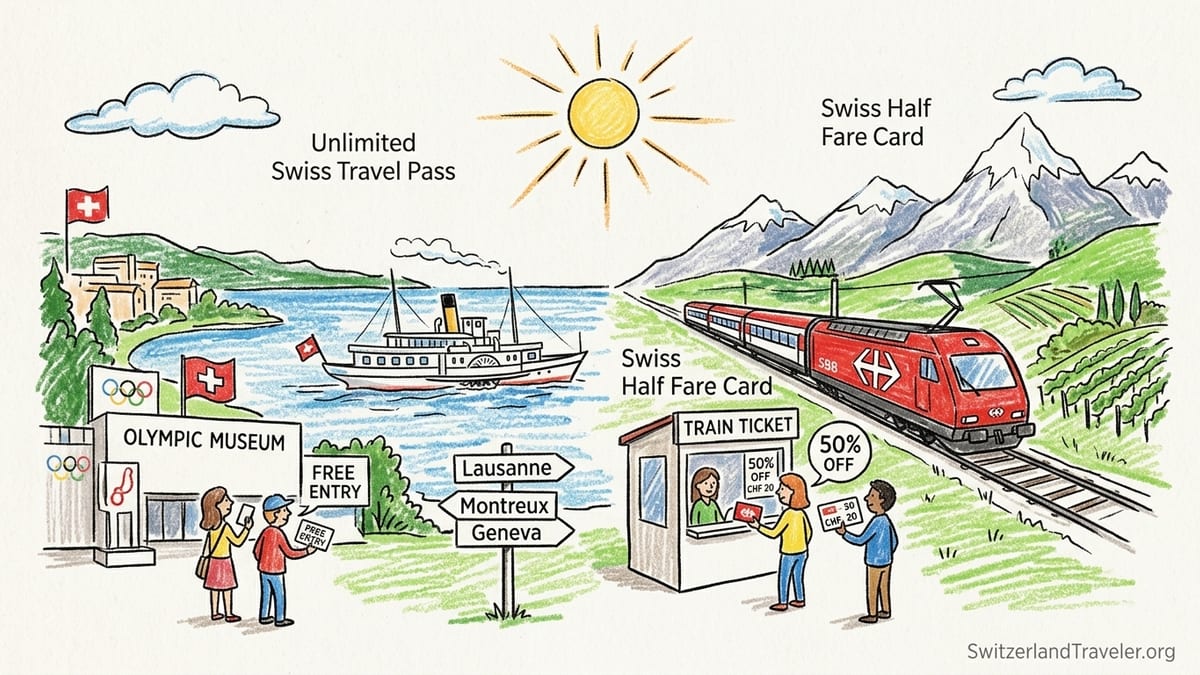
How Swiss Travel Pass and Half Fare Card Work in 2026
The Swiss Travel Pass and the Swiss Half Fare Card both cover trains, buses and boats across French-speaking Switzerland, but they do it in very different ways. The Swiss Travel Pass is an unlimited pass sold for 3, 4, 6, 8 and 15 consecutive days, with 2026 second‑class prices of about CHF 254 (3 days), CHF 309 (4 days), CHF 399 (6 days) and CHF 439 (8 days). You simply hop on almost any SBB train between Geneva, Lausanne, Montreux, Fribourg, Neuchâtel or Sion, or regional lines into the mountains, without buying extra tickets, and you can add free museums and most lake boats on top.
The Swiss Half Fare Card works more like a membership. In 2026 it costs CHF 150 and lasts one month. During that month you still buy tickets for every single journey, but most long‑distance tickets on SBB and regional railways are roughly 50 percent off the full fare. The card also reduces boats and many mountain railways, though often by around 50 percent rather than making them free. For a concentrated week in Romandy it acts as a discount engine across your whole stay, not just on three or four intense sightseeing days.
One key difference in Romandy is museum coverage. The Swiss Travel Pass includes free entry to more than 500 museums nationwide, which in French-speaking Switzerland covers places like the Olympic Museum in Lausanne, Chaplin’s World above Vevey and several major art museums in Geneva. The Half Fare Card does not include free museums, so you will pay each entry separately. When you add two or three paid museum visits into a short city‑hopping trip, the gap between the two products can shrink.
Because Geneva, Lausanne and Montreux are relatively close together, and many regional mountain trips in Vaud and Valais are short, the Half Fare Card’s 50 percent reduction usually applies to relatively modest base fares. That is why, in practice, the Swiss Travel Pass only starts to win financially in Romandy once you string together several intercity days plus boats and museums, or when you particularly value the freedom of unlimited hopping in and out of trains and ferries without thinking about cost.
Typical Romandy Route: Geneva to Montreux and the Riviera
To see how the numbers play out, consider a very common three‑day route: arrive in Geneva, overnight, then travel Geneva to Lausanne and on to Montreux, explore the Lavaux vineyards, and use Lake Geneva ferries. Full‑fare second‑class tickets in 2026 for Geneva to Lausanne on a regular intercity or RegioExpress service are typically around CHF 28 one way, while Lausanne to Montreux is roughly CHF 12. With a Half Fare Card you pay about CHF 14 plus CHF 6, so CHF 20 total for Geneva to Montreux instead of CHF 40.
Add in some realistic local moves. Many visitors use the Vevey or Montreux area as a base and ride the local trains between Vevey, Montreux and the vineyard villages in Lavaux. A short hop such as Montreux to Vevey might cost about CHF 6 full fare, reduced to around CHF 3 with the Half Fare Card. If you make four or five of these short hops in a day, you might spend CHF 20 at full price or about CHF 10 with the card. Over three days of light shuttling on the lakeshore, that adds perhaps CHF 30 with Half Fare versus CHF 60 without.
Lake Geneva boats have a larger impact. A typical Compagnie Générale de Navigation day pass on the upper lake, valid on the main routes between Lausanne, Vevey, Montreux and Chillon, can cost on the order of CHF 70 at full price, with Swiss Travel Pass holders generally traveling free on the regular scheduled boats on Lake Geneva. With a Half Fare Card you usually get roughly 50 percent off, so budget around CHF 35 to CHF 40. On a day where you ride the boat from Lausanne to Montreux, hop off to tour Chillon Castle, then continue to Vevey and back toward Lausanne, the difference between free travel on the pass and CHF 35 or more with Half Fare is one of the most tangible savings.
On this Riviera‑focused routing, if you tally Geneva to Lausanne to Montreux one way (CHF 40 full fare, CHF 20 with Half Fare), three days of short lake‑shore hops (perhaps CHF 60 full price, CHF 30 with Half Fare) and one substantial boat day (around CHF 70 full price, CHF 35 with Half Fare), you arrive near CHF 170 full fare or about CHF 85 with the Half Fare Card. Compared with a CHF 254 three‑day Swiss Travel Pass, it is clear that the pass does not break even purely on transport unless you add multiple museum visits and possibly squeeze in a longer day trip, such as from Montreux into the mountains above the Rhône valley.
Adding Gruyères: Cheese, Chocolate and Mountain Railways
Extend the Riviera trip with a classic excursion from Montreux or Vevey to Gruyères, home of the hilltop medieval village, cheese dairies and nearby chocolate factory. A typical routing uses regional trains from Montreux to Montbovon, then onward to Gruyères via Bulle. A one‑way full‑fare ticket between Montreux and Gruyères in second class will often land around CHF 25 to CHF 30. With the Half Fare Card you pay roughly CHF 13 to CHF 15. Round trip, budget CHF 50 to CHF 60 full fare or CHF 25 to CHF 30 with Half Fare.
Once in Gruyères, most visitors tour at least two paid attractions: the demonstration cheese dairy at La Maison du Gruyère and one of the village museums. Individual entry tickets commonly run around CHF 7 to CHF 14 per site. The Swiss Travel Pass includes many of these museums, so a pair of visits that might cost CHF 25 to CHF 30 per person without a pass could effectively be free. With the Half Fare Card, you pay every entry but enjoy the train discount. This is a good example of where the unlimited pass’s museum component narrows the cost gap even when the transport distances are modest.
From Montbovon and other stations in the pre‑Alps, travelers can branch out on local mountain railways. For instance, from Montreux there is a cog railway up to Rochers de Naye, a spectacular summit above the lake. A return ticket from Montreux to Rochers de Naye can easily exceed CHF 70 full fare. With the Swiss Travel Pass, expect around a 50 percent reduction on this mountain line, so roughly CHF 35 at the window. With the Half Fare Card the discount is often similar, again around 50 percent. Here the two products come closer: both cut the price of the mountain trip in half, but only the Swiss Travel Pass bundles in many of the lowland museums you might include in the same day.
Price out a sample day from Montreux to Gruyères and back, with two museum entries and perhaps a short separate excursion on the same day, such as the cogwheel train above Vevey. At full fare with individual tickets you can quickly approach CHF 110 to CHF 130 including museums. With the Half Fare Card you might land closer to CHF 70 to CHF 80, depending on how many attractions you pay for. With a Swiss Travel Pass, most of the museum tickets drop out and many local transport segments disappear from your line‑item list, so you may use CHF 60 to CHF 70 of “value” from the pass that day. Even so, given the CHF 254 base cost of the pass, it will usually take several similarly intensive days to catch up.
Looping to Neuchâtel or Sion: Longer Distances, Clearer Differences
Where the math starts to move in favor of the Swiss Travel Pass in Romandy is when you string together longer intercity jumps, not just short lake‑shore hops. Two good examples from Montreux or Lausanne are Neuchâtel on the north side of the Jura and Sion in the Rhône valley. A regular second‑class ticket from Montreux to Neuchâtel via Lausanne and Yverdon might be in the region of CHF 60 full fare one way, roughly CHF 30 with the Half Fare Card. A round trip in a single day therefore could be about CHF 120 without a pass, CHF 60 with the card.
In Neuchâtel, museum options again matter. The city’s lakeside Laténium archaeology park and the regional art museum are both on many visitors’ lists and are typically included with the Swiss Travel Pass. Entry prices without the pass can add CHF 16 to CHF 25 per person for two visits. With a Swiss Travel Pass you still travel “for free” on the SBB intercity services and regional Neuchâtel buses or trams, and you walk into these museums with no extra cost. With the Half Fare Card you buy all of those tickets and entries, benefiting only from the 50 percent rail discount, which is substantial on the long intercity stretch but still leaves you paying out of pocket in the city.
A similar calculation applies if you turn southeast instead, along the Rhône. Lausanne to Sion via Martigny is an intercity journey that can cost around CHF 50 full fare in second class one way, about CHF 25 with the Half Fare Card. A day trip Lausanne to Sion and back, then local trains up the side valley to Sierre or to the mountain resort of Crans‑Montana, can easily push the full‑fare cost toward CHF 130 or more. With the Half Fare Card you may pay around CHF 70. With a Swiss Travel Pass, all of these SBB and regional trains within the valid area are covered, and discounted mountain railways in Valais are available at roughly 50 percent off, similar to the Half Fare Card.
If you widen the loop and add Geneva at one end and Neuchâtel or Sion at the other, a three‑ or four‑day itinerary that includes Geneva to Lausanne to Montreux, a boat day on Lake Geneva, and at least one long out‑and‑back to Neuchâtel or the central Valais will generate full‑fare transport costs that can approach CHF 300 to CHF 350. The Half Fare Card will typically bring that down into the CHF 180 to CHF 200 range. Set against a CHF 254 Swiss Travel Pass, the Half Fare Card plus point‑to‑point tickets is still usually cheaper in Romandy unless you add multiple substantial museum days and really exploit the unlimited nature of the pass with extra spontaneous hops.
Where the Swiss Travel Pass Breaks Even in French-speaking Switzerland
To understand the break‑even point in practical terms, imagine two travelers following a four‑day Romandy circuit: Day 1 Geneva to Lausanne with city sightseeing, Day 2 Lausanne to Montreux with a full Lake Geneva boat day, Day 3 a return day trip to Gruyères from Montreux, and Day 4 a long intercity day trip to Neuchâtel before overnighting back near Lausanne. Rough full‑fare second‑class costs in 2026 could look approximately like this per person: CHF 40 for Day 1 rail, CHF 80 for Day 2 rail plus boats, CHF 110 for Day 3 rail plus museums, and CHF 120 for the Neuchâtel rail plus local buses and two museum entries on Day 4. That totals around CHF 350 to CHF 360 in transport and key attractions.
With a Half Fare Card, that same program might cost around CHF 200 in tickets plus the CHF 150 card, so CHF 350. The Swiss Travel Pass at 4 days is CHF 309 in second class and would cover all the regular rail, most boats and many museums outright, with only a few cable cars or mountain railways paid on top at a discount. In this scenario the two products come very close: the Half Fare Card plus tickets and museums might be slightly more expensive, while the 4‑day Swiss Travel Pass edges into better value, especially if you squeeze in even a couple of extra museum stops or an evening hop to Vevey or Nyon that you would otherwise skip due to cost.
For a shorter three‑day version, such as Geneva to Montreux with lake boats and Gruyères but no long Neuchâtel or Sion excursion, the totals look different. You might tally around CHF 260 to CHF 280 full fare including a boat day and a couple of museums. The Half Fare Card would roughly halve the rail and boat components, so you would spend perhaps CHF 150 on tickets and CHF 150 for the card, or around CHF 300. A 3‑day Swiss Travel Pass at CHF 254 would still be slightly cheaper in pure outlay but leaves less headroom for additional paid mountain rides. If you are skipping many museums and boats, the savings of the unlimited pass shrink and the Half Fare Card with normal tickets often comes out ahead.
The general pattern in Romandy is that the Swiss Travel Pass breaks even or wins when three conditions align: you are traveling on at least four intensive days that include one or two long intercity routes, you plan to visit several covered museums, and you will make heavy use of boats on Lake Geneva or Lake Neuchâtel. If your trip is slower, focused on one base like Lausanne or Montreux with just one or two intercity days, the Half Fare Card usually remains the better financial choice for 2026.
When Normal Tickets Beat Any Pass in Romandy
Not every traveler to French-speaking Switzerland needs a national pass. If your 2026 itinerary is essentially city‑based, for example three nights in Geneva with a single round trip to Lausanne and perhaps a short jaunt to Nyon, the total cost in full‑fare point‑to‑point tickets will often stay under CHF 120 per person. Adding a CHF 150 Half Fare Card or a CHF 254 Swiss Travel Pass to such a light schedule rarely makes sense. In Geneva and Lausanne, local day tickets in the urban fare networks often cost less than CHF 12, and many hotels in Geneva provide free local transport cards that cover city buses and trams during your stay.
A similar logic applies if you are splitting your time between only two bases in Romandy, such as three nights in Lausanne and three nights in Montreux, and you are content to explore mainly on foot with the occasional local bus or funicular. The rail journey between these two cities is short enough that full‑fare tickets do not add up quickly, and if you skip boat days and mountain railways, there is simply not enough expensive travel to justify a national pass. In those cases, buying individual SBB tickets or using regional day passes sold in the Vaud and Valais tariff networks is usually the cheapest strategy.
Another group that can often skip passes are travelers who have generous hotel benefits or conference transport cards. Business visitors to Lausanne might receive a Lausanne Transport Card that covers local public transport zones around the city. Conference attendees in Montreux or Geneva sometimes get similar local perks. When your host already covers your urban buses and trams, the incremental benefit of a nationwide pass for a handful of extra intercity journeys is relatively small unless you extend your stay with extensive side trips.
Normal tickets also remain an effective backup for weather‑dependent plans. Romandy’s appeal includes outdoor terraces in Vevey, lakeside promenades in Ouchy and vineyard walks in Lavaux, all of which depend on decent weather. If you are sensitive to rain and intend to make last‑minute decisions about long excursions, you may prefer not to lock in value with a consecutive‑day pass. Instead, you can monitor the forecast and simply buy intercity tickets the night before, perhaps adding Saver Day Passes from SBB when prices align, and keep your overall spend modest on days when the clouds roll in over the lake.
Practical Recommendations by Traveler Type
For first‑time visitors who want to “see it all” in four to six days around French-speaking Switzerland, the 4‑day or 6‑day Swiss Travel Pass in 2026 can be worthwhile if you consciously load your pass days with your biggest rail, boat and museum days. A sample 4‑day pass plan could start in Geneva, move to Lausanne by train and boat, then use Montreux as a base for boats, Gruyères and one long intercity loop to Neuchâtel or Sion. Spread across those days, it is realistic to generate CHF 350 or more in transport and museum value, at which point a CHF 309 4‑day pass offers both savings and convenience.
Independent travelers who like flexibility and plan eight to ten days in Romandy and central Switzerland usually do better with the Swiss Half Fare Card. Because the Half Fare Card lasts one month, you can mix very busy days with quieter ones, decide spontaneously to take a boat from Nyon to Yvoire or a side trip up the vineyards by train, and know that each decision is automatically half price. For example, over a ten‑day base in Lausanne and Vevey, taking occasional day trips to Montreux, Gruyères, Fribourg, Neuchâtel and Sion, it is quite plausible to spend CHF 220 to CHF 260 in half‑price tickets, bringing your total including the card to roughly CHF 370 to CHF 410. The equivalent full‑fare spend could exceed CHF 500, and a sequence of Swiss Travel Passes would either cost more or force you to concentrate travel too narrowly.
Families and small groups should weigh the impact of museum and boat usage carefully. Parents with teenagers who are keen on the Olympic Museum, Chaplin’s World and hands‑on science museums in Geneva and Lausanne may extract more value from the Swiss Travel Pass, especially once they factor in the Swiss Family Card that lets many children travel for free with a parent on passes and Half Fare products. On the other hand, families focused on outdoor activities like hiking in Lavaux, swimming in the lake and riding only one or two mountain railways will usually find the Half Fare Card, perhaps combined with regional promotions, a more efficient use of their budget.
Finally, repeat visitors and budget‑conscious travelers should not underestimate the value of combinations. It is entirely possible, for instance, to buy a Swiss Half Fare Card for a month‑long trip that includes a week in Romandy and a week in the Bernese Oberland, and then layer a short 3‑day Swiss Travel Pass Flex product on top to cover the densest sightseeing days. This strategy can be complex to plan but, when aligned with two or three big loop trips and several museum‑heavy days, can yield savings while preserving the psychological freedom of unlimited travel during your personal “grand tour” days.
The Takeaway
For 2026 journeys focused on French-speaking Switzerland, the numbers favor the Swiss Half Fare Card for most itineraries, especially stays of more than four days that mix busy travel days with quieter moments on the lake. The card’s CHF 150 cost is quickly offset by half‑price intercity tickets between Geneva, Lausanne, Montreux, Gruyères, Neuchâtel and Sion, even when you add in the cost of individual museum entries and occasional boats. In concrete terms, a week based between Lausanne and Montreux with two or three full‑day excursions will often see you spend roughly CHF 350 including the card, which typically beats both full‑fare tickets and a short‑duration Swiss Travel Pass.
The Swiss Travel Pass in 2026 becomes competitive or clearly superior in Romandy when you compress a lot of long‑distance travel, boats and museums into four to six consecutive days. A circuit that includes Geneva, Lausanne, the Lavaux vineyards, a full Lake Geneva boat day, Gruyères and a separate intercity loop to Neuchâtel or the central Valais can generate full‑fare costs that meet or exceed the CHF 309 price of a 4‑day pass. In those cases, the pass’s museum coverage and the psychological ease of unlimited travel can justify its higher base cost.
Normal point‑to‑point tickets remain perfectly sensible for very short or highly localized visits, such as a long weekend in Geneva with a single side trip to Lausanne or Montreux. In those cases you may never approach the CHF 150 or CHF 254 thresholds that would make a national pass worthwhile. As always in Switzerland, the best way to decide is to sketch your real itinerary, look up indicative 2026 fares for your specific trains and boats, and let the arithmetic between Geneva, Lausanne, Montreux, Gruyères, Neuchâtel and Sion tell you where the real savings lie.
Ultimately, there is no single best product for all travelers in Romandy. The Swiss Travel Pass rewards those who plan museum‑rich, boat‑heavy grand tours across several cantons in a tight window. The Swiss Half Fare Card rewards those who explore at a more relaxed pace over a longer stay. With a little planning and a realistic look at how many trains, boats and mountain lifts you will actually use, you can match your 2026 French‑speaking Switzerland adventure to the pass that keeps both your costs and your expectations well aligned.
FAQ
Q1. For a 4-day Geneva–Lausanne–Montreux–Gruyères trip in 2026, which pass usually saves more?
For this specific four‑day loop, the Swiss Half Fare Card plus normal tickets is usually slightly cheaper, unless you pack in a Lake Geneva boat day and several museums, in which case the 4‑day Swiss Travel Pass can pull even or ahead.
Q2. How much travel do I need in Romandy for a 3-day Swiss Travel Pass at CHF 254 to break even?
You generally need at least one long intercity day trip, one full boat or excursion day and several museum visits. If your three days are mostly short hops between Geneva, Lausanne and Montreux with light sightseeing, you rarely reach CHF 250 in full‑fare costs.
Q3. Does the Swiss Half Fare Card give any free museum entry in French-speaking Switzerland?
No. The Half Fare Card is a pure transport discount product. In Romandy it reduces trains, buses, boats and many mountain railways, but museum entries in places like Geneva, Lausanne, Montreux and Gruyères are still paid separately.
Q4. Are Lake Geneva boats fully covered by the Swiss Travel Pass in 2026?
Regular scheduled services on Lake Geneva operated by the main navigation company are generally included with the Swiss Travel Pass, while Holders of the Swiss Half Fare Card typically receive reduced fares, not free travel, on these boats.
Q5. If I am staying only in Geneva with one side trip to Lausanne, should I buy any pass?
Usually no. Full‑fare second‑class return tickets between Geneva and Lausanne plus local transport rarely reach the CHF 150 threshold of the Half Fare Card, so passes are unlikely to save money on such a short, localized stay.
Q6. Does the Swiss Travel Pass or Half Fare Card give better discounts on mountain railways in Vaud and Valais?
For many mountain lines above Montreux or in Valais, both products give similar percentage reductions, often around 50 percent off. The big difference is that the Swiss Travel Pass also covers your approach by regular trains and many museums on the same day.
Q7. Can I use the Swiss Half Fare Card together with occasional Saver Day Pass offers in Romandy?
Yes. On dates when Saver Day Passes are attractively priced, you can use your Half Fare Card to buy them more cheaply and combine them with your base discounts, which is useful for long Geneva–Neuchâtel or Lausanne–Sion days.
Q8. Is the Swiss Travel Pass Flex useful if I only have two very busy travel days in Romandy?
The Flex version can help if those two days involve long intercity journeys, boats and museums, but for just two heavy days the Half Fare Card plus regular tickets often remains cheaper. Flex passes improve in value as you add more intensive days.
Q9. How should families decide between the Swiss Travel Pass and Half Fare Card in French-speaking Switzerland?
Families who plan to visit several paid museums and ride boats frequently between Lausanne, Vevey and Montreux often get better value from the Swiss Travel Pass, especially when using a Swiss Family Card, while families focused on a slower, mostly outdoor itinerary tend to save with the Half Fare Card.
Q10. What is the best way to compare costs for my own 2026 Romandy itinerary?
List each day’s likely routes, check current second‑class fares for those trains and boats, then calculate totals with full fare, with Half Fare Card reductions and with the fixed price of a Swiss Travel Pass. This day‑by‑day comparison is the most reliable way to see which option actually saves more for your specific plan.