


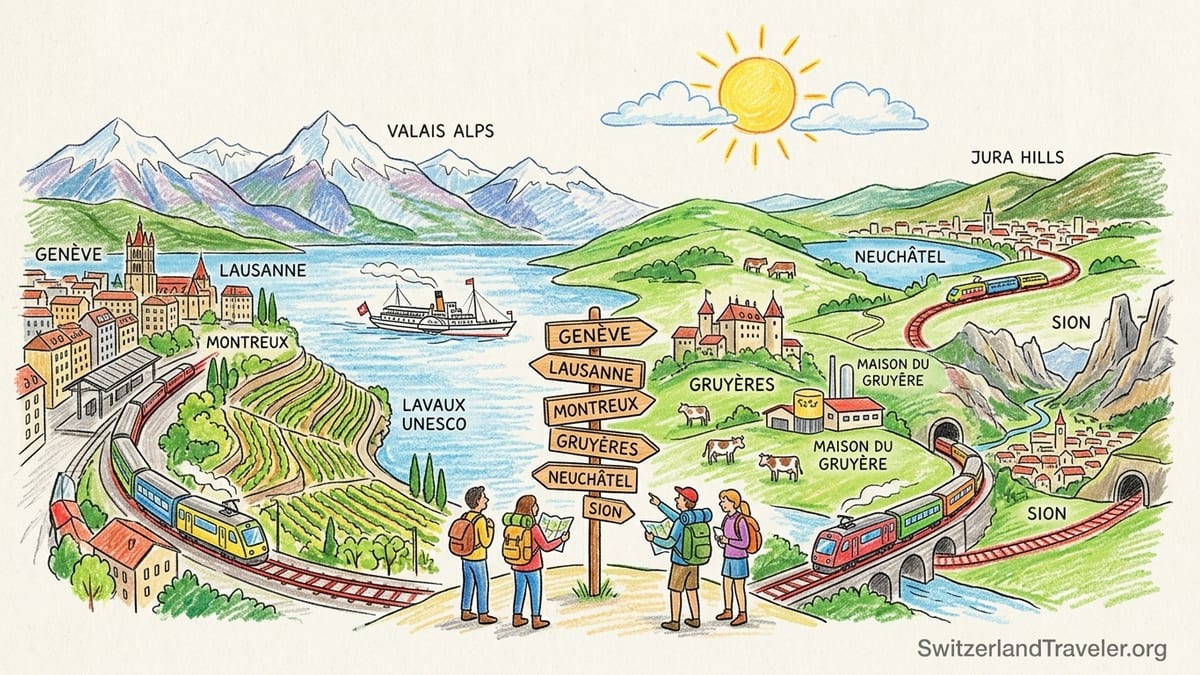
French-speaking Switzerland, or Romandy, looks compact on the map, but choosing the right base can shape your entire trip. The Lake Geneva region alone currently offers roughly 170 Switzerland Tourism listed accommodations, and that is before you even add the wider inventory across the Jura and Valais. With dense rail links, several lakes and multiple mountain gateways, the real challenge is not finding a room but deciding where to sleep. This guide compares the main bases used by international travelers: Geneva, Lausanne, Montreux and Vevey, Gruyères and Fribourg, Neuchâtel, and Sion along with nearby Lower Valais wine villages.
How to Think About Bases in Romandy
Romandy stretches from the Jura hills along the French border to the high peaks of Valais. Distances are relatively short, but each city or town offers a distinct mix of rail connectivity, hotel pricing, food scene and day-trip potential. You might fly into Geneva, sleep in Lausanne for a few nights of lakefront life, then move on to the vineyards around Montreux or the castles and pastures near Gruyères. Others prefer to set up in one place for five or six nights and rely on fast trains and boats for day trips.
Switzerland’s integrated rail network means that most of the locations in this article are within 1 to 2 hours of each other by train. For example, Geneva to Lausanne is usually about 40 minutes on a direct intercity service, while Geneva to Montreux is around 1 hour, and Geneva to Sion typically 2 hours with a change in Lausanne. Trains are frequent on these main arteries, with departures often every 30 minutes or better in peak times. That reliability makes it realistic to stay in one base and still reach vineyards, high alpine cable cars and medieval old towns on the same day.
Costs vary noticeably between bases. Geneva usually has some of the country’s highest average room rates, especially during major conferences or motor shows. A central, midrange hotel might easily run from 220 to 300 Swiss francs per night in high season. In Lausanne or Neuchâtel it is often possible to find solid three-star rooms between about 160 and 220 francs if you book ahead and avoid big trade fairs. In smaller centers such as Sion or Gruyères, family-run hotels and guesthouses can be slightly cheaper again, particularly outside school holidays.
Before you commit, think about your priorities. If you value immediate access to an international airport and big-city dining, Geneva makes sense. If you want a central Lake Geneva location with easy access to the UNESCO listed Lavaux vineyard terraces between Lausanne and Montreux, Lausanne is hard to beat. For the most dramatic lakeside scenery, Montreux and Vevey edge ahead. Travelers focused on pastoral landscapes, cheese dairies and quiet walking routes might benefit from a countryside base near Gruyères or Fribourg, while Neuchâtel and Sion suit those who want quick access to lakes and Jura hills or Valais mountains and wine villages.
Geneva: Gateway City and Lake Hub
For many international visitors, Geneva is the point of entry to French-speaking Switzerland. Geneva Airport sits just a few minutes by train from the city’s main station, and direct flights connect it with major hubs across Europe, the Middle East and North America. If you land late or depart early, an overnight stay close to Cornavin station keeps logistics simple: you can roll your suitcase between platform and hotel in under ten minutes, then connect easily to intercity trains for Lausanne, Montreux or Sion the next morning.
Hotel choice in Geneva is broad but skewed toward business travelers. Around the lakefront and in the districts near the United Nations you will find high-end properties where standard rooms can cost well over 300 Swiss francs per night in busy months. Closer to the main station there are more midrange chains and independent options, often between 200 and 260 francs if booked ahead. Budget-conscious travelers sometimes choose simple guesthouses or airport hotels, especially if they are treating Geneva as a one-night stop between flights and mountain resorts.
Geneva excels for cosmopolitan dining rather than rustic Swiss charm. You can dine at Michelin listed restaurants along the lake, sample Lebanese mezze near the UN district, or eat at relaxed neighborhood bistros in Carouge and Plainpalais. Prices are high by European standards: a pizza and a drink in a casual place can easily reach 30 to 35 francs, while three-course dinners in popular central restaurants often climb past 70 francs per person without wine. On the other hand, Geneva’s diversity means you can find everything from Vietnamese pho to Ethiopian injera within a short tram ride.
As a base, Geneva works especially well for city-focused trips that combine museums, lake cruises and short rail excursions. You can ride a paddle steamer along the lake to towns like Nyon or Yvoire in France, visit the Red Cross Museum and the headquarters area, or take a half-hour train to Lausanne for the day. However, if your main goal is to access the Lavaux vineyards, alpine cable cars or Valais hiking areas on several days in a row, you may find that moving your base east to Lausanne or Montreux cuts down your daily train time and reduces hotel costs.
Lausanne: Central Lake Geneva Base and Lavaux Gateway
Lausanne sits almost exactly between Geneva and Montreux on the northern shore of Lake Geneva, making it an exceptionally practical base for travelers who want to explore the lake and Lavaux while keeping some big-city conveniences. Intercity trains from Geneva typically reach Lausanne in about 40 minutes, and from Lausanne you have direct routes northeast along the lake to Vevey and Montreux, and south into the Alps via Martigny toward Verbier and Chamonix.
The city itself climbs steeply from the Ouchy lakefront up to the Gothic cathedral and the old town. This means many hotels come with views over the water and the French Alps on the far shore. Lakefront hotels in Ouchy, especially at four- and five-star level, can be pricey, competing with Geneva’s upper-midrange rates. Further uphill around the train station and in the city center, three-star and simpler four-star hotels are more accessible, often starting in the mid- to high-100 franc range outside major events. Many Lausanne hotels offer free local transport cards, making it easy to ride the metro between the lake and the upper town.
Lausanne is also the main urban gateway to Lavaux, the terraced vineyard landscape that runs for roughly 30 kilometers from the outskirts of the city to the area near Chillon Castle and Montreux, and that has been recognized by UNESCO as a cultural landscape. Local trains from Lausanne reach villages such as Lutry, Cully and Saint-Saphorin in 10 to 20 minutes, where you can walk between stone-walled terraces, taste Chasselas based white wines and look down on passing lake steamers. This combination of city comforts and quick rural access makes Lausanne attractive for travelers who want to alternate museum days at the Olympic Museum or Collection de l’Art Brut with vineyard walks and wine tastings.
In terms of restaurants, Lausanne offers a relaxed middle ground between Geneva’s global business scene and the resort focus of Montreux. Around Place de la Palud and Flon, you will find bistros, Italian trattorias, casual burger bars and contemporary Swiss restaurants, where main dishes usually run between about 25 and 45 francs. Down by the lake in Ouchy, hotel restaurants and terrace brasseries cater to visitors arriving from the paddle steamers, with typical lake fish dishes, risottos and regional wines. As a central base on Lake Geneva with relatively good value for money, Lausanne is an appealing choice for stays of four to six nights.
Montreux & Vevey: Scenic Riviera on Lake Geneva
East of Lausanne, the shoreline curves into the so called Swiss Riviera, where the towns of Vevey and Montreux sit between steep vineyard slopes and the lake. Arriving by train from Lausanne, the view suddenly opens onto stacked terraces and a broad sweep of water framed by alpine peaks, one of the classic rail approaches in Switzerland. Travel time from Lausanne to Vevey is typically about 20 minutes, and another 10 minutes brings you to Montreux. From Geneva, the total is usually around an hour.
Montreux is known worldwide for its summer jazz festival and lakeside promenade lined with flowers, sculptures and Belle Époque hotels. Room rates reflect that appeal. In high summer, a lakefront four-star hotel can easily cost 250 to 350 francs per night or more, especially when concerts are scheduled. Vevey, a little smaller and quieter, sometimes offers better value while still giving quick access to Lavaux villages and the same scenic boat services. In both towns, there are a few more modest hotels and guesthouses above the station or in back streets, but overall this stretch of shoreline leans toward midrange and upscale stays rather than backpacker bargains.
From a touring standpoint, Montreux and Vevey shine. You can walk the lakeside path from Vevey through La Tour-de-Peilz to Montreux, passing small harbors, outdoor sculptures and viewpoints. A short train or bus ride brings you to Chillon Castle, widely cited as one of Switzerland’s most visited monuments, perched between cliffs and the lake. From Montreux station, the cogwheel train to Rochers-de-Naye climbs to above 2,000 meters, offering views over the lake and possible marmot sightings in summer. Further inland, the GoldenPass railway route connects Montreux with the mountain towns of Gstaad and Zweisimmen, giving easy access to high pastures and ski areas without a car.
Restaurant choice here is broad but oriented toward leisure travelers. You can eat lakeside pizza at casual places on the promenade, try refined tasting menus at hotel dining rooms, or head into the vineyards above Vevey to visit country inns serving local wines and seasonal dishes. Expect menu prices similar to Lausanne for midrange meals, with premium for prime lakeview terraces. For many visitors, the unmatched combination of scenery, lake access, Lavaux proximity and mountain railways makes Montreux or Vevey the best all-round base on Lake Geneva, provided you are comfortable with resort-level pricing.
Gruyères & Fribourg: Countryside Calm and Gastronomy
Travelers who picture Switzerland as green hills, cows with bells and stone farmhouses often find that image fulfilled around Gruyères and the surrounding countryside of the canton of Fribourg. By fast train, Lausanne to Fribourg usually takes around 50 minutes, and from Fribourg you can connect by regional train and bus to Gruyères in roughly another 35 to 45 minutes. From Montreux, there are also direct trains on certain regional lines that climb through pastureland toward Gruyères, although journeys typically involve at least one change.
Gruyères itself is a compact, car-free hilltop village dominated by a medieval castle and a main street lined with traditional inns and restaurants. Hotel capacity is limited compared with the cities on Lake Geneva, which means that rooms can book out in high summer and on autumn weekends. Typical options include small hotels housed in historic buildings and simple guesthouses, often with wood-paneled dining rooms serving cheese fondue, raclette and meringues with Gruyère double cream. Nightly rates for a double room in such places often sit in the mid-100 franc range in shoulder seasons, rising toward or above 200 francs when demand peaks.
Nearby, the town of Fribourg provides a larger selection of accommodations, from chain hotels near the station to character properties in the Old Town overlooking the Sarine river gorge. Staying in Fribourg and day-tripping to Gruyères can be a sensible strategy if you want more restaurant choice and easier rail connectivity. In Fribourg, you can sample both French and German speaking Swiss cultures in the same city, with menus that range from classic brasserie fare to hearty Bernese style dishes. Prices are broadly similar to Lausanne, though some neighborhood restaurants and cafés can be slightly cheaper.
Countryside attractions are the main reason to base yourself here. The Maison du Gruyère demonstration cheese dairy sits below the village, where visitors can watch curds being stirred in copper vats and sample cheeses aged for different periods. A short train ride away, the Cailler chocolate factory at Broc offers tours and tastings. Paths through the nearby pre-alpine hills invite gentle hikes, and families can ride small cable cars in the Moléson area for views toward the Alps. If you want pastoral scenery and food experiences rather than constant lake views, a few nights around Gruyères or Fribourg can complement time spent on the shores of Lake Geneva.
Neuchâtel: Lakeside Base for Jura and Three-Lakes Region
North of Lake Geneva, the city of Neuchâtel sits on the shore of its own lake in the so called Three-Lakes region, within easy reach of the Jura hills and watchmaking towns. By intercity train, Neuchâtel is typically about 1 hour 15 minutes from Lausanne and around 1 hour 30 minutes from Geneva when connections run smoothly. Direct services also link Neuchâtel with Bern and Biel/Bienne, making it an interesting alternative base if you want to combine French-speaking Switzerland with German-speaking cities without changing hotels too often.
Neuchâtel’s lakefront is lined with parks, marinas and footpaths, and the yellow sandstone buildings of the old town rise behind. Hotel inventory here is smaller than in Geneva or Lausanne but still diverse enough for most visitors. On the waterfront, a few higher-end hotels offer lakeview rooms, often priced slightly below comparable properties on Lake Geneva. In the upper town and near the station, you will find midrange hotels and simple business-style properties where double rooms may start around the mid-100 franc range depending on season. Rental apartments are another option, especially for longer stays or families.
Restaurant choices lean local and relaxed. You can eat lake fish with perch fillets on terraces by the water, enjoy seasonal game dishes in autumn, and try traditional specialties like Neuchâtel style fondue or sausages baked in pastry in nearby towns. Prices tend to be modestly lower than in Geneva, especially for lunch menus and simpler dishes. Cafés in the old town offer pastries and coffee for a mid-morning break between visits to the castle, the archaeology museum or boat trips on the lake.
As a base, Neuchâtel is particularly strong if you are interested in the Jura rather than the high Alps. Local trains and buses climb to towns such as La Chaux-de-Fonds and Le Locle, centers of Swiss watchmaking history surrounded by rolling pastures. Hiking and cross-country skiing areas in the Jura are within a short drive or bus ride. At the same time, you can still reach Lausanne or Bern in about an hour for day trips, making Neuchâtel a balanced choice for travelers who want water, hills and smaller-town atmosphere without the price tag of the Lake Geneva Riviera.
Sion & Lower Valais: Wine Villages and Mountain Access
Following the Rhône valley east from Lake Geneva brings you into Valais, a canton famous for its vineyards, sunshine and alpine resorts. Sion, the cantonal capital, is one of the main rail and road gateways to mountain destinations such as Crans-Montana, Nendaz and the 4 Vallées area, as well as Saas-Fee and Zermatt further up the valley. Intercity trains from Lausanne usually reach Sion in around 1 hour 10 minutes, while from Geneva the full journey is closer to 2 hours with at least one change. That makes Sion viable both as a base in its own right and as a transfer point to smaller villages.
The town’s twin castle-topped hills and old streets give it a distinct character that differs noticeably from the cities on Lake Geneva. In the center and near the station, you will find a cluster of midrange hotels, often used by both tourists and business travelers. Typical nightly prices for a simple double room can start around the mid-100 franc range outside school holidays, with some boutique properties and larger hotels charging more in ski season. In nearby Lower Valais wine villages like Sierre, Salgesch or St-Pierre-de-Clages, guesthouses and small hotels are often integrated into wine estates or historic buildings, adding atmosphere but with limited capacity and the need to book ahead.
Sion and its surroundings are particularly appealing if you want to combine wine tasting with easy mountain access. The south facing slopes of Lower Valais are lined with vineyards producing a wide range of grape varieties, from Fendant and Petite Arvine whites to Cornalin and Syrah reds. Many wineries receive visitors by appointment, offering tastings in barrel cellars or terraces overlooking the valley. At the same time, buses and cable cars climb from the valley floor to resort villages like Nendaz, Veysonnaz or Anzère in roughly 30 to 45 minutes, where you can hike along historic irrigation channels known as bisses, ride chairlifts in summer or ski in winter.
Restaurant options in Sion range from traditional Valaisan taverns serving plates of cured meats and melted raclette to contemporary bistros and hotel dining rooms. Prices are comparable to other medium-sized Swiss towns: expect to pay around 25 to 40 francs for main dishes in many sit-down restaurants, with slightly lower prices for daily lunch specials. In the wine villages, menus often highlight local cheeses, rye bread and seasonal produce, and reservations are wise on weekends. For travelers who prioritize alpine landscapes and local wine culture over urban museum visits, basing in Sion or a nearby village can be more rewarding than staying on Lake Geneva and backtracking into the valley each day.
Comparing Rail Links, Costs and Day-Trip Potential
When choosing among these bases, it helps to compare them on a few practical axes: train connectivity, average hotel prices, restaurant variety, lake or mountain access, and the range of realistic day trips. On rail links, Geneva, Lausanne and Sion sit along a major intercity corridor, with frequent trains running from early morning to late evening. Montreux and Vevey are on the same line, connected by regular regional and some intercity services. Neuchâtel, Fribourg and the areas around Gruyères connect via direct or semi-direct lines, usually with at most one change to reach Geneva or Lausanne. Travel times between any two of these hubs often fall between 40 minutes and 2 hours, meaning no destination in this set is truly remote.
Hotel costs follow a rough gradient from most expensive in Geneva, through the Lake Geneva Riviera, down to more moderate prices in Lausanne, Neuchâtel, Fribourg and Sion, with the countryside around Gruyères offering pockets of good value albeit with smaller inventories. Lake Geneva’s roughly 170 Switzerland Tourism listed accommodations indicate how dense the supply is along that shore, which generally keeps some options available even at shorter notice, though not always at bargain prices. In smaller destinations, the issue is less about high prices and more about early booking, especially in school holidays or during local festivals.
For restaurant choice, Geneva and Lausanne are the most cosmopolitan, with wide ranges of international cuisines and late-opening venues. Montreux and Vevey add high-end hotel dining and many scenic terraces but have fewer neighborhood budget options. Gruyères, Fribourg and Sion emphasize regional dishes such as fondue, raclette and charcuterie, often at slightly lower prices than on Lake Geneva’s prime promenades. Neuchâtel sits somewhere in the middle, with a friendly, local restaurant scene and a few fine-dining addresses sprinkled among more modest bistros.
Lake access is obviously strongest in Geneva, Lausanne, Vevey, Montreux and Neuchâtel, all of which have beaches or bathing areas plus seasonal boat services. You can easily structure days around morning swims, picnic lunches and afternoon cruises. In contrast, Sion and Gruyères trade lakefront for better mountain access. From Sion, you reach high-elevation resorts and hiking networks quickly; from Gruyères and Fribourg, pastoral valleys and foothill walks are right at the door. Many travelers ultimately split their stay between a lake base and a mountain or countryside base to balance these different landscapes.
The Takeaway
In a compact region as varied as French-speaking Switzerland, there is no single “best” place to stay. Instead, there are bases that pair more naturally with different kinds of trips. Geneva works well as a first or last night stop, and as a base for travelers who value air links, diplomacy-focused sightseeing and a big-city restaurant scene. Lausanne is the strategic choice for those who want a central Lake Geneva location, easy rail access in multiple directions and quick hops into the UNESCO listed Lavaux vineyard terraces.
Montreux and Vevey appeal to travelers willing to pay resort prices for exceptional scenery, lakeside promenades and convenient links to both vineyards and mountain railways. Gruyères and nearby Fribourg suit visitors who dream of traditional villages, cheese dairies and peaceful walks in rolling pastureland. Neuchâtel attracts those who prefer a smaller city on a different lake with straightforward access to the Jura hills and watchmaking country, while Sion and Lower Valais are ideal bases for wine enthusiasts and hikers who plan to spend much of their time in the Alps rather than along the big lakes.
If you have a week or more, consider combining at least two contrasting bases: for example, three nights in Lausanne and four in Sion, or a few days in Montreux and a long weekend near Gruyères or Neuchâtel. With frequent trains and boats, moving between them is rarely complicated. By thinking clearly about your priorities and how you like to travel, you can match your base in Romandy to the landscapes, food and experiences that matter most to you.
FAQ
Q1. If I fly into Geneva, should I stay there or go straight to another base?
Many travelers choose to spend one night in Geneva after a long flight, then move on to Lausanne, Montreux or Sion the next morning. If your main interests are vineyards, mountains or quieter lakeside towns, shifting east soon after arrival usually makes better use of your time.
Q2. Is Lausanne really more central than Geneva for exploring Lake Geneva and Lavaux?
Yes. Lausanne sits roughly between Geneva and Montreux and has very frequent trains in both directions. This makes day trips to the Lavaux vineyards, Vevey, Montreux and even Sion or Fribourg more efficient than starting from Geneva each day.
Q3. How many nights should I stay in Montreux or Vevey?
For most visitors, two to four nights are enough to enjoy the lakeside promenade, visit Chillon Castle, ride a mountain railway and explore nearby vineyards. If you prefer a slow pace with multiple boat trips and hikes, you could easily stretch that to a full week.
Q4. Is Gruyères better as a day trip or an overnight stay?
Gruyères works well in both formats. As a day trip, you can see the castle, walk the village and visit the cheese dairy. Staying overnight, however, lets you enjoy quiet evenings after the day-trippers have left and gives time for walks and nearby chocolate factory visits.
Q5. How do hotel prices in Neuchâtel compare with those on Lake Geneva?
On average, Neuchâtel can be slightly cheaper than Geneva and the Montreux area, especially for midrange hotels and apartments. Prices are often closer to those in Lausanne, with some savings on meals and less touristy cafés and restaurants.
Q6. Is Sion a good base if I want to ski or hike in several different resorts?
Yes. Sion is a central rail and bus hub in Valais, with road and lift connections to areas like Nendaz, Veysonnaz, Crans-Montana and others. Staying there makes it easy to sample different resorts without changing hotels every two or three nights.
Q7. Do I need a car to enjoy these regions, or is the train enough?
For most travelers, trains, buses and boats are more than sufficient. Main routes between Geneva, Lausanne, Montreux, Fribourg, Neuchâtel and Sion are frequent, and many vineyards and mountain lifts are linked to stations by local buses or short walks. A car can help for very rural guesthouses, but it is not essential.
Q8. When are hotel prices lowest in French-speaking Switzerland?
Prices tend to be lower in the shoulder seasons of late autumn and early spring, outside major festivals and school holidays. Winter can be expensive in ski resorts but more moderate in cities like Geneva, Lausanne and Neuchâtel, while July and August are often the costliest months on Lake Geneva.
Q9. Which base is best for food lovers focused on cheese and chocolate?
Gruyères and the wider Fribourg region are particularly strong for cheese experiences, with dairies and traditional restaurants. Nearby Broc is known for its chocolate factory. Staying in or near Gruyères makes it easy to combine tastings with short countryside walks.
Q10. Can I visit both Lake Geneva and the Valais Alps in a single week without rushing?
Yes. A common pattern is to spend three or four nights on Lake Geneva, for example in Lausanne or Montreux, then move to Sion or a nearby Valais village for the remaining nights. With good rail links, this split itinerary allows you to experience both lakeside life and high mountain scenery at a comfortable pace.