


French-speaking Switzerland might be one of Europe’s easiest regions to explore by car: compact distances, superb roads and a string of atmospheric lakeside towns and mountain valleys. That has turned the Geneva–Lavaux–Montreux–Gruyères–Neuchâtel–Valais arc into a busy market for road trip packages, from pre-arranged hotel itineraries to fly-drive bundles. For independent travelers, the key question is not whether to go, but whether to book a package or build a self-drive trip from scratch.
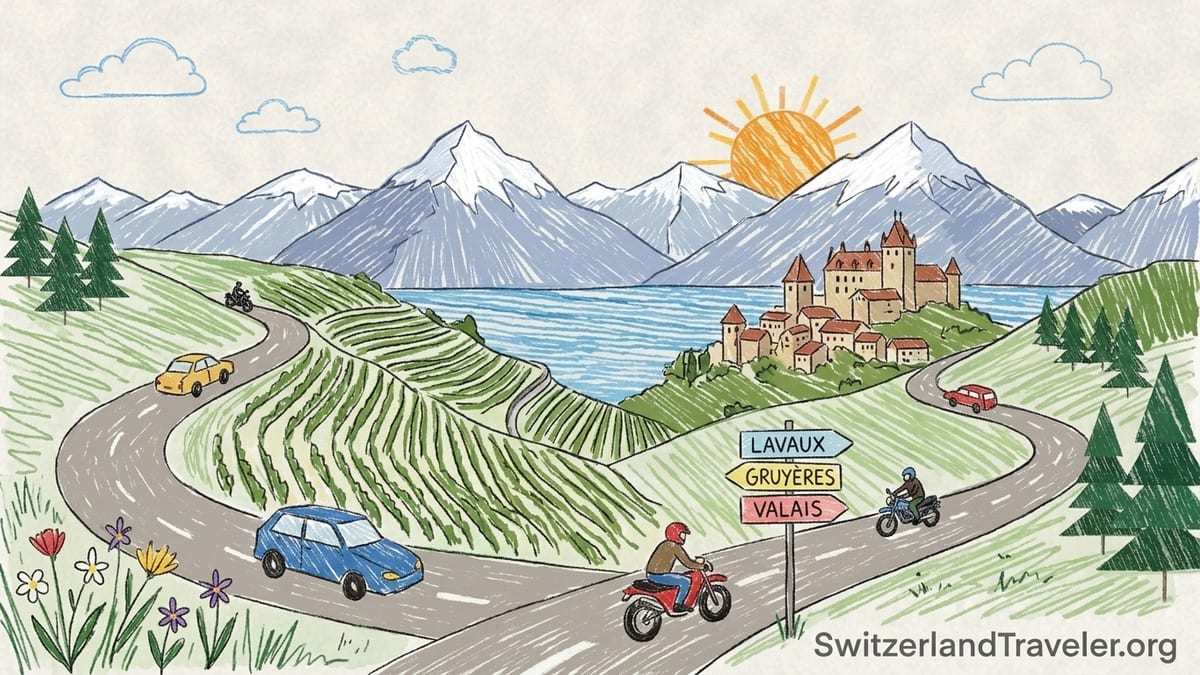
Why French-Speaking Switzerland Is Built For Road Trips
Western Switzerland’s French-speaking arc combines dense sightseeing with short, scenic drives. Geneva to Montreux is roughly 95 kilometers along Lake Geneva, with Lavaux’s terraced vineyards in between, while Montreux to Gruyères is about an hour on quiet country roads. From Gruyères, Neuchâtel sits a relaxed two-hour drive away via Fribourg and the rolling Swiss Plateau. A final leg into the Valais Rhône valley, toward towns like Sion, Sierre or Martigny, adds classic Alpine scenery without extreme driving.
The region’s infrastructure also favors self-drive. Motorways are well maintained, signage is clear, and mountain sections such as the lower Valais are generally wide, year-round roads rather than intimidating passes. Many villages, including Lavaux’s wine hamlets and medieval Gruyères, have signposted parking outside largely car-free centers, so drivers can leave the vehicle and explore on foot.
At the same time, car travel here coexists with an excellent public transport network. This underpins many packages: travelers might drive between Geneva, Montreux and Valais, then switch to scenic trains such as the GoldenPass Express or regional mountain railways. The result is a hybrid style of touring where driving is for flexibility and viewpoints, while certain Alpine sections are left to the experts on rails or cable cars.
All of this has created a mature market for road trip products. Large operators, regional tourism boards and online agencies now sell set itineraries through French-speaking Switzerland that bundle hotels, some meals and a suggested route, while leaving day-to-day pace and stops to the traveler behind the wheel.
Pre-Arranged Hotel Itineraries: The Classic Package
A good example of this packaged market is Switzerland Travel Centre’s “Grand Tour of Switzerland – Western Route,” a 6-day / 5-night self-drive itinerary priced from around CHF 660 per person for late September 2026, based on two people sharing. That price typically includes accommodation with breakfast, a detailed roadbook and various extras such as their Digital Swiss Coupon Pass, which unlocks 2-for-1 deals and discounts at attractions and activities across the country.
These pre-arranged itineraries are usually structured around one-night and two-night hotel stays that trace a loop through French-speaking Switzerland and nearby Alpine regions. A common pattern might be Geneva, Montreux or Vevey, a stop in the Gruyères region, then onward to the Bernese Oberland or Valais. Hotels are mid-range, three- or four-star properties selected for location, breakfast quality and parking access, with room categories fixed in advance.
The main appeal is simplicity. Instead of searching for hotels in Montreux during the summer jazz festival or trying to decode parking rules in Neuchâtel’s old town, travelers receive a day-by-day plan with confirmed reservations. Many itineraries are also designed with international flight schedules in mind, placing the first and last nights in Geneva or Lausanne for easy airport access. This is especially useful for visitors landing late in the day who do not want to confront mountain roads immediately.
The trade-off is reduced flexibility and some markup over true DIY pricing. A package that includes five hotel nights and a coupon pass for CHF 660 per person is competitive by Swiss standards, but a traveler who is willing to comparison-shop and accept simpler hotels might find slightly lower rates. Changes to dates or cities can also incur amendment fees, and there is usually a fixed cancellation schedule, for example, a partial charge from a set number of days before departure.
Fly-Drive and Self-Drive Bundles From Geneva
Fly-drive and self-drive bundles go a step further by combining flights or rail travel with a rental car and hotel itinerary. Travelers from long-haul markets such as the United States or the United Kingdom often see these sold by large tour operators or specialist agencies: round-trip flights to Geneva, a compact rental car waiting at Geneva Airport, and a pre-defined hotel route through Lake Geneva, Gruyères, Neuchâtel and Valais.
At Geneva Airport, car rental is a highly competitive business on both the Swiss and French sides of the terminal. Recent comparison data suggests that entry-level car rentals in September often average between roughly CHF 36 and CHF 50 per day for small cars when booked in advance, with wide variation depending on provider, pickup side and insurance options. Bundled packages may use contracted rates that are better than what a casual traveler could secure alone, particularly at busier times like late August and mid-September when major events and trade fairs can push prices up.
For a one-week road trip through French-speaking Switzerland, a fly-drive package might include a compact car with unlimited kilometers, collision damage waiver with a moderate deductible, and seven or eight nights in three-star hotels, with two nights in Geneva or Lausanne, two on the Montreux Riviera, one around Gruyères, one in Neuchâtel and one or two in the Valais valley. The driver simply follows the suggested loop, with optional side trips to Lavaux’s wine terraces, thermal spas in places like Leukerbad, or cable cars above Sion and Sierre.
However, fly-drive bundles introduce additional layers of terms and conditions. Flights and car rental are often subject to separate change penalties, and drivers need to check carefully whether their car is equipped with a Swiss motorway vignette, what the winter or shoulder-season tyre provisions are, and whether cross-border travel to France or Italy is included. Insurance sold as part of a package can be more generous than basic rental coverage, but may still leave deductibles of several hundred francs in the event of damage, so travelers should factor this into cost comparisons.
Going Fully Independent: Booking Your Own Car and Hotels
Booking a rental car and hotels independently offers maximum control over both budget and route. A traveler landing in Geneva in September 2026 might, for example, reserve a compact car directly with a major rental company on the Swiss side of Geneva Airport, targeting daily rates in the CHF 40 to 70 range for basic models when booked months ahead. They could then piece together a route with two nights in Geneva, one or two in Lavaux or Montreux, a night in Gruyères, a night in Neuchâtel and two nights in Sion or nearby Valais towns.
Accommodation pricing varies widely. In Montreux in early September, three-star hotels can sometimes be found in the CHF 160 to 230 per night range for a double room, rising higher during events like the Montreux Jazz Festival or international conferences. In smaller towns such as Gruyères or villages in Lavaux, charming inns and B&Bs may fall closer to CHF 140 to 190, particularly midweek. Neuchâtel and Sion typically sit somewhere in between, though lake-view or designer properties will be higher.
With full freedom, travelers can also mix styles. One might pair a design-led lakeside hotel in Geneva, a rustic winegrower’s guesthouse in Lavaux, a family-run inn beneath Gruyères castle and a modern spa hotel with Alpine views in Valais. They can also fine-tune the number of nights: lingering in Lavaux for three nights to walk between vineyards and take ferries on Lake Geneva, or extending in Valais to visit Zermatt by train while leaving the car in the valley.
The main costs of this independence are time and responsibility. Travelers must decode parking rules in each town, ensure that their rental car has the requisite motorway vignette for Swiss highways, and keep track of cancellation policies across multiple hotel bookings. In high season, desirable small hotels around Lavaux and Gruyères can sell out months in advance, so late planners may find themselves pushed to less central locations, negating some of the savings over packages.
Cost Comparison: Package vs DIY in Real Terms
To understand the financial trade-offs, consider a couple planning a 6-day / 5-night road trip in late September 2026, starting and ending in Geneva. A packaged self-drive itinerary from a national provider priced from around CHF 660 per person would yield a base of CHF 1,320 for two, including five hotel nights with breakfast and extras such as a digital coupon pass. The couple would then add a mid-range rental car, perhaps CHF 300 to 400 for six days, and budget fuel costs for about 600 to 800 kilometers of driving.
Replicating the same schedule independently might involve five nights of hotels averaging CHF 180 per night, for a total of CHF 900, assuming early booking and non-refundable rates. A comparable rental car booked directly could cost approximately CHF 250 to 450 for six days, depending on timing and insurance choices. In this scenario, the fully DIY version can come out similar or modestly cheaper, but the packaged option includes curation, support and add-ons like attraction discounts that may offset a portion of the price differential.
The picture changes for travelers seeking higher-end properties or more complex routing. If a fly-drive bundle negotiates favorable rates at four-star hotels with lake views in Montreux and boutique stays in Valais, it may undercut what an individual can achieve for the same standard. Conversely, budget-conscious travelers willing to stay slightly outside town centers, or those using apartment rentals in places like Lausanne’s outskirts or Neuchâtel’s residential neighborhoods, can undercut mainstream packages by a wider margin.
Beyond headline prices, travelers should compare hidden or variable costs. Parking charges in Geneva, Montreux and Neuchâtel can add CHF 20 to 35 per day in some central hotels, while suburban properties with free parking are easier for drivers but less convenient on foot. Packages sometimes negotiate reduced or included parking at partner hotels. Similarly, generous breakfast buffets included in hotel rates can substantially reduce daily food costs compared with room-only deals in a DIY plan.
Route Design: Connecting Geneva, Lavaux, Montreux, Gruyères, Neuchâtel and Valais
Most Western Switzerland self-drive packages, whether pre-arranged or custom, follow a logical loop that taps this region’s strongest highlights. A typical clockwise itinerary might start in Geneva with a lakeside evening and a walk through the old town, before following the north shore of Lake Geneva through Nyon and Lausanne into the Lavaux vineyards. Here, terraced slopes plunge into the lake, and many drivers stop in villages such as Cully or Chexbres to taste local Chasselas wines and photograph the sweeping views toward the Alps.
From Lavaux, the drive to Montreux is short, often less than 30 minutes, but scenic. Montreux’s flower-lined promenade, Belle Époque hotels and the fortified Château de Chillon on its rocky islet are staples on packaged itineraries, with many including a suggested visit or discounted entry. Some itineraries extend to Vevey or up toward Rochers-de-Naye for panoramic views, while others encourage a half-day lake cruise as a break from driving.
The next logical segment pushes inland to Gruyères, about an hour from Montreux. Packages highlight its medieval hilltop village, cheese demonstrations at the local dairy, and the nearby chocolate factory in Broc. Overnighting here after the day-tripper crowds leave is a common recommendation. From Gruyères, packages diverge: some turn north to Neuchâtel via Fribourg, introducing a different lake and a more restrained Belle Époque lakeside city, while others swing east toward the Bernese Oberland before re-entering French-speaking territory.
The link from Neuchâtel back to Geneva or onward into Valais usually follows a combination of motorway and lake or river valleys. A Valais extension might include Sion, with its twin hilltop castles, vineyards along the Rhône, and easy rail links to resorts like Zermatt or Crans-Montana. For self-drivers, this part of the trip captures the shift from gentle lakeside Switzerland to a more obviously Alpine world, without committing to narrow, high passes if they prefer to avoid them.
Practical Pros and Cons for Different Traveler Types
For first-time visitors nervous about driving in Europe, pre-arranged hotel itineraries and fly-drive packages provide reassurance. The route has been tested, distances are realistic, and support is generally available through a local hotline if something goes wrong. Instructions typically flag local quirks, such as Geneva’s paid parking zones, vineyard lanes in Lavaux that are off-limits to non-residents, and the need to check mountain weather before driving into higher Valais valleys.
Experienced European drivers, and those who enjoy planning, often gravitate to fully independent self-drive trips. They may want to linger in niche spots like St-Saphorin in Lavaux, small spa villages in Valais or Neuchâtel’s nearby Jura hills. They also tend to be more comfortable trading the security of a package for the ability to switch routes at short notice, such as avoiding a rainy day on the lake by driving earlier to sunny vineyards or higher, drier valleys.
Families with children frequently find value in packages that factor in kid-friendly stops and manageable daily driving. Some Western Switzerland itineraries build in attractions like lake beaches near Montreux, easy castle visits at Chillon and Gruyères, and chocolate tours in Broc, with overnight stays staged so that driving rarely exceeds two hours in one stretch. Having the accommodation puzzle solved in advance can be especially helpful when traveling in school holiday periods, when family rooms and interconnecting rooms are in demand.
Meanwhile, couples on a romantic trip, honeymooners and food-focused travelers might lean toward independent or tailor-made versions that prioritize special stays and restaurant reservations. They could, for instance, plan a two-night stay in Lavaux with a reserved terrace at a vineyard restaurant, followed by an upscale spa hotel in Valais, which may fall outside the standard hotel lists used by off-the-shelf packages.
The Takeaway
French-speaking Switzerland lends itself perfectly to a road trip linking Geneva, Lavaux, Montreux, Gruyères, Neuchâtel and Valais. The region’s compact size and polished tourist infrastructure have produced a wide range of self-drive products, from Switzerland Travel Centre’s Western Route road trip to international fly-drive bundles that wrap together flights, car hire and pre-booked hotels. These options sit alongside the pure DIY approach of booking a rental car and handpicked hotels independently.
For many travelers, the choice ultimately balances three factors: budget, confidence in planning and appetite for flexibility. Packaged hotel itineraries and fly-drive deals deliver convenience, tested routes and local support at a price that is often competitive in high season, particularly when extras such as breakfast, attraction discounts and occasionally parking are included. Independent booking, on the other hand, rewards research time with more tailored stays and the possibility of modest savings, especially if you are flexible on locations and travel outside major events.
Whichever route you choose, the fundamentals remain the same. Reserve your car early for Geneva Airport, understand the difference between the Swiss and French sides if relevant, check that your vehicle has a motorway vignette, and favor hotels with clear parking arrangements. With those basics in place, the real luxury of driving through French-speaking Switzerland is not the car itself but the freedom to pause on a Lavaux balcony, detour into a Valais side valley or linger in Gruyères after day-trippers have gone, secure in the knowledge that your bed for the night is waiting nearby.
FAQ
Q1. Is it cheaper to book a French-speaking Switzerland road trip as a package or independently?
It depends on travel dates, hotel standards and how early you book. Packages can be competitive in peak periods, especially when including extras like breakfasts and attraction discounts, while independent booking may be slightly cheaper if you are flexible with hotel locations and willing to mix simpler properties with occasional splurges.
Q2. Do packaged self-drive itineraries in Western Switzerland include the rental car?
Some do and some do not. Many pre-arranged hotel packages from Swiss-based providers include only accommodation, breakfasts and a roadbook, leaving you to book your own rental car. Fly-drive bundles from larger tour operators more often include car hire in the overall price, so it is important to read the inclusions carefully.
Q3. How much should I budget per day for a rental car from Geneva in September?
Recent comparison data suggests that small rental cars from Geneva Airport in September can often average somewhere between roughly CHF 36 and CHF 70 per day when booked in advance, before extra insurance or optional equipment. Prices depend heavily on demand, provider and exact dates, so it is wise to compare several sources early.
Q4. Is driving between Geneva, Lavaux, Montreux, Gruyères, Neuchâtel and Valais difficult?
For most drivers used to European conditions, the core route is straightforward. Roads are well maintained, signage is clear and the main sections between Geneva, Lake Geneva towns, Gruyères, Neuchâtel and the lower Valais valley are not extreme mountain passes. Caution is still needed in bad weather and on smaller rural roads.
Q5. Do I need a Swiss motorway vignette for this kind of road trip?
If you plan to use Swiss motorways, which is common on this route, your car must display a valid vignette. Most rental cars picked up on the Swiss side of Geneva Airport already include one, but you should confirm this at the counter. Driving without a vignette on motorways can result in fines.
Q6. Can I visit Zermatt or other car-free resorts as part of a self-drive package?
Yes. Many packages and independent itineraries incorporate car-free resorts such as Zermatt by having you park in valley towns like Täsch or Visp and continue by train or shuttle. The car remains useful for reaching the valley and exploring neighboring areas, while the final stretch into the resort is handled by public transport.
Q7. Are parking costs included in road trip packages?
Parking policies vary by hotel and package. Some properties in suburbs or smaller towns offer free on-site parking, while central hotels in Geneva, Montreux or Neuchâtel may charge daily fees. A few packages negotiate reduced or included parking at partner hotels, but this is not universal, so always check individual hotel notes.
Q8. When should I book to get the best rates for a September 2026 road trip?
For September travel, it is sensible to start comparing options at least six to nine months ahead. This gives better access to early-booking hotel rates, a wider choice of car categories and availability on popular packaged itineraries, which can sell out around events and trade fairs.
Q9. Is public transport a viable alternative to driving in this region?
Yes. Western Switzerland is exceptionally well served by trains, boats and buses. It is entirely possible to link Geneva, Lausanne, Montreux, Gruyères, Neuchâtel and Valais by rail and lake boat, often with scenic routes. Many travelers choose a hybrid approach, using public transport for city-to-city travel and renting a car for a few days to explore vineyards and valleys.
Q10. How flexible are packaged road trip itineraries if the weather changes?
Most off-the-shelf packages fix hotels and basic routing, but the daily schedule is usually up to you. If rain is forecast over Lake Geneva, you might spend more time in museums or drive earlier to the next destination. Significant date or hotel changes, however, can trigger amendment fees, so travelers wanting maximum weather flexibility may prefer a more independent setup.