

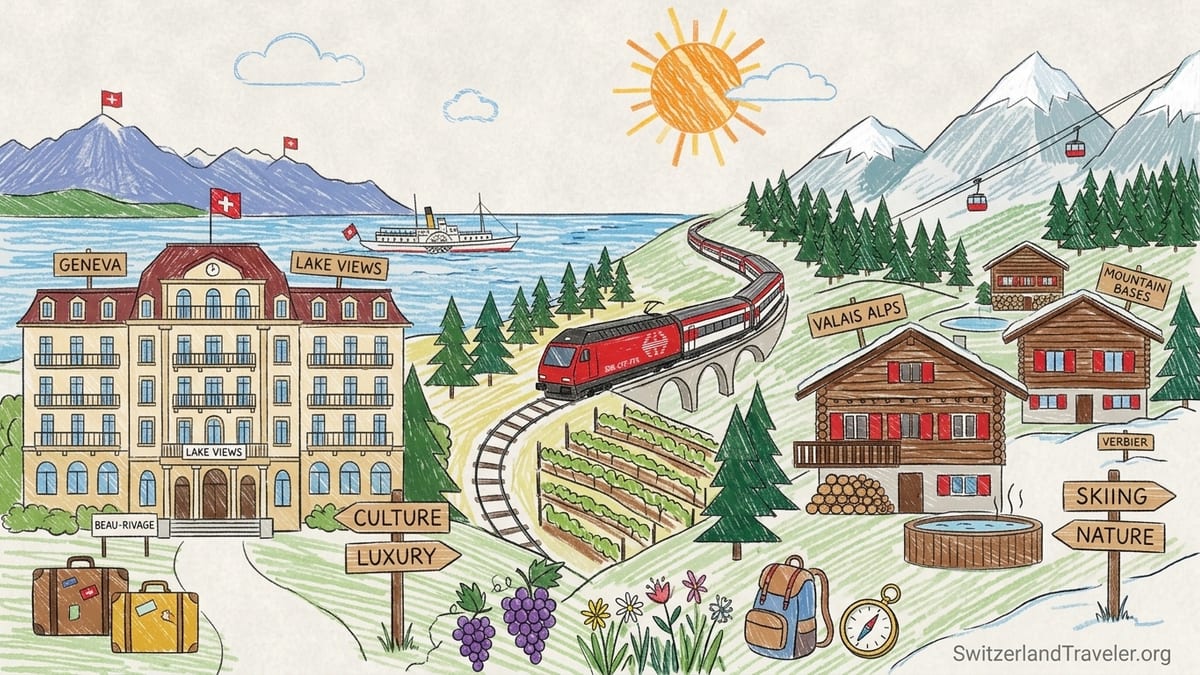
French-speaking Switzerland offers one of Europe’s richest mixes of hotel experiences, from Belle Époque palaces on Lake Geneva to discreet spa resorts in Valais and farmhouse-style retreats in the Jura hills. Rather than ranking a Geneva lakeside icon against a countryside inn in Fribourg, this guide follows the geography of Romandie so you can choose the right base for your itinerary and travel style. It compares real hotels and real logistics: station access, lake or vineyard views, parking, breakfast, spa offerings, family suitability and whether local public transport is included in the room rate.
How to Think About Booking in French-Speaking Switzerland
The first decision is regional. French-speaking Switzerland stretches from Geneva along Lake Geneva to Lausanne, Vevey and Montreux, then inland to the Fribourg countryside, the Jura and Neuchâtel region, and into French-speaking Valais around resorts such as Crans-Montana and Verbier. Distances are short, but the feel of a lakeside palace hotel in Lausanne-Ouchy is very different from a chalet-style spa hotel above Sion. It is usually better to pick two or three contrasting bases than to change hotels every night.
Train access is excellent around Lake Geneva and in the main Valais valley. If you plan to rely on public transport, focus on hotels within a short walk of a major station, such as Lausanne’s city hotels or properties near Geneva Cornavin, and then use mountain railways or postal buses for day trips. Drivers, on the other hand, may prefer countryside inns in Lavaux vineyards or Jura ridge hotels with free outdoor parking and quieter surroundings.
Budget is another filter. On Lake Geneva, double rooms in five star properties like Beau-Rivage Palace in Lausanne or Beau-Rivage Genève typically start in the high hundreds of Swiss francs per night and rise steeply in summer or during events. By contrast, a good three star family-run hotel in the countryside of Fribourg or Neuchâtel can cost significantly less outside peak ski and festival dates. Breakfast is usually included at mid-range and upscale properties, but always check, as in cities some business hotels price it separately.
Finally, consider extras that affect real-world value. Many city and lakeside hotels in cantons such as Vaud, Geneva and Valais participate in guest card schemes that give free or reduced local public transport and museum discounts for the duration of your stay. Spa access policies vary: at some resorts the wellness area and pools are included, at others access to thermal baths or rooftop spas is an add-on. Families should check for interconnecting rooms, sofa beds, pool rules for children and availability of kids’ menus or babysitting.
Lake Geneva Luxury: Lausanne, Vevey and Montreux
Lake Geneva is where French-speaking Switzerland most clearly displays its grand hotel heritage. In Lausanne-Ouchy, Beau-Rivage Palace is a textbook example: a five star Belle Époque property set in several hectares of lakeside park with direct views across to the French Alps and a large Guerlain-branded spa. Rooms and suites are classic in style, often with balconies or terraces facing the water, and the hotel is known for its high-end gastronomy, including a restaurant by Anne-Sophie Pic. From here, the local metro line takes you uphill to Lausanne station in a few minutes, making rail day trips to Bern, Montreux or Geneva straightforward while you still feel based in a resort-style environment.
Elsewhere in Lausanne, Lausanne Palace in the city center offers a different luxury experience, with easier access to shops, offices and the historic old town and a mix of city and distant lake views. Many guests choose it when they want to be based near the station and tram connections rather than right on the water. Royal Savoy, between the city center and the lake, bridges the two worlds, with a contemporary spa, gardens and a rooftop bar that looks toward the lake and mountains. All three typically include breakfast at this level of pricing, feature comprehensive spa and fitness facilities, and offer valet parking for drivers, although daily parking charges in urban locations can add noticeably to the bill.
Further along the shore, Montreux and Vevey combine lakefront promenades with immediate access to the Lavaux vineyards by short train or boat rides. In Vevey, Grand Hôtel du Lac is a refined boutique-sized lakeside option with classic interiors, a pool and manicured gardens facing the water. In Montreux, large international properties such as Fairmont Le Montreux Palace line the lakeside road, many with outdoor pools and spa areas overlooking the lake. For travelers who picture themselves walking out of the hotel lobby straight onto the promenade, these are good candidates. Train stations in both towns sit only a few hundred meters behind the lakeshore strip, so even larger hotels are typically reachable on foot with luggage, though some are up or down gentle slopes.
Lake Geneva luxury hotels are particularly strong for couples and culture-oriented travelers who want easy access to festivals, gourmet restaurants and vineyard walks. Families are welcome at most, but parents should check whether pools have dedicated children’s hours and whether the room categories realistically sleep more than two without feeling cramped. Many of these hotels participate in regional guest card schemes that include free local buses along the shore, making it realistic to stay in Vevey or Montreux and still explore Lavaux and Lausanne without driving.
Urban Bases: Geneva, Lausanne City Hotels and Fribourg
Geneva’s city hotels fall into three broad zones: the lakefront palaces on Quai du Mont-Blanc and the left-bank promenade, business and mid-range hotels around Cornavin station, and more boutique properties tucked into neighborhoods such as Eaux-Vives or the Old Town. The lakeside icons, which include Beau-Rivage Genève and Four Seasons Hotel des Bergues, are all about direct lake views, grand lobbies and concierge teams used to diplomatic and luxury-leisure clients. Many rooms have balconies looking toward the Jet d’Eau, and spa facilities range from classic treatment rooms to full rooftop wellness areas with pools. They are a few minutes’ walk from Cornavin station and the main boat piers, and they charge for valet parking but make a car unnecessary for most stays.
A block or two behind the lake, Geneva’s four star hotels often offer better value while still putting you within walking distance of the water and the Old Town. Mid-range chains and independent properties around Cornavin and in the Paquis district are popular with travelers arriving by train or catching early flights from the airport. Rooms tend to be more compact, but breakfast is frequently included in packages, and many travelers appreciate that the area has a dense network of trams and buses. Geneva’s long-standing practice of providing a free transport card to overnight guests means you can ride trams, buses and boats within the city area during your stay without extra cost; some hotels issue this electronically at check-in.
Lausanne’s city hotels provide a similar urban base with strong public-transport integration. Hotels near Lausanne’s main station or the Flon district generally give overnight guests a transport card valid for metro and buses within the city, which is valuable if you plan to come and go multiple times in a day. Properties such as Lausanne Palace or well-rated mid-range hotels near the station combine walking access to trains with quick metro rides down to the lakefront in Ouchy. In hilly Lausanne, this can matter more than it looks on a map, especially if you are managing luggage or traveling with children.
Inland, the small city of Fribourg makes an underrated base for exploring both French and German-speaking Switzerland, as the language border runs through the canton. Boutique hotels and well-kept three star properties cluster around the station and the medieval upper town, generally offering breakfast, paid parking and access to local buses with a guest card. While Fribourg does not have the same spa culture as the big lake or mountain resorts, it offers proximity to Gruyères, the Pre-Alps and countryside inns a short drive or train ride away, making it a sensible choice for travelers seeking a less touristy city base.
Romantic Lakeside Hotels and Vineyard Stays
Not all lakeside hotels are large palaces. Along Lake Geneva and the smaller lakes of Neuchâtel and Biel/Bienne, you can find smaller romantic properties that emphasize intimacy, vineyard views or direct access to the water over sheer scale. In the Lavaux region between Lausanne and Vevey, for instance, several small hotels and guesthouses sit right above the terraced vineyards and offer rooms looking out across the vines to the lake. Guests typically drive or arrive by local train and then walk between wine villages such as Cully and Epesses. Parking is often free but limited, and these properties may have fewer spa facilities, focusing instead on good breakfasts with local products and wine-themed dinners.
On Lake Neuchâtel, lakeside hotels pair well with quiet getaways. Properties on or near the shore often highlight outdoor pools or natural swimming access as their key wellness feature. Many advertise bike rentals, stand-up paddle boards and small private piers rather than large indoor spas. Rooms with terraces facing the lake are especially popular and can book out well in advance for summer weekends. As with Lake Geneva, most of these lakeside towns are on main rail lines, so choosing a hotel a short walk from the station can give you car-free access to the rest of the Jura and Three-Lakes region.
For couples, room choice matters as much as hotel choice. A mid-range hotel with a corner room and panoramic balcony can feel more romantic than a grand palace where your room faces the street. When booking, it is worth reading descriptions carefully to distinguish between “lake view,” which may mean a side glimpse, and “lakefront” rooms directly facing the water. Many hotels now allow you to choose an exact room type or floor category online, and it is generally worth paying a supplement for a guaranteed view if this is a key motivation for your trip.
Breakfast at these romantic lakeside and vineyard properties is usually included and often a highlight, with regional cheeses, breads and seasonal fruit served in dining rooms or terraces overlooking the water or vines. Spa offerings, by contrast, tend to be more modest: a small sauna, a whirlpool and perhaps a treatment room. Travelers fixated on extensive wellness circuits and large indoor pools may be happier in dedicated spa hotels along Lake Geneva or in Valais thermal resorts such as Leukerbad, using smaller lakeside hotels for shorter stays focused on walks, wine tasting and quiet dinners.
Countryside Stays in Vaud and Fribourg
The countryside between Lake Geneva and the Pre-Alps in Vaud and Fribourg is dotted with small hotels, auberges and renovated farmhouses that appeal to travelers wanting a slower rhythm. These properties are typically reached by car or occasionally by postal bus, and they often include free outdoor parking in the room rate. Settings range from open pastureland near the Vaud Jura foothills to rolling dairy country around Gruyères. Interiors can be anything from rustic wooden beams and tiled stoves to contemporary minimalism inside historic shells.
A countryside inn may not have a spa, but it can offer comforts that matter just as much on a short break: quiet nights, generous breakfasts based on local products and on-site restaurants focused on regional specialties such as fondue, cured meats and seasonal game. Double rooms often come with balconies or terraces facing fields or distant peaks rather than lakes, and rates are generally below what an equivalent room would cost in Geneva or Lausanne. Because staffing is leaner, reception hours can be shorter than in cities, so late arrivals should be arranged in advance.
Families often find countryside hotels in Vaud and Fribourg practical because rooms are larger and outdoor space is easy to access. Children can play in gardens, and some properties have small playgrounds or simple farm experiences. However, without a car you may feel constrained unless there is a good bus connection to a nearby station. Travelers who want to mix countryside calm with city visits sometimes split their stay between a few nights at a rural inn and a few nights in a city such as Lausanne or Fribourg, using the latter as a transport hub.
Value is one of the countryside’s strong points. While you will not usually find the elaborate spa complexes of Valais or the designer interiors of Geneva’s boutique hotels, you are likely to receive half-board packages that include dinner and breakfast at rates that compare favourably with room-only prices on the lake. For travelers planning to spend most evenings on-site rather than out in town, these packages can simplify budgeting and highlight regional cuisine without daily restaurant decisions.
Jura and Neuchâtel: Quiet Hills and Three-Lakes Region
The Jura and Three-Lakes region covers the hills and plateaus north of Lake Neuchâtel, as well as the lakes of Biel/Bienne and Murten. It is a softer, less dramatically alpine landscape, making it ideal for walking, cycling and winter cross-country skiing. Hotels here tend to be smaller than in the big resorts, with a mix of town properties in Neuchâtel, Biel/Bienne and La Chaux-de-Fonds and rural hotels on passes and ridges. Lakeside hotels on Lake Neuchâtel often foreground their access to the water, with natural swimming areas, saunas and small spa zones that feel intimate rather than grand.
Several hotels in the Jura hills position themselves explicitly as wellness retreats, with saunas, hammams and small pools as well as access to extensive hiking and riding trails. Their spas are usually reserved for guests and included in the room rate, although some charge a small supplement for certain areas or treatments. Because altitudes are lower than the high Alps, these hotels can be attractive year-round, with cool nights in summer and reliable snow for soft winter sports on the plateaus rather than steep downhill skiing.
Neuchâtel town itself, built along the lake, has a number of hotels within walking distance of both the station and the historic lakefront. Many are mid-range, with modern interiors, good breakfast buffets and optional parking. Rooms with lake views are especially sought after on upper floors, and some properties integrate small fitness or wellness areas as a nod to the region’s spa culture. For travelers arriving by train from Zurich or Geneva airports, Neuchâtel makes an easy base for day trips into the surrounding vineyards and Jura hills using the coordinated railway and bus network.
Compared with Lake Geneva and Valais, prices in the Jura and Neuchâtel region are often a little lower, particularly outside peak festival weekends. The trade-off is a more low-key atmosphere in the evenings and fewer large full-service spas, but that is precisely what many repeat visitors appreciate. If your idea of a good evening is watching the light fade over a quiet lake from a small hotel terrace after a day of hiking or cycling, this part of French-speaking Switzerland fits well.
French-Speaking Valais: Spa Resorts and Mountain Bases
French-speaking Valais, running roughly from the area around Martigny through Sion and Sierre toward the language border, offers a different set of hotel choices focused on mountains, thermal baths and skiing. In resorts such as Crans-Montana, Verbier and Leukerbad, you will find a mix of upscale spa hotels, design-forward lodges and traditional chalets. Crans-Montana, perched on a sunny plateau above the Rhone valley, hosts several luxury hotels including international brands known for extensive wellness areas and gourmet dining, alongside long-standing local five star properties. Rooms frequently feature wide balconies or terraces with views of the Valais peaks, and spas emphasize indoor pools, saunas and treatment rooms with natural daylight and mountain vistas.
Verbier, one of the region’s most internationally recognized ski resorts, combines high-end hotels right by the main lifts with quieter chalet-style properties on side streets. Luxury hotels here usually put ski-in or ski-out convenience at the top of their selling points in winter, with in-house ski rental, boot rooms and shuttles, and then pivot to hiking, biking and music festivals in summer. Parking is often available but can be constrained in the village core, so using hotel shuttles and local buses is common even for drivers. Families appreciate the structured kids’ programs some larger hotels run in peak seasons, while couples may focus more on spa quality and room views.
Leukerbad, by contrast, is all about thermal water. Here the hotel choice often comes down to whether you want direct access to private thermal pools within the hotel or are content to walk to the large public baths. Some hotels connect directly to thermal complexes via indoor corridors, allowing guests to move in bathrobes from their rooms to the pools. Others have their own smaller thermal pools and saunas reserved for hotel guests. Breakfast is commonly included and can be leisurely, given that spa schedules are flexible, and many packages combine room, spa access and sometimes dinner in attractive bundles.
Access to French-speaking Valais resorts is straightforward by a combination of mainline trains along the Rhone valley and connecting mountain railways or buses. For example, the line from Geneva or Lausanne to Sion or Sierre runs frequently, and from there mountain transport climbs to Crans-Montana or nearby villages. Drivers need to be comfortable with alpine roads and winter conditions if visiting outside summer. In exchange, they gain the freedom to explore side valleys and smaller spa towns that may have only limited public-transport options. As in other regions, guest cards for local buses and lifts are common, especially in summer, and can add significant value for active visitors planning multiple ascents to mountain viewpoints.
The Takeaway
French-speaking Switzerland is compact enough that you could in theory stay anywhere and day-trip everywhere, but in practice the best experience comes from matching your hotel to your priorities. If lakeside grandeur and spa time top your list, concentrating on Lake Geneva’s five star palaces around Lausanne, Vevey and Montreux makes sense. For a more urban rhythm with strong public transport and a wide range of dining, Geneva or Lausanne city hotels provide efficient bases. Couples seeking intimacy may prefer smaller lakeside and vineyard properties around Lake Geneva and Lake Neuchâtel, trading big spas for quiet terraces and breakfasts with a view.
Travelers who want to feel the countryside can look to Vaud and Fribourg’s rural inns and farm hotels, where driving is helpful but the rewards are space, calm and regional food. Those drawn to mountains, thermal waters and year-round outdoor activities will likely gravitate toward French-speaking Valais, choosing between Crans-Montana’s high plateau, Verbier’s lift-centric village and Leukerbad’s hot springs. Across all these regions, pay attention to how close your chosen hotel is to a station or key bus stop, whether breakfast and spa access are included, the availability and cost of parking if you are driving, and whether a local guest card extends the value of your stay through free or reduced public transport.
Rather than chasing a single “best” hotel, think in terms of the best combination of region, town and property for the season and style of trip you have in mind. With that mindset, French-speaking Switzerland’s varied hotel landscape becomes less a puzzle and more a menu of compatible options, whether you are planning a long weekend of vineyard walks, a family ski week or an anniversary trip spent watching the sun set over Lake Geneva from your balcony.
FAQ
Q1. Is it better to stay in Geneva or Lausanne for exploring Lake Geneva?
Both work, but Lausanne often suits leisure travelers better thanks to its mix of lakeside resorts in Ouchy, easy train access to Lavaux, Vevey and Montreux, and generally slightly lower luxury-hotel prices than Geneva’s prime lakefront. Geneva is stronger if you need quick airport access or are combining sightseeing with business.
Q2. Do Lake Geneva hotels usually include local public transport in the room rate?
Many hotels in cantons such as Vaud and Geneva issue guest cards that include free or reduced local public transport, often covering city buses, metros and sometimes regional trains or boats. In Lausanne and Geneva this is common, but the exact conditions vary by town and property, so it is worth confirming at booking.
Q3. Are spa facilities generally included in Swiss hotel room rates?
At dedicated spa and mountain resorts the main wellness areas and pools are usually included for hotel guests, while specific treatments cost extra. In city and lakeside hotels, access to pools and basic wellness zones may be included, but some rooftop spas or external thermal complexes charge a supplement or sell separate day passes.
Q4. Do I need a car to enjoy countryside hotels in Vaud and Fribourg?
You can reach some rural inns by combining trains and postal buses, but having a car makes countryside stays in Vaud and Fribourg much easier, especially if you want to visit several villages, cheese dairies or viewpoints in a short stay. For strictly car-free travel, towns like Fribourg, Gruyères and Neuchâtel themselves make more practical bases.
Q5. How family-friendly are luxury hotels around Lake Geneva?
Most of the large five star hotels around Lake Geneva welcome families and can arrange extra beds, interconnecting rooms and children’s menus. However, pools may have specific hours for children, and some spas are adults-only. Families who want more informal atmospheres and larger rooms at lower prices may be happier in mid-range lakeside or countryside hotels.
Q6. When is the best season to visit French-speaking Valais for spa and mountain scenery?
Winter and summer are the main seasons. Winter brings skiing and snow-covered peaks, with hotels in resorts like Verbier and Crans-Montana at their liveliest. Summer offers hiking, biking and long evenings on terraces. Spring and autumn can be quieter and better value, especially in spa-focused places like Leukerbad where thermal baths are appealing year-round.
Q7. Are lakeside rooms worth the price premium on Lake Geneva and Lake Neuchâtel?
For travelers whose main reason for choosing these regions is the water and mountain views, lakeside rooms are usually worth the supplement, especially if you plan to spend downtime on your balcony or terrace. If you will be out exploring all day and mainly need a comfortable base, a non-lakeview room in the same hotel can offer better value.
Q8. How far in advance should I book popular hotels in Lausanne, Montreux or Valais resorts?
For peak summer weeks, major festivals, and the main winter ski season in Valais, booking several months in advance is prudent, particularly for lakefront rooms and well-known spa hotels. Outside those periods you often find more flexibility, but last-minute bargains on the most desirable room types are uncommon in Switzerland.
Q9. Do hotels in French-speaking Switzerland cater well to guests without a car?
Yes. Towns and resorts across Romandie are generally well served by trains, trams, buses and boats, and many hotels are within a short walk of a station or stop. Choosing properties near transport hubs, and using guest cards or regional passes, makes it realistic to travel entirely by public transport in most lake and mountain areas.
Q10. Are there good mid-range alternatives to the famous five star hotels?
Across Lake Geneva, the Jura and Valais you will find many well-run three and four star hotels that offer comfortable rooms, substantial breakfasts and convenient locations without palace-level pricing. They may lack extensive spas or fine dining, but often compensate with friendly service, practical amenities and easier access to local neighborhoods rather than purely tourist zones.