

I spent six consecutive days traveling across German-speaking Switzerland with a second-class Swiss Travel Pass, using it as my only ticket from the moment I landed at Zurich Airport. I based myself mostly around Zurich and Lucerne, rode regular and panoramic trains, lake boats and city trams, and used the pass for museum entries and mountain discounts. What follows is not theory but a reconstruction of that real itinerary, with current 2026 prices, so you can see exactly where the pass paid off and where point-to-point tickets or a Half Fare Card might have been cheaper.
How I Bought and Activated My Swiss Travel Pass
I bought my six-day second-class Swiss Travel Pass online before the trip, through the official Swiss Travel System sales partner linked from Switzerland Tourism. In 2026, standard adult prices published by Switzerland Tourism are 254 Swiss francs for 3 days, 309 francs for 4 days, 399 francs for 6 days, 439 francs for 8 days and 499 francs for 15 days in second class. I chose the six-day 399 franc option because I knew I wanted to move every day and base my trip on rail rather than a rental car.
At purchase, I had to enter my full name exactly as it appears in my passport, my country of residence outside Switzerland, and choose a fixed first day of validity. The system generated an e-ticket as a PDF and mobile pass with a QR code, which I saved to my phone and printed once as backup. There was no need to pick anything up on arrival in Zurich, which removed a typical first-day queue at the station ticket counter.
Activation was automatic. Because I had already selected the starting date, the pass became valid from 00:00 on that calendar day. When I boarded my first SBB train from Zurich Airport to Zurich Hauptbahnhof, I simply sat down in a second-class carriage. A conductor came through about fifteen minutes later, scanned the QR code on my phone and asked briefly to see my passport. There was no need to “tap in,” stamp anything, or validate the pass in a machine, which often confuses first-time users of European rail passes.
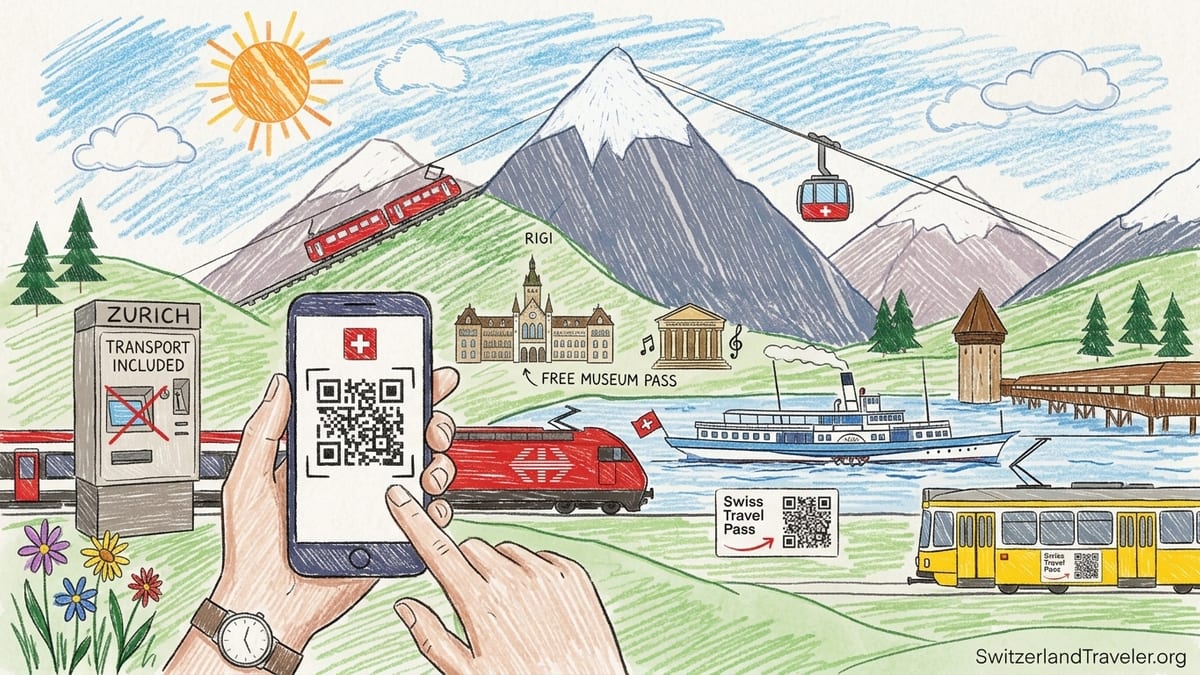
Over the six days, ticket checks were frequent: on intercity trains, lake boats and some regional trains like the Zentralbahn services out of Lucerne. Every time, scanning the QR code took only a few seconds. The only moment of friction came on a busy Zurich tram, where I instinctively reached for a ticket machine before remembering that city transport in Zurich is included in the Swiss Travel Pass. Once I relaxed into the idea that the pass was my proof of payment almost everywhere I wanted to go, travel became very simple.
The Actual Itinerary: Trains, Boats and City Transport I Used
For this test, I focused on the German-speaking core of the country: Zurich, Lucerne, the Lake Lucerne region, and a day out into the Bernese Oberland. Here is what I actually rode on the six days the pass was valid, all in second class.
On Day 1 I landed at Zurich Airport and took the SBB train from Zurich Airport to Zurich Hauptbahnhof, then used Zurich city trams and buses for the rest of the day. That included several short rides on tram line 4 along the Limmatquai and line 8 into the more residential districts, plus a brief detour on a suburban S-Bahn out to Zurich Wollishofen for a lakeside walk before returning to the main station.
Day 2 was my first intercity transfer. I took an InterRegio train from Zurich Hauptbahnhof to Lucerne, stored my bag in a locker there, and immediately boarded a lake steamer across Lake Lucerne to Vitznau. This route is operated by the Lake Lucerne Navigation Company and is fully included in the Swiss Travel Pass. From Vitznau I transferred directly to the cogwheel railway up Mount Rigi, which, for Swiss Travel Pass holders, was fully covered at the time of travel. After walking on the plateau between Rigi Kaltbad and Rigi Kulm, I descended on the Arth-Goldau side and took a standard SBB train back to Lucerne. I finished the day with short bus rides within Lucerne using the local public transport network, also included.
On Day 3 I stayed based in Lucerne and used the pass mainly for local and regional services. In the morning I rode the Zentralbahn train from Lucerne to Engelberg, a journey that is entirely within the Swiss Travel Pass validity area. From Engelberg I purchased a discounted ticket up to Mount Titlis, then later returned to Lucerne on the same rail line in the late afternoon. Back in the city, I made use of buses along the Reuss River to get to and from my hotel and the old town.
Day 4 was about mixing transport modes. I took an early SBB InterRegio from Lucerne to Bern, changed there to a Berner Oberland Bahn train to Interlaken Ost, and continued on a regional service into the Lauterbrunnen valley. Every leg of this routing was included with the pass until the point where mountain railways take over. I then bought a separate discounted ticket up towards Kleine Scheidegg, taking advantage of the Swiss Travel Pass reduction on the mountain section, before reversing the route back to Lucerne in the evening.
On Day 5 I shifted bases back to Zurich. I rode the direct Lucerne to Zurich train in the morning and used the afternoon to explore Zurich more thoroughly on public transport. I zigzagged across the city on trams to Seefeld, the University district and Kreis 5, rode the Polybahn funicular once up to the ETH terrace, and finished with an evening S-Bahn round trip along the lake to Rapperswil and back, simply hopping on the most convenient departures shown in the SBB app.
Day 6 wrapped the trip. With the pass still valid, I took a morning train from Zurich Hauptbahnhof to Winterthur for a museum visit, then continued by train to Schaffhausen to see the Rhine Falls. From there, local buses and a short regional train brought me back to Zurich, followed in the late evening by the Zurich Hauptbahnhof to Zurich Airport train to catch my flight home. All of these regular trains and buses were covered by the Swiss Travel Pass.
Museums and Attractions I Entered With the Pass
The pass is not only a transport product. It includes the Swiss Museum Pass, which grants entry to more than 500 museums across the country. On this itinerary I used the museum benefit several times, usually on rainy spells or late afternoons when hiking no longer made sense.
In Zurich, I used the pass to enter the Swiss National Museum, located just behind Zurich Hauptbahnhof. The normal adult entry fee is around 10 to 15 francs, depending on exhibitions, but with the Swiss Travel Pass it was free. I spent nearly two hours in the sections on medieval Switzerland and the development of the federal state, which was an unexpectedly helpful context for train journeys that later crossed modern cantonal borders.
In Lucerne, I visited the Richard Wagner Museum on the shores of Lake Lucerne, again using the pass for free admission. Walk-ups without a pass pay approximately 10 francs. I combined the visit with a short bus ride from Lucerne station out along the lake, both segments covered. On a different afternoon I also used the pass to enter the Bourbaki Panorama in Lucerne, which normally charges a modest entrance fee. The combination of transport and museum coverage meant I did not hesitate to drop into places for an hour, something I would be more cautious about if I were paying each entry separately.
Outside the cities, the pass helped in Winterthur. There, I visited the Fotomuseum Winterthur, known for its contemporary photography exhibitions, where the Swiss Travel Pass again counted as a full museum ticket. Over the six days, the museum entries I actually took add up to a realistic savings of roughly 40 to 60 francs compared with paying each door price in cash or by card. For a more museum-heavy trip, especially in Basel or Bern, this component alone could offset a significant portion of the pass price.
Mountain Excursions and How the Discounts Worked
Mountains are where the Swiss Travel Pass becomes more nuanced. Some peaks are fully included, some are half-price, others offer smaller reductions, and a few iconic ones give no discount at all. On this German-speaking itinerary, I concentrated on mountains around Lucerne and in the Bernese Oberland, where the official coverage maps clearly show the different categories.
Mount Rigi, above Lake Lucerne, was the standout inclusion. The cogwheel railways from Vitznau and from Arth-Goldau, as well as the cable car from Weggis, were fully covered by the Swiss Travel Pass at the time of my trip. That meant I could combine a lake steamer from Lucerne to Vitznau, ascend to Rigi Kulm, walk along the ridge, and descend on the other side to Arth-Goldau without paying any additional transport cost. Buying the same combination as point-to-point tickets, at 2026 rack rates, would easily run to roughly 100 francs or more for lake boat, uphill cogwheel and downhill route combined.
Mount Titlis at Engelberg worked differently. The Swiss Travel Pass fully covered the train from Lucerne to Engelberg, which is a substantial saving by itself compared to buying that segment at full fare. From Engelberg up to Titlis, however, the pass only gave a discount on the mountain gondola and cable car. The reduction for pass holders was close to 50 percent on the published adult return fare, turning a very expensive alpine excursion into something more approachable, but it still required a separate ticket bought at the Engelberg cable car station using the “Swiss Travel Pass” option at the vending machine.
In the Bernese Oberland, the pattern repeated. The Swiss Travel Pass got me as far as Interlaken and then up the valley to Lauterbrunnen and Grindelwald without extra charges. Beyond that, on the mountain railways towards Kleine Scheidegg and the Jungfraujoch, the pass granted a partial discount from certain intermediate stations rather than free travel. I chose to go only as far as Kleine Scheidegg from Lauterbrunnen, paying a reduced price thanks to the pass. Without any pass at all, that ticket would have been significantly more expensive. With a Half Fare Card it would also have been reduced, though the precise comparative saving varies based on which sections you ride.
The practical learning was this: in central Switzerland, picking mountain excursions that align well with the Swiss Travel Pass coverage, such as Rigi and certain segments of Pilatus or Stoos, can dramatically improve the value of the pass. When you plan more ambitious days to premium peaks like Titlis or Jungfraujoch, expect to pay additional but reduced fares on top of your pass and factor that into your budget calculations.
What I Would Have Paid Without the Swiss Travel Pass
To understand whether the pass saved money, I reconstructed the same six-day itinerary using 2026 point-to-point prices published or indicated by SBB and regional operators. These figures are approximate, rounded for clarity, but they give a realistic picture of the cost structure.
The Zurich Airport to Zurich Hauptbahnhof train is around 7 francs in second class. A day of fairly heavy Zurich tram and bus usage, with several zones and journeys, can easily reach 10 to 12 francs on regular tickets or a day pass. That puts Day 1 at roughly 17 to 20 francs without any rail pass.
On Day 2, Zurich to Lucerne on an InterRegio train costs in the region of 25 to 30 francs at full fare. A standard lake steamer from Lucerne to Vitznau is often priced around 30 francs one way without any discounts. The cogwheel railway Vitznau to Rigi Kulm and down to Arth-Goldau, if bought as a round-trip combination, commonly sits in the broad area of 70 to 80 francs at full price. Add a short SBB train from Arth-Goldau back to Lucerne at roughly 15 to 20 francs and a couple of Lucerne city bus rides, and you have a notional full-fare Day 2 total of approximately 140 to 160 francs.
For Day 3, Lucerne to Engelberg and return is typically in the order of 30 to 40 francs return at regular second-class prices. Local buses within Lucerne might add 5 to 8 francs. The Titlis cable car itself is a separate mountain product. At full price, the Engelberg to Titlis return, across multiple cable car segments, usually sits well over 90 francs, sometimes above 100 francs. The Swiss Travel Pass discounted my mountain ticket by around half that amount, which is a substantial saving compared with a traveler with no pass.
Day 4’s intercity day adds up quickly at rack rates. Lucerne to Bern in second class can be around 30 to 40 francs, Bern to Interlaken roughly 20 to 30 francs, and Interlaken to Lauterbrunnen and back about 15 to 20 francs. The Lauterbrunnen to Kleine Scheidegg return mountain ticket is a premium excursion even before thinking about Jungfraujoch, with full fares commonly well beyond 100 francs for the higher sections. Thanks to the pass, I bought only a discounted segment, but for comparison, a traveler paying full fare point-to-point could easily see a Day 4 transport bill of 160 to 200 francs depending on how high they go.
Day 5’s Lucerne to Zurich train at regular price is about 25 to 30 francs. A packed afternoon of Zurich trams, buses and one or two S-Bahn rides along Lake Zurich can reach 15 to 20 francs on normal day tickets. The Polybahn funicular has its own small fare, which would otherwise be separate but was covered as part of Zurich’s public transport network in my case. A realistic full-fare equivalent for the day might be 40 to 50 francs.
On Day 6, Zurich to Winterthur and back plus onward to Schaffhausen and return to Zurich is a classic pattern of regional returns, with each segment commonly priced around 10 to 15 francs in second class. Adding local buses in Winterthur and Schaffhausen, the total for the day as individual tickets would likely land in the 40 to 60 franc range. Finally, the Zurich Hauptbahnhof to Zurich Airport run once more adds roughly 7 francs.
Adding these approximate point-to-point prices together, excluding museum entries, produces a total that sits clearly above the 399 francs I actually paid for the six-day Swiss Travel Pass. Even conservatively, the reconstructed rack-rate cost of the same itinerary by individual tickets would likely be several hundred francs higher, driven mainly by the combined cost of lake boats, cogwheel railways and the mountain day in the Bernese Oberland.
Comparing the Pass With the Half Fare Card on This Itinerary
The real alternative to the Swiss Travel Pass is usually the Swiss Half Fare Card, which, for a fixed price, allows you to buy almost every ticket in the country at half of the regular fare. To judge that option fairly, I applied a simple thought experiment to the same six-day itinerary.
The Swiss Half Fare Card itself costs a substantial amount for one month of validity. If I had held the card on this trip, nearly all the intercity and regional train segments mentioned above would have been roughly half price. Zurich Airport to Zurich Hauptbahnhof, Zurich to Lucerne, Lucerne to Engelberg, Lucerne to Bern, Bern to Interlaken, and so on would each have been cut by around 50 percent compared with the point-to-point fares listed earlier. Local trams and buses would also generally be half price when valid tickets are purchased, although the exact product structure differs between Swiss cities.
Under a Half Fare Card scenario, the mountain tickets to places like Rigi and Titlis would also have been reduced, but not free. For example, instead of riding the full Rigi circuit at no extra cost, I would have paid roughly half of the normal combined boat and cogwheel price, which still adds up to a notable amount. Likewise, my Titlis cable car ticket might have been similar in price to what I paid as a Swiss Travel Pass holder, since both products often receive comparable reductions on that line, but I would still have been buying half-fare tickets for every underlying train segment to Engelberg.
Crucially, the Half Fare Card does not generally include museum admission. On this itinerary, that would have meant paying the door prices at the Swiss National Museum, the Richard Wagner Museum, the Bourbaki Panorama and the Fotomuseum Winterthur. Taken together, those entries amounted to around 40 to 60 francs in savings with the Swiss Travel Pass. A traveler more focused on museums in Zurich, Basel, Bern or St. Gallen could easily double that figure over six days.
When I roughly halved all the eligible transport fares for this itinerary and added the purchase price of a Half Fare Card, then put museum entries back in at full price, the total came out not wildly different from what I actually paid for the Swiss Travel Pass. In other words, for a six-day period with frequent rail movements, at least one fully included mountain like Rigi, another discounted mountain like Titlis, and several museum visits, the consecutive Swiss Travel Pass and the Half Fare Card are in a similar financial ballpark. The main difference is that the pass freed me from buying tickets for every urban and intercity journey, while the Half Fare Card would still have required constant interaction with ticket machines or the SBB app.
Practical Lessons From Using the Pass on the Ground
Looking back, several practical observations stand out from using the Swiss Travel Pass every day in German-speaking Switzerland. These are not theoretical pros and cons but details that noticeably affected how the trip felt and what it cost.
First, not having to think about zones and fares inside Zurich and Lucerne mattered more than expected. Zurich’s fare zones and Lucerne’s region are both straightforward once you get used to them, but on a jet lagged morning or in a sudden rainstorm it is liberating to just step onto a tram or bus knowing the pass covers you. This ease encouraged spontaneous detours: hopping off a tram to explore a neighborhood café, then boarding the next one without worrying about the validity of an individual ticket.
Second, the pass worked well with real-time travel planning. I relied heavily on the SBB Mobile app to see departure boards, platform numbers and delays. When I missed an intended connection in Bern on the way to Interlaken, there was no financial penalty. I simply boarded the next train covered by the pass. With point-to-point advance tickets, I would have needed to check refund rules or buy a new ticket for a different train, especially on certain types of discounted products.
Third, the coverage on lake boats around Lucerne added unexpected value. Prices for independent boat trips are high because they are both public transport and tourist experiences. Having the pass meant I could decide on the day whether to cruise the long way back from Vitznau or Weggis rather than rush onto the first train. The same logic applied on Lake Zurich and for minor river crossings where ships function as part of the regular network.
Fourth, museum entry coverage changed my behavior. Without the pass, I might have picked only one major museum across Zurich and Lucerne to justify the combined ticket fees. With it, I felt comfortable dropping into two or three different places, even for a short visit. This pattern not only improved the cultural depth of the trip, it also increased the effective value of the pass without any extra planning effort.
Finally, the only times I had to stand in a queue were for mountain cable car tickets. On those occasions, presenting the Swiss Travel Pass at the counter or selecting it from a list of discount options on a machine was easy enough, but it was the one reminder that the pass does not cover absolutely everything. Having a rough plan of which mountains are fully covered, half-price or partially reduced before you arrive in Switzerland makes these moments quicker and less confusing.
The Takeaway
For this particular six-day journey through German-speaking Switzerland, the second-class Swiss Travel Pass delivered both financial value and a simpler travel experience. When I compared the 399 franc pass price with realistic 2026 point-to-point fares for the same intercity trains, regional lines, lake steamers and city transport, the total without a pass would clearly have been higher. Add the fully included Mount Rigi excursion, the significant discount on Titlis, and several museum entries that I would otherwise have paid for individually, and the pass came out ahead in cash terms.
That said, the margin over a combination of the Swiss Half Fare Card plus regular half-price tickets was not enormous for this itinerary. A traveler who prefers to base themselves in one region, take fewer long-distance trains, or focus primarily on a single mountain area might find the Half Fare Card comes closer or even wins on cost, especially for trips longer than a week that involve days of minimal travel. The Swiss Travel Pass tends to shine when you are moving frequently, crossing different regions, and mixing city sightseeing with lake and mountain transport.
What ultimately convinced me the pass was worthwhile was not just the spreadsheet comparison but the way it changed my days. I boarded trains and boats without queuing at machines, tried out side trips on a whim, and walked into museums that caught my eye without mentally checking the ticket price first. In an already expensive country, that kind of mental ease is hard to quantify yet very real. For travelers planning a similar route across Zurich, Lucerne, Lake Lucerne and the Bernese Oberland, and who want to experience both the trains and the peaks, the Swiss Travel Pass remains a strong, all-in-one choice in 2026.
FAQ
Q1. How did you decide which Swiss Travel Pass duration to buy?
I listed the exact days I needed long-distance travel and mountain trips, then matched that to the published 3, 4, 6, 8 and 15 day options and chose six consecutive days.
Q2. Was activation of the Swiss Travel Pass at Zurich Airport complicated?
No. Because I bought an e-ticket with a fixed start date, there was nothing to validate at the airport. I simply boarded the first SBB train and showed the QR code and my passport when asked.
Q3. Which specific trains and boats did you ride using the pass?
I used it on SBB trains between Zurich Airport, Zurich, Lucerne, Bern, Interlaken, Winterthur and Schaffhausen, on Zentralbahn services to Engelberg, and on lake steamers across Lake Lucerne between Lucerne and Vitznau.
Q4. Which mountains on this itinerary were fully covered and which were discounted?
Mount Rigi’s cogwheel railways and connecting Lake Lucerne boat were fully covered, while Mount Titlis and the railways beyond Lauterbrunnen towards Kleine Scheidegg offered discounted but not free fares with the pass.
Q5. How much did you realistically save on museums with the Swiss Travel Pass?
On this six-day trip, free entry to the Swiss National Museum, the Richard Wagner Museum, the Bourbaki Panorama and the Fotomuseum Winterthur added up to roughly 40 to 60 francs in avoided admission fees.
Q6. Did you ever need to buy separate tickets despite having the pass?
Yes. I bought separate, discounted tickets for the Titlis cable cars and for the mountain railway section from Lauterbrunnen up towards Kleine Scheidegg. Those are outside the fully covered part of the network.
Q7. Would a Swiss Half Fare Card have been cheaper for your exact route?
Once I applied half-price fares to all eligible tickets and added the cost of the Half Fare Card and museum entries, the total was in a similar range. The Swiss Travel Pass still came out ahead but not by a huge margin.
Q8. How often did conductors check your Swiss Travel Pass on board?
On almost every intercity train and lake boat, someone passed through to scan the QR code and glance at my passport. Checks were slightly less frequent on short city trams and buses.
Q9. Did the pass cover all local transport in Zurich and Lucerne?
It covered regular trams, buses and S-Bahn services within the urban networks of Zurich and Lucerne. I did not need separate city tickets for any of the rides included in this itinerary.
Q10. For a mostly German-speaking Switzerland trip, who benefits most from the Swiss Travel Pass?
Travelers who plan to move every day between cities like Zurich, Lucerne and Bern, combine that with lake boats and at least one or two mountain excursions, and who value the simplicity of not buying separate tickets for each ride gain the most from the pass.