


I have been to German-speaking Switzerland several times, and on my last extended trip I decided to stop collecting generic viewpoints and focus on experiences I would genuinely repeat. I built the itinerary around Zurich, Lucerne, Bern, Basel, Jungfraujoch, Appenzell and St. Gallen, using trains, mountain railways and lake boats instead of a car. What follows is not a greatest-hits checklist but a report of what I actually did, what it cost in Swiss francs, how long it took, how the weather and crowds affected the day, and, most importantly, whether I would spend the money again.
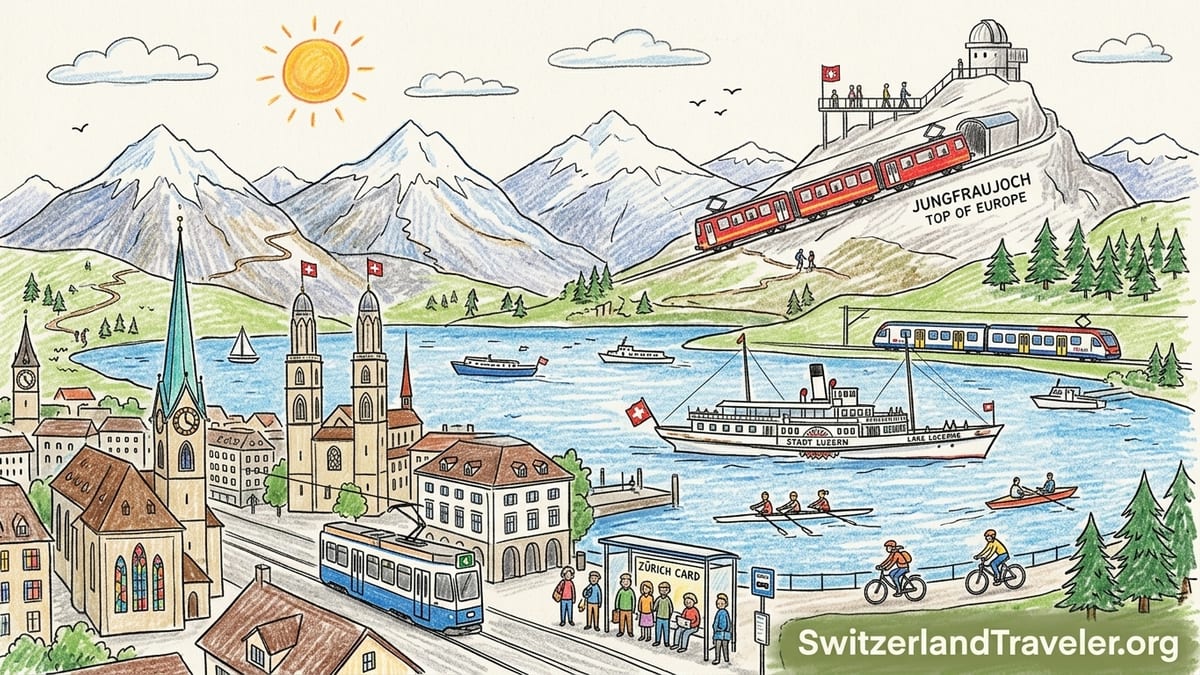
Exploring Zurich Beyond the Postcard Old Town
I based myself in Zurich for four nights because it functions as the financial and transport hub of German-speaking Switzerland rather than a scenic resort town. On my first full day, I bought a 24-hour Zurich Card in second class for a little under 30 Swiss francs, which covered trams, local trains, boats on the lake and free or reduced admission to several museums. With that card in hand, I rode tram 4 from my hotel near Langstrasse into the compact Altstadt, climbed the narrow lanes up to Lindenhof for the classic Limmat River view, crossed the river to see the stained-glass windows at Fraumünster, and then took a short train ride to Zürich West for dinner. The weather in mid-September was clear and cool, around 18 degrees Celsius in the afternoon, and crowds were thick around Bahnhofstrasse but much lighter once I reached the quieter residential hills. Door to door, I spent about 10 hours out exploring, and I would absolutely buy the Zurich Card again for a first or second day in the city because it eliminated small fare decisions and nudged me to see neighborhoods I might otherwise have skipped.
Another day I built around the lake rather than the old town. I took an early S-Bahn from Zürich Hauptbahnhof to Küsnacht and walked the easy lakeside trail north, watching commuters glide past on their bikes while rowers cut across the flat water. After an hour on the path I boarded a local boat heading back toward Bürkliplatz, essentially using the lake as a floating tram. The regular ZVV day pass for the central zone cost me under 10 francs, and the boat rides counted the same as a tram journey, which felt like terrific value for an otherwise expensive city. Skies were hazy but bright, the deck was busy with commuters in the morning and relaxed couples in the afternoon, and I never felt packed in. If I returned in summer, I would repeat this mix of walking and boat-hopping without hesitation, as it delivered lake scenery for the price of basic public transport.
My final Zurich ritual is one I now repeat every trip. I ride the short train up to Zürich Stadelhofen, follow the signed footpath up to the Zürichberg viewpoint, and then continue along the ridge to the D older area before dropping back down toward the lake. This half-day hike takes me three to four hours with photo stops and does not cost anything extra beyond a single local rail ticket or a day pass for the city. On my last visit the trail was quiet despite it being a sunny Saturday, and I shared the forest tracks mostly with local joggers and dog walkers. If you want to feel Zurich as a lived-in city with real hills, real forest and real suburban life, this ridge walk is the experience I would repeat before any museum or shopping trip.
Staying in Lucerne and Riding Lake Boats
Lucerne, in the German-speaking heart of central Switzerland, felt very different from Zurich. Here the lake and mountains dominate everything, and the compact medieval core is wrapped tightly around the waterfront. I stayed three nights in a mid-range hotel a few minutes from the station, which included free public transport in the city zone but not the boats. On my first proper day I bought a second-class day ticket for Lake Lucerne and committed to spending almost the entire day on the water. A standard round-trip between Lucerne and Vitznau or Weggis costs from roughly 30 to 50 francs return depending on class and route, but a day ticket that allowed me to hop on and off multiple boats came in under 80 francs for an adult. I left Lucerne on a mid-morning paddle steamer, watched the city slip away behind the stern, and spent about six hours in total cruising between Vitznau, Weggis and back to Lucerne with a lunch stop on shore.
The weather for that lake day was ideal: bright sun, a few high clouds, about 22 degrees Celsius at the low altitudes and a light breeze across the open decks. Crowds on the morning departure were moderate, with a mix of tour groups and independent travelers, but I easily found a rail-side seat on deck. At smaller intermediate stops the boat emptied and refilled constantly, so it never felt overloaded. Given the cost, this was one of the more expensive single-day activities of my trip, but the combination of slow travel, open-air time and classic paddle steamers made it feel worth every franc. I would repeat it exactly, especially if I had a Swiss Travel Pass that covered lake boats fully and dropped my marginal cost for the day to almost zero.
On another Lucerne day I combined the city’s famous wooden Chapel Bridge and old town with a shorter lake circuit. I spent the morning wandering the cobbled lanes, visiting the Lion Monument and stopping into a bakery for coffee and a dense Zopf bread sandwich for under 10 francs. After lunch I bought a simple one-hour circular cruise from the pier in front of the railway station, which cost around 30 francs at the counter. The afternoon had high cloud and a bit of haze around the peaks, but visibility over the lake was still good and the open upper deck never felt crowded. The one-hour format was less memorable than the full-day lake hopping, but if time is tight it is an easy add-on that gave me that essential Lucerne view of city, lake and snowy ridges in a compact block.
Bern’s Slow Pace and Museum Time
Bern, the federal capital, felt like a different country compared with Zurich and Lucerne. The old town sits on a loop of the Aare River, and the city runs at a noticeably slower pace. I arrived by train from Lucerne in about an hour, dropped my bag at the hotel near the station, and spent my first afternoon just walking the arcaded streets of the UNESCO-listed center. This part of the trip cost only the rail fare, which I covered with a Saver Day Pass purchased in advance that capped my full day of long-distance travel at under 70 francs. The weather was mixed sun and cloud, a little warm in the mid-twenties Celsius, and the arcades provided shade that made strolling comfortable. Crowds were steady but manageable, mostly day-trippers and workers on their lunch break.
The second day in Bern I dedicated to museums. Instead of paying individual entry fees of around 20 to 25 francs per museum, I bought a local museum card at the tourist office, which gave me unlimited access for 24 hours to most of the city’s major collections for a fixed price in the region of 30 francs. I started at the fine arts museum, moved on to the historical museum with its Einstein section, and finished at the Zentrum Paul Klee on the edge of town. This sequence took a full day from about 10 in the morning until closing time, with a picnic lunch from a supermarket on a bench above the river to keep costs down. The weather turned rainy in the afternoon, which actually made it a perfect museum day, and galleries were busy but not congested to the point of queuing for each room.
Would I spend the money on the Bern museum card again. Absolutely. The card removed any hesitation about ducking into a museum just for a particular room or temporary exhibition, and it concentrated the cultural side of the trip efficiently into one long but satisfying day. Bern is a city that rewards lingering rather than rushing, and using the museums as anchors for slow walks along the arcades felt like the right match for its more measured rhythm.
Basel and an Immersive Museum Day
Basel, pressed up against the borders with France and Germany, gave my trip a more international flavor. I came specifically for the museums and galleries, and I treated the city as an open-air extension of them. I arrived by direct train from Zurich in about an hour, using another advance-purchased Saver Day Pass since I was stringing together multiple intercity segments in one day. My total rail cost for that day worked out to around 60 francs rather than separate full-fare tickets that would have cost substantially more.
My main target was one of Basel’s flagship art museums, where an adult ticket cost just under 30 francs. I spent nearly four hours moving through the permanent collection and the temporary exhibitions, taking one coffee break in the internal courtyard café. Crowds were moderate on a clear weekday in late spring, with a steady trickle of school groups and independent visitors. I never felt rushed or jostled in front of the most popular works. The rest of the day I used my local transport ticket to ride trams through the old town and walk the embankment along the Rhine, watching locals floating down the river with dry bags in the late afternoon sun, a seasonal ritual in Basel when the weather allows.
From a value perspective, Basel is not cheap, but the depth of its cultural institutions justifies the cost if you plan ahead. I would repeat the combination of a Saver Day Pass for the intercity legs and a single well-chosen museum admission, rather than trying to rush through three or four shorter visits. Basel feels like a place where you sit with art and architecture rather than check them off, so my advice, shaped by that day, is to pay for one major museum, give it the time it deserves, then invest your remaining hours in the free experience of people-watching along the river.
Climbing to Jungfraujoch on the Mountain Railways
The most expensive single experience of my trip was the journey to Jungfraujoch, the high-altitude saddle above the Bernese Oberland that is heavily marketed as the Top of Europe. I based myself in Interlaken for two nights, and on the clearer of the two days I committed fully to the mountain railways. Starting around eight in the morning, I took the train from Interlaken Ost to Lauterbrunnen, changed to the smaller mountain train up to Wengen and Kleine Scheidegg, and then boarded the cogwheel train that disappears into the tunnel toward Jungfraujoch. With no special passes beyond a half-fare card, the return ticket from Interlaken to Jungfraujoch and back can easily reach several hundred francs per adult in 2026, and even with discounts it remained by far the largest single line item in my transport budget.
The weather that day started perfectly, with deep blue skies and crisp air around 10 degrees Celsius in the valley. As we climbed, temperatures dropped below freezing at the top, but the air remained clear enough that from the Sphinx Terrace I could see across to the Aletsch glacier and down the valley. Crowds, however, were intense. Trains up from Kleine Scheidegg were close to capacity, and the viewing platforms and indoor corridors at the summit felt at times like an airport terminal on a peak holiday. Despite that, the engineering of the route and the raw scale of the glacier still impressed me deeply. I spent roughly four hours at the top station and about five to six hours in total transit for the round trip.
Would I pay for Jungfraujoch again. I would, but only under specific conditions. I would check the forecast carefully and book or confirm tickets only when I saw a clear weather window, and I would aim for a shoulder season month such as late May or early October when there are slightly fewer tour groups. If the forecast suggested cloud or drizzle, I would skip it and reallocate that money to lower mountain excursions or an extra night in a scenic valley. The experience is spectacular when visibility is good, but given the price, it is not something I would gamble on with marginal conditions.
Hiking in Appenzell and the Alpstein
In contrast to the heavily engineered Jungfraujoch trip, my days in Appenzell and the Alpstein felt like classic Swiss hiking with simpler infrastructure and fewer crowds. I took an early train from St. Gallen to Appenzell, then a short connecting train to Wasserauen, all covered by a normal day ticket that cost me under 50 francs for the entire regional network when bought as a Saver Day Pass in advance. From Wasserauen I rode the cable car up to Ebenalp, paying around 30 francs for a return ticket, then hiked down past the cliffside guesthouse at Aescher and the tiny lakes below before returning to the valley on foot.
The weather was ideal for hiking: around 18 degrees Celsius at the start, cooler higher up, with a mix of sun and cloud that kept the light soft for photographs. Trails on this weekday in June were pleasantly busy but never crowded. I passed families, small hiking groups and a few trail runners, but there were long stretches when I had the path to myself. The full loop from the top of the cable car through Aescher and the lakes and back down to Wasserauen took about four to five hours at a relaxed pace, including a long lunch stop on a bench overlooking the valley with a sandwich and fruit I had brought from St. Gallen.
This is one experience I would repeat almost exactly. The combination of modest cable car cost and free hiking delivered the kind of mountain immersion I enjoy most. If you are willing to climb a little more, you can skip the return cable car ticket and hike both ways, cutting costs further. The Alpstein has a distinct character, with jagged limestone ridges and traditional farmhouses, that sets it apart from the Bernese Oberland, and Appenzell’s village center, with its painted wooden facades, adds a quietly traditional counterpoint to the more polished resort towns elsewhere in Switzerland.
St. Gallen’s Library and Everyday City Life
St. Gallen was a surprise favorite. I arrived on a direct train from Zurich in a little over an hour, again using a Saver Day Pass to keep intercity costs under control. The city does not have the dramatic lake or mountain setting of Lucerne or Interlaken, but it has a dense, walkable center and a calm, lived-in feel. My main goal was the abbey precinct and its baroque library, where an adult admission ticket cost a little over 15 francs when I visited. Entry included shoe covers to protect the historic floors and required leaving bags in lockers, which meant moving through the collection felt almost like entering a shrine to books.
I spent nearly two hours in the library, listening to the soft murmur of audio guides and other visitors in a handful of different languages. It was gently busy but never overcrowded, and there was always space to sit quietly and absorb the layered shelves and painted ceiling. The rest of the day I meandered through the surrounding streets, stopped for a mid-afternoon coffee and slice of local cake for about 8 francs, and rode a local bus up one of the hills for a broader view of the city before walking back down. The entire day, including admission, food and a local transport ticket, stayed under 60 francs beyond the intercity pass.
Would I return to St. Gallen. Yes, particularly as a counterweight to the more obviously photogenic destinations. The city gave me a sense of everyday Swiss-German life, with students, office workers and families using the same streets and squares, and the abbey library remains one of the most atmospheric interior spaces I have ever experienced in Europe. It is an experience of depth rather than height or speed, and worth carving out a full unhurried day.
Using Lake Boats as Transport, Not Just Scenic Cruises
Across my time in German-speaking Switzerland, I used lake boats not only as excursions but as functional parts of my travel days. Besides the classic Lake Lucerne routes, I also relied on shorter crossings that acted almost like bridges. On Lake Thun, for example, I used a scheduled boat to travel between Thun and Interlaken on a travel day, turning what could have been a straightforward train transfer into a three-hour moving terrace of water and mountain views. With a Swiss Travel Pass, that boat journey did not cost anything extra beyond the pass itself, and even without one, a point-to-point second-class ticket was in the region of 30 to 40 francs.
The weather matters more on these lake days than almost any other element. I had one crossing under solid grey skies with intermittent drizzle where the peaks were largely hidden and the decks felt chilly and deserted. It was still a pleasant way to move between towns, but I would not have chosen it as a dedicated scenic day. On clear or partly cloudy days, by contrast, the boats became highlights in their own right, with reflections on the water, layers of snow on the distant ranges and a quieter, slower rhythm than the trains. Crowds varied widely, from packed mid-morning departures on sunny weekends to almost empty late-afternoon boats on weekdays.
Looking back, I would deliberately plan more travel legs by boat when the timing worked, rather than treating lake cruises as bolt-on extras. They often cost the same as or only slightly more than the equivalent rail journey, especially when covered by passes, and they added a dimension of fresh air and open views that no tunnel-heavy rail line can deliver. Used this way, the lakes become corridors of movement rather than only scenic postcards.
The Takeaway
German-speaking Switzerland is often flattened into a single image of lakes, mountains and clean trains, but traveling through Zurich, Lucerne, Bern, Basel, Jungfraujoch, Appenzell, St. Gallen and the surrounding lakes revealed very different personalities. Zurich worked best for me as an urban base with efficient transport and short nature escapes. Lucerne delivered classic lake and mountain drama. Bern slowed the tempo and wrapped culture in arcades and river loops. Basel provided a dense day of art. Jungfraujoch delivered raw altitude at a high price. Appenzell and the Alpstein offered accessible hiking and regional character. St. Gallen gave intellectual depth and everyday city life. The lakes stitched all of it together.
If there is a pattern in the experiences I would repeat, it is this. I would spend on passes and day tickets that free me to improvise within a region, I would anchor days around one or two major paid experiences, and I would fill the rest of the time with walks, viewpoints and everyday streets that cost little or nothing. In a country as expensive as Switzerland, that balance of paid highlights and low-cost in-between moments made the trip both financially sustainable and emotionally rich, and it is the approach I recommend to anyone heading into the German-speaking side with limited days and a finite budget.
FAQ
Q1. How many days do you recommend for German-speaking Switzerland on a first trip.
For a balanced first trip that includes Zurich, Lucerne, one mountain excursion, and either Bern or Basel, I would plan at least eight to ten full days. That gives you time to absorb each place without treating cities like train stations and mountain railways like a race.
Q2. Is the Jungfraujoch trip worth the high cost.
When the weather is clear and visibility is good, I found Jungfraujoch unforgettable and worth the money once. I would not go if the forecast was poor, and I would only repeat it in a different season or with first-time travel companions who are excited about it.
Q3. Which city makes the best base, Zurich, Lucerne, Bern or Basel.
For pure transport convenience and flight connections, Zurich makes the most practical base. For scenery and easy lake and mountain access, I would choose Lucerne. Bern works best for a slower, more local-feeling stay, and Basel is ideal if your priority is museums and architecture.
Q4. How expensive did your daily costs feel in practice.
On days with major paid excursions like Jungfraujoch, my spending shot above 250 francs including trains and food. On simpler city or hiking days, I kept it closer to 120 to 150 francs by self-catering some meals, using city day passes and focusing on one main paid activity.
Q5. Do you need a Swiss Travel Pass, or are point-to-point tickets enough.
When I moved almost every day and took several boats and mountain railways, a Swiss Travel Pass or a combination of Saver Day Passes and half-fare discounts made financial sense. On trips with longer city stays and fewer long-distance moves, buying individual tickets and local day passes felt more economical.
Q6. How crowded were the main sights, and can you avoid the worst of it.
Crowds were heavy at Jungfraujoch and in central Lucerne and Zurich on sunny afternoons, but much lighter on early trains, in shoulder seasons and slightly away from the most photographed bridges and viewpoints. Starting days early and booking big-ticket items midweek helped a lot.
Q7. Is hiking in Appenzell suitable for beginners.
Yes, many of the routes around Ebenalp, Aescher and the small lakes are well signed and manageable for reasonably fit beginners with proper footwear. There are steeper and more technical options, but you can choose gentler loops that still deliver serious scenery without exposure.
Q8. Did you find lake cruises or mountain railways more rewarding for the money.
In pure value terms I felt lake cruises, especially when integrated into travel days, offered more relaxation and scenery per franc. Mountain railways delivered concentrated drama but at higher prices, so I chose one or two standout routes rather than trying to ride every line.
Q9. How did weather influence your plans day to day.
Weather shaped almost everything. I held flexible ideas for each region and then matched clear days to mountain or lake activities and rainy days to museums and city walks under arcades. Checking forecasts each evening let me shuffle the order of experiences and protect the most scenic ones.
Q10. Would you travel by car instead of trains and boats next time.
Personally I would stick with trains, buses and boats. They were frequent, reliable and comfortable, and they let me watch the scenery instead of the road. In city centers and mountain villages a car often felt like more burden than benefit when I saw others searching for parking or navigating narrow lanes.