


I thought I knew German-speaking Switzerland before I arrived. Zurich and Lucerne had long loomed large in my imagination, polished postcards of lakes, mountains and immaculate trains. What actually unfolded, over two weeks of zigzagging across Zurich, Basel, Bern, Lucerne, Interlaken, Grindelwald, Appenzell and St. Gallen, was far more textured, more expensive in some ways and more generous in others, and often surprising in the gaps between sleek cities and raw Alpine valleys.
Planning the Trip I Thought I Would Take
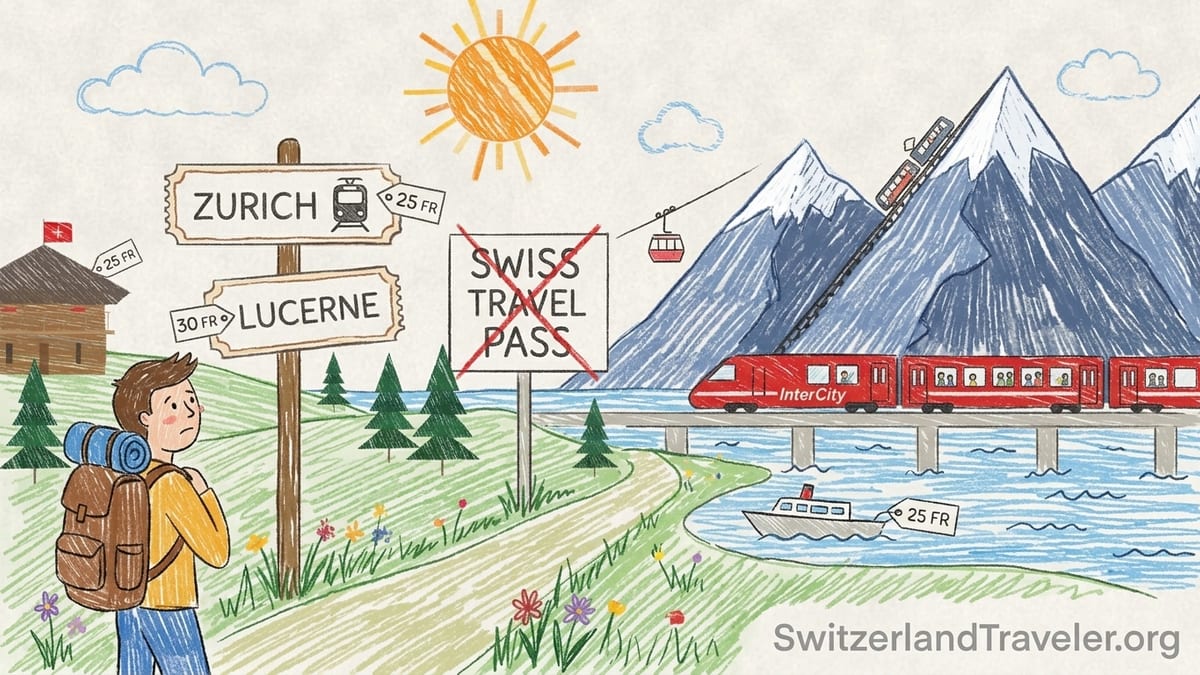
Before I landed in Zurich, I was certain a Swiss Travel Pass would magically simplify everything. On paper it seemed perfect: one ticket for almost all trains, buses and lake boats across the country, valid for 3 to 15 consecutive days, with museum entries layered on top. In 2026, a 4-day second-class Swiss Travel Pass costs around 295 Swiss francs according to Swiss transport tariff documents and Switzerland Tourism. That sounded high, but I assumed that once I added up intercity trains and boats, it would obviously pay for itself.
My first surprise came when I started pricing point-to-point tickets on the official SBB app while still at home. Zurich Airport to Zurich main station, Zurich to Lucerne, Lucerne to Basel: the individual fares were lower than the mental numbers I had been carrying from older guidebooks, especially when bought in advance with saver fares. I ended up splitting my trip into “heavy travel” days covered by a pass and quieter days where I paid single tickets. The pass was still valuable, but not the across-the-board bargain I had imagined.
I also underestimated how much mountain railways and cable cars would blow up my budget. The Swiss Travel Pass gives free travel on regular trains and many lake boats, and typically a 50 percent discount on many mountain routes, but flagship lines like the Jungfraujoch from Grindelwald or Interlaken still cost well over 150 francs return per person even with discounts, depending on season and departure point. I had vaguely assumed “half off” meant “affordable.” On the ground, those numbers felt very different from my spreadsheet at home.
If I were planning the same route again, I would map out specific long-distance days, check current prices in the SBB app and on the mountain railway websites, and buy the pass only for the days that truly involve crisscrossing the country. In my case, a 6-day pass for the whole stretch would have been an expensive mistake, and I only realised that after talking to a ticket agent in Zurich who calmly walked me through actual fares for my stops.
Zurich and Basel: Urban Rhythm, Subtle Dialects and Sticker Shock
Zurich was my first base, a short direct train ride of about 10 minutes from the airport to the main station, then a few minutes by tram to a small hotel off Langstrasse. The precision of the trains impressed me as expected, but I was surprised by how casual the city felt once I stepped away from Bahnhofstrasse. On my first evening, I ate at a simple neighborhood restaurant near Helvetiaplatz: a plate of Zürcher Geschnetzeltes with rösti and a small beer came to around 38 francs. The quality was excellent, but my US-based brain still converted it to a nearly fifty-dollar dinner and blinked.
Basel, about an hour by direct InterCity train from Zurich, hit my wallet in a similar way, especially for cafes and casual lunches. A straightforward plate of pasta near the Rhine ran to roughly 26 francs, and a cappuccino could easily be 5 or 6 francs. I had expected Switzerland to be expensive, but it was the day-to-day items, not just the special meals, that really added up. I began picking up take-away salads and sandwiches from Coop and Migros supermarkets, where a good picnic-style lunch could be assembled for 10 to 15 francs.
Linguistically, both cities were my first lesson that “I speak some German” does not automatically mean “I understand Swiss German.” On trams and in casual conversations, the dialect in Zurich and Basel was thicker and faster than I anticipated. I could read menus and signs with no difficulty, but informal announcements on regional trains sometimes passed me by. The surprise was how quickly staff switched to high German or English the moment I looked confused. In practice, I rarely needed English, but it remained a safety net, especially at ticket counters when discussing complicated passes.
Weather in both cities proved more variable than glossy photos suggest. In early summer, I had one hot, clear afternoon on the Rhine in Basel, followed by a grey, cool drizzle in Zurich that made even June feel like shoulder season. This mattered more than I expected for planning: lake swims and rooftop bars gave way to museums and long coffee breaks, and I was glad I had not locked in non-refundable, weather-dependent activities in advance.
Lucerne and Lake Boats: Smooth Connections and Quiet Corners
The train from Zurich to Lucerne is one of the easiest hops in the country, roughly 45 to 50 minutes by direct InterRegio trains that leave around every half hour. I walked onto a mid-morning IR70 service at Zurich main station, tossed my bag on a luggage rack and watched the suburbs slide into low green hills. The punctual glide into Lucerne’s terminal station, with the lake and mountain skyline just beyond the station hall, is one of those arrivals that live up to the brochures.
Lucerne was my second base, and staying near the station turned out to be one of my best decisions. From my hotel it was a five-minute walk to both the train platforms and the Bahnhofquai boat piers. I quickly fell into a pattern: train or bus excursions during the day, then an evening lake cruise. The Lake Lucerne Navigation Company operates a dense network of scheduled boats, and in the main season you can ride everything from modern motor vessels to nostalgic paddle steamers. With the Swiss Travel Pass, the regular scheduled services were included, which saved me around 25 to 35 francs per outing compared with a separate ticket.
What surprised me most was how easy it was to step off the main tourist trail. I had expected the iconic Kapellbrücke and the lakeside promenade to be crowded, and they were. But ten minutes by boat from the main quay took me to quieter stops near lakeside villages and the Swiss Museum of Transport, where short walks along the shore felt almost local. On an overcast afternoon, I rode a boat to Vitznau and watched commuters step on and off with grocery bags and strollers, a reminder that these boats are not just scenic cruises but actual public transport.
I did underestimate how much time the classic mountain excursions consume. A round trip from Lucerne to Mount Pilatus, for example, involves a boat or train to Alpnachstad, then the steep cogwheel railway up to Pilatus Kulm, and usually a cable car descent on the other side back toward Kriens and the city. Even on a well-timed day with early departure, I used nearly six hours door to door. I had planned to squeeze in Mount Rigi on the same day and quickly abandoned that idea. If I were redoing Lucerne, I would allow single full days for each major mountain trip instead of stitching them together.
Bern and the Train Network: When Assumptions Meet Timetables
Bern was my most misunderstood stop. On the map it looks like a simple midpoint between Zurich, Basel and the Bernese Oberland, and I expected it to feel like a small administrative town. Instead, the old town, wrapped in a loop of the Aare River, felt both grand and relaxed. From Lucerne, the trip to Bern took about an hour on an InterRegio train with no changes, and the moment I stepped out of the station, arcaded streets and sandstone facades gave the city a distinct personality not quite like anywhere else on my route.
My largest logistical surprise here involved train frequencies and connections. I had assumed that, in Switzerland, you can simply turn up and go anywhere at any time without thinking. While that is largely true on the main east–west trunk line, some of my planned detours, such as a same-day side trip from Bern into quieter Emmental valleys, involved hourly or even less frequent services. On one afternoon, a missed connection due to an extended lunch meant a full extra hour in a small junction station and a much later arrival back in Bern than planned.
The good news was that the integrated network still made even my clumsy choices workable. A delayed regional train ticket was still valid on the next departure, and connection times were clearly displayed on the SBB app. The bad news was that my original plan to pack multiple small towns into each day became unrealistic pretty quickly. In practice, I found that three to four segments per day, counted as individual train or boat rides, was the threshold before fatigue and minor delays started to erode the pleasure of the trip.
Bern also highlighted another surprise: how weather can vary within a single travel day. I left Lucerne on a cloudy, cool morning and arrived in Bern under glaring sun and near-summer heat, which then turned into an afternoon thunderstorm. I learned to check forecasts not just for “Switzerland” but for each region I planned to pass through, especially when a single day involved leaving a lowland city and ending at altitude.
Interlaken and Grindelwald: The Beautiful, Costly Heart of the Alps
From Bern to Interlaken Ost, the train ride along Lake Thun felt like the point where my trip shifted into full Alpine mode. Interlaken itself, wedged between Lakes Thun and Brienz, is more a transit and tour hub than a traditional mountain village, and I quickly realised that basing myself in Grindelwald might have made more sense. Hotels and restaurants in Interlaken felt busy and international, and prices were steep. A simple burger in a central restaurant pushed 30 francs, and even a basic hotel room could easily be 200 francs per night in high season.
The onward train to Grindelwald, operated by the Berner Oberland railway, took around 35 minutes from Interlaken Ost, climbing steadily into a valley framed by the Eiger. I stayed near Grindelwald Terminal, a combined rail and gondola hub where the modern Eiger Express cableway starts. This was my base for tackling the Jungfraujoch excursion, the single most expensive day of my entire trip. Buying the ticket on the official Jungfrau website and at the terminal, I confirmed what I had read beforehand: even with a Swiss Travel Pass, the round trip to Jungfraujoch cost around 180 to 200 francs per adult in the high season, depending on route and any early morning deals.
Financially, I misjudged how many “little” mountain trips I would want and how quickly they would add up. Beyond the Jungfraujoch, the First gondola from Grindelwald, the cable car to Männlichen and the nostalgic cog railway to Kleine Scheidegg all required separate tickets, often discounted but not covered in full by my pass. A single return ride on a gondola could be 30 to 60 francs per person. I found myself choosing one major mountain outing per day and then relying on free or discounted local hikes. In hindsight, if I had spent four or more nights in the region, a regional Jungfrau area pass might have been better value than relying only on the Swiss Travel Pass discount layer.
The payoff, though, is enormous. On a clear day, standing on the Sphinx Terrace at Jungfraujoch, looking out over a sea of ice, I understood why people budget heavily for this one experience. The contrast with the cities was also dramatic in a different way: at over 3,400 meters, the air was thin, the wind biting, and snow underfoot in summer. I had left Grindelwald in a light jacket and found myself pulling on every warm layer I had packed. This was where weather variation stopped being an inconvenience and became a safety consideration. I met travelers in sneakers and thin hoodies shivering after a few minutes outside.
Appenzell and St. Gallen: A Softer Side of German-Speaking Switzerland
After the intensity and expense of the Bernese Oberland, eastern Switzerland felt like an exhale. I routed from Interlaken back through Zurich and then on to St. Gallen, a ride of roughly two and a half hours in total, with a longer stretch on fast InterCity or InterRegio trains. St. Gallen’s baroque abbey district was my most pleasant surprise of the trip: ornate architecture, a famous library, and a compact old town that stayed lively into the evening without feeling overwhelmed by tourists.
From St. Gallen, I made an easy day trip into Appenzell using regional trains that meander through rolling pastures and small villages. This was where my assumptions about “German-speaking Switzerland” really broke down. The dialect here sounded even more sing-song and distinct than in Zurich or Bern, and my textbook German felt clumsy. Yet people were patient, switching cheerfully to high German or English when I faltered. Restaurant prices, while still high by global standards, felt slightly gentler than in Zurich or the high Alps. A plate of Appenzeller cheese and cold cuts with bread in a village inn came to around 22 francs, paired with a local beer under 6 francs.
The Appenzell region also taught me a lesson about seasonal operations in a quieter way than the big-name mountains. Mountain lifts and small funiculars here, such as those leading toward Ebenalp or other viewpoints, tend to have more limited seasonal windows and shorter daily hours than the headline Alpine resorts. On one attempt to reach a viewpoint, I discovered that the gondola had closed for maintenance between seasons, even though the weather that day was glorious. The information was clearly listed on the regional transport website, but I had lazily assumed that “summer” operations would match my dates without checking.
Compared with the logic of hubs like Interlaken, the transport web in Appenzell felt more local and less forgiving of spontaneous late-afternoon decisions. Trains were often hourly, and missing one meant long pauses in small rural stations. That said, the calm pace and the gentle landscape were a welcome contrast to the drama of the higher Alps. It was here, walking through fields with cowbells clanking in the distance, that I most wished I had planned an extra night or two.
Costs, Weather Whiplash and What I Would Do Differently
Looking back across all of these stops, a few themes stand out, many of them born from mistakes. First, I underestimated how strongly accommodation location would shape each day. In Zurich and Lucerne, being a short walk from major stations saved time and energy. In Interlaken, staying near Interlaken Ost would have simplified early mountain starts. Around Grindelwald, being close to either the village center or Grindelwald Terminal mattered when returning tired in the evening. Next time, I would be willing to pay a little extra for location, especially in bases used for early departures to mountains.
Second, I would build a clearer budget for food. Restaurant dinners in cities commonly landed between 30 and 50 francs per person without alcohol, while similar meals in mountain resorts could climb even higher. Shifting some lunches and a few dinners to supermarket picnics and simple takeaway saved a significant sum, and I wish I had factored that strategy into my expectations from the start rather than treating it as a mid-trip correction.
Third, I would choose a transport strategy per region rather than for the whole trip. In hindsight, a 4-day Swiss Travel Pass aligned with my heaviest intercity movements, combined with point-to-point tickets and maybe a regional mountain pass around Interlaken and Grindelwald, would have given me better value and more flexibility. I learned to use the SBB app not only for schedules but also for checking same-day saver fares, which can be noticeably cheaper than full-flex tickets if you commit to specific trains.
Finally, weather whiplash is real. On this trip I experienced hot city afternoons suitable for river swimming, foggy mornings in Lucerne, sudden thunderstorms in Bern and full winter conditions at Jungfraujoch within the space of a week. I now pack for three overlapping climates: urban summer, cool lakeside or shoulder-season weather, and high-altitude cold. The day I wore sunglasses, a T-shirt and then gloves and a hat in the space of eight hours drove home how fast conditions shift in a country where trains take you from 400 meters to over 3,000 in a morning.
The Takeaway
What surprised me most in German-speaking Switzerland was not the postcard views that match every classic image search, but the everyday mechanics of travel between them. Trains really do run with remarkable precision, but the value of broad passes like the Swiss Travel Pass depends heavily on the exact pattern of your days. Lake boats can be both a scenic highlight and a simple commuting tool, and mountain railways offer life-list experiences that come with very real price tags.
Equally striking was the cultural and linguistic variety within a relatively compact area. The Zurich dialect on a tram, the more rounded sounds of Bern, the sing-song cadence of Appenzell, and the easy switch to high German or English when needed created a constant, gentle sense of shifting ground, even though the signs all shared the same language. The jump from city pavements in Basel to cow-pat dotted meadows near St. Gallen or Appenzell made the trip feel longer and richer than the distances on the timetable would suggest.
If there is one overarching lesson I took away, it is that German-speaking Switzerland rewards both planning and restraint. The temptation is to cram Zurich, Lucerne, Interlaken, Grindelwald, Bern, Basel, Appenzell and St. Gallen into a frantic circuit. On the ground, I found that choosing fewer bases and allowing more nights in each yielded better value from passes, more flexibility with mountain weather and more real encounters, whether over a plate of rösti in a city cafe or a simple cheese board in a village inn.
I left with a longer list of places I wished I had lingered in than of sights I had missed. That, for me, is the best sign that a region has more to offer than any itinerary can hold. German-speaking Switzerland is tidy on the surface, but it is the subtle surprises in trains, tickets, dialects and changing skies that made it a place I already want to return to, better prepared and happy to be surprised all over again.
FAQ
Q1. Is a Swiss Travel Pass really worth it for German-speaking Switzerland?
For my route, it was only good value on days packed with longer train and boat rides. On lighter days, point-to-point tickets bought through the SBB app were cheaper. I would now align a 3 or 4 day pass exactly with my heaviest intercity travel and use regular tickets or regional passes for the rest.
Q2. How much should I budget per day for food in cities like Zurich or Basel?
In my experience, a modest sit-down dinner in Zurich or Basel often came to 30 to 50 Swiss francs per person without alcohol. A cafe lunch was commonly 20 to 30 francs, while supermarket picnics from Coop or Migros could keep a full meal closer to 10 to 15 francs. I found that mixing restaurant dinners with grocery-based meals helped keep costs under control.
Q3. Are mountain excursions like Jungfraujoch and Pilatus included in passes?
Regular trains and many lake boats were covered by my Swiss Travel Pass, but major mountain excursions were not fully included. To Jungfraujoch from Grindelwald or Interlaken I still paid roughly 180 to 200 francs per person with a discount, and lifts around Grindelwald and other alpine villages required separate tickets. Pilatus and Rigi from Lucerne offered discounts with the pass, but I still had to buy specific mountain tickets at the stations or docks.
Q4. How difficult is it to manage the language if I only speak basic German or English?
In all the places I visited, including Zurich, Lucerne, Bern, Basel, Interlaken, Grindelwald, Appenzell and St. Gallen, I found staff at hotels, restaurants and ticket counters very comfortable in English. Swiss German dialects on trains and in casual conversations were much harder to understand than I expected, but signs and printed information were clear, and people readily switched to high German or English when I looked confused.
Q5. What was the biggest financial mistake you made on this trip?
My most expensive misstep was not fully accounting for the cumulative cost of multiple mountain lifts in the Interlaken and Grindelwald area. I focused on the headline price of Jungfraujoch and overlooked how quickly smaller gondola rides to places like First or Männlichen would add up. I also initially considered buying a longer Swiss Travel Pass than I actually needed, which would have locked me into an unnecessary expense.
Q6. How did weather differences between cities and mountains affect your plans?
Weather shifted far more than I anticipated. I moved from warm afternoons in Basel to cool, grey days in Lucerne and then to winter conditions at Jungfraujoch, sometimes all within a week. On one day I started in a T-shirt at lake level and needed gloves at over 3,000 meters a few hours later. This influenced packing and planning: I learned to check forecasts separately for each region and to keep mountain excursions flexible so I could choose clearer days when possible.
Q7. Which places would you give more time to if you repeated the trip?
I would add at least one extra night each in Lucerne and the Jungfrau region, and probably another in or near Appenzell. Lucerne deserves separate full days for Pilatus, Rigi and the lake. The Interlaken and Grindelwald area rewards slower exploration of multiple viewpoints and hikes instead of one rushed mountain trip. Appenzell felt gentler and less crowded, and I left with the sense that an additional day of local walks and small village visits would have been very rewarding.
Q8. How did you choose hotel locations in each city and would you change anything?
At first I chose mostly on price, which meant some longer walks or tram rides to stations. I quickly realised how much staying near a main station or key gondola terminal improves each day, especially with early departures. In Zurich and Lucerne, being within a short walk of the central station worked very well. Around Interlaken and Grindelwald, I would now prioritise places close to Interlaken Ost or Grindelwald Terminal to cut down on transfers when tired or when catching early mountain trains.
Q9. How frequent are trains between major German-speaking Swiss cities?
On the core routes I used, such as Zurich to Lucerne and Zurich or Bern to Basel, trains ran at least every 30 minutes during the day, often with both InterCity and InterRegio options. Connections from Bern to Interlaken were roughly hourly. In rural areas like Appenzell, services could be hourly or less, so missing one train meant a noticeable wait. I relied heavily on the SBB app to keep track of departures, platforms and possible delays.
Q10. If you had only one week, which bases in German-speaking Switzerland would you pick?
With seven days, I would choose three bases: Zurich or Basel for an urban introduction, Lucerne for the lake and nearby mountains, and either Interlaken or Grindelwald for the high Alps. From Zurich or Basel you can sample city life and museums, from Lucerne you have easy access to Pilatus, Rigi and lake boats, and from Interlaken or Grindelwald you can reach Jungfraujoch and other alpine viewpoints. I would save Appenzell and St. Gallen for a longer or second trip rather than trying to see everything in one fast loop.