


On a cold, misty morning in Aargau, I walked into a Swiss thermal spa expecting hushed luxury and muscle-loosening pools. I got those, but I also got a crash course in how expensive, structured and rule-heavy Swiss thermal culture can feel if you arrive unprepared. Across visits to Baden’s gleaming Fortyseven, the long-established Therme Zurzach in Bad Zurzach, and the sulphur-rich pools of Bad Schinznach, the friction points were remarkably similar: layered ticket categories, strict sauna etiquette, no-phone zones, and little add-on costs that quietly lifted the bill beyond what I had expected for a short soak.
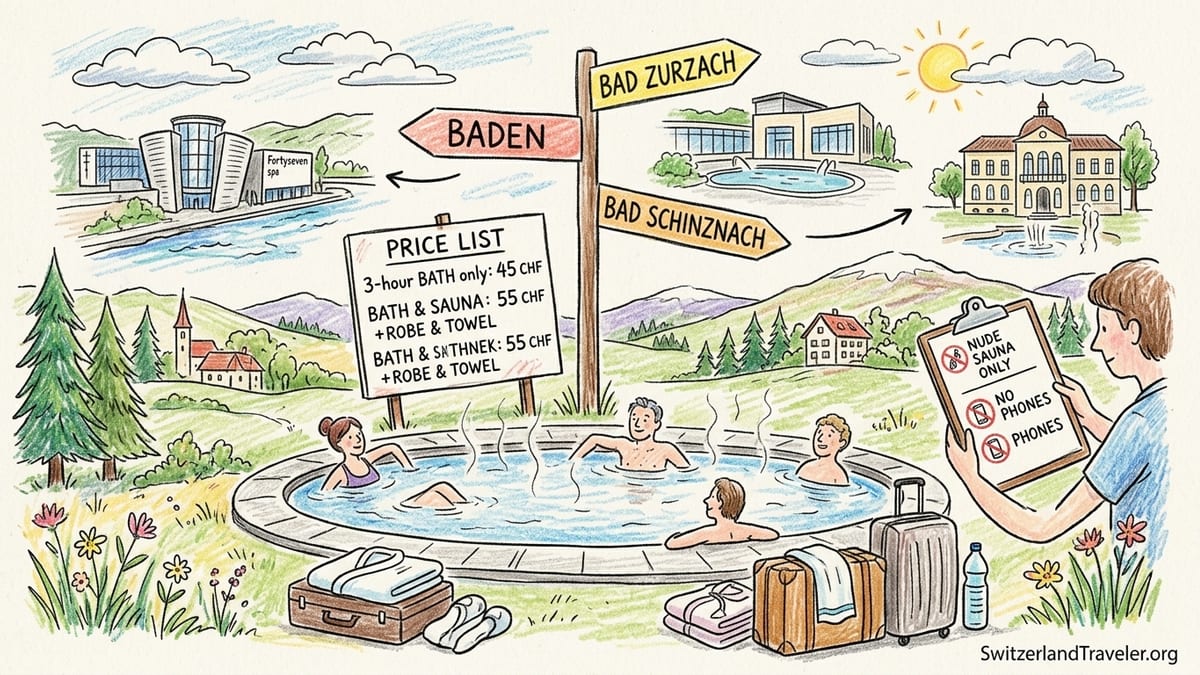
Why Aargau’s Famous Thermal Tradition Can Surprise First-Time Visitors
Switzerland Tourism often highlights Aargau as the country’s “spa canton,” linking historic sites like Schinznach’s sulphur springs with modern wellness complexes in Baden and Bad Zurzach. On paper, it sounds simple: hot mineral water, mountain light and a few hours of restorative calm. In practice, spending an afternoon in these baths in 2025 and 2026 involved more decisions and rules than I anticipated, especially compared with more casual pool visits in France or Italy.
At Fortyseven in Baden, the newest of the three, the experience begins with a pricing model that looks more like a dynamic transport fare than a simple day ticket. The official prices for adults for the thermal bath and sauna, valid in late 2025 and confirmed again in October 2026, hover roughly in the mid 40s Swiss francs range for a three hour visit when demand is average, with off-peak slots somewhat cheaper and peak times higher. For someone used to paying a flat fee for an entire day at a German Therme, seeing a three hour limit attached to a price above 40 francs was my first jolt of sticker shock.
Therme Zurzach in Bad Zurzach and the Aquarena / Thermi Spa complex in Bad Schinznach lean more on classic fixed pricing, but the numbers still climb quickly if you want access to everything. In autumn 2025, Therme Zurzach’s published adult ticket for three hours of baths and textile sauna on weekdays sat a little below 40 francs, with higher prices in the evening and on weekends for longer stays. Bad Schinznach’s combined Aquarena Fun thermal pool and sauna access was listed at just under 50 francs for a day ticket. Each time, at the ticket counter, I had to decide between “bath only” or “bath plus sauna,” two hours or three, weekday or weekend, and each choice carried a clear price jump.
None of these figures are hidden, and staff patiently explain them, but the effect is cumulative. By the time I had committed to a three hour “bath plus sauna” ticket at Fortyseven and paid an extra fee to rent a bathrobe and towel, my planned quick soak had turned into a premium half-day investment that made me determined to “use everything” simply to justify the cost.
Ticket Choices: When a Short Soak Feels Too Expensive
The main friction started the moment I had to choose a ticket. At Fortyseven, the baseline three hour admission always includes sauna access. There is no cheaper, large-scale “pools only” option for casual visitors; instead, the system uses flexible pricing that adjusts by time of day and occupancy. On a busy Saturday afternoon, the adult price I faced at the counter approached 50 francs for three hours, which felt steep considering I mainly wanted to float in the outdoor pools and gaze at the Limmat River.
Because sauna was automatically bundled, that part of the facility became a sunk cost. I dutifully walked through the sauna zone, but between showers, cool-down rituals and the time spent in the main pools, I ended up sitting in only one Finnish sauna for about 15 minutes. In hindsight, I had essentially paid a double-digit premium for facilities I barely used. Had there been a pool-only ticket at a noticeably lower price, I would have chosen it and left happier, even if my total time in the water was the same.
At Therme Zurzach, the price tiers felt slightly clearer but still pressured. On a weekday visit, the three hour “bath only” ticket was roughly in the upper 20s francs, while the three hour combination ticket for bath plus sauna nudged into the mid 30s. Because the difference was less than 10 francs, staff understandably recommended the combined ticket. Once again, the upsell logic was compelling, but my actual usage did not keep pace. I spent most of my time drifting through the outdoor saltwater pool and trying the river current channel. The sauna, which required strict no-swimsuit nudity, was where I spent the least time simply because I had not mentally prepared for it that day.
Bad Schinznach was similar. The Aquarena thermal area alone was priced in the low-to-mid 30s francs. Adding sauna pushed the overall day ticket close to 50 francs. Because I had already travelled there specifically for the reputedly strong sulphur springs, I paid the higher price almost automatically, assuming I would make a full day out of it. In practice, between lunch, breaks in the relaxation area and the logistics of showering before and after the sauna, I again used only a fraction of what I had paid for.
In each case, the prices published on the websites were accurate. The friction came from my own underestimation of how time-consuming a “full wellness” visit is, and how fast three hours pass when you are moving between pools, showers, and rest zones. A two or three hour ticket that initially looked generous became tight, and the feeling that I had “overpaid for underuse” was hard to shake.
Lockers, Robes and Towels: Small Add-ons that Add Up
The next surprise at every site was how the infrastructure nudged me into additional small expenses. All three spas use electronic wristbands to open lockers and record purchases. The system itself is smart and efficient; you store your valuables in a digital locker, pay for drinks or snacks by tapping the band, and settle the bill when you leave. The friction appears when you start using that convenience.
At Fortyseven Baden, the wristband opens well-designed, spacious lockers in a co-ed changing hall subdivided by gendered cabin areas. Lockers are included in the ticket, which is welcome. However, renting a bathrobe and towel added roughly 12 to 15 francs to my bill, depending on package and current tariffs. I had assumed one towel might be included in such an upmarket spa. Instead, I either needed to bring my own robe and multiple towels or accept the markup. After two visits, I learned to arrive with a full spa kit in my bag, but that is not something casual travellers necessarily expect.
Therme Zurzach and Bad Schinznach followed a similar pattern. Lockers themselves were included, but rental of robes and additional towels cost between about 5 and 10 francs per item. At Therme Zurzach, a combined set of robe plus towel pushed my add-ons into the low teens. At Bad Schinznach, I limited myself to a single rented towel, then regretted it once I discovered that sauna etiquette favours one towel to sit on in the cabin, another to dry off, and sometimes a third as a wrap between zones.
The rule-heavy environment made the need for extra textiles more acute. Printed signs and staff reminders at all three sites stress that bare skin must never touch wooden sauna benches, and that wet swimwear is not suitable inside dry saunas. In practice, I found myself wishing for an extra large sauna towel specifically to meet these expectations. Had I known in advance, I would have packed one from home instead of stacking rental charges on top of already high entry fees.
In isolation, 5 francs here and 8 francs there feel modest. Combined with a three hour admission in the 40 to 50 franc range, plus perhaps a drink in the spa restaurant, the true cost of a “simple” afternoon thermal visit easily approached or exceeded 70 francs per person. For couples or families, that quickly reaches the level of a full day ski lift pass.
Sauna Rules, Quiet Zones and No-Phone Areas: Orderly but Unforgiving
Switzerland’s spa culture borrows heavily from Germanic sauna traditions. That means a strong emphasis on hygiene, silence and nudity in designated areas. None of these values are inherently unfriendly. In fact, they contribute to the calm atmosphere once you understand them. The problem for me as a visitor was not the existence of rules, but how unprepared I was for their detailed application.
At Fortyseven, the sauna area is strictly textile-free for adults. Large signs at the threshold explain that swimwear must be removed and that towels must fully cover the bench surface under your body and feet. The expectation is total nudity inside the cabins and while moving between them, with only a wrapped towel for modesty in corridors if needed. Entry to the sauna is limited to guests aged 18 and older, and staff enforce both the age rule and the nudity expectation consistently. For someone used to mixed textile saunas or “optional nudity” policies in other countries, this clear-cut rule took a moment to absorb.
Therme Zurzach offers both textile saunas included with standard thermal tickets and a classic nude sauna area. The division is logical, but signage can be easy to miss if you drift with the crowd. I twice stepped toward a cabin only to realise from a symbol at the door that it was a nudity-only zone. Age limits also vary by area. Textile family zones welcome children, while nude saunas restrict entry to adults, and some quiet pools explicitly exclude anyone under a certain age, often around 16. These distinctions are well intentioned, aiming to give both families and adults their space, but they required constant checking on my part to avoid missteps.
Bad Schinznach’s Aquarena Fun pool is relatively relaxed, but its sauna also adheres to classic Germanic rules. The printed sauna regulations include requirements to shower thoroughly before entering, avoid swimwear in the cabins, maintain silence, and leave mobile phones in lockers. In all three facilities, the no-phone policy is firm in wellness areas. Photos are forbidden to protect privacy, and phone use is generally limited to reception zones or restaurant tables outside the wet areas.
As a travel writer, I am used to taking discreet notes or reference photos, but here that was impossible once I passed the turnstiles. Instead, I found myself scanning walls for rule posters and trying to remember details afterwards. Had I read the sauna and bathing rules on each spa’s website before visiting, I would have known, for example, that shoes are banned in many barefoot zones, that some relaxation rooms require absolute silence, and that certain pools enforce maximum stay durations for health reasons. In the moment, not knowing whether I was allowed to talk quietly, bring a book or wear flip-flops added a low-level tension that did not sit well with the idea of relaxation.
Age Restrictions and Family Expectations
All three Aargau spas balance their historic wellness role with a family-friendly image, but the line between the two can be thin. At Fortyseven, the main thermal pool landscape welcomes children accompanied by adults, yet certain pools and relaxation rooms are designated as quiet or adults-only. The sauna area is restricted to guests 18 and over. During one evening visit, a family with teenagers was turned away from the sauna threshold because one child was under the age limit, despite being nearly adult in appearance. The staff were polite but firm, and the family had to rearrange their visit on the spot.
Therme Zurzach makes an effort to signal which pools are suitable for families. Warm outdoor pools with soft lighting and gentle currents welcome children at many times of day, while a few smaller indoor pools are marked as relaxation zones where children are either discouraged or not allowed. Age restrictions in the nude sauna area align with adult-only policies, but enforcement is less visible simply because parents seem to self-select away from that part of the complex when visiting with kids.
Bad Schinznach felt the most clearly segmented of the three. The Aquarena Fun pool area has a more playful character, and I saw many families with school-age children enjoying the slides and water features. In contrast, the Thermi Spa side marketed itself as a quieter, more focused wellness area, and the signage asked parents to respect this by keeping young children in the more active zone. Nonetheless, age rules were not always intuitive. For example, one shallow relaxation pool limited entry to guests older than 14, a detail that several parents only discovered when a lifeguard approached them.
For families, the friction lies in aligning everyone’s expectations before arrival. If one parent imagines rotating between sauna sessions and silent relaxation rooms while another envisions a playful afternoon with children in warm water, both will be disappointed unless they choose tickets and time slots that match their plans. Reading age restriction details on the spas’ websites would have made it easier to decide whether to book an evening adult visit or a daytime family session.
Nudity, Swimsuits and Cultural Expectations
The cultural gap that produced the most immediate discomfort for some guests was the expectation of nudity in sauna areas. In Germanic spa culture, including much of Switzerland, full nudity without swimwear in saunas is widely considered normal and hygienic. Towels are used to cover the benches, and modesty is managed through etiquette rather than fabric. None of the three spas framed this as optional; in nude-designated areas, staff reminded guests that swimwear is not allowed inside the cabins.
At Fortyseven, this led to a small shock for a couple visiting from North America whom I overheard whispering near the sauna entrance. They had paid for full wellness access, but when they learned that swimsuits must be removed, they hesitated and ultimately turned back toward the pools, effectively forgoing half of what they had purchased. In the changing area later, they mentioned that if they had known this clearly in advance, they might have chosen a cheaper ticket or a different timetable when they felt more comfortable trying a nude sauna.
My own surprise came at Therme Zurzach’s textile saunas. I had assumed that “textile sauna” meant I could wear my standard swimsuit, only to notice that many locals instead wrapped themselves in large towels that covered them modestly while still avoiding wet Lycra on the benches. Swimwear was technically allowed, but signs still asked guests to ensure that no bare skin touched the wood and that damp clothing did not drip onto floors. The more nuanced expectation, which I only fully understood later, was that a towel-only wrap is considered more appropriate even in textile zones.
Bad Schinznach’s sauna left less room for interpretation. Clear pictograms at the door showed a figure without a swimsuit and a towel on the bench. During an Aufguss heat ritual, an attendant politely requested that one guest remove their swim shorts, explaining that they could wrap themselves in a towel instead. The guest complied, but looked mortified. Watching this, I realised that reading a basic primer on Swiss and German sauna etiquette before visiting would have prevented a great deal of embarrassment for many international travellers.
What Justified the Cost, and What Did Not
For all the friction and expense, it is important to acknowledge what these spas do exceptionally well. Fortyseven’s architecture alone goes a long way toward justifying its high prices. The long, stone-clad building designed by Mario Botta frames the Limmat River and surrounding hills beautifully. The outdoor infinity pools hover above the riverbank, and on a winter evening with steam rising into the dusk, the view is close to magical. The water quality feels excellent, and the variety of temperature zones, from cooler lap pools to hot whirlpools, made it easy to find a comfortable spot. When I used both the pools and the saunas thoroughly, the three hour ticket felt like a dense, high-value experience.
Therme Zurzach’s strengths lie in its variety of water experiences. The large outdoor pool with massage jets, a brine pool with higher salt content, and gently lit evening sessions create a sense of escape that compares favourably to other mid-sized European spas. Sitting in the warm saltwater at night, watching steam drift under the lights, I felt my earlier irritation about robe rental fading. In Bad Schinznach, the biggest justification for the cost is the water itself. The sulphur-rich springs, known for their strength in Switzerland, give the pools a distinct smell and a silky feel on the skin. For travellers who care about the therapeutic tradition behind wellness tourism, that alone can make the trip and ticket worthwhile.
What felt less justified were the situations where pricing and structure nudged me into paying for services I did not use. At Fortyseven, bundling sauna access into every three hour ticket meant that a traveller who simply wants to relax in the pools and perhaps eat in the restaurant pays a premium for facilities they may never see. At Therme Zurzach and Bad Schinznach, less flexible ticket structures meant that it was difficult to extend a visit spontaneously without moving into significantly more expensive tariffs, which discouraged me from settling into the slow, unhurried rhythm that thermal baths ideally offer.
Add-on textile rentals at all three locations also felt unnecessarily high compared with the base ticket, especially considering that a robe and two towels are effectively mandatory if you want to use both the sauna and the pools comfortably. Including at least one towel in the standard admission or offering a bundled textile set at a modest discount would instantly soften this impression of nickel-and-diming.
Still, even with these criticisms, there was always at least one element in each spa that I left thinking about positively. In Baden, it was the riverside views and the carefully lit evening atmosphere. In Zurzach, it was the sensation of floating in warm saltwater under cold night air. In Schinznach, it was the particular character of the sulphur water and the sense of bathing in a long-established health tradition.
The Takeaway
After multiple visits to Aargau’s main thermal baths, my lasting impression is not that Swiss or Germanic spa etiquette is unwelcoming, but that it is deeply structured and assumes a level of prior knowledge that many international visitors do not have. Most of my frustration was avoidable. It came from walking into complex pricing systems, strict sauna rules and layered age restrictions without having taken ten minutes in advance to study them.
For travellers considering a similar trip, the most practical lesson is to book longer sessions and plan to slow down. Three hours sounds generous, but by the time you change, shower, explore the pools, rest, perhaps eat a snack and then comply with meticulous sauna rituals, those hours evaporate. A four hour or day ticket often costs only modestly more than a shorter stay, and the extra time reduces the sense of racing the clock to “get your money’s worth.”
Second, read the house rules on each spa’s website before you go. Look specifically for sauna etiquette, nudity expectations, age limits, no-phone zones and any mention of required textiles such as towels and robes. Knowing in advance that a particular sauna area is strictly nude, that children are not allowed in certain pools, or that phones are completely banned in wellness zones will help you choose the right ticket and time of day, and will spare you from awkward corridor conversations in a bathrobe.
Third, bring what you are allowed to bring. Pack at least two large towels per person, plus a robe if your accommodation has one. Slip-on sandals that can be left outside saunas, a water bottle for use in permitted areas, and a simple swimsuit for pool zones will cover most needs. This approach limits rental fees and lets you adapt to etiquette without constantly worrying about damp textiles.
Finally, be honest about what you truly want from the visit. If your goal is simply to float in warm water, enjoy the view and chat with a partner or friend, a pool-only ticket where available is often the best value. There is no obligation to buy full “wellness” access if you are not planning to sit through multiple saunas and structured silence. Conversely, if you are genuinely interested in experiencing the full Swiss spa ritual, then treat the higher price as payment for a long, unhurried day rather than a quick dip.
Approached with this mindset, Aargau’s thermal baths reveal themselves not as hostile or needlessly complicated, but as carefully curated spaces that reward those who arrive informed. The water is as warm, the views as soothing and the history as rich as the tourism brochures promise. It just takes a bit of homework, and sometimes a willingness to book a longer, simpler session, to make the experience feel as restorative as it looks in the photos.
FAQ
Q1. Are Swiss thermal baths really more expensive than in neighboring countries?
Swiss thermal baths in Aargau such as Fortyseven, Therme Zurzach and Bad Schinznach typically charge around 35 to 50 Swiss francs per adult for several hours of access, which is often higher than comparable facilities in many parts of Germany or Austria. The exact difference depends on the region and the type of ticket, but visitors frequently find Swiss prices noticeably higher for shorter time-limited sessions.
Q2. Do I have to be nude in Swiss saunas?
In many Swiss spa saunas, particularly in wellness-focused areas like those at Fortyseven Baden or the classic sauna zones in Therme Zurzach and Bad Schinznach, full nudity without swimwear is expected. Towels are used for hygiene and modesty, and you sit or lie fully on the towel so that no skin touches the wood. Some facilities also offer separate textile saunas where swimsuits or full-body towels are allowed, but it is important to check which zone you are entering.
Q3. Are phones allowed inside the spa and sauna areas?
Phones are generally not allowed in pool, wellness and sauna areas in order to protect guests’ privacy and keep the atmosphere calm. You can usually keep your phone in your locker or occasionally use it in designated reception or restaurant areas outside the wet zones, but taking photos or making calls near pools and in saunas is typically forbidden. Expect staff to remind you if you forget and bring your phone into a quiet zone.
Q4. How do locker systems work at Swiss thermal baths?
Most large Swiss thermal baths use electronic wristbands that serve as both your access key and locker opener. You receive the band at entry, choose an available locker, and close it by holding the band against a sensor. Any purchases inside, such as drinks or rented towels, are charged to the band and paid when you leave. Lockers themselves are usually included in the ticket price, but losing the band can lead to a replacement fee.
Q5. Should I rent a robe and towels or bring my own?
Rental robes and towels are convenient but add noticeably to the overall cost, often 5 to 10 francs per item. If you plan to visit more than one spa or stay several hours, it is usually more economical to bring at least one large sauna towel, one bathing towel and a robe from your accommodation. Bringing your own textiles also makes it easier to follow local etiquette, since you can choose towels large enough to fully cover the sauna bench beneath you.
Q6. What are typical age restrictions in Swiss spa and sauna areas?
Thermal pool areas in Aargau generally allow children when accompanied by adults, sometimes with specific family zones. Saunas and certain quiet pools are usually reserved for adults, with a minimum age often set around 16 or 18 years, especially in nude sauna zones. Some relaxation rooms also exclude children to preserve silence. It is important to check age rules for each area before buying tickets, particularly if you are visiting as a family.
Q7. How strict are quiet zones in Swiss thermal baths?
Quiet zones in Swiss spas are taken seriously and are designed for rest and reflection. Speaking loudly, using phones or playing music is not accepted, and staff may gently remind guests to lower their voices or move conversations to more social areas. While soft whispers are sometimes tolerated in pools, designated relaxation rooms and certain warm pools expect near silence, and respecting this expectation is part of fitting into local spa culture.
Q8. Is a three hour ticket enough time for a good experience?
Three hours can be enough for a basic visit if you focus on a few pools and perhaps one or two sauna sessions, but many visitors find it surprisingly short once they account for changing, showering, resting and exploring. If you want to make use of the full wellness facilities, a four hour or full day ticket often feels more relaxed, especially because you will not be watching the clock to avoid overstay surcharges or needing to rush through rituals meant to be slow.
Q9. How can I keep costs manageable when visiting Swiss thermal baths?
You can manage costs by visiting during off-peak times when prices are lower, choosing pool-only tickets where available, bringing your own robe and towels, and limiting restaurant or bar purchases inside the spa. Checking prices and ticket types on each spa’s website in advance will help you pick the option that best matches how much you actually plan to use the sauna and wellness facilities rather than automatically buying the most expensive ticket on arrival.
Q10. What should I know before my first visit to a Swiss thermal spa?
Before your first visit, read the spa’s rules about saunas, nudity, age limits, no-phone policies and required textiles so you know what to expect. Pack at least two towels and a robe if allowed, wear simple swimwear for pool areas, and decide whether you are comfortable with nude saunas. Consider booking a longer session rather than the shortest ticket so you can move slowly and enjoy the experience. Finally, choose a simpler pool-only ticket if you mainly want to float and relax rather than use every wellness feature.