


On paper, Aarau sounded like the kind of place I usually pass through without a second thought. A small administrative capital on the flat Swiss Mittelland, a name-check on the Mittelland cycling route, a station I have seen flash past on trains between Zürich and Bern. I knew almost nothing about it, except that Switzerland Tourism praised some painted gables in the old town. I arrived on a grey morning expecting a pleasant but forgettable stop. By late afternoon, I was checking train times back and mentally re-ranking my favorite small cities in the Swiss plateau.
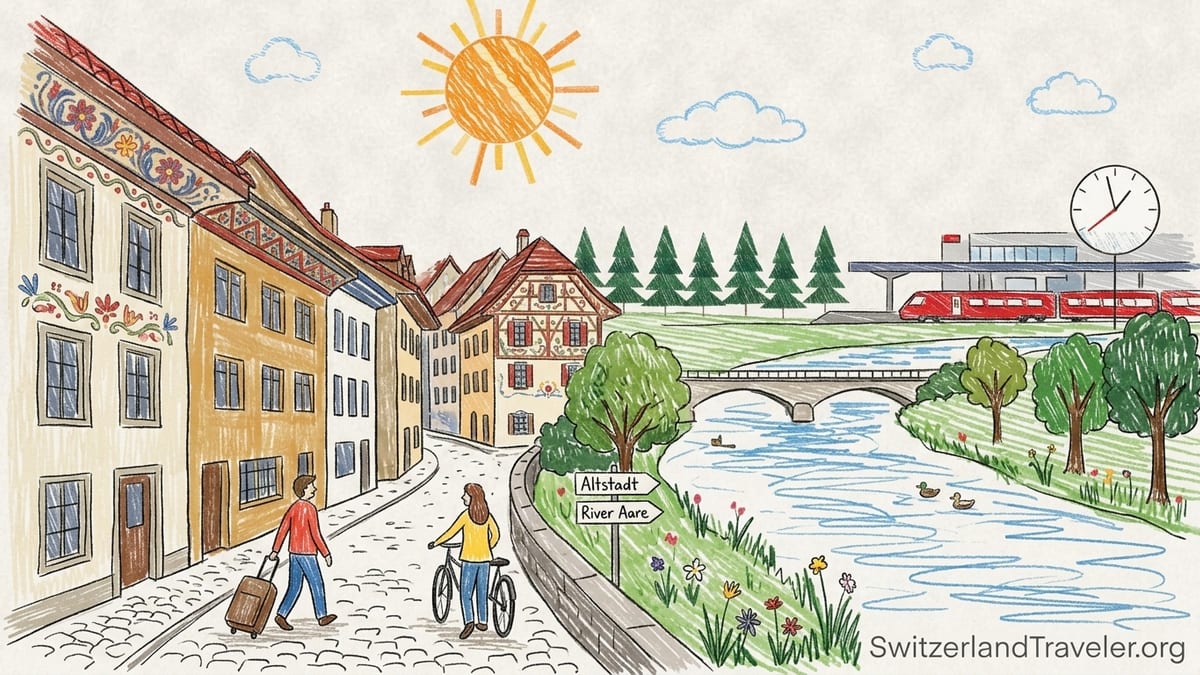
Arriving in Aarau With Modest Expectations
Getting to Aarau is straightforward, which is part of why I had never treated it as a destination in its own right. From Zürich Hauptbahnhof, direct InterRegio and RegioExpress trains usually take around 25 to 35 minutes, and from Basel SBB the ride is about 45 minutes. Trains on both axes run frequently through the day, so Aarau slots neatly into almost any Swiss rail itinerary, whether you are traveling between Zürich and Bern, Zürich and Basel, or connecting across Aargau toward Olten and Solothurn.
Stepping off the train, my first impressions were exactly what I expected from a Mittelland city: a modern station, a small cluster of chain shops, and buses feeding the suburbs. It felt efficient rather than atmospheric. The surprise came when I followed the signs to the Altstadt and realized how close everything is. Within about five minutes on foot, I had crossed under the tracks, left most traffic behind, and stepped into cobbled streets framed by historic townhouses.
This compactness became one of the main themes of my day. Aarau’s old town is small enough that nothing is more than a 10-minute walk from the station: the main squares, the Aargauer Kunsthaus, the Aare riverfront, and the densest cluster of painted gables all fall within a tight grid of lanes. It felt like a town scaled for pedestrians and cyclists rather than cars, which fit nicely with its role as a key stop on the national Mittelland cycling corridor that crosses Switzerland from Romanshorn to Lausanne.
Because I expected to find “just another pleasant Swiss town,” I planned only about four hours between trains. That proved workable, but in hindsight it was stingy. With a leisurely lunch and a museum visit, six hours would have been more comfortable, and an overnight stay starts to make sense if you like slow evenings, riverside walks, and the feeling of having a small city almost to yourself after dark.
First Encounter With the Painted Gables
Switzerland Tourism often calls Aarau the city of beautiful gables, a reference to the approximately 70 to 90 painted eaves that decorate the old town houses. These are not the postcard-facade frescoes you might know from places like Stein am Rhein or Lucerne. Instead, the paintings sit on the undersides of the overhanging roofs, visible as you look up while walking the narrow streets. Floral patterns, coats of arms, geometric borders, and small narrative scenes run beneath the rooflines, creating a band of color where you might expect only beams and tiles.
My first glimpse came in a short stretch of Rathausgasse. I looked up almost by accident and realized nearly every second house carried a different pattern under its eaves. Because the lane is car free, I could stand in the middle of the cobbles and crane my neck without worrying about traffic. On a cloudy day, the muted light actually helped, making the reds and blues of the paintwork stand out more clearly against cream and ochre plaster.
The effect is cumulative rather than spectacular. No single gable is a showstopper, but walking slowly from one end of the old town to the other, you start to notice how much work and pride went into decorating the houses. Late Gothic cores mingle with later facades, bay windows project over alleyways, and the gables often echo the function or status of their original owners. The painted undersides, known locally as “Ründen,” give Aarau an architectural signature that feels genuinely distinctive within the Mittelland, which more often leans toward plain, practical townscapes.
Compared with other plateau cities I have visited, like Olten and Brugg, Aarau’s old town feels more coherent and better preserved, yet still lived in. Shops occupy the ground floors, people push prams over the cobblestones, and cyclists roll through at walking pace. It is not a museum quarter sealed off from daily life. My low expectations started to shift here, not because Aarau was spectacular, but because it had a clear personality built into its roofs and streets.
Car Free Streets, Cafés and an Easygoing Lunch
One of the pleasures of Aarau is how quickly cars recede from the picture once you leave the station area. The core of the Altstadt around streets like Rathausgasse, Kirchgasse, and Kronengasse is either fully pedestrianized or very lightly trafficked, with deliveries limited and most movement on foot or by bike. For a visitor, this means you can stroll without constantly stepping aside for vehicles, and children can roam more freely than in many larger Swiss cities.
That car light setting pairs well with a small but appealing café and restaurant scene. For lunch, I settled into a compact café off one of the main squares, the kind of place serving daily menus and homemade cakes rather than elaborate tasting menus. A plate of pasta with vegetables and a side salad cost around 22 Swiss francs, a cappuccino added 5, and tap water was free. These prices felt in line with, or slightly below, what I have paid in other Mittelland cities of similar size. A more substantial sit down lunch with meat or fish, such as schnitzel with potatoes or a seasonal fish fillet, typically runs in the 25 to 35 franc range in central Aarau at the time of writing, based on posted menus in several restaurants I checked.
For a quick option, bakeries near the old town squares sell filled sandwiches for roughly 7 to 9 francs and slices of cake or fruit tarts in the 5 to 7 franc range. There are also simple kebab and Asian takeout spots within a few streets of the station, where a filling meal might fall between 14 and 18 francs, similar to fast food combo meals in town. These price points make it realistic to spend half a day in Aarau without feeling that lunch will dominate your budget, particularly compared with major Swiss hubs.
What struck me most, however, was the atmosphere. On a weekday, outdoor tables were moderately busy at lunchtime but never frantic, and by mid afternoon the pace slowed to a gentle trickle of locals meeting friends or catching a late coffee. If your image of Swiss plateau towns runs to “all banks and no charm,” sitting with a drink while watching people amble past painted eaves may change your mind.
Aargauer Kunsthaus and the Question of What to See
If you have more than two or three hours in Aarau and any interest in art, the Aargauer Kunsthaus is a strong candidate for your time. Located about a 7 to 10 minute walk uphill from the station and old town, the museum presents one of the significant collections of Swiss art, with works ranging from the 18th century to contemporary installations. The building combines a modern extension with an older core and sits amid trees, which softens the transition from narrow lanes to a more open, cultural precinct.
Current information from the museum indicates that adult tickets for the main collection and exhibitions are in the range of a couple of dozen Swiss francs, with reductions for students and other concession holders. Exact prices and any combination tickets can change with new exhibitions or local regulations, so it is wise to check the latest details shortly before your visit or at the ticket desk. The museum sits just above the old town, and several local bus lines from the station stop nearby, but the walk is short enough that most visitors will likely go on foot.
The Kunsthaus absorbed around 90 minutes of my time, including breaks to look out through the large windows toward the town. The mix of historic and modern Swiss art provides context for the local landscape and architecture you have just walked through. I left with a better sense of how artists from Aargau and beyond have seen the Mittelland: sometimes as a subdued, almost anonymous backdrop, sometimes as a place full of quiet patterns and small stories. For me, this reinforced the impression that Aarau’s character lies in details rather than big, dramatic gestures.
Not every attraction felt essential, though. A small niche museum near the center that I stepped into briefly, focusing on a very narrow historical topic, struck me as skippable unless you have a specific interest in that subject. The displays were earnest but conventional, and in a town where time might be limited, I would direct most visitors instead toward the painted old town, the riverfront, and the Kunsthaus, or simply allow more unscheduled time for cafés and wandering.
Down to the River: Aarefront Walks and Cycling Connections
One of Aarau’s assets is its position on the River Aare, which forms a natural boundary between the flatter Mittelland to the south and the more rugged Jura chains to the north. From the edge of the old town it took me less than 10 minutes on foot to reach the riverfront paths. The character shifts immediately: cobbled alleys give way to gravel tracks, mature trees line the banks, and the soundscape replaces city hum with flowing water and birds.
The riverside areas near the town center offer several short walking options. You can follow the Aare upstream or downstream on paths shared by pedestrians and cyclists, cross bridges to look back at the profile of the town, or simply sit on benches watching rowers and ducks drift past. It is not wilderness, but for a city that is essentially on the main north east to west train line, the green space feels impressively accessible.
For cyclists, Aarau is a strategic node. The national Mittelland Route, signed as Route 5 in Switzerland’s official cycling network, passes directly through the city. One key stage runs between Kloten near Zürich Airport and Aarau, another between Aarau and Solothurn, linking the town to both the airport region and one of Switzerland’s most handsome baroque cities. Distances on these stages are within a comfortable day’s ride for reasonably fit cyclists, and the route is known for its relatively gentle gradients, following rivers and low valleys instead of steep mountain passes.
This matters for how you might plan to see Aarau. If you are cycling the Mittelland route, the town makes an obvious lunch or overnight stop, with the compact center an easy detour from the signed path. If you travel by train with a day pass, you might pair a morning in Aarau with an afternoon ride along a section of the river, then hop back on the train from a different station. Bridges and local paths provide multiple options without locking you into a fixed linear itinerary.
How Compact Feels in Practice: Time and Distances
Many Swiss towns describe themselves as compact, but Aarau genuinely delivers on the promise. From the moment I left the station, I found that key landmarks clustered within a small radius. Walking at a relaxed pace, it took around three minutes to reach the edge of the Altstadt, another five to cross through its core, and less than ten to drop down to the river. The Aargauer Kunsthaus sat just a few minutes above the old streets, and simple wayfinding signs made navigation effortless.
For trip planning, you can think of Aarau in units of 10 minutes. Ten minutes from the train gets you into the old town. Another ten allows you to reach the museum or the riverfront. Ten more gives you time to cross the old town diagonally, stopping to photograph gables along the way. Even with frequent pauses, I rarely needed more than a quarter of an hour to get from one side of the center to the other. This human scale encourages spontaneity. You can decide on a whim to pop into a side street, follow the sound of a fountain, or detour toward a church spire without worrying that you will lose half an hour.
In terms of total time, my half day break looked like this: about 30 minutes to stroll from the station through the old town to the river and back, one hour for lunch and coffee in the car free center, 90 minutes at the Kunsthaus, and another hour to wander, shop for a small souvenir, and revisit a few favorite gables. That added up to roughly four hours without feeling rushed. With six to seven hours you could move at an almost meditative pace, add another café stop, and spend longer at the river.
Because hotels and guesthouses in Aarau cluster within walking distance of the center, an overnight stay still keeps everything reachable on foot. For comparison, in other Mittelland stops I have used primarily as transfer points, like Olten, some hotels and newer districts lie a longer walk or short bus ride from the historic core, which can make quick, car free access a bit less straightforward. In Aarau, the tightness of the central area means you maximize your time in streets that actually feel distinctive.
Does Aarau Go Quiet Too Early for an Overnight Stay
A fair question for any small city in the Swiss plateau is what happens after dark. If you hope for buzzing nightlife and late closing bars, Aarau will probably feel subdued. On my visit, a weekday in shoulder season, shopfront shutters began to come down between 6 and 7 p.m., and by 8:30 many of the narrow streets of the old town were calm, with only a few pedestrians heading to or from dinner. Some restaurants, especially those attached to hotels or oriented toward locals, remained open longer, and a handful of bars showed signs of life later in the evening, but this is not a city that tries to entertain you until midnight.
Whether that counts as a drawback depends on your travel style. If you use an overnight stay mainly as a chance to enjoy a long, unhurried dinner, perhaps followed by a drink on a quiet terrace in summer or a final stroll under the painted gables, then Aarau works fine. The calm streets and low traffic create a feeling of walking through a very safe, lived in set of historic rooms. You are never far from your hotel, and noise levels remain low enough that even centrally located accommodations are more likely to be disturbed by church bells than crowds.
If, however, you like to pack your evenings with multiple venues, live music, or spontaneous bar hopping, you may find that one night in Aarau is sufficient or that you prefer to use the town as a daytime stop while sleeping in a larger center elsewhere in the Mittelland. When I compare it with towns like Solothurn, which have a slightly more visible evening scene along the river and in certain plazas, Aarau’s nighttime charm lies more in its quietness and illuminated roofs than in energy.
For many travelers planning longer rail or cycling journeys across the plateau, this balance might actually favor Aarau as an overnight on a multi day itinerary. After busier days in big cities, landing in a compact town where you can walk everything, eat well without reservations far in advance, and go to bed early to the rhythm of a provincial capital can feel like a welcome reset.
The Small Detail That Stuck With Me
Every trip that surprises you has at least one detail that anchors the memory. In Aarau, it was a tiny painted figure under a gable at the corner of a narrow alley. I had already spent more than an hour looking up at patterns and borders when I noticed, almost tucked away in a corner, a small human shape worked into the decoration of an eave. The face was worn, the colors softened by time, but the posture felt almost conversational, as if someone from centuries ago was still peering down at people passing underneath.
It is the sort of feature you only notice in a place scaled for wandering. No tour group paused in front of it, and no plaque drew attention to the spot. I only saw it because the street was car free, the pace was slow, and I had learned to look up. That sense of unhurried discovery defined my day in Aarau more than any individual sight. The city does not overwhelm you with must see checklists. Instead, it rewards the traveler who is willing to stroll, to peer into side courtyards, to sit on a bench by the Aare and watch small changes in the light.
In contrast, when I think back to some other Mittelland cities that I have mostly experienced as transit hubs, my memories are of platforms, road overpasses, and generic high streets. Aarau has those elements too, of course, but they are not the part that stays with you. Instead, I remember the rhythm of painted gables above cobblestones, the way the old town opens so quickly after the station, and the realization that I had underestimated a place simply because it sat between more famous names on the timetable.
This shift from low expectations to genuine affection did not come from a single wow moment. It was the accumulation of small, well kept details: the curve of a lane, the quality of light on a row of roof beams, the mix of regular daily life and historic architecture. Aarau proved that a city you know almost nothing about can still lodge itself firmly in your travel imagination if you give it even half a day of open minded attention.
The Takeaway
So, is Aarau worth an intentional visit, or should you treat it as a convenient half day stop en route to somewhere else in Aargau or along the Mittelland cycling corridor. After spending a focused day in and around its old town, my answer sits somewhere between those two options, tilted more toward “go on purpose” than I expected.
If you are tracing a longer line across Switzerland, by train or by bike, Aarau is a highly rewarding break in the sequence of bigger names. Four to six hours here gives you enough time for a relaxed walk through the painted old town, lunch at a café, a visit to the Aargauer Kunsthaus, and a short excursion down to the river. The walking distances are short, prices for casual meals are within the usual Swiss range but not inflated by heavy tourism, and the atmosphere is calm without feeling empty.
An overnight stay makes sense if you value quiet evenings, compactness, and the ability to step from your hotel into car free historic streets within a minute or two. The town does go quiet relatively early, with limited late night options, but for many travelers that will feel like a feature rather than a flaw. Aarau pairs especially well with nearby Mittelland destinations like Solothurn or Olten, giving you a mix of old towns along the same rail line or cycling routes.
What surprised me most is how clearly Aarau stands out among the plateau cities I have personally visited. It is not trying to be Zürich or Bern, and it does not need to be. Its strengths lie in the rhythm of its painted gables, the ease of its car free core, the intimacy of its riverfront, and the sense that you have stumbled on a city that rewards curiosity more than checklist tourism. If you see its name on a departure board or a cycling map, consider resisting the urge to pass straight through. Aarau may not demand your attention, but it quietly deserves it.
FAQ
Q1: How much time do I really need to see Aarau’s old town?
Most visitors will be satisfied with four to six hours, which allows time to walk the old town, have lunch, visit the Aargauer Kunsthaus, and take a short riverside stroll.
Q2: Is Aarau worth an overnight stay or better as a day trip?
Aarau works both as a relaxed day trip and as a quiet overnight stop. Choose an overnight if you like calm evenings, short walks between sights, and early nights rather than nightlife.
Q3: How expensive is lunch in Aarau compared with other Swiss cities?
Casual sit down lunches in central Aarau typically cost around 20 to 35 Swiss francs for a main dish, with bakery snacks and sandwiches available for under 10 francs, comparable to many other Mittelland towns.
Q4: How do I get from the train station to the old town?
From Aarau’s main station, it is roughly a five minute walk following signs to the Altstadt. You pass under or over the tracks, and within a few blocks you reach the pedestrian streets and painted gables.
Q5: Is the Aargauer Kunsthaus worth visiting on a short stop?
If you have at least 60 to 90 minutes and enjoy art, the Aargauer Kunsthaus is a strong addition to your visit, offering a focused look at Swiss works in a compact, walkable setting.
Q6: Are the streets in Aarau’s center really car free?
The historic core around streets such as Rathausgasse and nearby lanes is largely pedestrianized or carries very light local traffic, so walking and cycling feel safe and relaxed compared with busier urban centers.
Q7: How late do things stay open in the evening?
Shops generally close by early evening, often between 6 and 7 p.m., while many restaurants serve dinner later. The overall city atmosphere becomes quiet by around 9 p.m. on weekdays.
Q8: Is Aarau a good stop on the Mittelland cycling route?
Yes, Aarau sits directly on the national Mittelland Route, making it an ideal lunch or overnight stop for cyclists, with easy access between the signed path, the old town, and the river.
Q9: Can I see the painted gables without booking a tour?
Yes, the painted eaves are visible from public streets throughout the old town. You can follow a self guided walk by simply wandering the lanes and looking up at the undersides of the gables.
Q10: How does Aarau compare with other Mittelland cities you have visited?
Compared with other plateau towns I have seen, Aarau’s compact, car light old town and distinctive painted gables give it a clearer character and make it feel more like a deliberate destination than a mere transit stop.