


By late morning the Baroque facades of Solothurn were already warming in the sun when I walked down to the Schiffländte, the small riverside pier where the Aare boat to Biel begins its three hour glide toward the Three Lakes region. Switzerland Tourism bills this as one of the country’s classic slow journeys, a gentle alternative to the fast and efficient train. I went to see what the Aare cruise from Solothurn to Biel is really like in practice, from buying the ticket to the final minutes in Biel’s harbor, and to decide whether the long ride on this milky-green river is transport, sightseeing, or something in between.
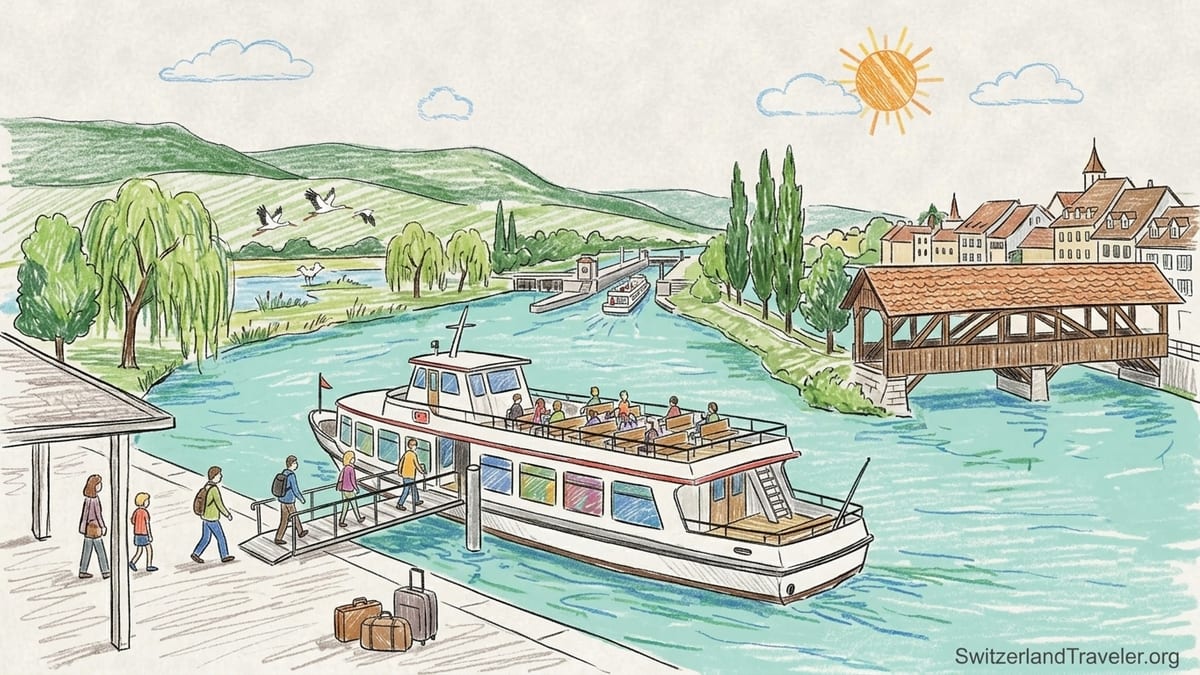
Boarding in Solothurn: Pier, Tickets and First Impressions
The Aare cruise starts at Solothurn Schiffländte, a compact pier on the Aare beside the old town rather than at the main railway station. From Solothurn SBB it is about a 10 to 15 minute walk through the center, past the cathedral steps and along the river promenade. On my October sailing the signage was clear, with “Solothurn Schiffländte” indicated on local maps and on SBB’s journey planner as the official boat stop. The pier has a simple waiting area, a covered shelter and a display board with the Bielersee-Schifffahrts-Gesellschaft (BSG) timetable for the Aare line to Biel.
The boat on my departure was one of BSG’s river and lake vessels that also serve the Bielersee. Doors opened about ten minutes before departure, in line with the operator’s own rules, and boarding was calm rather than hectic. Most passengers were day-trippers and local couples, with a few families pushing strollers. Luggage space is limited; this is not a Rhine-style cruise ship but a lake steamer adapted to river service, so expect a modest gangway and a quick step on board rather than a dramatic embarkation.
Tickets can be bought in several ways, and it is worth checking what you already hold. BSG follows national public transport tariffs. A one way ticket from Solothurn to Biel in 2026 is roughly the price of a comparable regional rail journey multiplied by the distance and category of boat travel, and discounts apply for the Half Fare Card and for children according to standard Swiss rules. Reservations are not essential for regular daytime sailings, and many people simply show their Swiss Travel Pass, regional pass or day ticket when boarding. On my journey, several passengers validated existing day passes rather than buying something new at the pier.
In terms of first impressions, the atmosphere at Solothurn Schiffländte felt closer to a local tram stop than a cruise terminal. There were no souvenir stalls or excursion photographers, just a mix of commuters, retired locals and travelers. The river flowed slowly beneath the pier, opaque turquoise from the alpine meltwater upstream. This understated beginning sets the tone for the entire Aare trip; it is public transport that happens to move through a very attractive landscape, not a choreographed premium river cruise.
Route, Duration and Day-to-Day Timetable Reality
The full journey from Solothurn to Biel takes around two and three quarter hours, generally timetabled at 2 hours 45 minutes. In the 2026 season the main through service runs between early April and late October, with a more frequent spring and summer timetable and a slimmed-down autumn schedule. In summer there are usually two boats per day in each direction on many days, including a popular morning departure from Solothurn around 09.00 and a return from Biel around midday. During the autumn shoulder period, roughly early to late October, there may be only one daily sailing in each direction from Tuesday to Friday and two at weekends, with no Aare boats on Mondays.
The route itself is straightforward but varied. Leaving Solothurn the boat heads downriver, stopping at Altreu, Grenchen, Büren an der Aare, Brügg, Port and Nidau before reaching Biel’s lakeside harbor. The Aare section covers the long navigable stretch between Solothurn and the Nidau area, after which the boat continues through a short canal section to reach the Bielersee basin. All of this falls under the Bielersee-Schifffahrts-Gesellschaft’s network, which also operates further across the lakes, but the Aare cruise is marketed as a self-contained segment that begins or ends in Solothurn or Biel.
On the day I traveled, the timetable matched exactly what the operator advertised: departure from Solothurn at 09.00, arrival in Biel at 11.45. The crew reminded us that this is a point-to-point service and that everyone must disembark in Biel, even if they hold a ticket that covers onward lake travel. This is a standard BSG rule so that cleaning and catering can be handled between trips. Delays are rare in good weather, but staff do emphasize that exceptionally high or low water levels on the Aare can lead to cancellations, particularly early or late in the season. In practice that means checking the online timetable again the evening before, especially if you are planning a tightly timed train connection.
Compared with the train, which covers Solothurn to Biel in around 25 minutes with at least two departures each hour, the difference in duration is stark. Where the S-Bahn hops once or twice across the river and dives through farmland, the boat ambles past every bend, taking more than six times as long. The entire experience depends on whether you view those additional two hours as a bonus or a burden.
On Board: Seating, Decks and Facilities
Once on board, the Aare boat feels like a small regional ferry rather than a luxury liner. There are usually at least two passenger decks. On the main deck you find an enclosed saloon with large windows, café-style tables and simple chairs. This area is heated and remains comfortable even on chilly October days. On my sailing the interior filled first, as locals laid out newspapers and card games and families settled in with snacks. Window seats are not assigned, so arriving ten or fifteen minutes early helps if you want an uninterrupted view.
Above the main saloon is an open upper deck that, in fine weather, is the prime place to sit. Long benches line the sides and there are unhindered views upriver and down. The atmosphere here feels more holiday-like, especially on summer weekends when cyclists and hikers stretch out with daypacks at their feet. On my journey in mild autumn sunshine, many passengers migrated outdoors shortly after departure from Solothurn and remained there until at least Büren, pulling on jackets as the breeze picked up along more exposed stretches.
Facilities are practical but not elaborate. There is at least one restroom on board, kept reasonably clean during the trip. A small self-service counter in the saloon sells coffee, soft drinks, beer and simple snacks such as sandwiches and pastries, similar in price to a Swiss station kiosk. Some boats in the BSG fleet also offer basic hot meals at lunchtime, but on my October trip the range was limited, more café than restaurant. Most passengers brought their own picnic and ordered drinks on board, which seemed entirely acceptable to the crew.
Space for bicycles is available but not unlimited. The crew directed bikes to a designated area near the bow, and numbers are informally capped to keep gangways clear. It is worth arriving early if you plan to roll on with a touring bike on a busy summer weekend. Inside, I found the noise level pleasantly low: a gentle hum from the engines when pushing upriver sections and only minor vibration. The overall impression is of clean, well maintained but unflashy public transport, with the focus on the landscape outside rather than amenities inside.
Weather, Light and How Scenic the Aare Really Feels
The Aare between Solothurn and Biel is often described by Swiss tourism bodies as the country’s most beautiful river cruise, and in good light it comes close to that promise. On my October day, skies were high and pale blue with intermittent sun, and the Aare ran its characteristic glacier-fed green, opaque yet luminous, with small eddies twisting at the bows. Leaving Solothurn, the city’s Baroque skyline appears briefly in reverse: the onion dome of the Jesuit church, the steps of the St. Ursus Cathedral and the neat river promenade slide past and then surrender to low meadows.
The first genuinely distinctive section arrives around Altreu, the tiny riverside village known for its white stork colony. Here the river widens slightly and the landscape opens onto protected wetlands and flat fields. Even in autumn I could see several storks circling over the fields and perched on roof nests near the village. The boat hugs the main channel, so you are observing rather than entering the stork center itself, but the combination of birds, reeds and slow water gives this segment a clear sense of place that shorter commuter river sections elsewhere in Switzerland often lack.
Downstream of Grenchen the scenery becomes more mixed. Long stretches follow forested banks, with alder and poplar leaning over the water and gravel bars gleaming in the shallows. There are industrial elements too: pylons crossing the river, the distant outlines of factories and the occasional sound of road traffic. These interludes keep the Aare grounded in its role as a working waterway, but they are not especially photogenic. Photographers will find the most rewarding views where the river bends and opens toward the Jura foothills, particularly when soft side light sketches out the fields and isolated farmhouses.
Overall, I would rate about half of the journey as distinctly scenic, with the Altreu stork region and the approach to Büren an der Aare as highlights, and the remaining segments as pleasant but visually repetitive. If you are expecting the constant drama of a Norwegian fjord or a Rhine gorge, this Aare cruise is quieter and flatter. Its appeal lies in gentle detail: the ripples on the water, the changing geometry of bridges, the glimpse of a fisherman standing on a gravel bank. In bright sun or the low light of early evening, the scene feels serene and remote considering how close you are to major train lines. Under heavy cloud or rain, however, those long straight reaches could feel like three hours of grey water and tree silhouettes.
Locks, Bridges and River Communities Along the Way
One of the reasons this Aare journey feels like genuine river travel rather than a lake shuttle is the presence of real infrastructure on the water. Shortly after leaving Solothurn the boat passes under modern road and rail bridges, including structures that carry the mainline toward Biel and Bern. Standing on the upper deck, you can watch commuter trains flash overhead while your own progress downstream remains resolutely slow. The contrast underlines that by choosing the boat you have stepped deliberately off Switzerland’s high speed grid.
The first significant riverside community after Altreu is Grenchen, better known for its watch industry and small airport. The boat stop sits beside a modest landing stage framed by trees and low buildings. A few passengers got off here with bicycles, clearly locals using the boat as a recreational extension to the regional bike network. The setting is more suburban than picturesque, and the stop itself is functional rather than charming, but it illustrates that this line still plays a role beyond tourism.
Büren an der Aare, in contrast, provides the journey’s most atmospheric man-made scene. The boat approaches through a gentle curve, revealing the town’s old covered wooden bridge spanning the river and the compact medieval center just behind. From the open deck I had a clear view of the bridge’s timber framework and the tiled roofs clustered beyond, a composition that feels almost too perfect to be accidental. Several passengers disembarked here to spend a few hours in Büren before continuing later by train, an option that works well if you want a shorter time on the water while still experiencing the cruise’s most attractive stretch.
Farther downstream the river passes Brügg and then reaches Port, where the cruise encounters its main piece of navigation theatre. Here the boat enters a lock that compensates for the difference in water level between the Aare and the canal leading toward Bielersee. The process is slow and surprisingly quiet: the vessel nudges into the concrete chamber, moors against the wall, and over several minutes you feel the deck either descending or rising by a few meters. Children pressed their faces to the railings, and even veteran commuters looked up from their newspapers. It is one of the few moments on the journey when you are actively aware of the river’s engineering.
After the lock at Port the boat follows a straighter channel past Nidau into the outskirts of Biel. Low apartment blocks and marinas replace meadows, and the flavor becomes less rural and more lakeside urban. The boat finally swings into Biel’s harbor, a modest basin with several piers and BSG vessels laying over between departures. Here everyone leaves the ship, and within a few minutes the same decks that felt like our small traveling village empty completely as people head toward the station or the old town.
How the Pace Feels Compared with the Train
From a purely functional standpoint, the Aare cruise loses comprehensively to the train. Between Solothurn and Biel, regular SBB services cover the distance in around 20 to 25 minutes, running at least twice per hour for much of the day. That same transfer by boat takes close to three hours and happens at most a couple of times daily in the main season, with no service at all in winter. If your priority is getting from A to B, there is no rational argument for choosing the boat.
On board, however, time feels different. Once the boat leaves Solothurn, there are no intermediate obligations. You are not checking departure boards, squeezing into carriages or watching for your stop. The only rhythm is that of river bends and bridge crossings. I checked a watch at Grenchen and was surprised to see how quickly the first hour had passed between coffee, conversation and watching the storks of Altreu recede behind us. Around Büren, the second hour felt slower; the boat’s unhurried pace over long straight reaches encourages a sort of enforced idleness that some will find meditative and others boring.
It helps to think of this not as three hours of transport but as three hours of structured downtime. On my sailing, one local couple unpacked a deck of cards and played for nearly the entire journey, occasionally glancing out at the views and chatting quietly. A solo traveler spent most of the time photographing details of the riverbanks and the lock at Port. Families rotated between the saloon and the upper deck to keep children engaged. The experience is closer to a moving riverside café than to a tour where a guide narrates every landmark.
Still, there are moments when the comparison with the train resurfaces sharply. As we slid under one mainline bridge, a double deck regional train rattled overhead, flashing past in seconds toward Biel. It was a reminder that, measured in productivity or efficiency, the boat is a self-imposed delay. Whether that delay feels like a luxury or a frustration depends completely on your expectations and temperament.
Combining the Boat with Bike or Train: Practical Logistics
Most travelers do not treat the Aare cruise as a there and back journey on the same day by boat alone. The classic pattern, also suggested by regional transport companies, is to ride the boat one way and return quickly by train. For example, you might start your day in Solothurn, board the 09.00 boat, arrive in Biel around 11.45, explore the lakeside promenade and bilingual old town for an hour or two, then walk or take a short bus ride to Biel station and catch a 20 minute train back to Solothurn.
Logistically this combination is straightforward. From Biel harbor it is around 15 minutes on foot to the station, almost level the entire way, or about five minutes on a city bus that runs along the lakeside and into the center. Trains between Biel and Solothurn usually run at least twice an hour in the daytime, often as part of a regional S-Bahn line that continues toward Olten or Bern. Tickets are integrated across modes; if you hold a day pass or regional pass, it will typically cover both boat and rail segments according to the validity zones printed on it. When I followed this pattern, I had more than enough time to stroll through Biel’s old town and still catch an early afternoon train.
Combining the cruise with cycling requires a bit more forethought but is equally feasible. BSG accepts bicycles on the Aare boats, and on my sailing several riders rolled on at Solothurn and off at Büren or Biel. If your plan is to cruise downriver and bike back, factor in that the most scenic sections of the cycle route do not always hug the riverbank completely, and you may need to navigate via small roads and signposted national cycle routes. One popular idea is to disembark with your bike in Büren an der Aare, explore the town’s bridge and old streets, then follow riverside paths or marked cycle route 8 upstream toward Solothurn, covering in an afternoon by bike what the boat did in a morning.
For those using the boat as part of a wider day trip, the interlocking of timetables matters. For instance, visitors based in Bern might take an early train to Solothurn, ride the Aare boat down to Biel, wander along the Bielersee shore or take a short lake cruise, then return to Bern by direct train from Biel in the evening. The integrated Swiss transport system makes such combinations realistic, but water levels or late timetable changes can disrupt the plan, so checking boat departure times close to the date is essential. It is also wise to carry a smartphone with offline maps, as wayfinding between harbors, town centers and stations can feel less intuitive in smaller river communities like Grenchen or Brügg.
Who Will Love This Cruise and Who Might Not
After three hours on the Aare, certain passenger profiles stood out clearly. First are the slow travel enthusiasts, people who relish the idea of deliberately taking the longest plausible route between two modest Swiss towns. For them, the rhythmic progress past river meadows, the chance to watch storks near Altreu and the quiet fascination of the lock at Port outweigh any impatience. These travelers tend to carry books, cameras or journals and treat the boat as a floating living room.
Couples looking for a low key romantic outing will also find much to like, particularly in late afternoon or early evening light during midsummer when special departures operate. The ability to sit together on a bench on the open deck, glass of local wine or mineral water in hand, while the countryside slides by at walking speed, creates a mood that no train can match. In conversation with a local pair from Biel, I heard that they occasionally use the Aare boat as a relaxed anniversary or birthday outing, boarding in Solothurn, lunching on board and strolling home from the harbor.
Families with children have a more nuanced experience. Young kids enjoy the novelty of a boat, the excitement of passing under bridges and the spectacle of the lock, but the nearly three hour duration can stretch attention spans. On my sailing, parents succeeded by breaking the time into segments: snack in the saloon, deck time spotting birds, coloring books at a table, then the thrill of watching water levels rise or fall at Port. For teens or children used to constant digital stimulation, this analog pace may feel long unless they are genuinely interested in boats or photography.
Those least suited to the Aare cruise are travelers on tight itineraries or people who become restless without frequent activity. If you are using a Swiss Travel Pass to try to “collect” as many towns and viewpoints as possible in a limited number of days, dedicating nearly three hours to a single low-intensity river segment between two medium sized towns may feel like a poor trade. Likewise, if you expect constant commentary or organized entertainment on board, this public transport style operation will seem sparse. Announcements focus on safety and stops, not storytelling; the river is left to speak for itself.
The Takeaway
So what is the Aare cruise from Solothurn to Biel, really, once the marketing phrases are stripped away? It is not a short scenic hop, nor a luxury river cruise with cabins and multi course dinners. Instead, it is a regular public boat line stretched over nearly three hours of calm, slowly changing river landscape, punctuated by a few clear highlights: the stork meadows of Altreu, the covered bridge and tidy old town of Büren an der Aare, and the quiet choreography of the lock at Port.
As transport, it is objectively inefficient compared with the brisk and frequent trains linking Solothurn and Biel. No one who is late for a meeting should be on this boat. As pure sightseeing, it is more subtle than spectacular. There is no single postcard moment that defines the journey, but rather a series of modest scenes that build into a satisfying whole only if you surrender to the pace. The scenery is half genuinely scenic, half gently repetitive, and heavily dependent on good weather to shine.
Where the Aare cruise excels is as a one way component of a larger day out and as an exercise in intentional slow travel. Use the boat to drift from the Baroque streets of Solothurn into the bilingual lakeside world of Biel, linger there for a lakeside lunch or a wander through the old town, then let the train carry you swiftly back through the landscape you only slowly traced by water a few hours earlier. For couples and reflective travelers who like their journeys unhurried and unscripted, this combination feels close to ideal. For everyone else, the Aare between Solothurn and Biel will remain in the background, glimpsed briefly from a bridge window as the train crosses in less than a minute what the boat takes all morning to explore.
FAQ
Q1. How long does the Aare cruise from Solothurn to Biel take?
The scheduled journey time is around 2 hours 45 minutes, depending on the season and exact departure, significantly longer than the 20 to 25 minute train ride.
Q2. Where exactly does the boat depart in Solothurn and arrive in Biel?
In Solothurn the boat leaves from Solothurn Schiffländte on the Aare beside the old town, about a 10 to 15 minute walk from Solothurn SBB station. In Biel it arrives at the lakeside harbor near the Bielersee, roughly a 15 minute walk or short bus ride from Biel/Bienne railway station.
Q3. On which months of the year does the Aare boat operate?
The Aare line generally runs from early April to around late October, with a fuller spring and summer timetable and a reduced schedule in October. There is usually no regular Aare service in winter, although precise dates vary by year.
Q4. Do I need to reserve a seat in advance for the cruise?
For standard daytime sailings, reservations are not usually required. Most passengers simply board with a valid ticket or pass. On very busy summer days or for special themed cruises, checking ahead and arriving early is wise to secure preferred seating.
Q5. Are food and drinks available on board the Aare boat?
Yes, there is a small café counter offering coffee, soft drinks, beer and simple snacks such as sandwiches and pastries. On some sailings, especially around midday, a limited selection of hot dishes may be available, but many passengers bring their own picnic and buy drinks on board.
Q6. Can I take my bicycle on the Solothurn to Biel boat?
Bicycles are accepted on the Aare boats, but space is limited and managed by the crew. Bikes are stored in a designated area, and it is best to arrive early on busy days to ensure there is room, particularly if traveling with touring or e-bikes.
Q7. Is the Aare cruise suitable for children and families?
Yes, families often use the cruise as a relaxed outing. Children usually enjoy the experience of being on a boat, passing under bridges and watching the lock at Port. However, the nearly three hour duration can feel long, so bringing games, books and snacks helps keep younger travelers engaged.
Q8. What happens if water levels are too high or too low?
In periods of very high or unusually low water on the Aare, individual sailings or the entire line can be suspended for safety. In such cases the operator may provide information on alternatives, but it is the traveler’s responsibility to check the latest timetable and conditions close to the travel date.
Q9. Is the cruise better taken from Solothurn to Biel or in the opposite direction?
Both directions cover the same route, but many travelers prefer starting in Solothurn and cruising downriver to Biel in the morning, then returning quickly by train. This sequence makes the most of calm morning light and leaves the afternoon open for exploring Biel or connecting onward.
Q10. Should I think of the Aare boat as transport or as a sightseeing tour?
It functions as public transport but feels like a slow travel sightseeing experience. For most visitors it works best as a one way scenic leg within a broader day trip, combined with faster rail travel in the other direction.