


The Swiss Plateau is often overlooked in favor of the Alps, yet it offers some of the country’s most rewarding road trip territory: gentle river valleys, storybook farm villages, medieval old towns and quiet country lanes that let you experience everyday Switzerland at a slower pace. This guide focuses on a practical driving route across the plateau, with concrete advice on rental cars, parking, scenic detours and sample 3, 5 and 7 day itineraries to help you turn the space between Zurich, Bern, Lucerne and Lausanne into the highlight of your trip.
Why Road Trip the Swiss Plateau Instead of Chasing Only Peaks
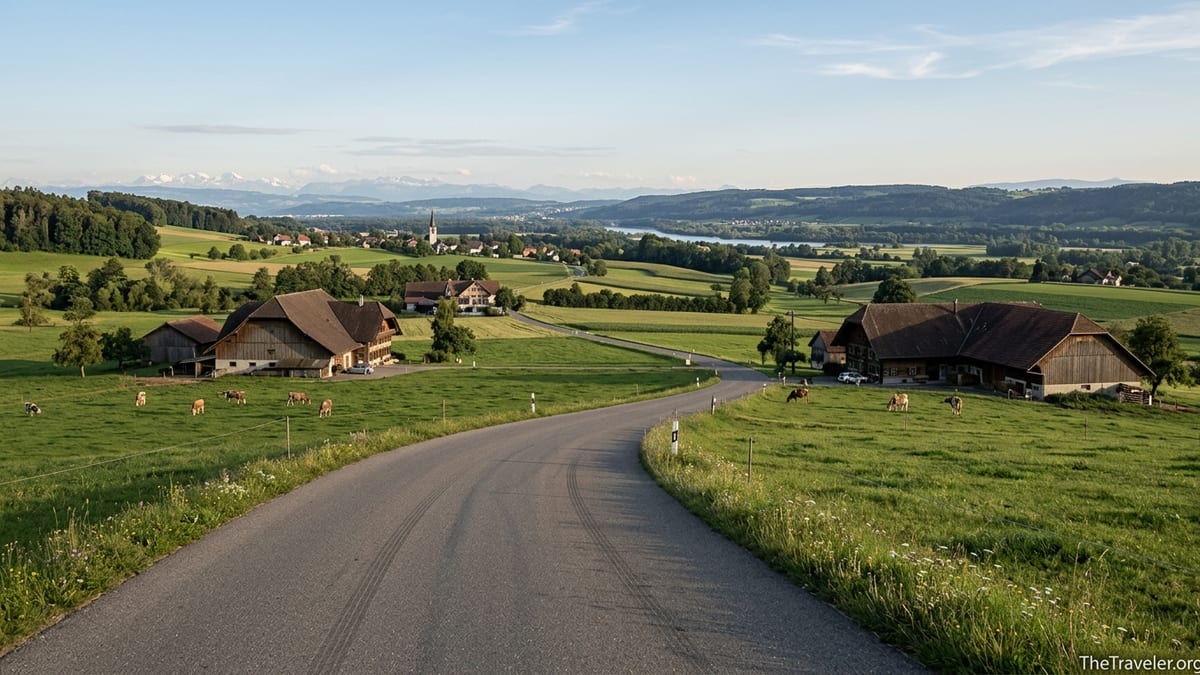
When travelers think of Switzerland, they usually picture high alpine passes such as Grimsel or Furka and resort towns like Zermatt. The Swiss Plateau, stretching broadly between Geneva and Lake Constance, has a different character: rolling hills, tidy dairy farms, broad rivers like the Aare and Reuss, and historic market towns that grew up along trade routes rather than ski lifts. Driving here is less about hairpin passes and more about slow curves through green meadows, half-timbered farmhouses and baroque village churches. For many visitors it feels closer to real Swiss life than the more touristed resorts.
The plateau is also ideal for first-time drivers in Switzerland. Major cities are linked by a dense motorway network, while secondary roads are well paved and generally open year-round apart from short construction closures. You can land at Zurich or Geneva, pick up a rental car at the airport and be on small country roads within 30 to 40 minutes. Distances are short: the drive from Zurich to Bern is around two hours on slower backroads, so you can comfortably string together multiple stops in one day without feeling rushed.
Costs are a key consideration. Fuel prices change frequently, but visitors report typical Swiss rental car rates from major brands at Zurich Airport such as Hertz, Europcar and Sixt often landing near 90 to 120 US dollars per day for a compact automatic when booked close to peak summer. Booking three to four months ahead, choosing a manual transmission and picking up in the city instead of the airport can bring that down. While trains are superbly efficient, a road trip across the plateau becomes competitive in price when two or more people share one vehicle, especially once you factor in the convenience of accessing small villages and farm stays that sit far from railway lines.
What this region lacks in dramatic vertical relief it makes up for in variety. In a single day you might have breakfast in the medieval arcades of Bern’s UNESCO-listed old town, follow the Aare River past sandstone cliffs and swimming spots, then end the evening at a farmhouse inn above the Emmental, eating rösti with locally produced Emmentaler cheese while cowbells ring in the pastures below. The road is seldom straight, but it is rarely stressful.
Practicalities: Renting a Car, Vignette, Fuel and Parking
Most visitors start a Swiss Plateau road trip by renting a car at Zurich Airport, Geneva Airport or Basel EuroAirport. Zurich and Geneva typically have the widest choice of vehicles and longer desk opening hours. Compact hatchbacks such as a Volkswagen Golf or similar are ideal: small enough for village streets and tight hotel parking, yet comfortable on motorways. Automatic transmissions are widely available but cost more; if you can drive a manual, you will have more choice and may save roughly 10 to 20 percent on the base rate. Check whether winter tires are mandatory for your travel dates; many rentals include them automatically for late autumn to early spring.
Switzerland requires a motorway vignette to use its motorways and expressways. This is a yearly toll sticker or electronic registration that costs around 40 Swiss francs and is valid for just over a calendar year. Rental cars picked up inside Switzerland almost always include the vignette in the price, already affixed to the windshield or registered electronically. If you are driving a foreign car into the country, you can buy the vignette at petrol stations near the border or at customs booths. Driving onto a motorway without it can lead to an on-the-spot fine of about 200 francs plus the cost of the vignette, so it is worth checking before you leave the rental lot.
Standard speed limits in Switzerland are typically 50 km/h inside built-up areas, 80 km/h on rural roads and up to 120 km/h on motorways unless posted otherwise. The country enforces speed limits tightly with automatic cameras and low tolerances. It is common to see short stretches reduced to 30 km/h near village schools, or to 60 or 80 km/h on motorway sections with curves or tunnels. Fines can increase quickly if you are more than a few kilometers per hour over the limit, and in serious cases prosecutors may become involved. Plan your driving times conservatively, expect slower stretches and enjoy the landscapes rather than trying to make up time.
Parking is another cost to factor in, but it is manageable with some planning. City centers such as Zurich, Bern and Lucerne rely heavily on underground garages and signed street zones. Blue-zoned residential streets generally allow short-term free parking if you display a blue cardboard disc set to your arrival time; these discs cost only a few francs at petrol stations and kiosks. White zones are usually metered, and yellow markings indicate private or reserved spaces. In medium-sized towns like Solothurn or Thun, you might pay 2 to 4 francs per hour in a central garage, while many countryside inns and farm stays offer free parking on site. Always check hotel policies before booking; some design-centric properties in old towns offer only off-site garages at additional daily fees.
Designing Your Route: Historic Towns and River Valleys of the Plateau
A classic loop across the Swiss Plateau connects Zurich, Lucerne, Bern, the Emmental and the lakeside towns between Fribourg and Lausanne. This circuit can be driven in three long days or opened up into a week of leisurely exploration. Starting in Zurich allows you to ease into driving with a short stretch on the A4 motorway before peeling off onto quieter country roads. Heading west, you can follow the Reuss River valley via Bremgarten, an atmospheric little town with a covered wooden bridge and arcaded main street, then continue through fields and forest to Lucerne.
Lucerne is an obvious but worthwhile stop. While many travelers focus only on the Chapel Bridge and the lakefront, the surrounding plateau offers a softer landscape than the steep alpine walls around nearby Mount Pilatus or Rigi. A short drive southwards into the Entlebuch UNESCO Biosphere Reserve brings you to peat bogs, moorlands and small hilly farms, with signposted country lanes suitable for slow drives and brief hikes. You can easily spend a half day looping from Lucerne through Entlebuch and back, combining it with time in the old town.
From Lucerne to Bern, instead of racing along the motorway, consider paralleling the Aare River. One pleasant version leads through Sursee and the rolling farmland of the canton of Lucerne before dropping to the lakeside at Sempach or Murten. Murten, with its intact city walls, arcades and lakeside promenade, makes a good lunch stop. From there it is a short onward drive to Bern, where the sandstone old town sits high above a dramatic loop of the Aare. Several central garages, such as those near the main station and the old town, let you park the car and explore the arcades, cathedral terrace and river views on foot.
East of Bern the Emmental valley stretches into one of the most emblematic plateau landscapes. Between Burgdorf, Langnau and Sumiswald, narrow country roads dip and rise past patchwork fields, dense pockets of forest and traditional Emmental farmhouses with deep, swooping roofs. This is cheese and dairy country: many small creameries welcome visitors to sample local Emmentaler or butter, and farm hotels let you wake up to mist hovering over the hills. Interlacing these valleys with a day trip toward the Aare gorge at Huttwil or the smaller tributaries near Lützelflüh creates a satisfying countryside loop.
Three-, Five- and Seven-Day Swiss Plateau Itineraries
A three-day Swiss Plateau itinerary suits travelers who want a taste of the region alongside a broader Swiss trip. One efficient loop starts and ends in Zurich: on Day 1 drive from Zurich to Lucerne via Bremgarten, spending the afternoon between the old town and an Entlebuch detour. Overnight in Lucerne. On Day 2 continue from Lucerne to Bern through Sursee and Murten, leaving time to walk Bern’s old town and climb the cathedral tower if you wish. On Day 3, head back to Zurich via the Emmental: Bern to Burgdorf, then through Langnau and over the rolling heights to the region around Willisau before rejoining the motorway toward Zurich. Each driving day is about three to four hours behind the wheel, broken into segments of one hour or less.
With five days, you can slow the rhythm and add more river valleys. Start again in Zurich and follow the Limmat and Reuss through Baden and Bremgarten before reaching Lucerne, staying two nights there. Use the second day for a loop through the Entlebuch Biosphere, perhaps combining a short walk on a moorland trail with lunch at a countryside inn in Schüpfheim or Flühli. On Day 3 drive Lucerne to Bern via Sempach and the small city of Sursee, then along Lake Sempach or Lake Hallwil, stopping at lakefront lidos if the weather is warm. Spend Days 4 and 5 in the Emmental: one night in Burgdorf, exploring its hilltop castle and old town, and one night deeper in the countryside near Sumiswald or Trubschachen, where family-run inns and farm stays are common.
A full seven-day itinerary lets you thread in the western plateau and lake region. Begin in Zurich and follow the same route to Lucerne, staying two nights to allow for a half-day lake cruise or a cable car ride up to a nearby peak. From Lucerne continue to Bern via the scenic backroads through Sursee, Willisau and the Napf region, a knot of hills that feels surprisingly remote despite sitting between major cities. After two nights in Bern, including a river swim along the Aare if you are comfortable with currents and visit in summer, drive south-west to Fribourg and the lakes of Gruyère and Neuchâtel. Medieval Fribourg offers another compact old town, while the countryside between Romont and Moudon is a gentler French-speaking counterpart to the Emmental. Finish with one or two nights near Lausanne or Vevey on Lake Geneva before returning the car in Geneva or looping back to Zurich on the motorway.
For each of these itineraries, try to build in at least one non-driving afternoon in every two-day block. A road trip across the Swiss Plateau is not about rushing from viewpoint to viewpoint, but about soaking in small details: local bakeries serving dense rye bread and plaited Zopf, village fountains with cold running water, or evenings spent on a guesthouse balcony watching the light fade over patchwork hills. Leaving time allows for spontaneous detours when you spot a sign for a farm shop, castle ruin or panoramic side road.
Scenic Detours: Emmental Lanes, Cheese Villages and River Walks
Some of the best scenery on the Swiss Plateau lies just a few kilometers away from the main routes. In the Emmental, signed theme routes for cyclists and e-bikes crisscross the hills, and many of them parallel or intersect quiet minor roads that are pleasant to drive. For instance, the cycling route named after the writer Jeremias Gotthelf links Lützelflüh, Sumiswald and Trachselwald with viewpoints over the middle Emmental. While the heart of these routes is designed for bikes, you can adapt the general line for a driving detour, pausing at small parking areas near chapels or viewpoints for short walks.
Cheese villages add a culinary anchor to scenic drives. East of Bern, the village of Affoltern im Emmental hosts a visitor-friendly cheese dairy where you can observe part of the production process and sample regional specialties. Planning a midday stop here or at similar small creameries in the region turns an otherwise purely visual drive into a sensory experience. Nearby farm shops often sell local yogurt, dried meat and herbal teas, and many have simple self-service terraces where you can sit with a view over the hills.
Rivers are another thread tying together plateau landscapes. The Aare, Limmat, Reuss and Emme all have stretches where you can combine a short drive with a riverside walk. Near Bern, well-marked paths follow the Aare under steep forested banks with periodic access points where locals swim in summer. Between Lucerne and Bremgarten, the Reuss meanders through low wooded cliffs and gravel banks, and small roadside lay-bys allow you to pull over and walk down to the water for a picnic. Building two or three of these short stops into each driving day breaks up time behind the wheel and allows you to feel the textures of the landscape rather than merely looking at them through the windshield.
In the western plateau, the lakes of Murten, Neuchâtel and Biel provide a different kind of detour, with vineyards climbing the north-facing Jura slopes and small harbors lined with wooden boats. You might, for example, drive from Bern to Murten on backroads, walk a stretch of the lakefront path, then continue through the wine village of Praz or Twann before rejoining the motorway toward Lausanne. Parking at lakeside towns tends to be metered, but short free intervals are common, especially outside peak holiday weekends.
Driving Culture, Safety and Seasonal Considerations
Swiss driving culture on the plateau tends to be disciplined but not aggressive. Drivers expect you to respect speed limits, keep right on multi-lane roads except when overtaking and yield to pedestrians at marked crossings. Automatic cameras enforce many limits, so you will see local drivers slowing promptly at signed changes in speed. On rural roads with oncoming traffic, people are generally courteous about pulling into wider spots to pass tractors, cyclists or postal buses. That said, expect variations: commuters on familiar stretches may drive closer to the limit than visitors feel comfortable with, especially around larger cities at peak times.
Seasonal changes affect both driving conditions and the feel of the landscape. In spring, from April into early June, fields are bright green and fruit trees blossom along the valley bottoms. Farm roads can be muddy along verges after rain, so be cautious when pulling off onto grass to admire a view. Summer brings warmer temperatures and more traffic, especially near lakes, but also longer daylight hours. In July and August, you might still be driving in soft evening light at 9 p.m., which allows flexible timetables but also means deer and other wildlife are more likely to appear near dusk.
Autumn, particularly from late September to late October, is perhaps the most atmospheric season for a plateau road trip. Forests in the Emmental and along the Jura foothills turn shades of gold and red, and agricultural life moves into harvest mode, with apples, pumpkins and grape picking visible from the roadside. Some high, narrow farm lanes can become slippery with wet leaves, so moderating speed is wise. Winter brings more frequent fog in river valleys and potential snow on higher hills, though major roads are well maintained. If you plan a plateau road trip in winter, request a rental car with winter tires and be prepared for shorter daylight windows; structure your driving so that rural stretches are mostly in daylight and use motorways after dark.
Whatever the season, it pays to refuel before you are nearly empty. Petrol stations are common along motorways and in towns, but can be sparse on minor roads in the Emmental or Napf regions. Many rural stations are automated, accepting major credit cards and often remaining open outside staffed hours. Keep a mental note of the fuel gauge when you leave a major town, and take advantage of opportunities to top up when you pass a station, especially late in the day or on Sundays when some smaller outlets reduce their hours.
Budgeting and Booking: Where to Sleep and What It May Cost
Costs on a Swiss Plateau road trip can vary widely depending on when and where you travel. As a rough guide, mid-range hotels in cities such as Lucerne, Bern and Lausanne often start around 220 to 300 Swiss francs per night for a double room in high season, while family-run inns in rural areas might range between 150 and 220 francs including breakfast. Farm stays, which are popular in regions like the Emmental and Napf, can be better value and more atmospheric, though bathrooms may be shared and amenities simpler. Booking platforms and regional tourism sites list many options, from renovated barns with modern interiors to basic guest rooms in working farms.
Parking costs should be factored into your accommodation choice. A central city hotel may charge 25 to 40 francs per night for a garage space, while suburban properties or countryside inns often include free on-site parking. Some travelers choose to stay just outside city centers, for example in small communities a ten to fifteen minute drive from Bern or Lucerne, where they can park easily and then use trains or trams into the historic core. This approach combines the flexibility of a car with the convenience of urban public transport, and can reduce both parking stress and nightly costs.
Meal prices are another key part of the budget. Lunch in a village restaurant along your route might cost 20 to 30 francs for a plate of pasta, rösti or daily special, while a dinner with a main course and a drink in a mid-range city restaurant can easily reach 40 to 60 francs per person. To keep costs under control, many road trippers shop at supermarket chains for picnic supplies: fresh bread, cheese, fruit and prepared salads can make a satisfying roadside or riverside meal at a fraction of restaurant prices. Many plateau towns have well-maintained public picnic areas with tables, grills and drinking fountains.
Booking timing matters. Summer, especially July and August, along with public holidays and major events, sees higher room rates and lower availability. For a seven-day plateau loop in peak season, reserving all accommodations one to two months in advance is prudent, particularly if you want specific farm stays or boutique hotels that only offer a few rooms. In shoulder seasons such as May, June, September and October, you may find more flexibility and slightly lower prices, though popular weekends can still book up. Make sure any rate you choose allows reasonable flexibility in case you need to adjust your route due to weather or personal preference.
FAQ
Q1. Do I really need a car for a Swiss Plateau trip or can I rely on trains?
The Swiss Plateau is very well served by trains and buses, and you could visit major towns like Zurich, Bern and Lucerne without a car. However, having a car gives you access to small Emmental valleys, farm stays and minor river villages that are difficult or time-consuming to reach by public transport. For itineraries focused on countryside roads, a car is significantly more convenient.
Q2. How much should I budget per day for a rental car on the Swiss Plateau?
Prices vary by season and booking horizon, but visitors commonly report around 90 to 120 US dollars per day for a compact automatic from a major brand in high season, including basic insurance and taxes. Booking earlier, choosing a manual transmission and picking up in the city rather than at the airport can lower this cost.
Q3. Are there special tolls on Swiss Plateau roads besides the motorway vignette?
In most cases, no. Once you have the standard Swiss motorway vignette, which applies nationwide, you will not encounter separate toll booths on the plateau’s motorways or main roads. Some mountain tunnels and passes elsewhere in Switzerland may have extra fees, but typical plateau routes between Zurich, Lucerne, Bern and Lausanne do not.
Q4. Is parking difficult in historic towns like Bern, Lucerne or Murten?
Parking in historic centers can be tight but manageable if you follow signs to multi-storey or underground garages at the edge of old towns. In Bern, for example, garages near the main station or riverside provide access to the old town on foot. Smaller towns such as Murten generally have clearly marked pay-and-display lots within walking distance of the center.
Q5. What type of car is best for a Swiss Plateau road trip?
A compact hatchback or small SUV is usually ideal. It offers enough comfort and luggage space for two to four people, while staying nimble on narrow village streets and rural lanes. Large SUVs or vans can be less practical when maneuvering into tight hotel garages or small farm parking spots.
Q6. How many hours per day should I plan to drive on these routes?
For a relaxed pace, aim for two to four hours of actual driving per day, broken up into one-hour segments with frequent stops. Distances on the plateau are short, so there is rarely a need to drive more than that unless you are trying to cover a lot of ground quickly.
Q7. Is it safe to drive in winter across the Swiss Plateau?
Yes, but conditions can include fog, rain and occasional snow or ice, especially in higher hill regions like the Emmental and Napf. If traveling in winter, ensure your rental car has winter tires, drive with extra caution and plan most rural driving for daylight hours. Major routes and motorways are generally cleared and treated promptly.
Q8. Can I combine a plateau road trip with a visit to the Alps?
Very easily. From Bern or Lucerne, alpine areas such as the Bernese Oberland or Central Switzerland peaks are within a one to two hour drive. Many travelers spend several days exploring plateau towns and countryside, then drive into the mountains for hiking or skiing before returning the car in a city.
Q9. Are there low-emission zones or other restrictions for driving in Swiss cities?
Switzerland does not currently operate the same style of extensive low-emission zones found in some neighboring countries, but individual cities may restrict access to certain old-town streets, pedestrianize central areas or limit parking to residents. Pay attention to local signage and never drive past a clear prohibition sign into a restricted zone, as fines can be steep.
Q10. What is the best season for a Swiss Plateau road trip focused on countryside scenery?
Late spring (May and June) and early autumn (September and October) are particularly rewarding. Fields are green or turning golden, temperatures are moderate and traffic is usually lighter than in peak summer. Summer months also work well if you enjoy lake swimming and long evenings, but accommodation and car rental prices are often higher.