


The Swiss Plateau stretches between the Jura and the Alps, a broad, gentle belt of lakes, rivers and historic towns that is ideal for families who want Swiss scenery without hair-raising mountain roads. Trains are frequent, bike paths are flat, castles appear around river bends and there is always a playground or ice cream stand nearby. This guide focuses on practical, real-world ways to turn the plateau into an easy-going family base, from Bern to Baden and Lausanne, with castles, museums, riverside cycling, thermal baths, nature walks and day trips that work with children rather than against them.
Why the Swiss Plateau Works So Well for Families
The Swiss Plateau sits between roughly 400 and 800 metres above sea level, running from Lake Geneva in the west towards Lake Constance in the east. For visiting families, that translates into milder weather, gentler hills and far fewer logistical headaches than a week of switching between high Alpine resorts. Distances are short and most towns are on the main rail lines, which means parents can keep transport simple while children still feel like they are travelling through a storybook landscape of farms, church spires and rivers.
Unlike some famous mountain destinations, plateau towns such as Bern, Solothurn, Aarau, Baden or Lausanne offer proper urban services alongside the scenery. You can find large supermarkets for budget-friendly picnics, pharmacies and children’s clothing stores if you forget something, plus frequent buses and trams. For many families, this combination of Swiss efficiency and everyday convenience makes the plateau much less stressful than a remote village at the end of a cable car line.
Another advantage is affordability in relative Swiss terms. Accommodation around the Plateau can be more reasonably priced than in top Alpine resorts. For example, a mid-range family room in a Bern or Solothurn hotel outside peak festivals is often noticeably cheaper than a comparable room in Zermatt or a high-end ski village in midsummer. You still pay Swiss prices, but basing yourself on the plateau can make a rail pass, museum entries and the occasional restaurant meal more manageable across a one or two week stay.
The plateau is also extremely well set up for non-car travel. Families can combine trains, trams, mountain railways and lake boats with almost no transfers requiring long walks or confusing changes. Many of the attractions in this guide sit directly next to a train station, tram stop or marked cycling route, which is crucial when you are pushing a stroller, shepherding a toddler and trying not to lose a teenager glued to their phone.
Best Family Base Towns on the Swiss Plateau
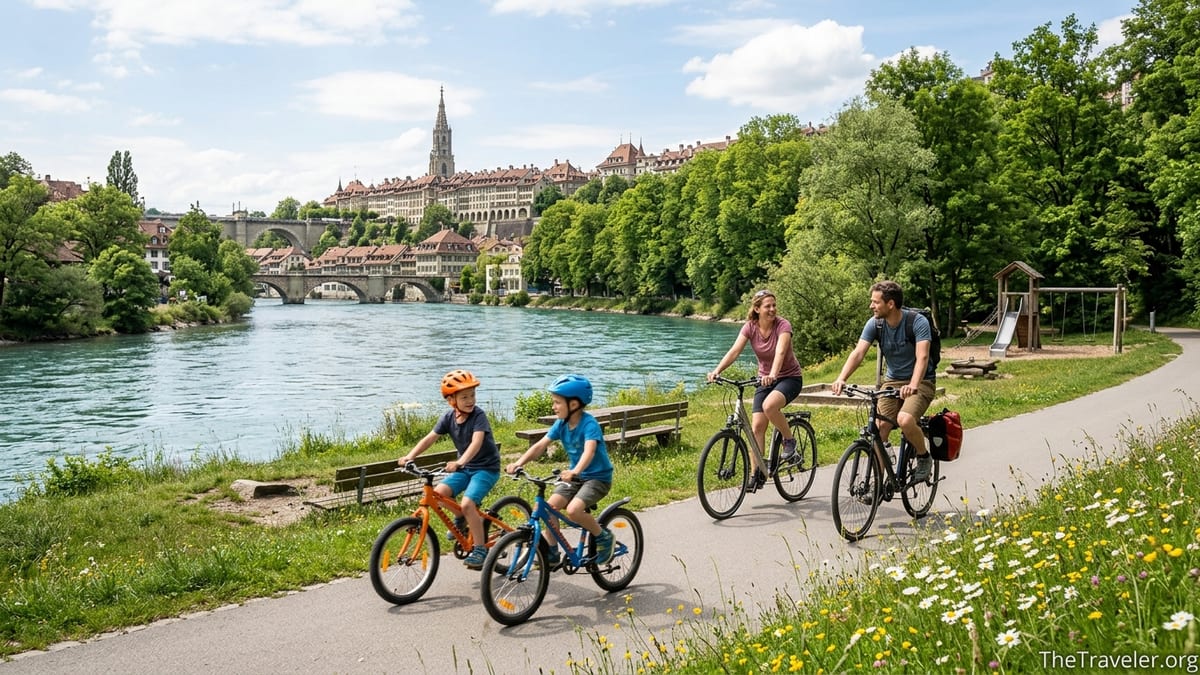
Bern is one of the most practical and atmospheric bases for a family holiday on the Swiss Plateau. The compact UNESCO-listed old town sits in a loop of the turquoise Aare river, so you get river views at almost every turn and a manageable size that is easy to navigate with children. From Bern’s main station, direct trains run to places such as Lausanne, Fribourg, Thun, Interlaken, Solothurn, Basel and Zurich, usually in under an hour. Families appreciate that you can return “home” to a relaxed city with parks, playgrounds, the Bear Park and child-friendly museums after a day out.
Lausanne, on the northern shore of Lake Geneva, is another strong option. The city is built on hills, but its lakefront Ouchy district is flat, full of promenades and playgrounds, and served by a simple metro line that links directly to the main station. Families can combine city days with boat trips on Lake Geneva, visits to the large freshwater aquarium-vivarium complex at Aquatis, or easy rail excursions to vineyard villages in Lavaux or to Montreux.
Further east, Baden and Aarau make convenient and often overlooked bases for families who want quick access to Zurich without paying big-city prices. Baden is a small spa town on the Limmat river with historic streets, playgrounds by the water and thermal baths that welcome children at specific times. Aarau has a photogenic old town, riverside paths along the Aare and several castles and museums within an easy train or bike ride. Both towns sit on the main rail corridor, so day trips towards Lucerne, Zurich and Basel remain straightforward.
For families who prefer compact towns even smaller than Bern or Lausanne, Solothurn and Yverdon-les-Bains are worth considering. Solothurn, often described locally as one of the prettiest baroque towns in the country, lies directly on the Aare river with long, traffic-free embankments made for evening strolls. Yverdon-les-Bains combines a sandy lakeside beach on Lake Neuchatel with an accessible castle, tree-shaded parks and its own thermal spa complex, giving younger children plenty to do within walking distance of town accommodation.
Castles and History Kids Can Touch
One of the pleasures of the Swiss Plateau is how casually castles appear in everyday scenes. A short regional train ride from Aarau, for example, brings you to Hallwyl Castle, a moated water castle reached by wooden bridges and surrounded by reed-fringed ponds and walking paths. Families can wander ramparts, peek into furnished rooms and then rent a pedal boat or take a small lake cruise on nearby Hallwilersee for a relaxed afternoon that mixes history and play.
Closer to the Aare valley, Lenzburg Castle rises above the town of Lenzburg and has been developed as a lively cultural and children’s castle. Inside, families often find hands-on exhibits where children can try on costumes, sit at medieval-style tables or explore themed rooms that explain life in a fortress in an accessible way. Because the castle is only a short uphill walk from Lenzburg station, it fits easily into a half-day trip from bases like Aarau, Baden or Zurich.
In Bern, the city itself functions as a kind of living history lesson. The arcaded streets, clock tower and sandstone facades require little explanation for children to sense that this is an old place. For something more structured, families can step into the Einstein House or the Bern Historical Museum, which often features exhibits suitable for older children. When attention spans flag, the riverfront Marzili area with its playgrounds and leisure lawns is only a short tram ride or walk away.
Many plateau castles and old towns are integrated with signposted cycling routes, so you can turn history sightseeing into an easy ride. In the Aargau region, for instance, a popular loop links multiple castles in one day, while shorter child-friendly variants follow quieter roads and river paths towards a single destination like Wildegg Castle or Habsburg Castle. Parents can plan routes using the national SwitzerlandMobility network, which clearly labels family-suitable segments and avoids steep climbs and busy roads where possible.
Hands-on Museums and Rainy Day Rescues
The Swiss Plateau concentrates some of the country’s most engaging museums for children, which is reassuring when the weather turns or everyone needs a break from walking. In Bern, the Museum of Communication has won international recognition for its highly interactive approach. Children can play with old and new technologies, experiment with sound and images, and handle many of the exhibits instead of walking past glass cases. Exhibitions focus on how people connect with each other rather than on dry technical explanations, which tends to work well across age groups.
Another standout is the Swiss Science Center Technorama in Winterthur, reachable by frequent trains from Zurich and the eastern Plateau. This large facility is filled with hundreds of experiments covering physics, perception, electricity and more, all designed to be touched and manipulated. Families often spend an entire day here, pausing only for snacks and lunch at the on-site restaurant. For plateau-based visitors, Technorama can be a major highlight, especially for school-age children who like tinkering and building.
On the western side of the Plateau, near Kerzers between Bern and Neuchatel, Papiliorama offers something different: tropical biomes and butterflies under glass domes. Families walk through warm, humid halls where butterflies fly freely, and children can observe nocturnal animals and jungle-type vegetation up close in child-height displays. Because it lies not far from the main road and railway line between Bern and the Lake Morat region, Papiliorama is easy to pair with a lakeside stroll or short cycling segment on the same day.
Lausanne’s Aquatis complex combines a large freshwater aquarium and vivarium with educational displays about rivers and lakes worldwide. Families can follow a set route through themed zones covering European mountain streams, African lakes and Asian river systems, passing large tanks filled with freshwater fish, reptiles and amphibians. The complex also includes a restaurant and accommodation on site, and it sits directly above a metro stop at the edge of Lausanne, which simplifies access with strollers or tired legs on a rainy afternoon.
Riverside Cycling and Easy Trails With Children
The Swiss Plateau is one of the easiest regions in the country for family cycling. The terrain is mostly rolling rather than mountainous, and long stretches of the Aare and Limmat rivers are lined with paved or well-maintained gravel bike paths that avoid traffic. National cycling routes, such as the Aare Route and the Mittelland Route, are well signposted and often follow these riverside corridors. Many families opt for short segments, for example a 10 to 20 kilometre stretch from one small town to another with a picnic mid-way, rather than attempting the full multi-day itineraries.
Along the Aare near Bern, families can ride from the city towards villages like Münsingen or Aarberg, passing through forests, meadows and picnic spots beside the water. These sections are valued for being largely flat and separated from busy roads, which reduces stress for parents riding with children who may wobble or stop suddenly. In summer, it is common to see families pause at river lawns where older teenagers float downstream on inflatable boats while younger siblings play in shallower eddies under close supervision.
On the eastern plateau, the Limmat valley between Zurich and Baden offers a practical, almost entirely flat cycling route of around 25 kilometres, following the riverside from city suburbs to the spa town. Families can shorten the ride by starting at an outer Zurich station or by taking bikes onto the train for part of the journey. At Baden, children can be rewarded with riverside playgrounds or a visit to the thermal baths, while parents enjoy historic streets and cafes.
Families who prefer walking will find numerous low-altitude nature trails across the plateau. In the Aargau Jura regional nature park, for instance, themed trails are designed especially for children, mixing short hikes with playful sculptures, observation points and occasionally natural swimming pools or “bio-baths.” Elsewhere, lakes such as Biel, Neuchatel and Hallwil have flat shoreline paths where strollers, scooters and bikes mingle, with public swimming areas, ice cream kiosks and playgrounds punctuating the route.
Thermal Baths, Lakes and Relaxed Water Play
Thermal baths are a long-standing tradition in Swiss plateau towns built on natural springs, and many have updated their facilities to appeal to both wellness seekers and families. In the Aargau region, Bad Schinznach is a notable example, home to a thermal complex that markets itself as using one of the strongest sulphur springs in the country. The Aquarena Fun area there offers warm indoor and outdoor pools, massage jets, a grotto slide, a river pool and children’s zones, while a separate spa section caters to adults seeking quieter relaxation.
Further along the Rhine valley, spa villages such as Bad Zurzach or Rheinfelden combine thermal pools with small historic centres and easy cycling links along the river. Families might spend a morning riding a flat riverside path, followed by an afternoon soaking in saltwater or thermal baths that remain warm even on cooler spring or autumn days. These resorts often provide family changing rooms, shallow pools and slides, although specific age restrictions and quiet zones vary by facility.
The Swiss Plateau is also rich in lakes that are much warmer for swimming than some high Alpine tarns. Yverdon-les-Bains on Lake Neuchatel, for example, has a broad, shallow lakeside beach suitable for young children, with lifeguarded zones in summer, lawns, shade trees and playground equipment. Around Lake Biel and Lake Murten, small villages maintain public bathing lawns with piers and marked swimming areas where families can alternate between picnicking, paddling and renting pedal boats or stand-up paddleboards.
Even in cities, children usually have access to water play. In Bern, riverside lawns at Marzili and other official river pools become lively in hot weather, while in Lausanne the lakefront promenade at Ouchy is dotted with splash fountains, paddling zones and hire points for small boats. Parents should always check local signage and follow advice from lifeguards, especially concerning river currents on the Aare and other swift-flowing streams, but with common-sense precautions, water-based activities are often a highlight of plateau holidays.
Easy Day Trips and Classic Plateau Itineraries
One of the main reasons to choose a plateau base is how many classic Swiss excursions become achievable as day trips without constantly changing hotels. From Bern, for instance, families can reach Thun and its lakeside castle in around half an hour by direct train, or continue to Interlaken and the Jungfrau region in roughly an hour. In the other direction, Solothurn lies only about 20 minutes away, making it simple to spend a morning wandering baroque streets and the afternoon cycling a short loop along the Aare.
From Lausanne, day trips fan out along Lake Geneva. Families can ride a boat or train to Montreux to stroll the flower-lined promenade and explore Chillon Castle, one of Switzerland’s most famous lakeside fortresses. Another straightforward excursion is to the Lavaux vineyard terraces, where short signed walks above the lake offer sweeping views and villages with playgrounds and ice cream stops. If the weather changes, returning to Lausanne for an indoor afternoon at Aquatis or one of the city’s museums is simple.
Baden and Aarau provide easy access to both plateau and pre-Alpine excursions. A family based in Baden might spend one day walking or cycling the Limmat river valley and soaking in the local baths, then use the next day for a train trip to Lucerne. There, they can combine a gentle boat ride on Lake Lucerne with a visit to the Swiss Museum of Transport, which many children consider one of the most memorable attractions in the country thanks to its interactive exhibits about trains, planes, cars and even space travel.
On the western side, bases such as Yverdon-les-Bains allow for low-stress days that mix short train hops and plenty of free play. A typical itinerary might see a morning visit to the town’s castle and lakeside playground, a quick regional train ride to the medieval village of Grandson for castle ruins and lake views, then an afternoon spent swimming or renting paddleboats back at Yverdon’s beach. Parents can adjust each day’s ambition level based on how the children are coping, confident that trains run frequently and that there is usually a playground or park close to any station.
The Takeaway
For families who want to experience Switzerland without turning every transfer into a logistical puzzle, the Swiss Plateau is a compelling alternative to an exclusively high-mountain holiday. Its mix of historic towns, gentle landscapes, bike paths, rivers, lakes and hot springs makes it easy to craft days that feel full yet not rushed. Children can bounce between castles, science experiments, butterflies and swimming areas, while parents benefit from short travel times, dense public transport and a wide range of accommodation and food options.
By choosing practical bases such as Bern, Lausanne, Baden, Aarau, Solothurn or Yverdon-les-Bains, families can string together castles like Hallwyl and Lenzburg, attractions such as Papiliorama, Technorama and Aquatis, and relaxed cycling or walking segments without constantly packing and unpacking. The plateau’s infrastructure means that even first-time visitors with young children can build flexible plans, change course when the weather or moods shift, and still feel they are getting a rich, varied picture of Swiss life.
Ultimately, a Swiss Plateau holiday is about balance. It offers city comforts alongside countryside calm, riverbanks and lake shores instead of cliff edges, and cultural depth without the crowds of the most famous Alpine hotspots. For many families, that balance is what turns a beautiful trip into a genuinely relaxing one, and what makes the plateau a region worth considering not just as a transit zone between the Alps, but as the main stage for a memorable Swiss adventure with children.
FAQ
Q1. Is the Swiss Plateau a good choice for a first family trip to Switzerland?
The Swiss Plateau is one of the easiest regions for first-time visitors with children, thanks to gentle terrain, short train journeys, strong infrastructure and a wide choice of child-friendly castles, museums, lakes and thermal baths.
Q2. Which town is best as a base with young children?
Bern is often the most practical all-round base, combining a compact old town, riverfront parks and excellent train connections, but smaller cities such as Solothurn, Aarau or Yverdon-les-Bains can be quieter and more relaxed for very young children.
Q3. Do we need a car to explore the Swiss Plateau with kids?
No, a car is not necessary. The region is dense with train, tram and bus services, and many attractions such as Papiliorama, Aquatis, Lenzburg Castle or Technorama sit close to stations or on signposted cycling and walking routes.
Q4. Are cycling routes on the Swiss Plateau safe for children?
Many plateau cycling routes, especially along the Aare and Limmat rivers and around lakes, are designed to be mostly flat and separated from busy roads, making them suitable for children who can already ride with some confidence.
Q5. What is the best time of year for a family holiday on the Swiss Plateau?
Late spring to early autumn tends to be most comfortable, with May, June and September often bringing mild temperatures, open attractions and fewer crowds than the peak summer holiday period in July and August.
Q6. Are Swiss Plateau thermal baths suitable for toddlers?
Many thermal complexes on the plateau, such as those in Bad Schinznach, Bad Zurzach or Yverdon-les-Bains, provide shallow pools and family areas, but parents should check each facility’s specific age rules, quiet zones and safety guidelines before visiting.
Q7. How expensive are museums and attractions for families?
Admission costs vary, but many museums and castles offer reduced or free entry for younger children, and families can save money by combining rail passes with discounted museum passes or by focusing on low-cost activities such as lakeside play and cycling.
Q8. Can we swim safely in rivers and lakes on the Swiss Plateau with kids?
Lakes such as Neuchatel, Biel and Murten have supervised public swimming areas that are generally suitable for families, while rivers like the Aare require careful attention to local advice, marked entry points and children’s swimming ability.
Q9. Is it realistic to combine the Swiss Plateau with a few mountain day trips?
Yes, from plateau bases such as Bern, Lausanne or Baden, families can reach mountain gateways like Interlaken, Montreux or Lucerne in around one to two hours, making it easy to add one or two higher-altitude days without changing accommodation.
Q10. How many days should a family plan on the Swiss Plateau?
A week allows time to settle into one or two bases, explore nearby castles, museums and lakes, and fit in a couple of longer excursions, while ten to fourteen days give more space for slower cycling rides, repeat swims and occasional mountain side trips.