


The Swiss Plateau is where Switzerland’s rail network, historic towns and soft green countryside all converge. Linking Bern, Fribourg, Solothurn, Aargau and the Zurich area, this region is compact enough for effortless train travel yet varied enough to fill a week or more. This guide proposes realistic 3, 5, 7 and 10-day rail itineraries with suggested overnight bases, sample journey times and concrete day-trip ideas to help you plan a practical route across the heart of Switzerland.
Understanding the Swiss Plateau and How to Move Around
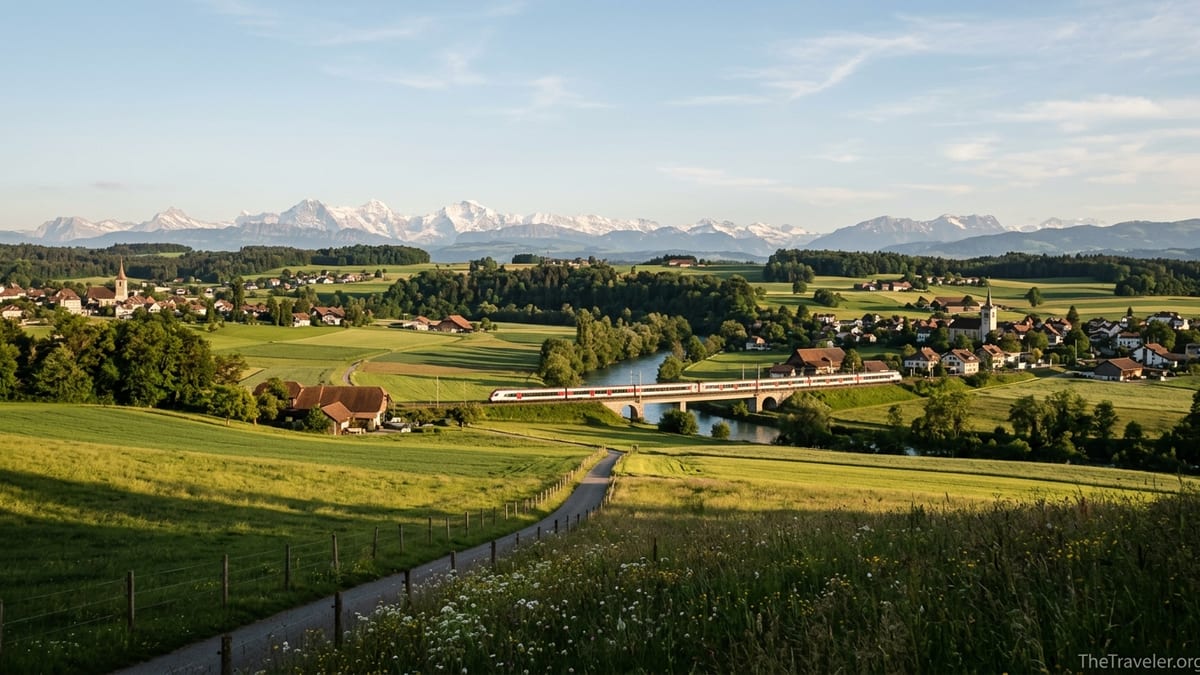
The Swiss Plateau, sometimes called the Mittelland, is the broad, gently rolling middle of the country between the Jura mountains and the Alps. It includes the main cities of Zurich, Bern and Fribourg as well as smaller historic centers such as Solothurn and Aarau. Distances are short: fast intercity trains link Zurich and Bern in about 1 hour, while Bern to Fribourg is around 25 to 30 minutes and Bern to Solothurn is roughly 30 to 35 minutes, which makes it easy to day-trip while keeping luggage moves to a minimum.
Switzerland’s national rail operator runs dense, punctual services across this region. InterCity and InterRegio trains connect the main hubs, while RegioExpress or S-Bahn services fill in the gaps to smaller towns and rural valleys. For example, from Bern you can reach the Emmental biscuit village of Trubschachen in around 35 to 40 minutes by RegioExpress, or the lakeside medieval town of Murten in about 35 minutes with a change in Kerzers. These timings make countryside excursions by rail entirely realistic within a normal sightseeing day.
Most foreign visitors use either standard point-to-point tickets bought in advance or on the day, or a rail pass such as the Swiss Travel Pass, which covers almost all trains, many boats and some local buses and trams. Pass holders simply board and show their pass when tickets are checked, which is convenient when you are hopping on and off for spontaneous detours like an afternoon at the Kambly biscuit factory in Trubschachen or a photo stop in Burgdorf on the way back to Bern.
For itinerary planning, it is helpful to think in hubs. Bern works well as a base for the western plateau and Emmental; Fribourg for Sarine valley villages and Gruyère country; Solothurn and Aarau for the Aare valley and Jura foothills; and Zurich for the eastern plateau, Lake Zurich and the Limmat valley. The itineraries below are structured around these hubs so you can combine them according to how many days you have.
A 3-Day Swiss Plateau Taster: Bern, Fribourg and Murten
With three days you will not cross the entire plateau, but you can capture its essence by focusing on Bern and Fribourg with a countryside excursion. Use Bern as your single base to avoid changing hotels. Bern’s compact UNESCO-listed old town, with its long arcaded streets and views of the Aare River bend, sits a few minutes’ walk from the main station, making arrival and departure simple even after a long international journey.
On day one, arrive in Bern and give the city a full afternoon and evening. From the station you can walk down Marktgasse and Kramgasse under the arcades to the Zytglogge clock tower, then continue to the Münster terrace for views over the river and distant Alps. If the weather is warm, consider an hour at the Marzili riverside baths below the federal parliament, where locals float down the river in wetsuits and drybags. Everything here is reachable on foot or by short tram hops included in local transport passes or national rail passes.
Day two is ideal for Fribourg and Murten. Take an early InterRegio or RegioExpress train from Bern to Fribourg, around 25 minutes. Spend the morning in the old town, riding the funicular down to the river quarter and climbing the tower of St Nicholas Cathedral for views over the Sarine gorge. Around midday, continue by train to Murten via either a direct RegioExpress or with a quick change at Kerzers; the journey usually takes about 25 to 35 minutes. Murten’s intact ramparts and arcaded main street give a good feel for smaller plateau towns, and in summer there are lakeside lawns where you can swim or rent a pedal boat before returning to Bern in the early evening.
On day three, you might head into the Emmental for a half-day at Trubschachen, home to the Kambly biscuit factory accessible directly from the small station. Trains from Bern take roughly 35 to 40 minutes and the experience center offers free biscuit tastings and exhibits on local baking. After lunch, either continue deeper into the Emmental by bus or regional train, or head back to Bern for last-minute museum visits and shopping before an evening departure.
A 5-Day Route: Adding Solothurn and Aargau
With five days you can extend the 3-day taster into a small loop by adding Solothurn and the Aargau area. One practical pattern is three nights in Bern followed by two nights split between Solothurn and Aarau, both well connected by rail along the Aare valley. This avoids backtracking and gives a good sample of both Bernese and German-speaking plateau culture.
After your first three days based in Bern following the taster route, travel on day four to Solothurn, often described by Swiss tourism offices as the most beautiful baroque town in Switzerland. Direct trains from Bern usually take about 30 minutes. When you arrive, your hotel will likely be within a 10 to 15 minute walk of the station, as the old town is small and concentrated around the St Ursen Cathedral. Spend the afternoon exploring the riverside promenade, walking the old city walls and sampling local specialties on an outdoor terrace if the weather allows.
On the same day or the following morning, you can add a short countryside excursion around Solothurn. For a taste of the Jura foothills that border the plateau, cable cars and hiking trails on the local mountain Weissenstein are accessible via a brief train ride to Oberdorf, around 15 minutes from Solothurn, followed by a gondola. On clear days the panorama includes the entire sweep of the Alps above the plateau, which helps put your journey across central Switzerland into perspective.
Continue on to Aarau in the canton of Aargau, a relaxed small city that makes a good overnight stop between Solothurn and Zurich. Direct trains from Solothurn usually take about 40 to 45 minutes, and the ride follows the Aare River across flat farmland and villages. In Aarau, the old town’s painted eaves and cobbled streets are only a few minutes’ walk from the station, so it is easy to arrive by midday, drop bags at your hotel, then spend the afternoon on a riverside walk or a visit to a local museum before a relaxed dinner.
A 7-Day Circuit: Including Zurich and Extra Countryside Time
A full week allows you to make a more complete circuit through Bern, Fribourg, Solothurn, the Aargau area and Zurich without rushing. A practical pattern is two nights in Bern, two in Fribourg, one in Solothurn or Aarau and two in Zurich. This keeps hotel moves to four while giving you three distinct urban atmospheres and several rural excursions.
Start with two nights in Bern, following the earlier suggestions for the city and day trips to Murten or the Emmental. On day three, take a short morning train to Fribourg, again about 25 minutes. Check into a hotel near the station or in the lower old town, then spend the rest of the day walking across the town’s medieval bridges and visiting its Gothic churches. Dinner might be a fondue or raclette in one of the traditional restaurants that dot the old town, which can be an atmospheric introduction to the region’s mix of French and German cultural influences.
Use day four from Fribourg for a deeper countryside excursion. A classic option is Gruyères, the postcard village perched on a hill above the Sarine valley, reachable in roughly 45 to 60 minutes from Fribourg with a change in Bulle. Many travelers combine a walk around the walled village with a visit to the nearby cheese dairy and, if time allows, the chocolate factory in Broc. Thanks to frequent trains, you can comfortably have lunch in Gruyères, visit one museum and return to Fribourg by early evening without feeling rushed, especially in summer when days are long.
On day five, continue to Solothurn or Aarau. Routes vary, but a typical Fribourg to Solothurn journey via Bern and possibly a second connection takes around 1 hour 30 minutes, while Fribourg to Aarau via Bern and Olten is usually about 1 hour 40 minutes. Once you arrive, the rest of the day is best kept light: stroll through the compact old town, climb a church tower if open, and choose one riverside cafe or restaurant to linger in, rather than trying to tick off a list of sights.
For days six and seven, base yourself in Zurich. Trains from Aarau to Zurich usually take about 25 to 35 minutes, while Solothurn to Zurich via Olten is typically around 1 hour. Zurich’s main station is right in the city center, so even with luggage you can walk to many hotels in 10 to 15 minutes, or use trams included in many regional passes. Spend your final days exploring the old town along the Limmat River, the lakeshore promenades, and possibly a short excursion to nearby Rapperswil on the upper Lake Zurich, which is reached in about 35 minutes by S-Bahn.
A 10-Day Slow Journey Across the Plateau
With ten days you can slow the pace further and add less visited corners of the plateau, such as small Aargau spa towns or additional Zurich-area lakeside communities. A good structure is three nights Bern, two nights Fribourg, one night Solothurn, two nights in the Aargau area and two nights in Zurich. This gives you enough full days in each place for sightseeing plus one or two rural days per base.
In Bern, use your extra time to explore beyond the obvious old town loop. Consider a ride on the Kambly round-trip route through the Emmental, which connects Bern with Trubschachen and further on toward Lucerne and Interlaken, or a visit to Burgdorf, about 15 minutes by train from Bern, where a hilltop castle now houses an inn and museum. Another option is the Rosengarten above Bern’s old town for sunset views, which is easily reached by bus or a 20 to 25 minute uphill walk from the city center.
During two nights in Fribourg, rely on trains and local buses to reach small Sarine valley villages or lakes. For example, you can be in the Lac de la Gruyère shoreline area in roughly 20 to 30 minutes by train and bus, where easy walking paths and small beaches invite a summer picnic. Short bus rides also connect Fribourg with nearby viewpoints and monasteries, which you can combine into flexible half-day loops without needing a rental car.
When you move on to Solothurn and then deeper into Aargau, dedicate a day to the Aare river landscapes that define this part of the plateau. From Solothurn or Aarau, trains and local buses link to small river towns such as Olten or Brugg in under 20 to 30 minutes, where you can pick up waymarked walking paths along the riverbanks or visit nearby castle ruins. Some visitors choose to stay in one of Aargau’s thermal spa villages, where hotels integrate their own pools and wellness facilities, turning the Aare valley into a low-key resort experience between city visits.
Finishing with two nights in Zurich gives you time to look beyond the busy Bahnhofstrasse. S-Bahn trains from Zurich main station reach lakeside communities such as Meilen, Horgen and Rapperswil in 15 to 40 minutes, and many of these towns have promenades, small historic centers and designated swimming areas. Because connections are frequent and punctual, you can easily return to Zurich for dinner even after an evening swim at a lakeside lido, or choose to dine in a quieter lakeside restaurant before a late train back.
Choosing Bases, Rail Passes and Trip Logistics
When deciding where to sleep, prioritize towns with direct InterCity or InterRegio connections and compact centers. Bern, Fribourg, Solothurn, Aarau and Zurich all fit this pattern, and in each case hotels ranging from simple guesthouses to international chains cluster within a 10 to 15 minute walk of the station. This means that even on a travel day, you can comfortably check out in the morning, ride a train to your next base and be out sightseeing by lunchtime without relying on taxis.
Rail passes versus individual tickets will depend on how intensively you travel. If your itinerary includes multiple day trips, a Swiss Travel Pass or regional pass can be cost effective and convenient, especially when combined with city trams, buses and boats. For example, a traveler spending a week between Bern and Zurich with day trips to Murten, Gruyères and Rapperswil might ride trains and local transit several times a day, which quickly adds up in point-to-point fares. Conversely, if you are planning a slower 10-day journey with only four or five actual rail days, discounted advance-purchase tickets bought online for specific InterCity routes may save money.
Seasonality also shapes logistics. In summer, extended daylight allows long day trips, such as combining Fribourg and Gruyères from Bern or Fribourg in one day, while in winter it makes sense to keep journeys shorter, for instance limiting yourself to Bern and Murten or Zurich and a single lakeside town. Some mountain-adjacent excursions, like higher Jura viewpoints near Solothurn, may be limited by snow or reduced cable car operations in shoulder seasons, so always check local timetables and operating dates a few weeks before travel.
Accommodation pricing on the plateau tends to be slightly lower than in the high Alpine resorts, but cities such as Zurich and Bern are still expensive by global standards. To keep costs manageable, many travelers choose midrange hotels just outside the most central shopping streets or opt for simple business hotels near railway stations, which often include free breakfast. Self-catering apartments can be attractive for families, particularly in Fribourg or Aargau towns where residential neighborhoods lie a short tram or bus ride from the center.
Sample Day Trips and Excursions from Each Hub
Using the itineraries as a backbone, you can plug in day trips according to your interests. From Bern, classic outings include the medieval town of Thun on Lake Thun in about 30 minutes by train, the Emmental region via Burgdorf and Trubschachen, and easy urban pairings such as a half-day in Fribourg followed by an evening return. Because travel times rarely exceed an hour in any direction, it is feasible to leave Bern after breakfast, spend five to six hours in another town and be back for dinner.
Fribourg makes a strong base for exploring Gruyères and the surrounding pre-Alpine hills without committing to a full Alpine program. In addition to the cheese village, you can reach Bulle in about 25 to 30 minutes by regional train for market days and local restaurants, or ride local buses into small villages that offer short, signposted walks with views back toward the plateau. Lakeside stops around Lac de la Gruyère or further toward Lake Geneva are also within roughly one hour’s reach, giving you flexibility to choose between cultural and nature-focused days.
From Solothurn or Aarau, think in terms of rivers and ridges. The Aare river path is accessible in a few minutes’ walk from most town centers, and trains connect to nearby bridges, locks and small dams that can serve as starting points for half-day walks. A short ride from Solothurn to the Jura foothills opens up panoramas over the entire plateau, while from Aarau you can easily reach industrial heritage sites or smaller Aargau towns with historic cores, like Lenzburg with its hilltop castle, usually in under 20 minutes by train.
Zurich is both your likely international gateway and a versatile base for short excursions. Besides obvious city-center sights, consider a loop combining a morning in the old town, an afternoon boat cruise on Lake Zurich covered by many rail and local passes, and an evening in lakeside or riverside bathhouses used by locals after work. For a quieter contrast, riders can board a suburban S-Bahn to a smaller community such as Rapperswil, stroll its harbor and castle, then return to Zurich after sunset on a direct train in about 35 minutes.
The Takeaway
Traveling across the Swiss Plateau by rail is less about ticking off dramatic Alpine passes and more about linking together liveable, walkable towns, farmland views and river valleys. With careful choice of bases and realistic travel times, even a three-day stopover can feel rich, while a 10-day itinerary can thread together Bern’s sandstone arcades, Fribourg’s bridge-laced gorge, Solothurn’s baroque facades, Aargau’s gentle Aare landscapes and Zurich’s lakeside promenades without any rushed hotel changes.
The key is to think in hubs, keep individual train legs under two hours whenever possible and pair each urban base with one or two well-chosen countryside excursions. Whether you choose a short taster or a full circuit, the plateau’s dense rail network, compact city centers and wide choice of day trips make it one of the easiest parts of Switzerland to explore in depth without a car.
FAQ
Q1. Is it realistic to visit Bern, Fribourg and Murten in three days using only trains?
Yes. Bern to Fribourg is around 25 to 30 minutes by train, and Fribourg or Bern to Murten is roughly 25 to 35 minutes. With an early start and one hotel base in Bern, you can comfortably see all three without feeling rushed.
Q2. How many overnight bases do you recommend for a 7-day Swiss Plateau trip?
For one week, three or four bases work well. A common pattern is Bern, Fribourg and Zurich, with an optional single night in Solothurn or Aarau to break up the journey between the Bern region and Zurich area.
Q3. Do I need a Swiss Travel Pass, or are point-to-point tickets enough?
If you plan multiple day trips and frequent short hops on trains, trams and boats, a Swiss Travel Pass or regional rail pass is often more convenient and may be cheaper overall. If you are making only a few longer journeys, advance point-to-point tickets can be sufficient.
Q4. Can I use Zurich as my only base and still see Bern and Fribourg?
It is possible, as Zurich to Bern is about 1 hour by fast train and Bern to Fribourg about 25 minutes. However, this adds extra travel time each day, so many travelers prefer at least one or two nights in Bern or Fribourg for a more relaxed pace.
Q5. Are countryside excursions like the Emmental or Gruyères feasible without a car?
Yes. Regional trains and buses link Bern and Fribourg with Trubschachen in the Emmental, Gruyères, Bulle and Broc. Typical journey times are 35 to 60 minutes, making these destinations realistic day trips by public transport.
Q6. What is the best season to follow these itineraries?
Late spring to early autumn offers the most flexibility, with long daylight hours, frequent trains and open summer attractions. Winter trips are still possible but are better focused on the cities, with shorter countryside excursions due to limited daylight.
Q7. How far in advance should I book hotels on the Swiss Plateau?
For peak summer months and major holidays, booking several weeks in advance is sensible, especially in Zurich and Bern. In shoulder seasons, you can often secure central hotels a few days ahead, though last-minute deals may be limited near big events or trade fairs.
Q8. Are these routes suitable for families with children?
Yes. Short train segments, frequent playgrounds in Swiss towns and attractions such as the Kambly biscuit experience in Trubschachen or lakeside promenades near Zurich and Murten make the region family friendly, especially if you limit hotel moves.
Q9. Is it easy to manage luggage on these itineraries when changing bases?
Most suggested towns have compact centers with hotels within a short walk or tram ride of the station. Swiss stations often offer luggage lockers, and there are optional luggage forwarding services if you want to hike or stop en route between bases.
Q10. Can I combine this Swiss Plateau route with a few days in the high Alps?
Yes. From Bern you can reach Interlaken or the Jungfrau region in roughly 1 to 1.5 hours by train, and from Zurich you can access Luzern or the central Swiss Alps in a similar time. Many travelers add two or three Alpine days before or after a plateau-focused itinerary.