


The Swiss Plateau, or Mittelland, offers some of Switzerland’s most inviting cycling terrain: lake-dotted lowlands, historic river towns and a well-marked network of cycle paths that make planning a bike holiday refreshingly straightforward. This guide focuses on the classic Mittelland Route and the Aare Valley corridor through Aargau and Solothurn, with practical advice on bike rentals, luggage-transfer holidays, accommodation, route difficulty and sample multi-day itineraries.
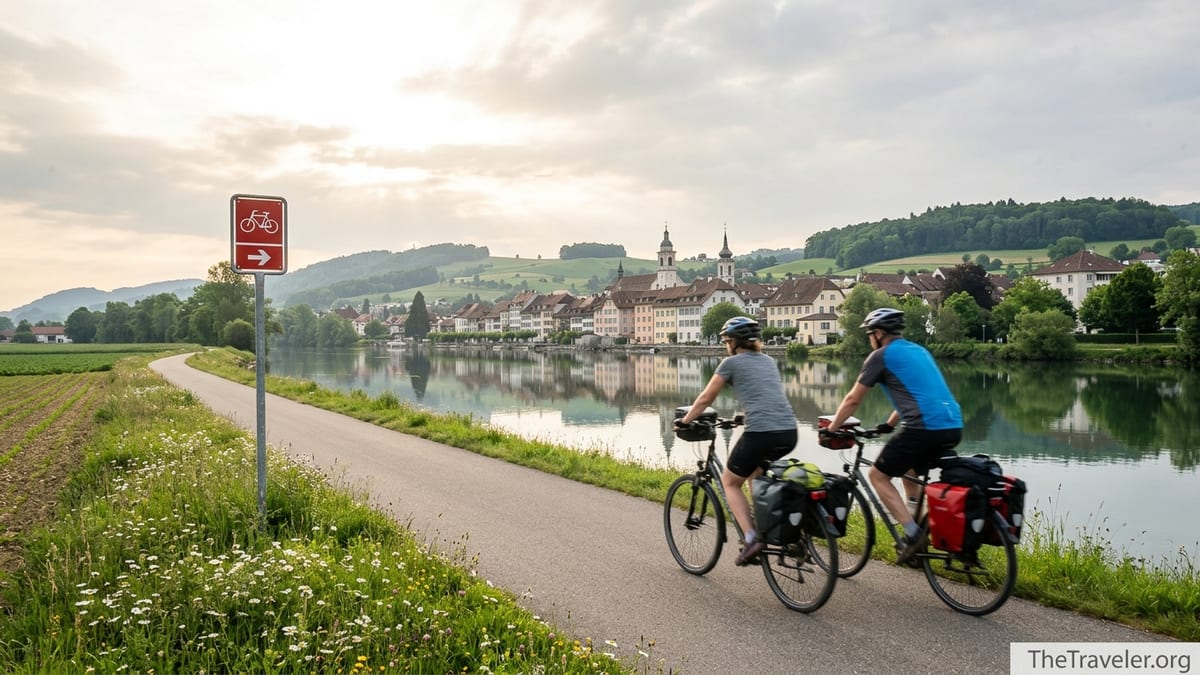
Understanding the Swiss Mittelland and Route Options
The Swiss Mittelland is the broad plateau that stretches between the Jura mountains and the Alps, running from Lake Constance toward Lake Geneva. For cyclists, it is synonymous with gentle gradients, tidy agricultural landscapes, and frequent towns and stations that make it easy to shorten or lengthen a ride as you go. Much of the cycling infrastructure is part of the national SwitzerlandMobility network of signposted routes, which are designed for touring with minimal interaction with busy roads.
The backbone of any cycling trip here is National Route 5, the Mittelland Route. It runs for roughly 375 kilometers from Romanshorn on Lake Constance to Lausanne on Lake Geneva, passing via Winterthur, Zurich, Aarau, Solothurn and Biel. The route is generally described as easy, mostly on traffic-free paths or quiet lanes at low altitudes, with a total elevation gain of around 2,700 meters over its full length, making it accessible to recreational riders with basic fitness.
Alongside Route 5, the Aare cycling corridor follows Switzerland’s emblematic river from the high Alps all the way down through Bern, Solothurn and Aargau. Several commercial tour operators sell “Aare Route” holidays that use sections between Bern, Solothurn and Aarau as multi-day trips, often packaged with luggage transfer and hotel bookings. In practice, cyclists often mix short stretches of the official Aare Route with the Mittelland Route to create a relaxed, river-focused holiday.
For visitors focused on Aargau and Solothurn, the key segment to know runs from Aarau to Solothurn and on to Biel and the Three-Lakes region. This corridor combines river scenery, baroque and medieval town centers and flat riding suitable for both touring bikes and e-bikes. From these hubs, it is easy to connect by train or bike to Zurich, Basel or Bern, which simplifies international arrivals and departures.
Route Highlights: Aarau, Solothurn and the Aare Corridor
The section of the Mittelland and Aare routes between Aarau and Solothurn is one of the most appealing for a short cycling holiday. Leaving Aarau, the route typically follows quiet riverside paths and agricultural roads, with views of the Jura foothills on one side and forest patches on the other. Day itineraries between these towns are often in the 50 to 65 kilometer range, with modest climbs that most riders on touring bikes or e-bikes can handle comfortably in a day.
Solothurn itself is a reason to plan an overnight. Often described as one of Switzerland’s most beautiful baroque towns, it sits directly on the Aare, with riverside promenades, arcaded streets, and a compact center that rewards an evening stroll. Cyclists on commercial tours commonly stay in mid-range hotels such as traditional inns in the historic core or modern riverside properties, and many of these hotels are familiar with cyclists arriving late in the afternoon with panniers and helmets in hand.
North of Solothurn, the Aare winds through a gently rolling landscape toward Biel and the Seeland vegetable-growing region. Multi-day tours frequently include a stage from Solothurn to Biel of about 30 to 40 kilometers, passing floodplain forests and the Nidau-Büren Canal. Another popular day ride continues along the lakes toward Yverdon-les-Bains, making use of the largely flat shoreline cycle paths that appeal to families and casual riders keen to swim or picnic along the way.
South and east of Aarau, Aargau canton offers additional loops through castle-dotted valleys and spa towns. Riders can build rest days around places like Baden or Bad Zurzach, both accessible by train from the Aare corridor, combining gentle cycling with thermal baths. Because regional trains in Switzerland generally allow bikes with a ticket and reservation on busy lines, it is easy to modify a route plan in case of bad weather or tired legs.
Difficulty, Surfaces and Seasonal Considerations
Official descriptions classify the Mittelland Route as easy, and that is accurate when compared with Alpine passes, but conditions still vary between stages. Most sections along the Plateau and the Aare use paved cycle paths, farm tracks and quiet side roads, which are suitable for trekking bikes, hybrids and e-bikes. There are, however, occasional gravel stretches and short forest tracks, so very narrow racing tires can feel less comfortable in some sections.
Daily distances on commercial itineraries along the Aare and Mittelland corridor typically range from about 30 to 65 kilometers. For example, organized Aare Route holidays often sell an eight-day trip from the Grimsel Pass area to Bad Zurzach, with stages such as Solothurn to Aarau around 60 kilometers. That distance is manageable for moderately fit cyclists at a relaxed pace, especially with an e-bike, but families with younger children tend to favor shorter stages of 25 to 40 kilometers and factor in swim stops or playground breaks.
The best time to ride the Mittelland and Aare corridors is generally from late April through early October, when most dedicated cycle paths are clear of snow and daytime highs are mild. July and August bring the warmest temperatures and the busiest travel period, which means more cyclists on popular stretches near lakes and major towns. Spring and early autumn often offer quieter paths and slightly cooler riding conditions, although you should be prepared for passing showers and pack lightweight waterproof layers.
Because the Mittelland is relatively low-lying, heat can occasionally become a factor in high summer. Long riverside stretches with little shade can feel exposed on sunny days, so refilling bottles whenever you pass a village fountain and timing rides to avoid the hottest mid-afternoon hours is a sensible strategy. The advantage of the region’s dense rail network is that you can often cut a hot or rainy ride short by boarding a train at the next town instead of pushing through to your original endpoint.
Bike Rentals, Luggage Transfer and Supported Holidays
For riders arriving from abroad, renting bikes locally is often easier than transporting your own. In Switzerland, many mid-sized towns including Aarau, Solothurn and Biel have access to rental services, either through bike shops or regional platforms. Standard trekking bikes suitable for the Mittelland and Aare routes typically rent for somewhere in the range of 30 to 45 Swiss francs per day, while e-bikes are more often priced around 50 to 70 francs per day, depending on the provider and length of rental.
Several tour operators offer pre-packaged Mittelland or Aare cycling holidays that include rentals, hotel bookings and daily luggage transfers. Companies selling “Mittelland Route for families” packages, for example, usually arrange five or six-day itineraries starting in Solothurn and ending near Yverdon-les-Bains, with luggage transported each day between pre-selected family-friendly accommodations. Prices for such multi-day trips often begin in the low four-figure range per person for a week, including breakfast, luggage transfers and route documentation, with surcharges for e-bikes or premium hotel categories.
Independent travelers who prefer to book their own hotels can still take advantage of Switzerland’s luggage-transfer services. National rail operator services allow you to ship suitcases between certain stations or directly door to door within the country for a fee, typically arriving same or next day depending on the option chosen. While these services generally exclude bicycles and e-bikes themselves, they can greatly lighten your load on the bike, making it feasible to ride with only a day bag while your main luggage moves by train between Aarau, Solothurn and other towns on your route.
When comparing self-organized trips with fully supported packages, consider not only price but also the convenience of pre-booked hotels in small towns during high season and the reassurance of having a contact person if something goes wrong. Package holidays often include a brief arrival meeting or detailed written notes that highlight tricky intersections, ferry times or construction-related detours, which can be especially helpful for first-time visitors unfamiliar with local signage conventions.
Accommodation Styles: From Bike-Friendly Hotels to Farm Stays
The Mittelland corridor through Aargau and Solothurn offers a wide spectrum of accommodation, from simple guesthouses to upscale business hotels and riverside boutique properties. In Aarau, cyclists commonly stay in mid-range hotels near the historic center or the river, which offer easy access to restaurants and supermarkets. Properties in this category often provide secure bike storage in a garage or dedicated room, and some offer laundry service or a drying room for wet gear.
Solothurn has a particularly rich mix of places to stay, including traditional inns in the old town, design-oriented hotels built into former hospital or industrial buildings, and modern properties overlooking the Aare. Many of these are accustomed to hosting guests on cycling holidays that connect Solothurn with Biel or Aarau. At check-in, it is worth asking directly about where to store bikes; in many cases, staff will guide you to a locked courtyard, basement or bike room rather than having you leave your bike on the street.
Along the Aare corridor, smaller villages and rural areas sometimes offer farm stays and simple guesthouses. These can be attractive for travelers seeking quieter surroundings and a local feel, with breakfast featuring regional cheese, bread and homemade jams. Availability, however, can be limited, and some rural properties may only be accessible by a short detour off the main cycle route, so it is wise to check exact locations and plan arrival times accordingly, especially when traveling with children or in bad weather.
Campers will find several campgrounds along lakes near Biel and in the Three-Lakes region, some of which are used as overnight points on marketed family tours. These sites typically offer tent pitches, sanitary blocks and sometimes direct lake access for swimming. In high summer, booking ahead is recommended, as lakeside locations close to major cycle routes can fill up quickly, particularly on weekends and during school holidays.
Building Multi-Day Cycling Itineraries
When planning a multi-day cycling trip in the Swiss Plateau, the main decisions involve how many kilometers per day you would like to ride, and whether your priority is continuous through-riding or using a single town as a base for day trips. A common one-week itinerary focused on the Mittelland and Aare corridor might start in Aarau, overnight in Solothurn, continue to Biel, and then follow lakeside paths towards Neuchâtel or Yverdon-les-Bains before returning by train. Daily stages on this type of journey often run between 40 and 60 kilometers, leaving time for sightseeing and swims.
For a shorter long weekend, a three or four-day loop around Solothurn and the Aare valley works well. For example, you might arrive in Solothurn, spend the first afternoon exploring the baroque town on foot, then cycle to Aarau the following day along the river. On the next day, you could take a different route back via smaller villages or incorporate train segments to create a figure-eight pattern, allowing you to see varied scenery without committing to one long transfer stage. Families often appreciate this base-and-loop approach because it keeps accommodation changes to a minimum.
Riders wanting to cover a longer stretch of the Mittelland Route could plan a point-to-point holiday between Romanshorn and Lausanne, breaking the roughly 375 kilometers into about seven stages of 45 to 65 kilometers each. In that case, the Aargau and Solothurn section becomes a mid-trip highlight rather than the sole focus. This style of journey suits cyclists comfortable with daily movement, packing and unpacking, and regular use of trains to reach the start and finish towns at either end.
Whatever itinerary you choose, Switzerland’s high-frequency public transport allows many contingency options. If a day between Solothurn and Biel proves too windy along the lake, you can shorten it by boarding a regional train at a mid-route station. If bad weather hits during a planned Aarau to Solothurn stage, you might ride as far as the next sizable town, check train connections and continue by rail. Building such flexibility into your plan helps ensure that the trip remains enjoyable even when conditions do not match the idealized images of blue skies and still water.
Practical Tips for Riding in Aargau and Solothurn
Navigating the Mittelland and Aare routes is usually straightforward thanks to Switzerland’s standardized cycling signage, with red route numbers and clear directional arrows at junctions. That said, it is wise to carry a map app or offline maps that show cycling routes, both to double-check ambiguous intersections and to improvise detours if a path is closed for construction. Some riders also use GPS tracks from tour operators or route-planning platforms to complement local signage.
Food and water provisioning along the route is generally uncomplicated, as most towns and larger villages have bakeries, supermarkets and fountains. A typical day might start with a hotel breakfast, followed by a bakery stop in a mid-morning village for pastries and coffee, and then a picnic lunch purchased at a supermarket and eaten at a riverside bench. Evening meals can be taken in town restaurants, ranging from simple pizzerias and kebab shops to traditional Swiss inns serving dishes like rösti or river fish where available.
Budgeting for a Mittelland or Aare cycling holiday depends on your travel style. As a rough guide, mid-range hotels in towns like Aarau, Solothurn and Biel often fall in a band of approximately 140 to 220 Swiss francs per double room including breakfast, while simple guesthouses and farm stays can be somewhat cheaper. Daily food costs vary, but combining supermarket lunches with restaurant dinners helps control spending. Adding bike rental in the 30 to 70 franc per day range and any train tickets or luggage-transfer fees will give you a realistic estimate for total daily expenditure.
Finally, take local etiquette and safety into account. Shared paths near towns are often used by pedestrians, in-line skaters and families with children, so moderate speed and clear bell signals are appreciated. Helmets are not legally mandatory for conventional bicycles in Switzerland but are strongly recommended, and are required for many e-bike categories. Stopping at pedestrian crossings, respecting farm traffic and closing gates where indicated all help maintain the positive relationship between cyclists and local communities in the Swiss Plateau.
FAQ
Q1. How difficult is the Mittelland Route for an average cyclist?
The Mittelland Route is generally considered easy by Swiss standards, with gentle gradients and mostly paved paths. Riders with basic fitness who are comfortable cycling 40 to 60 kilometers a day at a relaxed pace usually find it manageable, especially if they use an e-bike or schedule an occasional rest day.
Q2. What type of bike is best for the Aare and Mittelland corridors?
A trekking or hybrid bike with moderately wide tires is ideal, as surfaces range from smooth asphalt to occasional gravel or forest tracks. E-bikes are very popular on these routes, particularly for riders who want assistance on mild climbs or prefer to enjoy the scenery without worrying about fitness.
Q3. Can I rent a bike in Aarau or Solothurn?
Yes, both Aarau and Solothurn have access to rental options through local bike shops and regional providers. Typical daily rates for a standard touring bike fall somewhere around 30 to 45 Swiss francs, while e-bikes usually cost more, often in the 50 to 70 franc range depending on season and rental duration.
Q4. Are there tour companies that organize luggage-transfer cycling holidays?
Several Swiss and European tour operators offer packaged trips along the Mittelland Route and Aare corridor, including family-focused tours between Solothurn and the Three-Lakes region. These packages normally include hotel bookings, daily luggage transfers between properties and detailed route notes, which can be helpful if you prefer a supported holiday.
Q5. What is a realistic daily distance for families with children?
Families with school-age children often plan stages between 25 and 40 kilometers per day, especially on riverside or lakeside paths where there are frequent opportunities to stop at playgrounds, beaches or picnic spots. Choosing shorter stages also leaves more time for sightseeing in towns like Solothurn or Biel.
Q6. When is the best season to cycle the Swiss Plateau?
The main cycling season typically runs from late April to early October. Summer months offer warm temperatures and long daylight hours but can be busier on popular paths. Spring and early autumn bring cooler conditions and fewer crowds, though riders should be prepared for changeable weather and occasional showers.
Q7. Do I need to book accommodation in advance?
In peak periods such as school holidays and sunny summer weekends, it is wise to book hotels or campgrounds in advance, particularly in popular towns like Solothurn and Biel or at lakeside campsites. Outside these times, spontaneous travel is often possible, but booking at least a day or two ahead still provides peace of mind on a multi-day trip.
Q8. Is it easy to shorten a stage using public transport?
Yes, the Aarau–Solothurn–Biel corridor is well served by regional trains, and many stations are close to the cycle routes. By purchasing a bike ticket and, where necessary, a reservation, you can board trains to skip a section in bad weather or simply reduce the day’s distance if you feel tired.
Q9. Are the routes suitable for complete beginners?
Short segments along the Aare and lake shores are suitable for beginners, particularly if you keep daily distances modest and avoid busy urban sections at commuting times. Absolute beginners may wish to start with one or two day rides using a single base, then build up to a multi-day journey once they feel more confident on the bike.
Q10. How much should I budget per day for a mid-range cycling holiday?
As a broad estimate, a mid-range cyclist might budget around 200 to 300 Swiss francs per person per day, covering hotel accommodation with breakfast, bike rental, food, train tickets where needed and occasional entrance fees. Costs vary with hotel category, restaurant choices and whether you share rooms or travel solo.