


The Swiss Plateau is the country’s lived-in heartland: a chain of lakeside cities, medieval towns and farmland stretching between Lake Geneva and Lake Constance. It is also one of the easiest regions in Europe to explore entirely by train. With dense east–west rail lines, frequent regional services and walkable city centers, you can base yourself in one or two hubs and see a surprising amount without ever renting a car.
Understanding the Swiss Plateau by Rail
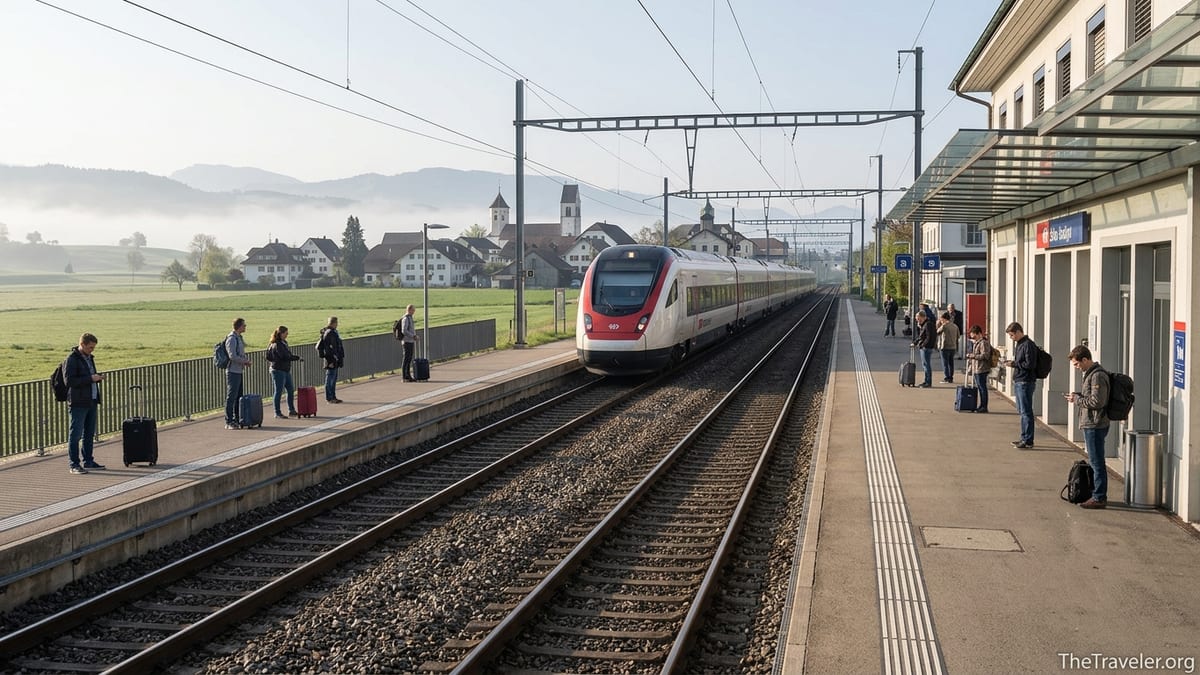
On the map, the Swiss Plateau is the relatively flat belt between the Jura mountains to the north and the Alps to the south. By rail, it reads like a string of city names on the departure board: Geneva, Lausanne, Fribourg, Bern, Olten, Zurich, Winterthur, St Gallen. Fast InterCity and InterRegio trains run along this corridor at least hourly, often every 30 minutes on key sections such as Geneva to Lausanne and Bern to Zurich. A current SBB long-distance network map shows continuous lines of IC and IR services across this band, making it the backbone for rail-based travel in Switzerland.
Trains in this region fall into a few categories that matter for visitors. InterCity (IC) and InterRegio (IR) trains are the long-distance workhorses linking major cities with few stops. RegioExpress (RE) and regional trains connect mid-size towns and scenic side valleys, while S-Bahn services operate as high-frequency suburban trains around urban areas like Zurich, Bern and Lausanne. For example, the IR "Aare Linth" line connects Bern, Zurich and Chur hourly across the Plateau via Burgdorf and Glarnerland, and is marketed by Switzerland Tourism as one of the most attractive ways to move between city, countryside and river landscapes.
For a rail-focused trip, this hierarchy means you can comfortably rely on public transport for everything from intercity hops to local errands. A visitor arriving at Zurich Airport, for instance, can step directly onto an IC to Bern or an IR to Lucerne from the underground platforms, while S-Bahn services reach nearby towns every few minutes. You do not need to understand the full timetable in advance; planning around the main east–west spine and adding short regional hops as needed is usually enough.
Because trains are so integrated, it is common to combine modes in a single day. You might take an IC from Lausanne to Bern in the morning, switch to an RE into the Emmental for a village walk, then return via an S-Bahn to Bern and a late IC back to your base. All of these segments are shown on the SBB network and in the national timetable, making spontaneous side trips easy as long as you keep an eye on the frequency of the last return train.
Choosing the Best Base: Geneva, Lausanne, Bern, Zurich and St Gallen
Several cities on the Swiss Plateau work extremely well as railway bases, each with a slightly different character. At the western end, Geneva and Lausanne sit on Lake Geneva, with grand promenades and quick access into nearby wine villages. Geneva’s Cornavin station has direct IC services to Lausanne, Bern, Zurich and St Gallen as well as frequent airport shuttles, which makes it convenient for short stays or late arrivals. Lausanne’s station sits on a hill above the lake and has slightly more central access to the Plateau, with fast connections in both directions.
Bern, in the middle of the country, is often the most efficient base for a rail-heavy itinerary. Its station is directly attached to the UNESCO-listed old town via a short, level walk. From Bern, IC and IR services radiate in every direction: roughly 1 hour 40 minutes to Geneva Airport, about 1 hour to Basel, around 1 hour 20 minutes to Zurich, and quick links south toward Thun and Spiez if you want a taste of the Alps. For travelers with four to six days, staying in Bern and adding day trips west to Fribourg and Gruyères or east into the Emmental and Lucerne can keep changes of hotel to a minimum.
Further east, Zurich and nearby Winterthur are strong choices for travelers focused on culture, shopping and flight connections. Zurich Hauptbahnhof is the busiest station in the country, but it is manageable: platforms are clearly signed, and hotel districts like the old town or Langstrasse are a 5 to 10 minute walk away. From Zurich, direct IC and IR trains reach almost every corner of the Plateau within two hours, including Lausanne, Biel/Bienne and St Gallen. St Gallen itself, near Lake Constance, makes a quieter base with easy rail access to the Appenzell hills and the Bodensee shoreline.
When choosing your base, think about arrival and departure logistics as much as sightseeing. If you fly into Geneva and out of Zurich, a three-base plan such as Lausanne, Bern and St Gallen minimises backtracking along the Plateau. If you prefer to unpack once, Bern or Zurich work well because they sit at junctions of multiple IC lines. Accommodation near the station is often the most practical choice: in Bern or Zurich, hotel areas within 500 meters of the main hall still feel central and safe, and they reduce the need for extra trams or taxis when catching early trains.
Key East–West Rail Connections Across the Plateau
The primary east–west route across the Swiss Plateau links Geneva or Geneva Airport with Lausanne, Bern, Zurich and St Gallen. A current long-distance network diagram from SBB shows this as IC1 and IC5, with hourly or half-hourly services under normal conditions. Typical end-to-end journeys might be around 2 hours 45 minutes from Geneva Airport to Zurich, and just under 4 hours from Geneva Airport to St Gallen, depending on the exact train. These trains usually have restaurant or bistro cars, power outlets and clear luggage racks above and at the end of the carriages.
Parallel to this main line are variations that skirt different lakes and mid-sized towns. One IC line runs Lausanne to Biel/Bienne and on to Zurich, giving a scenic arc around the Jura foothills. Another Basel to Zurich route crosses the Plateau via Olten and Aarau, forming an important link if your plans combine the Rhine-side city of Basel with Plateau bases such as Lucerne or Zurich. InterRegio trains often overlay these IC services, offering more stops in towns like Fribourg, Burgdorf, Sursee or Wil.
For visitors, the practical implication is that east–west movement across the Plateau rarely requires long planning sessions. On routes like Lausanne to Zurich or Bern to Zurich, you can usually arrive at the station and find a suitable train within 30 minutes. The SBB Mobile app and station departure boards show IC, IR, RE, regional and S-Bahn departures in one list, usually with platform numbers posted at least 20 minutes before departure for long-distance trains. Even if a direct IC is delayed, an alternative combination of IR and RE services will often get you to your destination only slightly later.
Some of these IC and IR lines are also designated as scenic routes in tourism promotions. The IR "Aare Linth" between Bern and Chur, for example, takes you from the Plateau into river valleys and past Lake Zurich and Lake Walen, making it a pleasant way to link a Plateau base such as Bern with mountain destinations in Graubünden. Similarly, IR trains between Lausanne and Brig follow the upper Rhone valley, which can serve as an informal scenic continuation of a Plateau-focused journey toward the Alps.
Tickets, Passes and How to Pay for Your Plateau Itinerary
Switzerland’s ticketing system is integrated, so one ticket usually covers trains, local buses and city trams within zones or on specified routes. For a rail-intensive trip along the Swiss Plateau, many visitors consider national passes. The Swiss Travel Pass remains the most widely known option for tourists, offering unlimited travel on most trains, buses and boats, plus city trams and buses in about 90 towns. A 6-day Swiss Travel Pass in 2nd class in 2026 is listed at just under 400 Swiss francs on official sales materials, with youth and flex versions priced somewhat lower. Exact tariffs are published by Alliance SwissPass and can be checked shortly before travel.
For those staying longer in one city and doing fewer long-distance days, the Swiss Half Fare Card or regional products may be more cost-effective. The Half Fare Card lets you buy almost every ticket at half price for a set period, which can make sense if your plan combines a few IC journeys across the Plateau with discounted mountain railways or lake boats. In many Plateau cities, hotel guests also receive a free local transport card, valid on trams and buses within city limits, which reduces the need to pay separately for short hops between your hotel and the station.
Buying individual tickets for each journey is straightforward, especially for shorter trips like Bern to Thun or Zurich to Winterthur. Ticket machines at all major stations have English-language options and accept credit cards, and the SBB Mobile app allows you to purchase digital tickets right up to departure time. If you are using a Swiss Travel Pass or another valid pass, you simply board and show it during on-board inspections, occasionally together with a passport or identity card. Seat reservations are generally not required on IC or IR trains along the Plateau, though they are possible for a small fee if you want extra peace of mind on busy holiday weekends.
When comparing passes, sketch out your likely journeys with approximate fares from the SBB timetable and add in potential extras such as mountain day trips from Lucerne or lake cruises from Lausanne. If the sum of these point-to-point fares is close to the price of a Swiss Travel Pass or Half Fare Card, the flexibility of a pass often justifies the small difference. Always allow a margin for unplanned side trips; the ease of hopping off at a village like Murten or Rapperswil for an hour is one of the joys of traveling the Plateau by rail.
Using Luggage Services and Traveling Light
One of the biggest advantages of a rail-focused trip on the Swiss Plateau is that you can minimize the hassle of moving luggage between bases. Major stations from Geneva Airport through Lausanne, Bern, Lucerne, Zurich and St Gallen all offer a mix of self-service lockers and staffed left-luggage offices. Lockers typically come in several sizes with prices that are moderate by Swiss standards, and they allow you to store a suitcase for a few hours while you explore a city between trains.
For those who prefer to travel with just a daypack, SBB offers station-to-station and door-to-door baggage transport services. According to SBB’s own information, standard station-to-station service usually delivers your luggage in about two days between participating stations, while express services and home delivery options can shorten that time on selected routes. You check in your suitcase at the luggage counter of your departure station and collect it from the destination station or have it delivered to a hotel that participates in the program. This can be especially useful if you want to travel from, for example, Lausanne to St Gallen with an overnight stop in Bern, carrying only a small overnight bag on the train.
On board, long-distance trains provide overhead racks for small and medium bags and dedicated luggage spaces near doors. Boarding is level or nearly level at most Plateau stations, though there may be a small step up into older carriages. If you can, pack in a suitcase you can comfortably lift onto a rack about chest height. Crowded peak-hour commuter trains around Zurich and Geneva are easiest to navigate with one rolling suitcase and a backpack rather than multiple loose bags.
A practical strategy is to plan one or two luggage-moving days between bases and then focus the rest of your itinerary on out-and-back day trips from a single hotel. For example, you might spend four nights in Bern with a single suitcase and use light daypacks for excursions to Fribourg, Murten, Solothurn or Lucerne. If you choose to use SBB baggage services, check the latest cut-off times and participating stations shortly before travel, as conditions and prices are updated periodically.
Easy Day Trips by Train from Classic Plateau Bases
From each Plateau base, a cluster of easy day trips lies within an hour or so by train. From Geneva or Lausanne, frequent regional and RegioExpress trains run along Lake Geneva to Nyon, Morges, Vevey and Montreux. A typical day might see you ride a morning train from Lausanne to Vevey in about 20 minutes, stroll the lakeside and the old town, then continue to Montreux for an afternoon walk before returning via a fast IC to Lausanne in the evening. Wine villages in the Lavaux terraces, like Cully or Epesses, are also reachable by local trains that stop above the vineyards.
From Bern, popular outings include the medieval city of Fribourg, around 20 to 25 minutes away on IR or RE trains, and the double-walled town of Murten, reached by a short connection at Kerzers. Solothurn, often called Switzerland’s most beautiful baroque town, sits about 40 minutes from Bern on direct trains. If you want a taste of the Alps without leaving the Plateau corridor entirely, you can ride an IC or IR south to Thun and then continue along Lake Thun or transfer toward Interlaken.
Zurich offers its own network of straightforward day trips. RegioExpress trains and S-Bahn lines follow the lake to Rapperswil, a small town with a castle and lakeside promenade, generally under 40 minutes away. Winterthur, about 20 minutes from Zurich HB by frequent trains, combines a walkable old town with art museums and gardens. St Gallen, roughly one hour away on IC and IR services, rewards a visit for its baroque abbey library and compact center. These trips can all be done with simple return tickets or covered by passes.
For travelers based in Lucerne, which sits just at the southern edge of the Plateau, fast IR trains link back into the main east–west corridor at Olten and Zurich. A day to Aarau, for example, offers cobbled streets and painted gabled houses less than an hour away, while Zug, halfway to Zurich, charms with its lakeside sunsets. Because journey times on many of these day trips are under an hour, you can comfortably return to your base for dinner even after a long afternoon stroll.
Exploring Cities and Towns Without a Car
Once you step off the train on the Swiss Plateau, you rarely need a car to explore. City centers in Bern, Zurich, Lausanne and Geneva are built around pedestrian streets, tram lines and riverfront promenades. From Bern station, a few minutes on foot lead into the arcaded Kramgasse and down to the Aare River, while trams head toward the Paul Klee Center or the Gurten funicular. Zurich’s main station opens directly onto the Bahnhofstrasse shopping avenue and the Limmatquai, with trams and lake boats forming a web of transport that is easy to navigate with a city map or app.
Medium-sized Plateau towns are often even simpler. In Fribourg, Solothurn or St Gallen, the old town is generally within a 5 to 10 minute walk from the station, and wayfinding is supported by clear brown tourist signs. Regional buses connect railway hubs with outlying villages and viewpoints. For example, from Murten station, local buses run to lakeside hamlets and trailheads along Murtensee. In winter, these same bus lines often serve small ski lifts on the Plateau’s modest hills, allowing spontaneous half-day outings from your base.
Most Plateau cities are covered by integrated fare networks, where a single ticket or pass is valid on trains, trams, buses and sometimes lake boats within certain zones. If you are staying in a hotel in cities such as Bern, Geneva or Lausanne, you will typically receive a guest card that provides free or discounted public transport within the local area. This can cover your tram from the station to your hotel on arrival and back again on departure, further reducing the need to think about taxis or rideshares.
Walking remains the best way to experience many Plateau towns, especially those with medieval cores and riverside paths. Surfaces are usually well maintained, though there can be hills, as in Lausanne, and cobblestones in historic centers. Comfortable walking shoes are enough for most visitors, and if mobility is a concern, trams and funiculars help soften the steepest climbs. Because distances are short, it is entirely realistic to arrive by train in the morning, explore a town on foot for several hours, enjoy a meal and return to your base all in one leisurely day.
The Takeaway
Traveling the Swiss Plateau by train is less about ticking off famous mountain peaks and more about settling into the rhythms of everyday Swiss life. The region’s dense network of IC, IR, RE and S-Bahn services lets you move freely between lakefront promenades, baroque town squares and rolling farmland without the stress of driving or parking. With a thoughtful choice of base in cities like Lausanne, Bern or Zurich, you can cover a wide swath of the country through easy day trips and relaxed rail journeys.
For many travelers, the sweet spot is a flexible pass, a single suitcase and a willingness to improvise. Use long-distance trains to bridge the main gaps along the Plateau, then switch to regional lines and city trams for finer detail. Take advantage of baggage services if you prefer traveling light between bases, and remember that many hotels include local transport cards that simplify your movements on arrival. Above all, allow time to step off the fast trains, wander through smaller towns, and watch daily life unfold on station platforms and cafe terraces.
FAQ
Q1. Do I need to reserve seats on Swiss Plateau trains?
Seat reservations are generally optional on InterCity and InterRegio trains across the Plateau. Most travelers simply board with a valid ticket or pass and find any free seat.
Q2. Which city is the best base for exploring the Swiss Plateau by train?
Bern and Zurich are the most practical all-round bases, thanks to their central locations and dense rail connections, but Lausanne, Geneva and St Gallen also work very well.
Q3. Is the Swiss Travel Pass worth it for a Plateau-focused trip?
It can be good value if you plan several long-distance train days plus local trams and buses. Compare the pass price with approximate point-to-point fares from the SBB timetable.
Q4. How often do trains run between Geneva, Lausanne, Bern and Zurich?
On this main east–west corridor, you can usually expect at least hourly IC or IR services, often every 30 minutes on busy sections such as Geneva to Lausanne and Bern to Zurich.
Q5. Can I send my luggage ahead instead of carrying it on trains?
Yes. SBB offers station-to-station and door-to-door baggage services on many routes, typically delivering standard luggage in about two days, with some faster options.
Q6. Are Swiss Plateau cities walkable from the station?
In most cases, yes. Old towns in Bern, Fribourg, Solothurn, St Gallen and many others start within a 5 to 10 minute walk of the station, often supported by local trams or buses.
Q7. Do I need a car to visit small towns and villages on the Plateau?
No. Regional trains, RegioExpress services and local buses reach many villages and trailheads, and timetables are coordinated so that connections are usually smooth.
Q8. How early should I arrive at the station before my train?
For domestic IC and IR trains, arriving 10 to 15 minutes before departure is usually enough time to find your platform, board calmly and store your luggage.
Q9. Is it easy to travel with children on Swiss trains?
Yes. Trains usually have family-friendly spaces, room for strollers and clean toilets, and many discount schemes or free travel options exist for younger children with passes.
Q10. Can I combine Plateau train travel with scenic mountain routes?
Absolutely. The Plateau’s IC and IR lines connect smoothly to scenic routes such as those toward Interlaken, Lucerne, Chur and beyond, so you can add mountain days without renting a car.