


The broad Swiss Plateau between Zurich and Bern is often rushed through on the way to the Alps, yet two cantons here quietly reward travelers who slow down: Aargau and Solothurn. Both offer riverside historic towns, castle-dotted hills and easy train access, but the feel on the ground is different. This internal Plateau comparison looks at how each region performs for characterful towns, castles, thermal spas, cycling, countryside breaks, hotels and logistics for couples and families, and asks the practical question: if you have limited days, which area deserves more of your time?
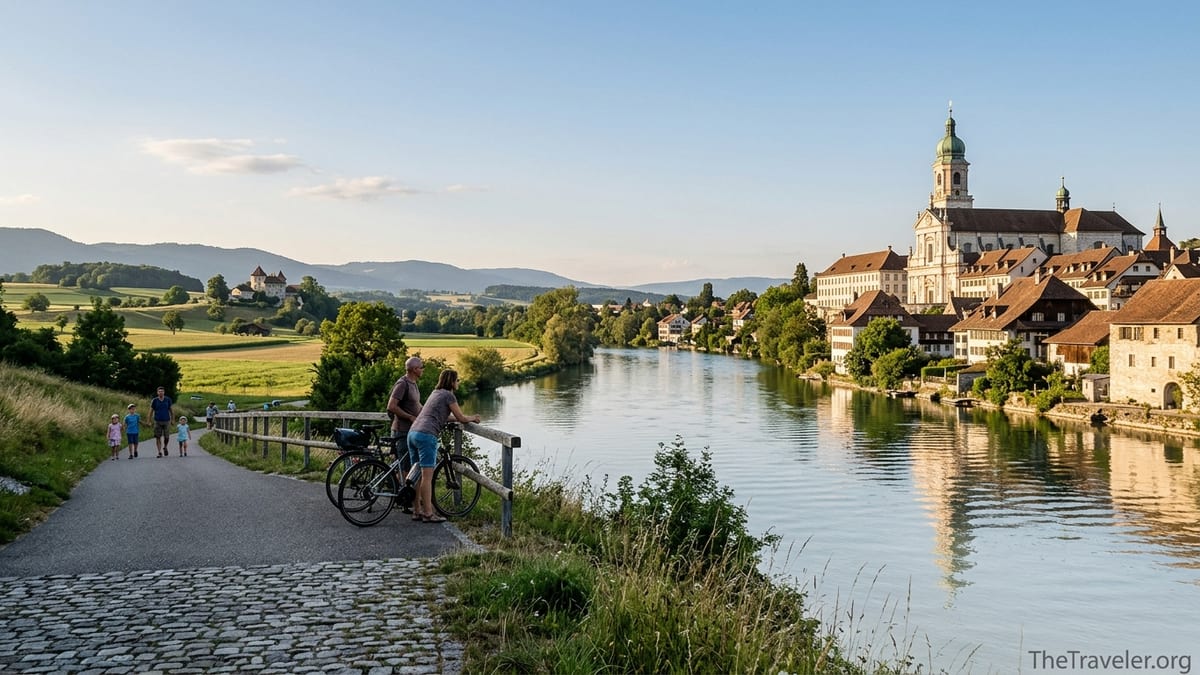
Setting the Scene: Two Plateau Cantons With Different Personalities
Aargau and Solothurn sit side by side on the Swiss Plateau, yet their identities are distinct. Aargau, stretching west from the edge of Zurich, is river country: the Aare is joined here by the Reuss and Limmat, and castle sites cluster around this historic crossroads near Brugg, where medieval Habsburg power and Roman Vindonissa once dominated the landscape. The canton today mixes quiet farmland, small industrial towns and pockets of surprisingly grand heritage around places like Lenzburg, Hallwyl and Baden.
Solothurn, farther west, is more compact and focused. Its capital, also called Solothurn, is often described by Swiss tourism authorities as the country’s most beautiful baroque town, with a pedestrian old core built between the 16th and 18th centuries, grand squares and mansions reflecting its role as the seat of the French ambassador. The city sits directly on a curve of the Aare beneath the Jura foothills, which rise steeply to viewpoints like Weissenstein, so the impression is of a small, self-contained city pressed between river and mountains.
For visitors, this matters because it shapes how you use your time. Aargau lends itself to road trips or rail-based day excursions that stitch together castles, thermal baths and small towns. Solothurn works particularly well as a base: you can spend a full day in its baroque streets, then head out by bike or train along the Aare or up into the Jura for varied day trips without changing hotels. The choice between them is less about absolute “must-sees” and more about the style of trip you prefer.
Costs are broadly similar: expect mid-range hotel doubles in either canton to start roughly around 160 to 220 Swiss francs per night in high season, with simple guesthouses and rural B&Bs a bit less. Rail fares are standardized nationwide, so the real differentiator is not price but the density of experiences around where you decide to stay.
Historic Towns and Castles: Where to Immerse in the Past
If you travel for historic towns, Solothurn’s capital is the heavyweight. Its compact, pedestrian old town runs from the riverside to the St Ursus Cathedral terrace, with baroque townhouses, fountains and towers in quick succession. You can easily spend half a day wandering from the Aare quay up to the cathedral, then on to Palais Besenval by the river and the former city gates, stopping for coffee on streets that still follow the medieval pattern. The whole center is walkable in 10 to 15 minutes, which is ideal for a relaxed city break or families with younger children who tire quickly.
Beyond the capital, the canton of Solothurn’s charm lies in its small towns and villages along the Aare and the southern Jura foot. Places like Wiedlisbach, with its preserved gate tower, and fortified hilltops such as Neu-Bechburg Castle near Oensingen, add variety within an easy regional train hop from Solothurn. These are not blockbuster sights in the sense of Lucerne or Bern, but for travelers who enjoy “everyday” Swiss history, they make for satisfying half-day excursions combined with short walks or a countryside lunch.
Aargau, by contrast, spreads its heritage over a much larger area, and it shows best when you treat it as a mini tour rather than a single city break. Lenzburg Castle, towering over its old town, ranks among the more impressive fortress complexes in northern Switzerland and appeals to families with its child-friendly exhibits and views over the Plateau. Hallwyl Castle sits low among reeds and water channels near Lake Hallwil, a classic moated castle that feels almost theatrical when approached over the walkways. Around Brugg you can still sense the convergence of history at Habsburg Castle, the Habsburg family’s ancestral seat, and the remains of the Roman legionary camp at Vindonissa at nearby Windisch.
If castles are your priority, and you are willing to move around by car or train, Aargau comes out ahead. You could realistically visit Lenzburg and Hallwyl in one full day from Zurich or Baden, adding Habsburg on a second day. If your time is short and you want one strong historic town experience without much moving, Solothurn city offers more concentrated atmosphere within a compact footprint.
Thermal Spas and Relaxation: Aargau’s Edge vs Solothurn’s Simplicity
When it comes to thermal water and spa culture, Aargau clearly has the upper hand. The canton is known within Switzerland for its thermal springs, with Baden and Bad Zurzach as two key hubs. In Baden, a long tradition of bathing on the Limmat has recently been reinforced by new and refurbished facilities. Hotels and day spas here offer thermal pools, saunas and wellness packages that attract both weekenders from Zurich and international travelers looking to combine culture with relaxation. Day entry to a quality thermal complex in this area typically runs around 35 to 55 Swiss francs per adult, depending on how extensive the sauna and wellness areas are.
Further north in Bad Zurzach, near the German border, spa hotels make good use of the region’s hot springs. Stays here tend to be oriented toward health and multi-day relaxation, with half-board deals that can be good value by Swiss standards. A couple might pay around 220 to 280 francs per night including breakfast and dinner, plus access to thermal pools. This cluster of well-established spa towns means Aargau works particularly well if part of your Plateau time is meant to be spent in the water rather than on the move.
Solothurn does not have comparable large-scale thermal resorts. Relaxation here is more about riverside life and proximity to nature. In summer, locals swim in the Aare, using riverside platforms and informal access points, and many hotels and guesthouses provide information on safe swimming stretches and currents. Wellness offerings tend to be hotel-based saunas or small spa areas rather than destination complexes, and you will not find the same density of thermal facilities as in Aargau.
For travelers viewing this as a “commercial decision” on where to invest limited vacation days, this is one area where Aargau justifies an extra night. If two days of your trip are dedicated to hot springs and saunas, basing yourself in Baden or Bad Zurzach and then using the remaining time for nearby castles and countryside can create a very coherent Aargau-centered itinerary.
Cycling, Walking and Countryside: Comparing Everyday Landscapes
Both cantons sit on the Swiss Plateau, which is generally gentler than Alpine regions, but their landscapes feel different. The Solothurn region is defined by the Aare river corridor and the immediate rise of the Jura. Signposted national and regional cycle routes pass through, including stretches of the Aare Route that bring riders along the river via historic places like Büren an der Aare, known for its covered wooden bridge and preserved old town, before continuing to Solothurn. For more variety, the Jurasüdfuss Route follows the southern foot of the Jura, mixing flat valley riding with views of cliffs and wooded ridges overhead.
This makes Solothurn an excellent base for day cycling. You might, for example, rent an e-bike in Solothurn, follow the Aare downstream to Altreu to watch storks nesting on rooftops, then continue to Büren for lunch in the historic center before returning by bike or regional train. Families with older children can manage such a day comfortably, with plenty of opportunities for river swims and playground stops. Mountain bikers can head toward Jura foothill routes, while walkers can use the cable car up Weissenstein above Solothurn for panoramic ridge hikes looking south to the Alps on clear days.
Aargau’s cycling is more dispersed but rewarding if you are willing to plan. Gentle river valleys along the Aare, Reuss and Limmat provide relaxed routes, and riders often stitch together castle visits into themed outings, such as a circuit that links Aarburg’s fortress above the Aare with Lenzburg and smaller hilltop ruins. The Plateau here features rolling farmland, fruit orchards and pockets of forest rather than dramatic mountain scenery, which can suit travelers who prefer low-gradient routes and frequent villages rather than remote passes.
For countryside stays, Aargau offers more traditional farm guesthouses and small inns scattered across villages, ideal for travelers with a car or those who are comfortable with infrequent bus services. Solothurn’s rural side is more tightly organized around the Jura foothills and the river valley, allowing easy access by train or bike from the city. In effect, Solothurn is stronger if you want to combine one urban base with multiple nature day trips, while Aargau better serves those who enjoy moving from village to village, perhaps by car, discovering quieter corners of the Plateau.
Hotels, Character Stays and Value for Money
Hotel choice can influence how much time you feel is justified in a region. Solothurn city centers its accommodation in and around the old town and riverfront. Many properties occupy converted historic buildings with thick walls, creaking staircases and views of either the Aare or the cathedral’s distinctive green dome tower. Standard double rooms in mid-range hotels commonly range around 180 to 230 Swiss francs per night in busy summer months, with simpler rooms or business-style hotels on the outskirts sometimes dipping below that.
Because the city is small, staying steps from the old town is easy without paying big-city premiums. This works well for couples looking for atmosphere, as you can stroll to dinner along the river, attend an evening event on the cathedral steps or in a baroque courtyard, and be back in your room in minutes. Families benefit from the car-light core and short walking distances: older children can explore a nearby square or ice cream shop without navigating complex streets or public transport hubs.
Aargau’s accommodation is more spread out. In Baden and Bad Zurzach, spa hotels dominate the mid to upper ranges, with facilities like extensive wellness floors, outdoor thermal pools and restaurant terraces overlooking rivers or gardens. Prices can be similar to Solothurn’s old-town hotels, but here part of the value is the inclusion of spa access or half-board meals. In smaller Aargau towns such as Lenzburg, Brugg or Rheinfelden, you will find a mix of modest business hotels and a few boutique properties in historic houses, but the density is lower than in Solothurn city.
For travelers looking at value, Aargau can come out ahead if you actually use the thermal and wellness features included in rates. A two-night package with dinners and spa access in Baden may deliver more tangible inclusions than a similarly priced stay in Solothurn’s old town. However, if your focus is culture, street life and easy restaurant hopping without committing to spa time, Solothurn’s concentration of characterful lodgings around its baroque streets may feel like a better use of your budget.
Rail Access and Practical Logistics
Rail access is a strong point for both cantons, but it shapes itineraries differently. Solothurn sits on a main east-west line between Olten and Biel, with frequent direct services to cities like Bern and Zurich. The station is just across the river from the old town, an easy 5 to 10 minute walk across the main bridge, so you can arrive by train and be in the heart of the baroque center quickly, even with luggage. From Solothurn, regional trains run to Jura foothill communities and along the Aare corridor, enabling car-free excursions to smaller towns and walking areas.
Aargau is more of a network. Key hubs include Aarau, Baden, Brugg and Lenzburg, all of which lie on major lines radiating from Zurich and Olten. This gives excellent connectivity if you are willing to move your base: for example, you might stay in Baden for thermal baths and day trip by short train ride to Zurich, or overnight in Lenzburg to access its castle and use the station as a springboard for exploring other Aargau towns. Travel times from Zurich to many Aargau destinations are typically around 15 to 40 minutes by direct train, making the canton attractive for shorter add-ons to a Zurich stay.
For a traveler choosing where to allocate more days, this means Solothurn is the more straightforward single-base option. You can check into one hotel in the capital and use simple, frequent trains to explore without constantly adjusting to new station layouts or timetables. Aargau, on the other hand, rewards those comfortable reading the rail map and hopping between several stops over a few days. If your party includes less experienced travelers or young children, the simplicity of Solothurn’s one-hub layout may be preferable.
Both regions integrate well with Swiss Travel Passes and regional day tickets. If you plan to use boats where available or multiple trains each day, passes can offer savings, but because distances here are relatively short, many visitors instead rely on point-to-point tickets or Saver Day Passes bought in advance. Either way, neither canton presents unusual logistical challenges compared to the rest of the Swiss network.
Best For Couples, Families and Different Travel Styles
Couples often weigh atmosphere, dining and ease of exploring on foot when choosing where to spend more time. On those criteria, Solothurn has a slight edge. Its riverside promenade, café terraces and baroque backstreets create an inherently romantic setting, especially in the evening when façades and the cathedral steps are softly lit. You can dine in a vaulted medieval cellar, then walk out to the Aare to watch the river flow past with distant lights reflecting on the water. Daytime options include an unhurried city walk, a short train trip to a Jura cable car for a ridge hike, or a boat excursion along the river in the warmer months.
Aargau is appealing to couples who prioritize wellness and varied day trips over a single picture-perfect old town. A long weekend split between Baden’s thermal quarter and a castle circuit around Lenzburg and Hallwyl, perhaps with a countryside walk in the Reuss valley, can feel restorative and varied. Evenings may be quieter than in Solothurn’s compact bar quarter, but couples who enjoy spa dinners, early nights and morning swims in thermal pools will likely prefer investing time here.
For families, the calculation depends heavily on interests and ages. Younger children often respond well to castles and hands-on experiences. In that respect, Aargau’s Lenzburg Castle, Hallwyl’s moated walkways and the fortress above Aarburg provide strong, imaginative backdrops for stories of knights and sieges. If you combine these with family-friendly thermal pools where children are welcome, a three or four day Aargau stay can be very successful. However, you will need to manage more train or car transfers between sites.
Solothurn city works better for families who value simplicity and freedom to roam. The old town’s pedestrian areas allow school-age children some independence, and there are playgrounds and open spaces near the river where they can let off steam. Cycling along the Aare on mostly flat paths is achievable even with older primary-school children, and swimming in the river under local guidance can become a trip highlight for teenagers. With everything focused around one compact city, parents spend less time navigating and more time actually doing things together.
The Takeaway: Which Area Deserves More of Your Time?
For travelers deciding where to invest more days on the Swiss Plateau between Zurich and Bern, the choice between Aargau and Solothurn comes down to trip style. If your priority is a single, atmospheric base with strong baroque character, riverside life, straightforward rail logistics and easy access to cycling and Jura foothill walks, Solothurn justifies more time. Two to three nights based in Solothurn city allow a full day in the old town, another for bike or river excursions, and a third to head into the Jura or along the Aare without feeling rushed.
If, however, you are drawn to thermal spas and castles and are happy to move a bit more, Aargau is the better candidate for extended exploration. A three or four night itinerary that splits time between Baden or Bad Zurzach for baths and Lenzburg or Brugg for castles and countryside delivers varied experiences across a compact area, even if any single town feels less dramatic than Solothurn’s capital. This is especially true for families with castle-obsessed children or couples who treat spa time as the center of their holiday.
For many visitors with a week in northern Switzerland, a blended approach works best. Spending two or three nights in Solothurn for baroque urban life and Jura views, followed by another two or three in Aargau’s spa and castle belt, gives a rounded picture of the Plateau that most tourists speed past from the train window. If you must choose, and want one place that feels instantly special on arrival, Solothurn edges ahead as the area that deserves more of your limited time, with Aargau an excellent extension for travelers who can stay longer or who place a premium on soaking in warm mineral water between castle visits.
FAQ
Q1. Is Aargau or Solothurn better for a first-time visitor to the Swiss Plateau?
For a first-time visit focused on one base, Solothurn is usually better. Its compact baroque old town, riverside setting and straightforward rail access create an immediate sense of place without needing a car or complex planning.
Q2. How many days should I plan in Solothurn compared with Aargau?
Solothurn works well for two to three nights, giving time for the old town, a cycling or walking day, and a Jura foothill excursion. Aargau benefits from three or more nights if you want to combine thermal baths, several castles and some countryside walking or cycling.
Q3. Which region has the more impressive castles?
Aargau has a higher density of notable castles, including Lenzburg, Hallwyl and Habsburg near Brugg, making it the stronger choice if castles are a major trip focus. Solothurn offers a few scenic sites and fortified towns, but not the same concentration.
Q4. Are there good thermal spas in Solothurn?
Solothurn itself does not have large destination thermal resorts. Most wellness offerings are smaller hotel spas and saunas. For substantial thermal complexes with multiple pools and saunas, Aargau’s Baden and Bad Zurzach are better options.
Q5. Which area is better for cycling with children?
Both regions offer family-friendly cycling, but Solothurn’s stretches of the Aare Route and the Jurasüdfuss Route stand out for flat riverside riding and clear signposting, with plenty of villages, playgrounds and river access points along the way.
Q6. Do I need a car to explore Aargau and Solothurn properly?
You can explore both largely by train and bicycle. Solothurn in particular works very well without a car. In Aargau, public transport reaches all main towns, but a car or e-bike makes it easier to link scattered castles and rural guesthouses in a single day.
Q7. Which region offers more romantic settings for couples?
Solothurn has the more immediately romantic setting, with its baroque streets, riverside promenade and compact old town ideal for evening strolls and intimate dinners. Aargau is more about spa hotels and scenic castles, which also appeal to couples who prioritize wellness.
Q8. Is either canton a good base for day trips to the Alps?
Both are within a few hours by train of Alpine destinations, but they are not the most efficient bases for intensive Alpine touring. They work better as a Plateau-focused segment of a longer Swiss itinerary, perhaps combined with separate stays in Lucerne, Interlaken or the Bernese Oberland.
Q9. How do hotel prices compare between Aargau and Solothurn?
Average prices are broadly similar, with mid-range doubles often starting around 160 to 220 Swiss francs per night. Aargau’s spa hotels may offer good value if you use included wellness facilities, while Solothurn’s charm lies in staying right in the old town without big-city premiums.
Q10. If I can only choose one, which area deserves more of my time?
If you must choose, Solothurn deserves more time for its concentrated baroque charm, riverfront life and easy cycling and hiking access from a single base. Aargau becomes the priority only if thermal spas and castle-hopping are your main reasons for visiting the Swiss Plateau.