


Snow capped peaks, glassy lakes and trains that glide in almost to the water’s edge make Switzerland one of Europe’s easiest countries to explore without a car. With a single rail pass and a rolling suitcase, you can link Zurich, Lucerne, Interlaken, Montreux and Lugano in a smooth lake hopping journey that feels more like a holiday than a transit puzzle. This guide walks through a practical, commercial ready itinerary, explaining exactly how to connect the major lake regions by train and boat, how long each leg takes and how to manage luggage so you can stay comfortably car free.
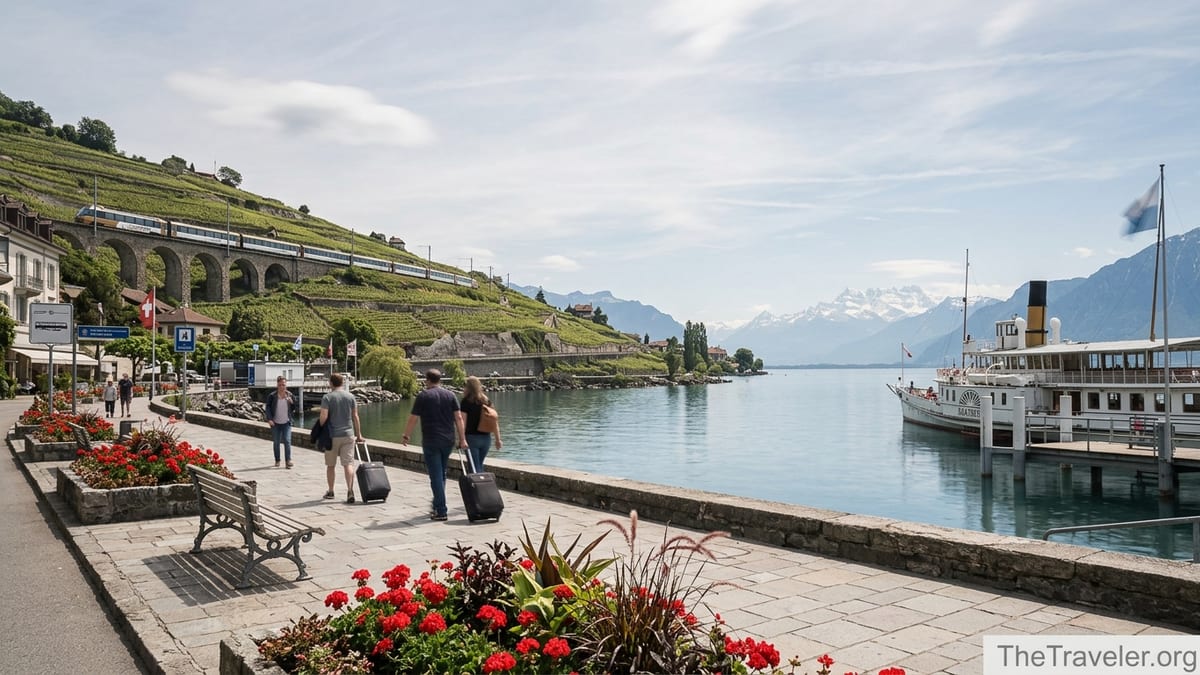
Why a Car Free Swiss Lakes Itinerary Works
Switzerland’s public transport is designed to replace the need for a car, not compete with it. Trains, boats and mountain railways share a single national timetable, so a train arriving in Lucerne at 10:00 will often connect directly to a Lake Lucerne boat departing a few minutes later. On the main Swiss Federal Railways lines between Zurich, Lucerne, Interlaken, Montreux and Lugano, departures are typically at least hourly and in many cases every 30 minutes.
For visitors, the Swiss Travel Pass acts as a single ticket across most of this network. Available for 3, 4, 6, 8 or 15 consecutive days, it covers almost all regular trains, many mountain railways at a discount and most scheduled boats, including services on Lake Lucerne, Lake Thun, Lake Brienz and Lake Geneva. As of 2024, a 4 day second class Swiss Travel Pass for adults is priced a little over 300 Swiss francs, while a 6 day pass is closer to 380 francs, giving a clear idea of budget for a multi lake itinerary.
Because the distances between these lake hubs are short, point to point travel days rarely exceed three hours of actual train time. Zurich to Lucerne is about 45 minutes, Lucerne to Interlaken roughly 2 hours on the Luzern Interlaken Express, Interlaken to Montreux around 3 hours on the GoldenPass Express, and Montreux to Lugano about 4 hours with a simple change in Brig or a panoramic option across the Alps. This creates space in the same day for a morning boat ride, an afternoon transfer and an evening lakefront stroll at the next stop.
The other key advantage of going car free is that many of the highlights sit in pedestrian or low traffic zones along the waterfront. Lucerne’s old town and Chapel Bridge, Interlaken’s Höheweg promenade, Montreux’s lakeside flower path and Lugano’s Parco Ciani are all best explored on foot. Trains and boats arrive directly in or beside these areas, so you wheel your suitcase a few hundred meters rather than navigating unfamiliar roads and parking garages.
Passes, Tickets and Seat Reservations
For a commercial style, multi destination itinerary that includes Zurich, Lucerne, Interlaken, Montreux and Lugano, the Swiss Travel Pass is usually the most efficient product. A traveler planning five travel days with some local exploration might choose a 6 day pass in second class, using it not only for the long rail segments but also for city trams and lake boats. For a tighter three day circuit, a 3 or 4 day pass could be enough, with an extra night or two staying put on the lakes where local buses and boats are already included.
Seat reservations on standard InterCity and InterRegio trains are generally not required and most travelers simply board with their pass and sit in any unreserved seat in the appropriate class. For premium panoramic services such as the GoldenPass Express between Interlaken and Montreux, reservations are recommended especially in summer and on weekends. The supplement is modest compared with the value of secured window seats overlooking Lake Thun, the Simmental valley and Lake Geneva.
If your plans are very flexible or you are spending more time based in one place than traveling between cities, a Swiss Half Fare Card can also work. It gives around 50 percent off most tickets for a month for a fixed fee, and you then buy individual tickets for each journey. As an example, a full fare second class ticket between Zurich and Lucerne costs roughly the price of two city museum entries, so frequent movers tend to get better value from the all in one pass while slower travelers benefit from half fare plus point to point tickets.
For families, the Swiss Family Card allows children under 16 to travel for free with a parent holding a Swiss Travel Pass, which can significantly reduce costs on routes like Lucerne to Interlaken or Interlaken to Montreux where everyone wants a window seat. Many lake boats, such as those on Lake Lucerne and Lake Geneva, also accept these passes, simplifying the process of hopping from a lakeside village back to the rail hub without extra tickets.
Zurich to Lucerne: First Lake Connections
Most international arrivals start in Zurich, either at the airport or the main station. From Zurich Airport, direct trains to Zurich Hauptbahnhof run roughly every 10 minutes and take a little over 10 minutes. From the main station to Lucerne, frequent direct InterRegio and InterCity trains cover the 50 kilometer journey in about 45 minutes. On many services, you can see Lake Zug briefly from the windows before reaching Lucerne’s lakefront terminus.
Lucerne station opens almost directly onto the quay where Lake Lucerne boats dock. It is common to arrive from Zurich just before midday, wheel your suitcase across the forecourt to your hotel on Pilatusstrasse or in the old town, and be back at the pier within half an hour for an afternoon cruise. Popular round trips include the one hour loop to Weggis, which connects by cable car to Mount Rigi, or the longer crossing to Flüelen that forms part of the historic Gotthard route.
A traveler staying two nights in Lucerne might dedicate the first afternoon to a basic lake cruise, then use the second day for a more involved “boat plus cogwheel train” circuit such as the famous Golden Round Trip to Mount Pilatus. This typically combines a boat from Lucerne to Alpnachstad, a steep cogwheel railway up to Pilatus Kulm, and two aerial cableways back down to Kriens, from where local buses return to the station. With a Swiss Travel Pass, most of the boat and bus legs are included, and the mountain segments are discounted, making the logistics and budgeting straightforward.
For luggage, Lucerne is compact and many mid range hotels such as those near the Culture and Convention Centre are within a five to ten minute walk of the platforms. If you prefer to travel lighter during the day, SBB offers station to station luggage services where you can check a bag in Lucerne in the morning and collect it in Interlaken or Montreux that afternoon or the next day, freeing you to step on and off boats with only a daypack.
Lucerne to Interlaken: Lakes, Passes and Panoramic Rail
The Luzern Interlaken Express is one of the most scenic ways to link central Switzerland with the Bernese Oberland. Trains generally depart Lucerne every hour, taking just under 2 hours to reach Interlaken Ost. Large panoramic windows frame views of Lake Lucerne at the start, then a string of lakeside villages, meadows and mountain passes, including the lakes at Sarnen and Lungern.
Because this is a regular part of the national timetable, you board with your Swiss Travel Pass or ticket as on any InterRegio service, yet the experience feels like a dedicated tourist train. Many travelers choose a mid morning departure, for example around 9 or 10, which brings you to Interlaken in time for lunch and an afternoon excursion on Lake Thun or Lake Brienz. From Interlaken Ost, a short walk or a two minute train hop brings you to Interlaken West, closer to Lake Thun and many hotels.
Boat and train combinations are easy to arrange here. One common pattern is to check into a hotel near Interlaken West, walk to the Lake Thun pier and board a boat bound for Spiez or Thun, then return to Interlaken by train in the evening. The boat from Interlaken West to Spiez typically takes a little over 2 hours, gliding past lakeside castles and vineyards, while the direct regional train from Spiez back to Interlaken takes about 20 minutes.
On Lake Brienz, boats depart from the quay directly in front of Interlaken Ost. A popular half day route is to take the boat to Giessbach, ride the historic funicular up to the Giessbach Falls and hotel terrace, then return either by boat or a mix of bus and train from Brienz. If you prefer more time on the water, a full loop cruise from Interlaken Ost to Brienz and back takes around 3 hours, making it an easy sunset outing after a rail travel day.
Interlaken to Montreux: GoldenPass Express and Lake Geneva
The flagship connection between Interlaken and Montreux is the GoldenPass Express, a through panoramic train that typically runs several times per day. The full journey takes around 3 hours, crossing from the Bernese Oberland over to the vineyards above Lake Geneva. The train follows the shores of Lake Thun briefly, then climbs through the Simmental and Saanenland pastures, passing Gstaad and descending through vineyards to Montreux with sweeping views of the lake.
Reservations for the GoldenPass Express are recommended, particularly if you want seats in the panoramic or prestige class sections. There is usually a modest surcharge on top of your Swiss Travel Pass or standard ticket. Travelers who prefer complete flexibility can also take regular regional trains via Spiez and Zweisimmen with simple changes, which adds little to the total journey time and still offers impressive scenery.
On arrival in Montreux, the station sits just above the lakeside promenade. It is common to step off the train, descend via escalators and be standing beside Lake Geneva within five minutes. Hotels line the waterfront, from traditional Belle Epoque properties with balconies over the water to contemporary apartments a short stroll inland. For a classic first evening, many visitors walk east along the flower lined path to the area near Château de Chillon, then return by local bus or a short regional train.
Lake Geneva boats link Montreux with Vevey, Lausanne and the French shore, and many daytime services are covered by the Swiss Travel Pass. A typical half day outing might involve a late morning paddle steamer from Montreux to Vevey, lunch in the old town and a return by train in less than 10 minutes. Another option is an afternoon cruise westwards towards Lausanne and back, timing your return to coincide with golden hour over the Alps on the French side of the lake.
Montreux to Lugano: Crossing the Alps by Rail
To reach Lugano from Montreux without a car, most travelers change trains once or twice, often in Brig and sometimes in Zurich or Arth Goldau. A common fast route is Montreux to Brig in about 1 hour, then Brig to Bellinzona in roughly 1 hour 45 minutes through the Alps, and finally Bellinzona to Lugano in about 30 minutes. The total travel time usually comes in just under 4 hours, which still leaves room the same day for a lakeside walk in Lugano.
The modern base tunnel routes under the Alps provide quick, comfortable rides with large luggage racks and level boarding. If you prefer more scenery over speed, regional routes over old mountain passes are also possible in the timetable. For example, travelers sometimes choose a slower but more panoramic line over the old Gotthard route between German speaking Switzerland and Ticino, trading an extra hour on the train for spiraling loops, stone bridges and deep valley views.
Lugano station lies on a hill above the lake, connected to the waterfront by a short funicular that runs frequently throughout the day. Hotels cluster along the lakeside and in the parallel streets behind, so it is realistic to roll a suitcase from the funicular exit to your accommodation in under 10 minutes. The town’s main park, Parco Ciani, stretches along the waterfront with shaded paths and boat piers.
Lake Lugano boats connect Lugano with villages such as Gandria, Morcote and Melide, making boat plus train days easy to arrange. One example is to take a mid morning boat to Morcote, explore its steep lanes and church terraces, then return by boat or by regional bus and train via Melide, where you can also visit the Swissminiatur attraction. Another half day idea is a shorter boat ride to Gandria for lunch on a terrace above the water, returning on foot along the Olive Tree Trail and by bus to central Lugano.
Luggage, Stations and Practical Timing
One of the biggest concerns for car free travelers is luggage, especially when combining trains and boats. In practice, the main Swiss lake hubs are designed for rolling bags. Zurich, Lucerne, Interlaken, Montreux and Lugano stations all have elevators, escalators and clear signage. Platforms are generally level with train floors or have only a small step, and most long distance trains include large luggage shelves near the doors and smaller racks above the seats.
To minimize stress, aim to travel with one medium suitcase in the 60 to 70 liter range and a daypack. This makes it easy to board quickly, navigate station corridors and store your bag in hotel rooms without feeling cramped. On boat days, many travelers leave the suitcase in the hotel luggage room after checkout, spend the day on the lake with only a daypack, then return to collect the suitcase before boarding an evening train onward.
For those who prefer not to handle bags at all on travel days, SBB luggage services offer station to station and hotel to hotel transfers within Switzerland for a fee. For example, you might check a suitcase in Lucerne early in the morning, ride the Luzern Interlaken Express with only a small backpack, enjoy an afternoon on Lake Thun and find your suitcase waiting for you in Montreux the next day. These services require you to respect cut off times, often mid to late morning, so planning is needed, but they can make multi stop itineraries more comfortable.
In terms of timing, building in a 20 to 30 minute buffer between train and boat connections is usually enough, given the reliability of Swiss timetables. Many timetables are coordinated more tightly, but a short cushion gives room for a quick coffee, a moment to locate the correct pier or platform, and avoids any feeling of rush. When in doubt, travel earlier in the day, leaving afternoons open for unscheduled lake time or weather dependent excursions up to nearby peaks.
Sample 6 Day Car Free Lake to Lake Itinerary
A practical six day itinerary for first time visitors might look like this. Day one, arrive in Zurich, connect immediately by train to Lucerne and spend the afternoon exploring the old town and a short Lake Lucerne cruise. Day two, make the full Golden Round Trip to Mount Pilatus or a similar boat and mountain combo, using your Swiss Travel Pass for the water and local transport segments.
On day three, board a mid morning Luzern Interlaken Express and arrive in Interlaken around lunchtime. Spend the afternoon on Lake Thun, perhaps taking a boat to Spiez and returning by regional train. Day four can be devoted to the mountains above Interlaken, choosing either the Jungfraujoch railway or the cable cars and trains to Mürren or Grindelwald, depending on budget and interest. Many of these mountain routes offer discounts with the Swiss Travel Pass, but require separate tickets and sometimes reservations.
Day five starts with a GoldenPass Express departure to Montreux, arriving by early afternoon. After checking into a lakeside hotel, walk part of the waterfront path towards Château de Chillon and return by local bus or train. Finish the day with an evening drink on a terrace overlooking Lake Geneva. Day six, travel from Montreux to Lugano via Brig and Bellinzona, arriving in time for a late lunch in the old town and a leisurely stroll through Parco Ciani. If you have additional days, day seven and eight can be spent with slow boat trips on Lake Lugano and an excursion up Monte Brè or Monte San Salvatore.
This outline keeps travel segments to half days and mixes boats and trains almost every day, giving a sense of continuous movement along the water without feeling hurried. Travel days average between two and four hours of actual train time, and most boat segments can be shortened or lengthened according to weather and energy levels. Throughout, the same Swiss Travel Pass or equivalent ticketing strategy covers the core rail and lake legs, simplifying the transactional side of the journey.
The Takeaway
Exploring the Swiss lakes by train and boat is less about ticking off scenic rail lines and more about settling into a gentle rhythm of waterfront towns, short transfers and easy connections. By linking Zurich, Lucerne, Interlaken, Montreux and Lugano in a logical arc, you move from German to French to Italian speaking Switzerland without ever needing a rental car or complex navigation. The national timetable, generous rail passes and well designed stations do the heavy lifting.
For travel planners and travelers alike, the key decisions are how many days to allocate, whether to choose an all inclusive pass such as the Swiss Travel Pass and where to weave in premium panoramic trains like the GoldenPass Express. Once those building blocks are set, the rest becomes a matter of preferences on lakes, mountain excursions and hotel styles. With realistic travel times between lakes rarely exceeding four hours and reliable luggage solutions available, a car free Swiss lakes itinerary is both commercially practical to sell and deeply relaxing to experience.
FAQ
Q1. Do I need a Swiss Travel Pass to follow this lakes itinerary?
While it is not mandatory, a Swiss Travel Pass usually offers good value for a multi day, multi destination trip that includes Zurich, Lucerne, Interlaken, Montreux and Lugano, because it covers most trains, many boats and city public transport on a single ticket.
Q2. How long does it take to travel from Zurich to Lucerne by train?
Direct trains between Zurich Hauptbahnhof and Lucerne typically take about 45 minutes, with departures at least every hour and often every 30 minutes during the day.
Q3. Is seat reservation required on the Luzern Interlaken Express?
No, the Luzern Interlaken Express is part of the regular timetable and does not require a reservation, although it can be useful to board early in busy seasons for the best window seats.
Q4. How much time should I plan between train and boat connections?
Connections in Switzerland are often timed to within a few minutes, but allowing a 20 to 30 minute buffer between train arrival and boat departure provides a more relaxed experience and time to find the correct pier.
Q5. Are lake boats on Lucerne, Thun, Brienz and Geneva included in rail passes?
Many scheduled lake boats on Lake Lucerne, Lake Thun, Lake Brienz and Lake Geneva accept the Swiss Travel Pass, though some special cruises may require a supplement, so it is best to check locally for each departure.
Q6. Can I store or ship my luggage between these lake destinations?
Yes, all major stations on this route have lockers or attended luggage offices, and Swiss Federal Railways also offers station to station and hotel to hotel luggage transport services within Switzerland for an additional fee.
Q7. How long is the GoldenPass Express journey from Interlaken to Montreux?
The through GoldenPass Express service between Interlaken and Montreux generally takes around 3 hours, crossing the Bernese Oberland and the vineyards above Lake Geneva.
Q8. What is the typical travel time from Montreux to Lugano by train?
A common route from Montreux to Lugano, changing in Brig and Bellinzona, usually takes just under 4 hours, depending on the specific connections chosen.
Q9. Is first class worth it on these lake to lake train routes?
First class offers more space and quieter carriages, which some travelers appreciate on scenic routes like the GoldenPass Express, but second class is comfortable and has the same views, so many consider it sufficient.
Q10. Can this itinerary be done year round?
The core train routes operate year round, but some lake boats and mountain railways reduce schedules or pause in winter and shoulder seasons, so checking seasonal timetables is important when planning outside the main summer months.