


I had seen the photos long before I ever set foot in Bern: sun-drenched locals drifting down a jade-green river, the medieval old town rising above them, everyone looking impossibly relaxed. Swimming in the Aare is one of Bern’s proudest summer traditions, heavily promoted by local tourism. When I finally tried it myself in 2026, I discovered that the reality is both more exhilarating and more intimidating than the postcard images suggest, and that taking the river seriously is not optional, especially for visitors.
Choosing a First-Timer Route on the Aare
Before I even packed a swimsuit, I spent time digging through Bern’s official “Aare You Safe?” safety campaign, the city’s Aare swimming map, and Cantonal Police advisories. In 2026, Bern tourism is very clear: swimming the Aare is a core part of the city’s summer identity, but it is only recommended for experienced swimmers and never without preparation. At the same time, new guidance highlights ecological protection and quiet zones for wildlife, clearly marked on maps and on signs along the banks, where entering the water is discouraged or prohibited.
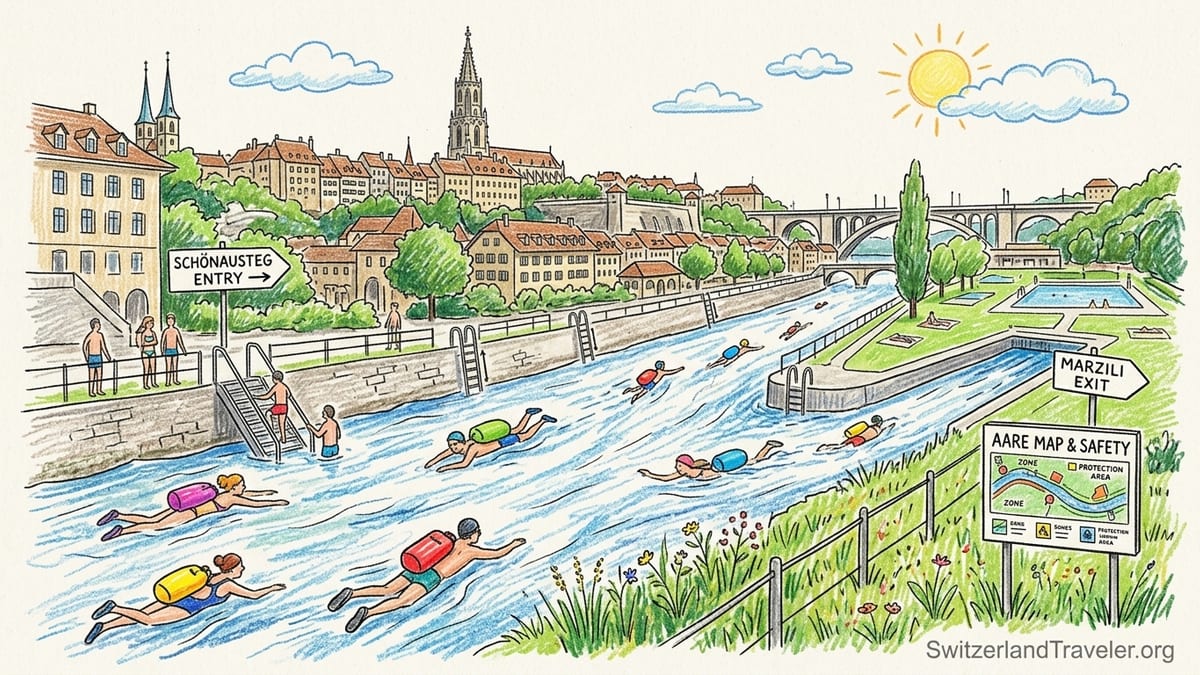
I chose what local friends and lifeguards often recommend as a manageable introduction for confident swimmers: the section from the Schönausteg footbridge down to the exits at Marzilibad, Bern’s famous riverside pool complex. On a typical summer afternoon this stretch is full of locals with bright waterproof Aare bags, but it also offers several intermediate ladders and steps where you can get out early if something feels off. Importantly, the main construction-related swimming bans between Eichholz and Dalmazibrücke that applied into spring 2026 had ended by early summer, and the city once again treated this as a standard swimming corridor, with clear signage and lifeguard presence near the Marzili tunnel.
I deliberately avoided entering in quieter, more natural-looking spots upstream or beyond the recommended zones. Several sections near gravel banks and reed beds are now signposted as protected areas for birds and aquatic life. The authorities ask swimmers to stay out of these zones exactly because frequent entry and exit trample vegetation and disturb nesting birds. What might look like a peaceful wild beach from a distance can, in practice, be an ecological no-go area and a poor safety choice because there are no ladders or marked exits nearby.
For a first attempt, I also ruled out the popular but longer Eichholz to Marzili route. Locals describe trickier swirls and more powerful current near the Dählhölzli bend plus fewer options to leave the water in a hurry. I wanted a route with simpler entry and more forgiving exits, somewhere I could concentrate on the sensations of river swimming rather than worrying whether I would make it out in time.
Entry and Exit: Exactly Where I Got In and Out
On my chosen day, I left my larger bag and street clothes inside Marzilibad, which in 2026 continues to offer free entry and basic changing facilities. From there I joined the stream of swimmers walking upstream along the riverside path. The walk to my entry point at Schönausteg took about ten minutes at a relaxed pace. The footbridge itself is a practical landmark: it spans the Aare at approximately the point where the current becomes clearly noticeable but is still somewhat forgiving compared to the longer upstream sections.
I entered the water on the city-side bank, just upstream of Schönausteg, at a clearly designated metal stairway with handrails. This is not a wild scramble over rocks. The stairs are part of the official infrastructure, regularly used by locals, and the adjacent railings are dotted with people pausing to check their dry bags or check the flow. I sat on the lowest step for a minute to feel the water around my legs and to let my body register the temperature before committing. Only once I felt mentally ready did I push off into the current.
The exit was just as deliberate. My main goal was to leave the water at the large, unmistakable exit channel at Marzilibad, just before the low tunnel that carries swimmers briefly under a road. Before getting in, I had walked this stretch and counted the intermediate ladders: several metal escape ladders cling to the concrete banks between Schönausteg and Marzili, each marked with signs. Knowing exactly where these were, and what they looked like from the water, calmed me. I told myself firmly that I would treat the first few ladders as an optional out, not a failure.
In the end, I rode the current all the way into the main Marzili exit. The key detail is that I began moving toward the right-hand bank much earlier than instinct suggested, well upstream of the exit. The river flows at up to about 3 meters per second in this section, which translates to roughly 10 kilometers per hour, so you drift downstream extremely quickly once you commit to crossing. I started angling in right after passing under the second bridge downstream of Schönausteg and kept a steady side-stroke until the bank drew close. By the time the yellow exit signs loomed into view, I was already within arm’s reach of the handrails and could let the current carry me gently into the channel.
Water Temperature, Current, and How It Actually Felt
The most surprising moment was the first shock of temperature. On the afternoon I swam, the official hydrological station at Bern-Schönau had recorded water temperatures fluctuating around the high teens Celsius in the days before, with readings that morning in the 17 to 19 degree range. That may sound mild, especially during a central European heatwave, but the river still felt bracing. Coming from air that hovered close to 30 degrees, my skin tingled and my breath shortened for the first thirty seconds.
The Aare in Bern is not only cool but fast. Even on a relatively calm day, the flow rate here often climbs into the several hundred cubic meters per second, something local safety guides constantly reference. From the swimmer’s perspective, this shows up as an urgent sideways pull when you first push away from the stairs. Unlike a pool, where you feel resistance only where you move, the Aare tugs at your entire body from shoulder to toes. The moment I relaxed my kicking, my surroundings started sliding past like a moving walkway cranked to maximum speed.
After the initial chill, my body adjusted and I began to recognize why locals find this so addictive. The heat that had been building all day evaporated off my skin, and instead of fighting the current, I learned to float diagonally, steering with gentle strokes rather than swimming against anything. The city unfolded in layers: the curved sandstone arcades above, the parliament building perched high on its terrace, and, every few seconds, a flash of another swimmer’s fluorescent dry bag bobbing alongside.
But there were intimidating moments too. Twice, the current pushed me farther from the bank than I liked while I was distracted enjoying the view. Each time, I had to correct quickly with a burst of side-stroke to reclaim my line toward the right-hand shore. In a pool, drifting off course is a mild annoyance. In the Aare, drifting ten meters too far toward the center can mean missing your planned exit and confronting a much more serious section of river than you intended.
My Swimming Ability, Gear, and What I Carried
By the time I tried the Aare, I was a confident lane swimmer who can cover a continuous kilometer in a pool and feel fresh afterward. I also had some previous experience in slower rivers and tidal channels. I would not have attempted this as someone who could barely manage a few lengths without stopping, and I would emphatically not recommend it to anyone who needs a floatation aid just to stay comfortable in deep water. Bern’s own campaign is blunt about this: weak and inexperienced swimmers should stay out of the river and enjoy the city’s pools instead.
For gear, I followed local best practice and used a dedicated waterproof river bag, often called an Aare sack. Mine was a mid-sized roll-top dry bag with welded seams and a transparent phone pocket, bought from a sports shop in Bern rather than online. On the walk from Marzili to Schönausteg I watched how locals packed theirs. The general rule was minimalism: in my bag I carried only a light microfiber towel, my phone in its own small waterproof sleeve inside the dry bag, a transit card, and a bit of cash. Anything sentimental or irreplaceable stayed locked in my accommodation.
Footwear was a strategic choice. Many Bernese swim barefoot, but regulars I spoke to recommended light river shoes for first-timers, especially when water levels are lower and more rocks are exposed near some entry points. I opted for flexible neoprene booties with thin rubber soles, which made the metal stairs less slippery and protected my feet from any unseen debris on the riverbed. I strapped them tightly so there was no chance of losing them in the current.
Because I was new to this specific stretch, I did not go alone. A Bernese colleague, who has been swimming the Aare most summers since childhood, walked up and got in with me. Before we entered, she talked me through exactly where we would start, which emergency ladders she considered her personal “backup exits,” and how early she begins moving toward the bank before Marzili. Once in the water, she stayed just slightly downstream of me so that if I hesitated or cramped, she could be within arm’s reach. Having a local who knew this section intimately changed the entire emotional equation from “slightly reckless experiment” to “calculated challenge.”
How A River Swim Differs From a Pool
For anyone used to lane swimming, the Aare feels like an entirely different sport. In a pool, you choose your pace, distance, and direction. In the Aare, the river chooses distance and pace for you, and your job is mostly to manage direction and exit timing. My usual lap rhythm, counting strokes and breaths along tiled lines, was useless. Instead, I picked fixed points on the shore a bridge pillar, a set of stairs, a tree and estimated how quickly they moved past to judge how much time I had before the exit.
Breathing felt different as well. In a pool, you learn to anticipate waves from other swimmers and can see them coming. In the river, small standing waves and reflected chop appeared unpredictably as the current rebounded off the banks or bridge supports. I took in a few mouthfuls of water at first simply because I misjudged a wavelet at the wrong time. It was not dangerous, but it was a reminder that the environment is truly dynamic.
Psychologically, the biggest shift is that there is no wall to grab and no shallow end to walk to if panic rises. At full depth, the Aare in Bern is far over your head, and the banks along the main swimming stretch are high, vertical concrete in many places. The only way out is via specific, pre-identified ladders and ramps. This demands a different mindset. Instead of thinking “I will see how I feel after a few strokes,” I had to commit in advance: I knew I would be in the water for perhaps ten minutes, and there was no way to shorten that to two minutes halfway through.
Flow also amplifies small mistakes. In a pool, if you miss your preferred lane rope or ladder by a few meters, you simply stop and adjust. In the Aare, if you miss your planned exit by twenty meters and let yourself be carried along for another minute, you may pass the last safe escape for that entire section and end up heading toward boat channels, weirs, or construction zones. That reality underpins all of Bern’s messaging about not treating the river like an informal water park where you can jump in anywhere.
Safety First: Why Weak Swimmers Should Not Copy Locals
It is tempting to assume that if so many people are in the water, it must be fairly safe. On a hot Saturday, the path between Eichholz and Marzili can feel like a moving procession of bright bags and bikinis, with music drifting from the grassy riverbanks. Yet every year, local media report serious incidents and near-misses, and the Cantonal Police’s early-summer briefings repeatedly stress that even strong swimmers can be overwhelmed by cold shock, cramp, or an unexpected surge in flow.
Bern’s official “Aare You Safe?” rules are strikingly simple but strict. They warn against entering the river if you have consumed alcohol or drugs, against swimming with a very full or very empty stomach, against swimming long distances alone, and against underestimating how quickly you cool in relatively cold water. Safety officers like to repeat a rough rule-of-thumb that your continuous swimming time in minutes should not greatly exceed the water temperature in degrees Celsius if you expect to feel comfortable afterward. In water still under 20 degrees, that means keeping individual sections quite short.
For weak swimmers, the risk is magnified. If you struggle to swim without stopping in a calm lake, the Aare is not the place to practice. If you need an inflatable for security, local advice is blunt: stay in the pool. Floatation toys are common in the river, but they are used by people who could swim out even if they lost them, not by swimmers who depend on them for basic safety.
Weather and river conditions also transform risk from one day to the next. Heavy rain upstream can dramatically raise the discharge, turning the water chocolate-brown with suspended sediment and hidden debris. On those days, Bern’s authorities may temporarily discourage or even forbid swimming on certain stretches, particularly near construction zones or narrow passages. By contrast, during long dry spells and heatwaves, water levels drop, exposing more rocks and altering local patterns of turbulence, which can complicate entry and increase the risk of foot or ankle injuries at low-flow entry points.
What I Would Do Differently Next Time
Looking back, there are several things I would change for my second Aare swim, even though my first experience went smoothly. First, I would treat my initial float as a rehearsal and exit earlier, perhaps at one of the intermediate ladders rather than riding all the way to Marzili on my first try. That would give my body and mind extra space to adapt to the speed of the current and the feeling of deep, opaque water without the added pressure of timing the final exit correctly.
Second, I would arrive earlier in the day and spend more time simply watching how experienced locals handle the same route. On my swim, I noticed that regulars have a relaxed, almost unconscious zigzag pattern: they enter firmly close to the bank, drift out only slightly toward the center, and start angling in toward shore far earlier than visiting swimmers. Observing that choreography before getting wet is as educational as any written guide.
Third, I would refine my gear. My mid-sized dry bag performed well, but seeing the range of options in Bern convinced me that a slightly smaller, streamlined model with two shoulder straps instead of one might have been more comfortable. I would also double-bag my phone with both a dedicated waterproof case and the bag’s own roll-top closure, simply because a punctured Aare bag or a poorly sealed seam is all it takes to ruin both a device and a day.
Finally, I would be stricter with my personal conditions for swimming. On my chosen afternoon the sky was cloudless, the flow looked clean, and the official water temperature and discharge were within the ranges that local lifeguards consider acceptable for experienced swimmers. On any future attempt, if even one of those variables looks questionable if the sky turns suddenly stormy, if the water grows murky with runoff, or if the discharge spikes I would not hesitate to postpone. The Aare will still be there tomorrow.
Ecological Protection Zones and Respecting the River
Something that stood out during summer 2026 is how clearly the city communicates about ecological protection zones along the Aare. Some gravel banks and side channels now carry prominent signs indicating quiet areas for wildlife, where entering the water or even lingering with dogs is discouraged or banned. These spots often overlap with the most photogenic, “wild” looking sections of the river, which makes them tempting for visitors in search of an Instagram-perfect moment. Yet these are precisely the places where staying out is the right choice, both for the environment and for personal safety, since there are no formal exits or ladders.
The official Aare map and on-site boards distinguish between recommended swimming areas, boat routes, no-go construction sections, and protected habitats. In 2025 and early 2026, for example, a major flood-protection project around the Marzili stretch created temporary swimming and boating bans between Eichholz and the Dalmazibrücke. By mid 2026, the most restrictive bans had been lifted as construction phases ended, but the project left behind new, reinforced riverbanks and a renewed emphasis on steering swimmers and boaters toward specific corridors to limit disruption elsewhere.
As a visitor, the simplest way to respect these limits is to anchor your day around the formal bathing areas that Bern continues to maintain and promote. Places like Marzilibad, Eichholz, and Lorrainebad function as both recreational hubs and safety valves, concentrating river users where lifeguards, ladders, and rescue gear are most accessible. From these nodes, you can explore the river in a way that aligns with the city’s current environmental and safety guidelines rather than improvising quiet corners of your own.
For me, that meant resisting the understandable urge to find my own secret Aare spot, and instead embracing the communal, almost ritual feel of joining locals on a well-established route. It may seem less adventurous, but it is exactly that predictability knowing where others will be around you, where officials expect swimmers to appear, and where you can exit easily that makes the difference between a refreshing experience and an emergency call.
Safer Alternatives for Travelers Unsure About Strong Currents
Not everyone who comes to Bern in summer needs to swim the Aare itself. There are many ways to plug into river life without committing to a fast, deep, cold current. The most obvious option sits right at the heart of my own experience: Marzilibad. This riverside facility, at the base of the Bundeshaus, combines multiple outdoor pools including a 50-meter lane pool renewed in recent years with lawns that reach almost down to the water. Crucially, the pools are calm and supervised, letting you enjoy the same Aare-cooled atmosphere without the current.
Upstream, the grassy river beach at Eichholz is another beloved spot for sunbathing and picnics. Many locals there never leave the shallows and simply wade hip-deep on the inner side of the gravel bar, where the flow is gentler. Further along the loop of the river, Lorrainebad in the city’s north offers a more low-key alternative: a natural-water pool, river access with shorter, calmer swims, and a hangout scene with food kiosks. If you arrive, look at the current, and feel even a hint of doubt, you can simply stay in the pool section and still feel like part of Bern’s river culture.
Another very simple alternative is to turn the river into a walking route rather than a swimming course. Several footpaths follow the Aare for long stretches, and walking from the old town down to Marzili or from Marzili up toward Eichholz gives you a sense of the river’s gradient, landmarks, and speed with your feet firmly on land. Coupled with a stop at one of the riverside bars or kiosks, this can be just as memorable as a short swim, particularly if you take time to watch the choreography of swimmers entering and exiting in front of you.
For families with children or adults who cannot swim confidently, Bern’s many municipal pools remain the best option. They echo the same love of water that defines the Aare tradition, but in an environment where depth, temperature, and supervision are carefully controlled. The locals who love the river most tend to be the ones who recommend these alternatives most strongly to visitors, because they understand how unforgiving the Aare can be when conditions or abilities do not line up.
The Takeaway
My first swim in the Aare was one of the most vivid urban experiences I have ever had: the sensory jolt of cold water on hot skin, the surreal feeling of being carried at speed past parliament and cobbled alleys, the camaraderie of strangers bobbing downstream together. It made Bern feel less like a postcard city and more like a living organism pulsing around its river.
It was also an exercise in humility. The same current that made me grin with exhilaration could easily have carried me past my exit if I had misjudged my angle or overestimated my strength. The water that felt refreshing at first could have become dangerously chilling had I stayed in twice as long. What looked from the bridge like a lazy green ribbon is, at swimmer level, a serious natural force flowing at highway speeds.
If you are an experienced, confident swimmer who is comfortable in cold, deep, moving water, and if you are willing to study entry and exit points, check official conditions, go with a local or a similarly competent companion, and treat the river with real respect, then a carefully planned Aare swim can be a highlight of a Bern summer. For everyone else, the city offers abundant safer ways to enjoy its defining river, from riverside pools and lawns to simple walks along the banks.
Your trip to Bern does not become less authentic if you decide the Aare is better admired from shore. In fact, understanding why locals treat this river seriously is part of understanding the city itself. Whether you float, wade, or simply watch, the Aare will shape your memory of Bern. The only non-negotiable is that you let respect, not bravado, define how close you get.
FAQ
Q1. Is swimming in the Aare in Bern safe for beginners?
Swimming in the Aare is only recommended for confident, experienced swimmers who are comfortable in cold, deep, fast-moving water. Beginners and anyone who needs a floatation aid to feel safe should stay in Bern’s pools or in very shallow, calm areas at the river’s edge rather than attempting a full river swim.
Q2. What is a good first-time route for strong swimmers?
For strong swimmers who have studied local guidance, a common introductory route is from the Schönausteg footbridge down to the exits at Marzilibad. This section offers official entry stairs, several intermediate ladders, and a large, clearly marked exit, along with regular swimmer traffic. It is still a serious stretch of river and should only be attempted in good conditions and ideally with someone who knows the route well.
Q3. How cold is the Aare in summer?
In a typical Bern summer, the Aare often ranges somewhere from the mid-teens to low twenties Celsius, depending on recent weather and snowmelt. On hot days the contrast with air temperatures can feel stark. Even when the water feels refreshing at first, prolonged exposure will cool you quickly, so many locals keep individual swims relatively short, often roughly matching minutes in the water to the water temperature in degrees as a conservative guideline.
Q4. How strong is the current in the Aare through Bern?
The Aare’s current through Bern is fast, often around several kilometers per hour and in places approaching 10 kilometers per hour when converted from measured flow speeds. As a swimmer you are carried downstream much faster than in most lakes or slow rivers, which means you must start moving toward your planned exit much earlier than intuition suggests and should never assume you can stop or rest on the spot.
Q5. Do I need a waterproof Aare bag and special footwear?
A dedicated waterproof dry bag is strongly recommended if you plan to carry belongings such as a phone, transit card, or a small towel while swimming. Many swimmers in Bern use roll-top “Aare bags” that double as small floatation supports. Light river shoes or neoprene booties can also be helpful, especially for first-timers, because they provide grip on metal stairs and protect against unseen rocks or debris at entry points.
Q6. Can I just jump into the river anywhere it looks nice?
No. Jumping in “wherever looks good” is unsafe and increasingly discouraged. Bern’s safety campaigns and maps highlight specific entry and exit points that have been evaluated for depth, current, and accessibility, and they also mark ecological protection zones where entering is not allowed. Always use official stairs, ramps, or clearly signed access points and avoid wild-looking banks without ladders or visible exits.
Q7. How do weather and river conditions affect safety?
Recent rain, snowmelt, and heatwaves all affect the Aare. Heavy rain or rapid snowmelt can raise water levels and discharge, making the current stronger and the water murkier with debris. Heatwaves can warm the water but may also expose more rocks at low levels. Local authorities update guidance during the season, and experienced swimmers check official hydrological data and safety notices before deciding whether to enter.
Q8. Is it safe to swim the Aare alone?
Authorities and local rescue organizations strongly advise against long solo swims. Even strong swimmers can experience cramps, sudden cold shock, or disorientation. If you are new to the river, it is far safer to swim with a companion, ideally someone who knows the route well and can help if you misjudge the current or struggle to reach an exit in time.
Q9. What should I do if I realize I am going to miss my exit?
If you suspect you are drifting past your planned exit, stay calm and focus on angling toward the nearest bank rather than fighting directly against the current. Use any intermediate ladders or stairs you can reach safely, even if that means exiting earlier than planned. Do not allow yourself to be carried into sections you do not know, such as boat channels, weirs, or areas marked with warning signs. Once on land, walk back along the path rather than trying to correct your mistake from the water.
Q10. What are safer alternatives if I am uncomfortable with strong currents?
If you are unsure about your swimming ability or simply do not like the idea of fast water, you can still enjoy the Aare by visiting riverside pools like Marzilibad or Lorrainebad, relaxing at the grassy area of Eichholz without entering deep water, or walking the riverside paths to watch swimmers and boats from shore. These options keep you connected to Bern’s river culture without exposing you to currents that feel beyond your comfort zone.