


The Emmental north east of Bern is one of the few places where you can still see world famous cheese made from raw milk in front of you, walk through maturing cellars and then eat the result with a view over the hills that produced it. Built around Affoltern im Emmental’s Emmental Show Dairy and the village of Langnau, the Emmental Cheese Route is a compact province level journey through Switzerland’s living cheese culture rather than another vague “Swiss food” sampler. This guide explains how to follow it, what you will actually see and taste at each stop, and how to understand the difference between authentic Emmentaler AOP, Bernese alpine cheeses and the many lookalike “Swiss cheeses” found in supermarkets.
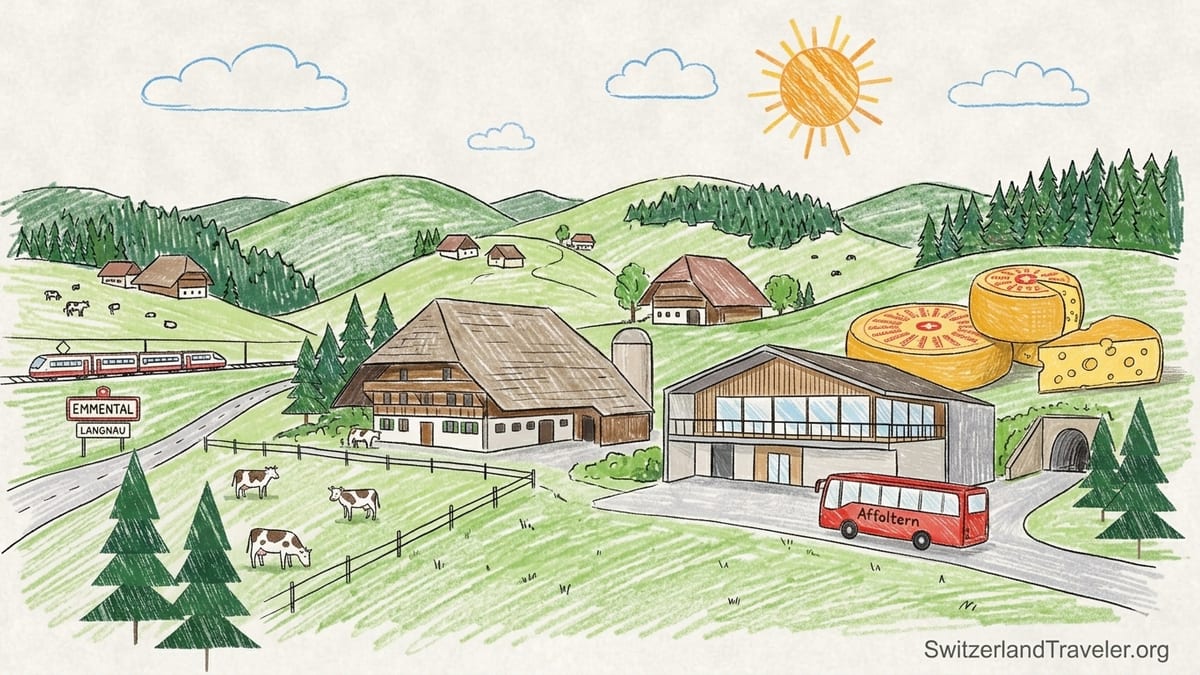
Understanding Real Emmentaler AOP in Its Home Landscape
Before setting out, it helps to know what you are actually coming to taste. “Emmentaler AOP” is the protected name for original Emmental cheese produced according to strict Swiss rules. AOP (in German AOP / French AOP) means protected designation of origin. For Emmentaler AOP this covers the origin of the raw milk, the way the cows are fed, the size and shape of the wheels, the long ripening and even the appearance of the famous holes. It is the opposite of anonymous factory “Swiss cheese slices” and is closely tied to the rolling pastureland of the Emmental and neighbouring cantons.
In practice, this means that Emmentaler AOP is made from fresh raw cow’s milk that is not pasteurised and comes from farms in a clearly defined region. The cows graze on grass and hay rather than silage, the wheels are typically around 80 to 100 kilograms, and the cheese must ripen for a minimum of about four months, often much longer for the strongest versions. Visitors who taste Emmentaler AOP near its birthplace often notice that it is far more complex and nutty than the mild, almost anonymous “Swiss cheese” sold in plastic packaging abroad.
It is also important to realise that not every cheese with large holes is Emmentaler AOP. Across Europe there are many “emmental” style cheeses, and even in Switzerland some industrial versions are simply labelled “Emmental” without the AOP. On a cheese board or in a village shop in the Emmental, the clue for visitors is the red or gold Emmentaler AOP branding etched or printed on the rind, and the clear mention of AOP on the label. When you buy directly at dairies along this route, staff will happily point you to the genuine wheels and explain where the milk came from.
The landscape plays a direct role in the taste. Travelling through the Emmental you will notice something that visitors often comment on: this is not dramatic high Alps but a green maze of rounded hills, scattered farmhouses and small forests. Many of the dairy farms you see from the train or road still deliver their milk to a village dairy once or twice a day. That short distance, usually just a few kilometres, helps explain why Emmentaler AOP producers are so insistent that you cannot simply copy the cheese on an industrial estate far from the pastures.
Affoltern’s Emmental Show Dairy: The Heart of the Route
Affoltern im Emmental is the natural starting point for an Emmental Cheese Route focused on real production. The Emmental Show Dairy sits in open countryside just outside the village, surrounded by pasture and the classic large roofed farmhouses that define the region’s architecture. Bern’s tourism board has made it a flagship attraction and for good reason: it compresses almost 200 years of cheesemaking evolution into one site that you can walk through in a single afternoon.
The grounds include four generations of dairy buildings from a small 18th century “Stöckli” cottage dairy to a 20th century village plant and the current modern cheese house. Walking between them lets you see how Emmental cheese moved from wooden tubs heated over fire to stainless steel vats and computer monitored temperatures. Inside the old Stöckli, visitors can watch cheesemakers work with open vats over gas or fire and lift smaller wheels from the whey using wooden tools. In the larger buildings, you peer through gallery windows into steel vats where hundreds of litres of raw milk are being stirred, cut and heated.
The core visitor experience is a self guided interactive circuit branded as the King’s Way, a reference to Emmentaler AOP’s nickname as the “king of cheese”. Over nine themed rooms, a virtual cheesemaker, cow and mouse guide you via audio and projections through the journey from pasture to cellar. Exhibits explain why holes form, how specific bacteria and long ripening create flavour, and what the AOP regulations actually require. The route finishes in an atmospheric maturation cellar where you walk alongside towering rows of golden wheels and can feel the cool, humid air that keeps them in condition. At the end of the tour you sample several maturity levels of Emmentaler AOP, often including a younger “mild” version and a much older, crystalline cheese.
The show dairy operates year round. The King’s Way is generally open daily and is designed to work in any weather, but from spring through autumn live cheesemaking plays a bigger role in the visit. On many mornings visitors can watch fresh cheese being produced in either the Stöckli or the main production area, depending on the schedule, and on some days there are special demonstrations where smaller groups stand right next to the vat while a cheesemaker explains each step. There is an on site restaurant with a terrace overlooking the hills, serving dishes such as macaroni with melted Emmentaler AOP, cheese platters and simple daily menus, plus a large shop selling cheeses and local farm products.
Cheese Making Workshops, Family Visits and Practical Details
For travellers who want to go beyond watching, the Emmental Show Dairy offers several participatory workshops. The flagship option lets guests make their own small cream cheese or soft cheese in a group setting under the guidance of a cheesemaker. Participants heat milk, add rennet, cut the curd and scoop it into small forms, learning the principles used for Emmentaler AOP on a much smaller, quicker scale. According to recent schedules, these workshops often run on selected days and last between one and two hours; they usually require advance booking, and places can fill quickly during school holidays.
Another option is a simplified “make your own cheese” experience frequently advertised in partnership with regional transport companies. Typical packages include return train or bus travel from Bern, entry to the King’s Way and a slot in a mini workshop where you produce a small fresh cheese to take away. Timetables and prices change every season, so before you travel it is worth checking the latest information through Bern’s official tourism channels or the show dairy’s own programme. Families with children will find that many of these activities have a minimum age, often around six to eight years, but younger children are still welcome on the King’s Way and in the restaurant and outdoor areas.
In terms of visiting times, mornings tend to be most interesting if you want to see production in action because many dairies heat and form the curds early in the day. The King’s Way itself takes around one to one and a half hours if you stop for videos and displays. Adding a workshop, lunch on the terrace and time in the shop can easily fill half a day. For families, there are outdoor play areas and paths around the site, meaning that children who become restless indoors can still run off energy between activities.
Practical access is straightforward. By car, Affoltern is reachable from Bern in around 40 to 45 minutes. The standard route is via the A1 motorway and then secondary roads that climb gently into the Emmental hills. Drivers should be comfortable with narrow country roads but the final approach is well signposted and there is a dedicated car park right next to the dairy. By public transport, regional trains run from Bern to Burgdorf or Hasle-Rüegsau, where you change to a bus that stops close to the show dairy. Total travel time is usually around one hour. When planning, allow a margin for connections, especially in winter when snow can affect rural bus timings.
Langnau’s Cheese Cellars and Village Cheese Culture
From Affoltern, the next logical stop on an Emmental Cheese Route is Langnau im Emmental. This small town lies directly on the Emme river and functions as an everyday centre for the surrounding farming communities. It is also known for cheese cellars that age and trade Emmentaler AOP and other regional cheeses. While some facilities are purely industrial spaces closed to the public, there are several village dairies and shops around Langnau where visitors can peer into cellars, see wheels under maturation and taste a range of different producers side by side.
Regional tourism offices often highlight Langnau as a place to discover the “behind the scenes” side of cheese. Local affineurs, the specialists who mature cheese, receive wheels produced in village dairies and keep them for months or even years in humid, well ventilated cellars, turning and brushing them regularly. Many visitors are surprised at how simple these rooms look, with wooden or metal shelving and thousands of wheels stacked in perfect rows, but the smell and subtle temperature control are critical. In some cellars you can arrange a guided visit, often through Bern Welcome or local partners, to learn how choosing a “mild”, “reif” (ripe) or extra old Emmentaler influences the flavour on your plate.
The advantage of spending time in Langnau is that you experience real cheese culture in context rather than as a stand alone attraction. On market days small producers come into town to sell not only Emmentaler AOP but also farmhouse butter, fresh cheeses and seasonal specialities like herb crusted cow’s milk cheese. Local restaurants and guesthouses often feature cheese prominently, whether as rösti with melted Emmentaler, Käseschnitte (cheese on toasted bread with wine and onions) or simple plates that let you compare Emmentaler with a Bernese alpine cheese from higher up in the canton. Asking for a plate of regional hard cheeses is an easy way to start a conversation about the differences.
Langnau is also practical as a transport hub. Direct trains from Bern take about 50 minutes along a picturesque route that already gives a feel for the Emmental’s hills and farmhouses. From Langnau you can either continue east on the same line toward Lucerne, making a wider regional loop, or head back toward Burgdorf and Bern after your cheese cellar visits. Several official Emmental walking and cycling routes start or pass through Langnau, which makes it a sensible overnight base if you want to combine cheese visits with rural hikes between farms.
Farms, Villages and Bernese Alpine Cheeses Along the Way
The Emmental Show Dairy and Langnau’s cheese cellars are the pillars of a cheese route, but the character of the region really emerges between the main attractions. Scattered over the hills are hundreds of dairy farms, some of which have small on farm shops or self service fridges selling cheese and butter made at the local dairy with their milk. Look for handwritten “Molkerei Käse” or “Hoflädeli” signs by the roadside. Buying a piece of Emmentaler AOP or a softer local cheese from such a farm gives you a direct connection between the slope you are looking at and the slice on your plate.
Many farms also produce related dairy products that link into famous local brands. For example, some Emmental milk goes into the butter used by the Kambly biscuit factory in Trubschachen, which you may pass if you continue by train from Langnau toward Lucerne. While the factory itself is better known for biscuits than cheese, its dependence on regional butter underlines how integrated the dairy economy is. In cafés and bakeries along the route you will find Emmental style plaited butter bread, rich cream desserts and seasonal dishes that echo this shared milk supply.
As you explore, you will encounter not only Emmentaler AOP but also Bernese alpine cheeses. Berner Alpkäse AOP and Berner Hobelkäse AOP originate higher in the Alps of the canton of Bern and adjacent valleys, where cows graze on mountain pastures in summer. These cheeses are usually made in small mountain dairies and matured without the large, round holes of Emmentaler. Their flavour tends to be stronger, spicier and more herbal, with a drier texture, especially for Hobelkäse, which is often shaved into thin curls. Tasting a slice of Berner Alpkäse alongside Emmentaler AOP makes the contrast clear and helps visitors understand that “Swiss cheese” is not a single flavour.
Several Emmental restaurants and farm shops build mixed plates that showcase this diversity. A typical tasting board might include three versions of Emmentaler AOP at different ages, a chunk of Berner Alpkäse from a named alp, and perhaps a creamier local “Bergkäse” that blends styles. Asking where each cheese comes from and how long it was matured often leads to stories about specific farms, mountain pastures and family dairies. This is a chance to move beyond generic supermarket labels and build memories tied to real landscapes and people.
Planning Your Route by Train, Bus or Car
One of the strengths of the Emmental Cheese Route is that it can be followed comfortably by public transport from a base in Bern, though having a car does add flexibility for spontaneous farm shop stops. A practical rail based itinerary from Bern might look like this. In the morning, take a train to Burgdorf, connect to a regional train or bus toward Affoltern im Emmental and arrive at the Emmental Show Dairy in time for the King’s Way and a late morning cheesemaking demonstration. After lunch on the terrace, continue by bus down into the valley and connect to Langnau, where you spend the late afternoon visiting a cheese shop with cellars and exploring the village before returning by direct train to Bern.
If you prefer to travel by car, you can turn this into a relaxed loop. Drive from Bern to Burgdorf and then up to Affoltern, stopping at viewpoints over the Emme valley. After visiting the show dairy, continue toward Sumiswald and then along minor roads toward Langnau, with stops at farm shops signposted along the way. Be prepared for steep, narrow lanes and occasional tractor traffic; this is active farming country rather than a polished theme park. In wet or snowy weather, stay on the main roads between villages, which are generally well maintained.
Some travellers combine the Emmental with other regional food experiences on the same day. Bern’s tourism campaigns, along with Swiss youth hostel packages, have recently promoted combinations such as a night in Burgdorf or Bern youth hostels with a day trip to the Emmental Show Dairy and the King’s Way tour included. Other agencies offer small group day tours from Zurich or Lucerne that include Bern’s old town and a visit to the show dairy. These options are convenient if you prefer not to manage timetables yourself, but they usually allow less time for slow exploration around Langnau or farm shops.
Whether you travel independently or with a tour, remember that rural public transport in the Emmental runs on a regular but not city level frequency. Trains between Bern and Langnau are quite frequent during the day, but some buses up to Affoltern and small villages may only run once an hour, especially on Sundays. When planning cheese workshops at the show dairy or guided cellar visits, aim to build in a buffer of at least one connection so that a missed bus does not jeopardise your booking.
What and How to Taste: From Fresh Curds to Long Aged Wheels
Experiencing Emmental cheese properly means tasting it in different forms and at different stages of maturation. At the Emmental Show Dairy, the standard King’s Way ticket usually includes a small tasting at the end, often featuring two or three ages of Emmentaler AOP. Younger cheeses, perhaps around four months, tend to be mild, creamy and slightly sweet, with smaller, more regular holes. Older cheeses, aged eight months or longer, develop nuttier, more intense flavours and sometimes tiny crunchy crystals inside. Asking staff which sample has been matured longest is a simple way to understand how time changes the same basic cheese.
Cheese making workshops add another texture to that experience by letting you taste still warm curds or very fresh soft cheeses. These have barely developed any complexity and instead showcase the pure flavour of the milk. For many visitors, especially children, the memory of lifting a ladle of warm curd and seeing it slowly firm into a small cheese they can carry away is one of the most vivid souvenirs of the region. Some packages allow guests to collect their personal mini cheese about 45 minutes after the workshop ends, once it has drained enough to travel.
Around Langnau and in village shops you will find a wider range of Emmentaler AOP labelled by age or style. Common categories include “mild,” “reif” (ripe), and occasionally special designations for cheeses matured 12 months or more. While specific pricing varies, you can expect to pay more as maturity increases, reflecting the time and storage space invested. This is also where you will see the difference between Emmentaler AOP and Bernese alpine cheeses. On tasting, compare the big, regular holes and smooth, elastic texture of Emmentaler AOP with the denser, often hole free body of Berner Alpkäse or Hobelkäse, and notice how the latter carries stronger grass and herb notes from higher altitude pastures.
When ordering dishes in restaurants, look out for menu terms that specify the cheese used. A traditional macaroni with Emmentaler AOP sauce, a baked Käseschnitte or a simple cheese fondue made with a blend that includes Emmentaler and another regional cheese will all give slightly different expressions of the same raw material. If in doubt, ask your server whether the cheese is from the Emmental region and whether it is AOP certified. Most places are proud to talk about their suppliers and may even recommend a dairy or farm to visit on your route.
Buying Cheese Without Creating Travel Storage Problems
One of the most common worries for travellers is how to buy cheese in the Emmental without causing storage issues on a longer Swiss trip. The good news is that hard cheeses like Emmentaler AOP and Berner Alpkäse travel relatively well if handled sensibly. Most dairies and shops along the route will vacuum pack purchases on request, which slows drying and minimises smell. In cooler seasons, a well wrapped piece can survive several hours on a train or in a car without refrigeration. In summer, aim to buy later in the day if you face a long journey, and keep cheese out of direct sun.
For multi day travel, the simplest solution is to buy modest amounts in different places rather than stocking up all at once. For example, pick up a 200 to 300 gram piece of Emmentaler AOP at the show dairy for immediate consumption over the next two days, then buy a smaller but older piece in Langnau to enjoy later or back home. Vacuum packed cheese usually keeps several weeks in a hotel fridge, although it is worth asking reception before storing anything with a strong smell in shared minibars.
If you plan to fly out of Switzerland after your trip, hard cheeses in solid form are generally permitted in cabin baggage on international flights, but soft cheeses that spread like a liquid may not be. To avoid problems at security, focus on firm Emmentaler AOP, Berner Alpkäse and similar cheeses, and keep receipts handy in case customs officers ask where the products come from. Airlines and regulations can change, so if you intend to transport large quantities it is wise to double check current rules close to your travel date and to declare food items where required.
Another way to enjoy the cheese culture without filling your luggage is to buy experiences rather than kilos. Cheese making workshops, guided cellar tours, and restaurant meals built around Emmentaler AOP all create memories and knowledge that do not need refrigeration. Small edible souvenirs such as a few individually wrapped portions or a thin piece of Hobelkäse also pack light while still capturing the flavour of the region.
The Takeaway
Designing your own Emmental Cheese Route turns a famous label on a supermarket packet into a living landscape of farms, dairies and cellars. Starting at Affoltern’s Emmental Show Dairy, you see how four generations of buildings and techniques still revolve around the same basic principles of transforming raw milk into meaningful food. In Langnau you encounter the quieter but essential work of maturing and trading cheese in cellars that rarely appear in tourist brochures. Between them, winding lanes and scattered farm shops remind you that regional dairy culture is made up of dozens of families and flocks scattered across the hills.
Along the way, the difference between Emmentaler AOP, Bernese alpine cheeses and generic “Swiss cheese” becomes tangible rather than theoretical. You learn to read a rind for the right AOP markings, to taste how altitude and pasture influence flavour, and to appreciate the patience behind wheels that spend months in the dark before reaching your plate. Train and bus connections from Bern make this accessible even for travellers who prefer not to drive, while car routes allow deeper detours into side valleys and small farm shops.
Most importantly, this is a form of food tourism that respects the scale and rhythm of the countryside you pass through. Cheesemaking workshops and cellar visits are set up to share knowledge without turning everyday production into a stage set. By choosing modest purchases, focusing on certified regional products and taking time to talk with producers, visitors help sustain the very culture they have come to experience. The Emmental’s gentle hills may lack the drama of high Alpine peaks, but for anyone serious about cheese they offer one of Switzerland’s most rewarding journeys.
FAQ
Q1. How long do I need to visit the Emmental Show Dairy and Langnau on the same day?
Most visitors can comfortably combine the Emmental Show Dairy and a short visit to Langnau in a single day from Bern if they start in the morning. Allow around three to four hours for the show dairy, including the King’s Way, possible cheesemaking demonstrations, lunch and time in the shop, plus at least two to three hours in Langnau for a cellar visit, a walk through the village and a café or restaurant stop, not including travel time.
Q2. Can I visit the Emmental Cheese Route all year, or is it better in summer?
The Emmental Show Dairy operates year round and the King’s Way experience works in any weather, so visits are possible in all seasons. However, from spring into autumn there are more live cheesemaking demonstrations, outdoor terrace seating and easier access to farm shops on minor roads. Winter has a quieter atmosphere and snow covered hills, but visitors should plan more carefully around bus timetables and possible weather related delays.
Q3. Is the Emmental Cheese Route suitable for children and families?
Yes, families are a major target audience for the Emmental Show Dairy and many children enjoy the interactive King’s Way and the chance to see cows and cheesemaking. Some hands on workshops have minimum age limits, often around six to eight years, so parents should check details in advance. Outdoor play areas, short walking paths and family friendly dishes in the dairy restaurant help keep younger visitors engaged throughout the day.
Q4. Do I need to book cheesemaking workshops and cellar tours in advance?
Booking ahead is strongly recommended for any participatory workshop at the Emmental Show Dairy, particularly in school holidays and on weekends, because group sizes are limited. Guided cellar tours in and around Langnau are often arranged through regional tourism offices or directly with affineurs and also usually require reservations. For simple entry to the King’s Way exhibition and casual shop or restaurant visits, advance booking is less critical outside peak times.
Q5. How much cheese can I realistically buy without storage problems on a longer trip?
For travellers moving between hotels over several days, it is practical to carry perhaps 300 to 500 grams of hard cheese per person at any one time, especially if you can use a small section of a hotel fridge. Buying cheese in vacuum packed portions helps, as does choosing firm styles like Emmentaler AOP and Berner Alpkäse that cope better with travel. If you want more variety, consider buying smaller pieces in several places instead of a large amount at the first stop.
Q6. What is the main difference between Emmentaler AOP and Bernese alpine cheeses?
Emmentaler AOP typically comes from valley dairies in the Emmental and surrounding regions, has large, regular holes and a smooth, elastic texture with a nutty, mild to medium flavour. Bernese alpine cheeses such as Berner Alpkäse and Berner Hobelkäse are made on higher mountain pastures, usually without large holes, and have a firmer, often drier texture and a more intense, sometimes spicy aroma that reflects alpine herbs and grasses.
Q7. Can I reach all key cheese experiences in the Emmental without a car?
Yes, it is possible to reach the Emmental Show Dairy and Langnau by public transport from Bern using a combination of regional trains and buses. The journey to Affoltern im Emmental usually involves a change at Burgdorf or Hasle-Rüegsau, followed by a short bus ride. Langnau lies on a direct regional rail line between Bern and Lucerne. However, some small farm shops and side valley dairies are easier to access with a car or by joining an organised tour.
Q8. How can I be sure I am buying genuine Emmentaler AOP rather than an imitation?
Look for the AOP designation clearly printed on the label and, when possible, inspect the rind for the official Emmentaler AOP marking. Buying directly from the Emmental Show Dairy, village dairies or reputable cheese counters in the Emmental region further reduces the risk of confusion. Staff are generally keen to explain where their cheese is produced, how long it is matured and how it differs from industrially produced “emmental” style cheeses made outside the official region.
Q9. Are there accommodation and package deals built around Emmental cheese experiences?
Yes, Bern’s regional tourism organisations and partners such as Swiss youth hostels periodically offer packages that combine overnight stays in places like Bern or Burgdorf with entry to the Emmental Show Dairy and the King’s Way. Some small group tour operators based in Zurich or Lucerne also run day trips that include Bern’s old town and a visit to the show dairy. Availability and pricing change by season, so travellers should check current offers when planning.
Q10. What should I wear and bring for a day on the Emmental Cheese Route?
Comfortable walking shoes and layered clothing are recommended, as you will move between warm indoor spaces, cooler cellars and outdoor paths or village streets. Even in summer, maturation cellars can feel cool and slightly damp. A small daypack is useful for carrying water, a camera and any cheese purchases, especially if they are vacuum packed. If you are sensitive to cooler temperatures, consider bringing a light jacket for cellar visits, and in winter be prepared for snow and ice on rural paths and car parks.