


By mid-morning in Thun the air already smelled of the lake: a mix of cool water, diesel, coffee from the station bakery and the faint sunscreen of day trippers queuing at the pier. Switzerland Tourism likes to call Lake Thun one of the classic Bernese Oberland experiences. On this day I set out to test that claim the slow way, by taking a scheduled BLS boat the full length of the lake from Thun to Interlaken West and back as far as Spiez, noting every practical detail that actually matters once you are out on the water.
Planning a Real Boat Day, Not Just an Attraction Check-List
I started my Lake Thun day in Thun, because that is where the long lake cruises begin and end. BLS operates the scheduled boats here, and their 2026 summer timetable lists multiple daily services from Thun to Interlaken West between roughly mid-May and mid-October, with the main through boat taking just over two hours end to end. The morning departure I used left from “Thun (See)” pier, directly behind Thun railway station, and was scheduled to arrive at Interlaken West about two hours later, after calling at intermediate villages such as Hünibach, Oberhofen, Gunten, Spiez and Beatenbucht.
For this day I chose a simple configuration: a full lake cruise Thun to Interlaken West, then a partial return by boat from Interlaken West to Spiez, and finally a short train hop from Spiez back to Thun. I bought a Saver Day Pass through the Swiss system, which covered both trains and boats for the day, so I did not have to think about individual boat fares once on the pier. Travelers using a Swiss Travel Pass or a Lake Thun and Lake Brienz day ticket could replicate the same pattern without extra boat supplements, which keeps a long boat day predictable in cost.
Rather than building the schedule around castles or specific villages, I built it around the long two hour crossing. My target was the mid-morning departure from Thun, so I arrived about 30 minutes early. This turned out to matter. The BLS summer boats on Lake Thun are popular, and although everyone eventually boarded, the difference between arriving 30 minutes before and 5 minutes before departure is the difference between choosing your deck and seat, and taking whatever is left.
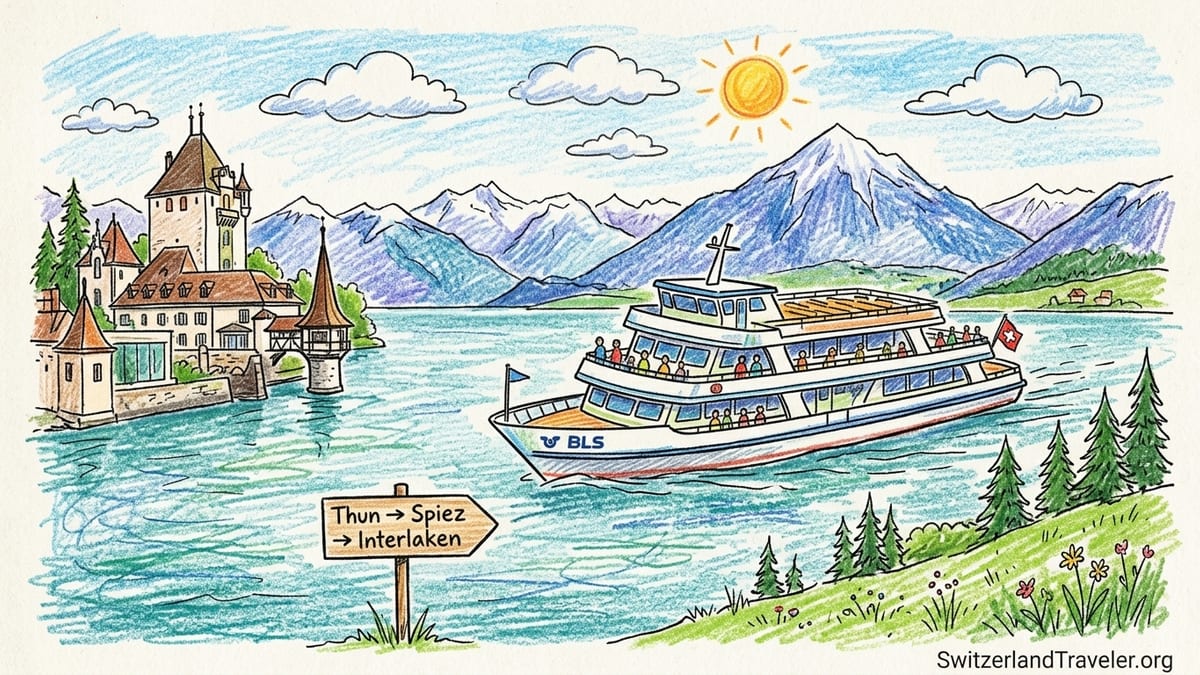
At the pier a small digital display confirmed the boat class and direction, and a BLS staff member checked tickets as we walked the short gangway to the vessel. On this run the boat was one of the larger modern motor vessels, with two main passenger decks and an open sun deck above. No vintage paddle steamer was assigned that day, which meant efficient boarding and plenty of seats but a contemporary, functional atmosphere rather than nostalgia.
On Board: Boat Class, Seating and Which Side Has the Best Views
From the moment I stepped on board, the question was not whether there would be enough space but what kind of space it would be. Second class seating dominated the main deck, with indoor saloons lined by large windows and doors opening to side promenades with benches. First class was upstairs in a quieter saloon and on a roped-off section of the upper deck, signposted near the stairwell. The open sun deck at the very top allowed mixed seating, although some areas were again marked for first class only.
Because I wanted to compare experiences, I started the morning in second class outdoors on the starboard side. Leaving Thun for Interlaken West, this is the right-hand side of the vessel. It gave long diagonal views back to Thun’s old town and castle as we pulled out, but the better long-running scenery during this first leg turned out to be to port, on the left-hand side, where the Niesen pyramid and later the Justistal range framed the wider lake. If your main goal is to watch the southern railway shore slip past, with its tunnels and the BLS Lake Thun line, then starboard pays off later, closer to Spiez and beyond. For the first 45 minutes though, I found myself repeatedly turning left to admire the open water and mountain horizon.
Deck choice mattered more than side. The morning began with bright sun and an air temperature in the low 20s Celsius, warm by Swiss standards but still with that cool lake wind once underway. Sitting on the fully exposed top deck felt glorious for about 20 minutes and fatiguing after 40. There was very little structural shade apart from small zones around the mast and stair cores, and those filled first. On the partially covered side decks of the main level I found a good compromise: fresh air and uninterrupted views, but with the ship’s overhang offering shade that shifted as we zigzagged along the lake.
Wind, Weather and How a Two-Hour Cruise Actually Feels
On paper, two hours from Thun to Interlaken West sounds leisurely. In practice it is a full sensory stretch. Once clear of Thun’s harbour the captain increased speed, and a steady oncoming breeze built up, stronger whenever we crossed the middle of the lake. I had left Thun under blue sky, but by the time we glided past Oberhofen Castle the typical Bernese Oberland pattern had set in. High cloud started to gather over the ridge above Beatenberg while sun still bathed the villages at lake level, creating high contrast views, white boats against almost teal water and dark background slopes.
The wind on deck peeled away any residual heat. People who had boarded in T-shirts began pulling on light jackets near Spiez, and those who had chosen the bow benches migrated aft where spray and wind were slightly less intense. It was perfectly comfortable for mid-summer, but I was glad of a light windbreaker and sunglasses. The reflections off the water were strong, especially between Gunten and Merligen, where the lake floor drops and the colour deepens. Photography was much easier from the shaded side decks than from the top in full glare.
In terms of how long the journey “felt,” the first hour passed quickly, helped by the frequent rhythm of short stops. Thun to Oberhofen, then on to Gunten and Spiez, delivered a sequence of approaches, dockings and departures that broke up the time. After Spiez, the lake narrows and the mountain walls rise more steeply. The second hour, from Spiez through Beatushöhlen and Neuhaus to Interlaken West, felt quieter and more meditative. Conversations on board dropped a notch, more passengers simply staring at the cliff faces and hanging forests above Beatenbucht.
By the time we nudged into Interlaken West, precisely on the timetable advertised on the BLS summer schedule, the full crossing felt like enough. Not overly long, not rushed, but like a proper journey that justified devoting half the day. Had I booked another through boat immediately back to Thun, it would have been too much. The break in Interlaken and the later partial return via Spiez kept it balanced.
Food, Coffee and the Quiet Value of the Onboard Restaurant
One of the underrated aspects of Lake Thun boats is their onboard catering. On my departure there was a staffed galley and restaurant area on the main deck, plus terrace seating near the stern reserved for diners. Menus on Bernese Oberland boats evolve each season, but in 2026 they typically include plated dishes such as rösti variations, salads, soups and simple grills, alongside coffee, soft drinks, local beer and basic pastries. Prices were very Swiss. A main course hovered somewhere around the mid-20s Swiss franc range, while a coffee cost roughly four to five francs and a soft drink not far behind.
I did not sit for a full meal, partly because I wanted freedom to change decks as the scenery shifted. Instead, I used the restaurant as a useful retreat. About 40 minutes after departure the top deck had become busy and noisy, and the wind more tiring than romantic. Stepping into the cool interior saloon for a coffee and mineral water gave me 20 minutes of quiet, framed by large windows and soft seating. It did not feel like escaping the experience so much as recharging in another part of the boat.
The galley also played an important practical role when summer crowds settled in. Families with young children used the restaurant to anchor themselves at a table for a good part of the journey, so they did not need to hunt for scattered seats on deck. Staff allowed people to bring drinks out to the railings briefly for photographs, but politely encouraged them to return glasses and crockery promptly. For anyone planning a full-length cruise, budgeting for at least one round of drinks or a snack on board is worthwhile. It turns the boat from mere transport into a short-lived lakeside café.
It is possible to bring simple food and eat it on the open deck away from the formal restaurant area, and I saw a few people do that with bakery sandwiches from Thun. For a special day, though, I found that ordering at least something small from the galley justified occupying a good table near the window for part of the ride, which made the boat feel like a destination in its own right.
Stopping in Spiez: Enriching the Day, Without Overloading It
On the outward leg I stayed on board all the way to Interlaken West, treating that crossing as a single continuous experience. On the way back, I wanted to see whether adding a lakeside village stop would enrich the day or simply fragment it. I chose Spiez for the return segment, because it sits roughly midway on the lake and is easy to connect back to Thun by train in about 20 to 25 minutes according to BLS Lake Thun line timings.
My partial return boat left Interlaken West early afternoon, again as noted in the BLS summer schedule, and reached Spiez after about 45 minutes. Here the stop felt substantial. The boat pulled into the Spiez ship station, directly below Spiez’s steep hillside. Instead of waiting through a short docking, passengers bound for Spiez actually disembarked. I followed them up the gentle path that connects the pier to the lakeside promenade.
Spiez’s harbour area was busy but not hectic: families licking ice creams by the water, locals in bathing suits heading to the lido, and a slow drift of boat passengers distributing into the cafés. I walked for about 20 minutes along the path toward the small park beneath Spiez Castle. From here the view back across the bay to the Niesen pyramid is one of the classic Lake Thun scenes, with masts and the occasional departing boat in the foreground.
In total I spent just over an hour in Spiez, long enough for a short stroll, a quick drink and a mental reset before heading up to Spiez railway station. Walking from the pier to the station takes around 15 minutes uphill. This was the moment when the question in the back of my mind got answered: did leaving the boat improve the day, or make it feel rushed? For me, disembarking at Spiez was a positive. The afternoon wind on the lake had picked up and the sun was beginning to feel more tiring than pleasant. Stepping onto solid ground gave a new angle on the same water and mountains and offered a contrast without the sense of chasing multiple attractions.
What I would not recommend is stacking multiple off-boat visits into a single Lake Thun day on a fixed schedule. Trying to add Oberhofen Castle or a village like Merligen, plus a full Spiez stop and the complete crossing to Interlaken West, risks turning a supposedly slow travel day into a timetable race. Choosing one lakeside village or one castle as your single off-boat anchor, and building the boat legs around it, strikes a better balance.
Boat Versus Train: Two Very Different Visual Experiences
As the afternoon wore on, I left Spiez by train instead of boat. From Spiez station I boarded a RegioExpress service on the BLS Lake Thun line toward Thun. According to BLS’s own line information, this route hugs the southern shore of the lake, linking Spiez, Thun and Interlaken and forming the main rail backbone of the region. The scheduled travel time from Spiez to Thun is about 20 minutes, often a little less, and the train runs through a series of tunnels and open sections that frame intermittent lake views.
Visually, the experience could not be more different from the boat, and that difference matters when you are choosing how to structure your day. On the boat, the lake fills your entire field of vision. You are low on the waterline, with foreshore villages sliding past at walking speed and mountains stacking up behind them. The soundscape is wind, wake and occasional announcements. Riding the train back from Spiez, the lake becomes one element among many. Views appear as quick scenic windows between tunnels, the water glimpsed from slightly above, behind trees or track ballast.
If I had only taken the train along Lake Thun, I would have remembered it as one more pretty Swiss rail segment. Doing both in one day highlighted how much more three-dimensional the scenery feels from the water. On the boat I could watch kayakers close enough to hear splashes and see the pattern of vineyards above Spiez Castle. On the train, those kayaks would have been a flash of colour below, if visible at all. This is not to say the train is inferior. It is faster, simpler, and ideal for commuters and travelers focused on reaching the high mountains beyond Interlaken as quickly as possible. But as a dedicated scenic experience, the full boat day won clearly.
Time-wise, combining a one-way boat trip and a one-way train leg also prevented the day from dragging. A return boat journey, over four hours of sailing in total plus any intermediate stops, would have risked blurring into monotony. With the train back, the story of the day had a distinct beginning on the water and a crisp ending back on rails, both anchored around the same shoreline.
Summer Crowds, Deck Strategies and Is First Class Worth It?
Lake Thun in peak season is popular. On my chosen day, a clear and warm forecast had filled Thun’s morning departure with a mix of international visitors, Swiss day trippers and small hiking groups using the boat to access trailheads. Boarding at Thun and Interlaken West was orderly but busy. This translated into nearly all outside seats being occupied within minutes of departure, with a second wave of passengers standing along the railings for the first half hour to snap photographs.
To stay comfortable, deck strategy mattered more than I expected. Shaded versus exposed seating is not a detail, it is the difference between finishing the cruise relaxed or sunburned. The partially covered main deck promenades on both sides became prime real estate, especially where the ship’s overhang cast a reliable strip of shade. Families with small children gravitated to these spaces, where they could move between inside and outside quickly, while couples and solo travelers competed for the small tables on the upper deck that still offered some overhead cover.
This is where the question of first class came into focus. First class on Lake Thun boats typically gives access to quieter saloons, a little more space, and often less crowded sections of the upper deck. It does not change the scenery. Standing at the rail on the second class starboard side, the mountains do not know or care what class your ticket is. On my sailing, first class was certainly calmer, and if cost were no concern I would have enjoyed the extra elbow room. In concrete terms, though, second class combined with smart timing and early boarding delivered almost the same experience at a lower price.
For travelers using a Swiss Travel Pass or a Saver Day Pass that already grants first class across trains and boats, my conclusion is simple: use it and enjoy the quieter spaces. For everyone else paying point-to-point or using second class rail passes, I would allocate money to onboard food and flexibility rather than an upgrade. Arriving 20 to 30 minutes before departure at Thun or Interlaken West, walking straight to your preferred deck and side, and being willing to shift seats as the sun moves are the real comfort upgrades.
The Boat-Day Configuration I Would Repeat
After testing options within one long circuit, I ended the day convinced that Lake Thun is best experienced as a hybrid, not as a relentless checklist. A full-lake cruise in at least one direction is essential. You need those two continuous hours between Thun and Interlaken West to feel the scale of the lake, the changes in light, and the rhythm of small harbours. But repeating the full length twice felt unnecessary once I contrasted the return train section.
If I were to repeat the day for myself or recommend a pattern to readers, it would be this. Start in Thun with a mid-morning boat to Interlaken West, staying on board all the way and using both decks: shaded outdoor seating for the first half and a short retreat indoors for coffee or lunch nearer Spiez. Spend an hour or two ashore in Interlaken West, either for a straightforward lakefront walk or to switch mindset before the return. Then take a boat back only as far as Spiez, giving you a second, shorter sailing through the most dramatic middle section of the lake but without locking you into another full two hours.
Disembark at Spiez, allow at least an hour there for a short harbour and castle-area stroll, and then walk up to the station for a quick RegioExpress back to Thun. This configuration delivers two distinct boat segments, one lakeside village interlude, and one scenic train run along the opposite shore, all within a natural-feeling day that does not overstay its welcome on the water. It lets you compare train and boat views directly while keeping the boat at the emotional centre of the experience.
What I would not change is the attention to small details that make or break a boat day. Check the current BLS timetable for Thun and Interlaken West departures, arrive a little early, choose your deck and side with intent, pack a light layer and sunscreen, and plan at most one off-boat stop. Do that, and Lake Thun becomes less of a postcard backdrop and more of a day-long story you actually lived.
The Takeaway
Lake Thun’s reputation in Bernese Oberland marketing is not hype. From the first low churn of engines leaving Thun’s harbour to the final tightening of brakes as the train rolled back into Thun in late afternoon, the day felt cohesive and quietly memorable. The boat did more than connect points on a map. It stretched time in a way the train alone never could, turning familiar names like Spiez and Interlaken into places approached slowly from the water, with castle towers and vineyards revealing themselves at human speed.
Recording the details of one specific cruise Thun to Interlaken West, with a partial return via Spiez, revealed how much those details matter. The boat class determined where shade and quiet could be found. The summer timetable shaped when coffee tasted best. The choice of starboard or port decided whether I watched the railway or the open lake for long stretches. Getting off the boat once at Spiez enriched the day. Trying to cram in many more stops would have eroded the calm that makes a lake cruise special in the first place.
In the end my conclusion was simple. For a traveler who wants to build one strong Lake Thun memory without losing a full day to logistics, the configuration I would repeat is a full lake cruise in one direction, a shorter cruise with a single village stop in the other, and one short rail segment along the shore. That mix respects the lake as the star of the show while using the train for what it does best: a swift, scenic closing chapter to a day spent at water level.
FAQ
Q1. How long does the full Lake Thun boat trip between Thun and Interlaken West take?
The scheduled BLS cruise between Thun and Interlaken West typically takes a little over two hours in each direction during the main summer season.
Q2. Which side of the boat has the best views on Lake Thun?
Leaving Thun for Interlaken West, the left-hand (port) side offers sweeping views of the open lake and mountain backdrop, while the right-hand (starboard) side becomes better if you want to watch the southern railway shore and villages like Spiez.
Q3. Is it better to sit inside or outside on the Lake Thun boats?
On warm, sunny days a mix works best. Shaded outdoor seating on the side decks gives the best combination of fresh air and comfort, while the indoor saloon is useful as a quiet, cooler retreat during the windiest stretches.
Q4. Do I need a special ticket or pass for the Lake Thun cruise?
You can buy point-to-point boat tickets, but many travelers use a Swiss Travel Pass, Saver Day Pass or a combined Lake Thun and Lake Brienz day ticket, which includes the BLS boats and can simplify costs for a full boat day.
Q5. Are the summer boats on Lake Thun very crowded?
On clear summer days, main departures from Thun and Interlaken West can be busy, especially on top decks. Arriving 20 to 30 minutes before departure helps secure good shaded seating even when the sailing is popular.
Q6. Is first class on the Lake Thun boats worth the extra cost?
First class generally provides quieter saloons and more space on upper decks, but the scenery is identical. If your rail or boat pass already includes first class, it is a pleasant perk. If not, early boarding and smart deck choices in second class offer very good value.
Q7. Does it make sense to get off the boat at Spiez or Oberhofen during a full-day cruise?
Adding a single stop, such as an hour in Spiez for a harbour and castle-area stroll, can enrich the day. Trying to fit several village and castle visits into one fixed-schedule cruise tends to make the experience feel rushed rather than relaxed.
Q8. How does the train along Lake Thun compare to the boat for scenery?
The train on the Lake Thun line offers quick, intermittent lake views from slightly above the water. The boat provides continuous, slower and more immersive vistas directly at lake level, which many travelers find more memorable for pure scenery.
Q9. What should I wear and bring for a summer Lake Thun cruise?
Even on warm days, bring a light jacket or windbreaker, sunscreen and sunglasses. The combination of wind, reflection from the water and exposed top decks can be cooler and brighter than it seems from shore.
Q10. What is the ideal itinerary for experiencing Lake Thun by boat in one day?
A balanced option is to cruise from Thun to Interlaken West in the morning, return by boat as far as Spiez, spend about an hour there, then take the short train ride along the lake back to Thun. This provides two boat segments, one lakeside stop and a scenic rail section without overloading the day.