


Eastern Switzerland packs an extraordinary amount of variety into a compact area: a UNESCO-listed abbey precinct in St. Gallen, storybook farm hills around Appenzell, the drama of Rhine Falls near Schaffhausen, and medieval river towns like Stein am Rhein. For a 2 to 4 day trip, most current itineraries orbit the same question: should you base yourself in St. Gallen, Appenzell, or Schaffhausen? Each offers a distinct experience, and the right choice depends on how you like to travel, how much you want to move around by train, and whether your priority is hiking, culture, or classic scenery.
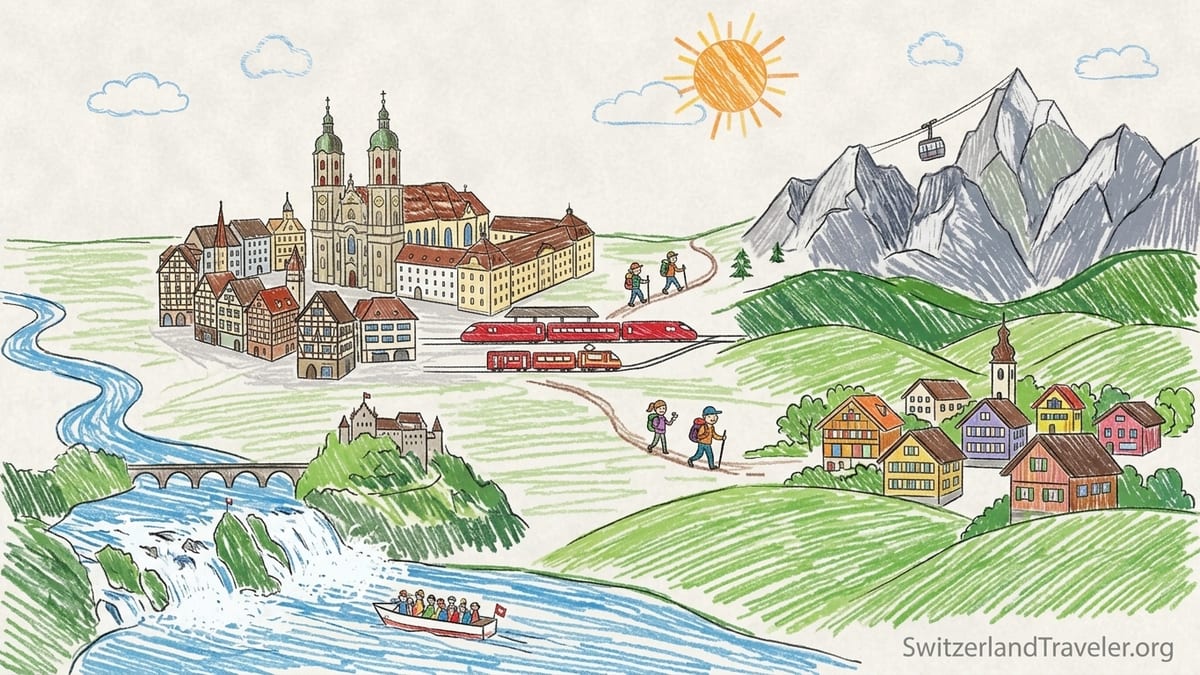
Overview: Three Bases, Three Very Different Stays
If you want an all-round base with excellent rail connections and heavyweight culture, St. Gallen is the most practical hub in Eastern Switzerland. Its compact old town, strong restaurant scene and frequent trains in all directions make it particularly well suited for first-time visitors and short trips built around day excursions. Intercity and regional lines from Zurich, Lake Constance and the Appenzell hills all converge at St. Gallen’s main station, which is served by Swiss Federal Railways, Appenzell Railways and other regional operators.
Appenzell, by contrast, is where you stay if you picture “traditional Switzerland” in your mind: painted façades, farmhouses on rolling hills, and hikers stepping off small red mountain trains into the Alpstein massif. The village of Appenzell is small enough to cross on foot in minutes, but has enough inns, cafés and shops to feel lively in high season. From here, short train rides connect you to cable cars into the Alpstein, where you can walk between rustic mountain guesthouses and lakes.
Schaffhausen is the scenic choice for river landscapes and medieval streets. Set on a bend of the Rhine close to Germany, it is the natural base for visiting Rhine Falls, often called Europe’s largest waterfall, and the perfectly preserved town of Stein am Rhein upriver. The old town’s oriel-windowed houses and cobbled alleys give it a charming, slightly sleepy character in the evenings, with enough bars and restaurants for a relaxed night out but less bustle than St. Gallen.
All three towns work well as a base, but each optimizes a different kind of trip. St. Gallen suits travelers who want maximum flexibility by train and a strong cultural core. Appenzell is ideal for walkers and anyone who wants to immerse themselves in alpine rural life. Schaffhausen favors visitors focused on the Rhine Falls area and cross-border day trips, especially those who prefer a quieter, riverside mood.
Getting There and Getting Around: Rail Connections & Car Need
For pure rail convenience, St. Gallen is hard to beat. The city lies about an hour by direct intercity train from Zurich, with regular services throughout the day. Its main station is a regional hub for the St. Gallen S-Bahn network, connecting into the Appenzell railways, Lake Constance, and even onward to Austria and Germany via the Bodensee routes. This means that most day trips, from Appenzell hiking to lakeshore towns like Rorschach or Kreuzlingen, start with a simple hop from St. Gallen, often without even changing platforms.
Appenzell is served by narrow-gauge Appenzell Railways, which run small electric trains through hilly pastures from St. Gallen or Gossau. The ride from St. Gallen to Appenzell typically takes a bit under 45 minutes on the red regional trains, with views of cows and church steeples along the way. Once in Appenzell, you can continue by train to Wasserauen for the Ebenalp cable car or to Schwende and Weissbad, all using local services that feel more like countryside trams than long-distance trains.
Schaffhausen is also well connected by rail. It sits on main and regional lines from Zurich, with journey times typically around 40 minutes by direct train. Local services link Schaffhausen with Neuhausen am Rheinfall, the station near Rhine Falls, in just a few minutes, and further along the lake and river towards Stein am Rhein. Trains also cross into nearby German towns, so it is straightforward to add a half-day visit to places like Singen for shopping.
None of these bases actually require a car for a 2 to 4 day stay. St. Gallen is the most obviously car-free friendly, since everything from its abbey complex to most hotels lies within walking distance of the station and city buses fill in any gaps. In Appenzell, the rail links and postbuses are specifically designed around hikers, and some mountain areas restrict or discourage private cars. In Schaffhausen, the short train hop to Rhine Falls and regular boats on the Rhine in season make sightseeing easier without having to navigate parking near popular viewpoints.
Where to Stay: Hotel Landscapes Compared
St. Gallen offers the broadest range of hotels across budgets. In the compact city center, you find everything from modern city hotels close to the station to smaller boutique properties tucked into residential streets just above the old town. Prices for midrange double rooms in the center typically land in the moderate-to-upper band for Switzerland, especially during trade fairs, but they buy you short walks to the abbey, museums and restaurants. Because the city is also a regional business hub and university town, availability outside peak summer and major events is usually good.
Appenzell’s hotel scene is smaller but very characterful. Many visitors choose traditional hotels on or near the Landsgemeindeplatz, the historic main square, where painted façades face each other across a traffic-calmed space. Long-established properties here emphasize Appenzeller hospitality and alpine decor, with wood-heavy interiors and on-site restaurants serving local dishes. Around the village and the surrounding countryside, guesthouses, farm stays and mountain inns cater to hikers who may want a bed directly on a trail rather than in the village center.
In practical terms, Appenzell accommodation often ties neatly into regional visitor cards. Travelers who stay three or more nights in participating hotels or apartments typically receive a local guest card that covers regional public transport in the nearby zones and discounts or free access to various cable cars and attractions. This can significantly reduce the need to budget separately for each small train or cable car trip, especially if you are doing several hikes in the Alpstein region.
Schaffhausen hotels cluster mainly around the historic core and the area between the station and the old town. You will find a mix of modernized historic properties and contemporary midrange hotels. Some well-known Swiss hotel groups operate central hotels in historic buildings here, with interiors that blend period exteriors and more modern rooms. While Schaffhausen typically has fewer beds than a larger city, demand is spread more evenly and, outside local events and summer weekends, booking a comfortable room at short notice is often feasible.
Eating and Drinking: From Abbey Quarter Cafés to Alpine Cheese
St. Gallen’s dining scene is the most varied of the three bases. You can move from a quick takeaway St. Galler Bratwurst and crusty bread roll on a station square bench to multi-course menus in refined hotel restaurants across a single evening. Around the abbey district and pedestrian streets, cafés serve strong espresso, homemade cakes and regional specialties. In recent years, casual bistros and international kitchens have multiplied, so it is easy to find everything from simple Italian dishes to Asian-inspired bowls within a ten-minute walk of the station.
Appenzell’s food is deeply tied to local tradition. Village restaurants feature dishes like rösti with melted cheese, sausages, and seasonal game in autumn, often using regional Appenzeller cheese and beers from the local brewery. Some hotels include half-board packages, which can be good value if you plan long hiking days and prefer to sit down in the same dining room each evening. For a more rustic experience, mountain guesthouses in the Alpstein serve hearty plates and homemade cakes to hikers, which can double as lunch stops or overnight stays on multi-day treks.
Schaffhausen’s culinary profile combines Swiss and cross-border influences. In the old town, many restaurants set up tables in narrow lanes in good weather, serving Swiss-German classics, fish from the Rhine and Lake Constance, and straightforward international dishes. Given the proximity to Germany, you may notice slightly more German-style hearty portions and beer lists than in Appenzell or St. Gallen. The waterfront and riverbank areas, particularly towards Neuhausen am Rheinfall, have cafés and casual spots that make sense for lunch during a Rhine Falls visit rather than a special dinner destination.
In all three bases, grocery stores and bakeries provide an easy way to keep costs under control. St. Gallen in particular has several supermarkets within a short walk of the station where you can pick up picnic supplies before heading out on a day trip. Appenzell and Schaffhausen, being smaller, have fewer options but still enough for simple self-catering or trail snacks on a moderate budget.
Day Trips and Signature Experiences From Each Base
From St. Gallen, the classic cultural highlight is the Abbey of St. Gall, whose library and cathedral form a UNESCO World Heritage Site. Spending at least a half day wandering the abbey precinct and the surrounding streets rewards you with painted oriel windows, quiet courtyards and small museums. Beyond the city limits, the Voralpen-Express line towards central Switzerland and the trains towards Lake Constance or Appenzell open up several compelling day trips without complex planning.
One popular outing from St. Gallen is a loop that combines the short scenic train ride to Gossau, the connecting local train into Appenzell, and either a walk around the village or a continuation into the Alpstein. In summer, you might ride to Wasserauen, take the cable car up to Ebenalp for views into the Alpstein, and then return via Appenzell to St. Gallen by early evening. Another easy day involves a train to Rorschach on Lake Constance for lakeside promenades and boat rides before returning to the city for dinner.
Appenzell’s standout experiences revolve around the Alpstein. Many visitors base here specifically to hike routes between places like Ebenalp, Schäfler, Säntis and Bollenwees, where inns sit in spectacular mountain positions. At lower elevations, gentler walks lead through rolling pastures, past small chapels and farm shops selling cheese. Because the local trains and buses are designed with hikers in mind, you can start from one valley station, end in another, and let public transport close the loop.
Schaffhausen’s signature day trips nearly always include Rhine Falls. The falls are a short regional train ride from the city center, with a short walk from Neuhausen am Rheinfall station to viewpoints and boat docks. Boat trips carry visitors close to the crashing water, and paths on both banks provide different perspectives. You can easily combine Rhine Falls with a further train ride along the Rhine to Stein am Rhein, a village known for its painted house fronts and well-preserved medieval core, before returning to Schaffhausen in time for dinner.
Evening Atmosphere: Lively, Laid-Back or Quiet
St. Gallen offers the most urban evening atmosphere in this trio. While it is not a late-night party city on the scale of Zurich, its student population and local workforce give it a steady buzz on weeknights and weekends. You can wander from wine bars and casual beer spots to low-key clubs and small music venues. During warmer months, outdoor seating in squares and side streets keeps things active until around midnight, after which activity tapers off to just a handful of late venues.
In Appenzell, evenings are appreciably quieter and more traditional. Hotel dining rooms and village restaurants fill around typical Swiss dinner hours, but by late evening the streets are calm, especially outside peak summer or festival dates. Many visitors end their day with a final drink on a hotel terrace or a stroll through the village rather than heading to bars. This can be a plus if you like restful nights and early starts for hiking, but it may feel too subdued for travelers seeking varied nightlife.
Schaffhausen’s evenings fall somewhere between the two. In the old town, there is enough foot traffic to keep terraces and wine bars comfortable and sociable, particularly from spring to early autumn, yet the vibe remains relaxed. The riverside paths invite after-dinner walks, and on warm evenings local residents and visitors alike linger on benches or by the water. If you are traveling with children or prefer low-key nights, this gentle rhythm can be ideal.
When deciding where to base yourself, consider your usual travel pattern. If you enjoy finishing each sightseeing day with a choice of several bars and late-opening cafés, St. Gallen will suit you best. If your ideal evening is an early meal and a quiet room with mountain air, Appenzell is your likely match. If you want a walkable old town with just enough buzz but no big-city feel, Schaffhausen strikes a comfortable balance.
Which Base for Which Traveler Type?
For first-time visitors to Switzerland or those carrying a Swiss Travel Pass who want to tick off a mix of culture, scenery and small-town charm in a few days, St. Gallen is usually the most forgiving base. Its frequent trains in all directions mean that even if the weather changes, you can switch plans easily, pivoting from a lake trip to a museum day without feeling stuck. The combination of UNESCO heritage, city services and quick access to countryside means you never have to choose between culture and nature.
Appenzell is the clear choice if hiking and a sense of rural tradition are your priorities. It works particularly well if you prefer to minimize hotel changes but still want to feel embedded in alpine scenery. Staying three or more nights is especially rewarding here, because local guest cards and included regional transport make it easy to explore multiple valleys and cable cars without recalculating every cost. Visitors planning to move between several mountain inns might also start or end their trek with a night in the village for comfort.
Schaffhausen suits travelers who are drawn to river landscapes, castles and cross-border excursions. It is an excellent base if you want to spend a full day around Rhine Falls without rushing, perhaps taking boat rides, exploring both banks and walking parts of the riverside trails. Adding Stein am Rhein, a detour into Germany, or a relaxed cruise on the Rhine slots naturally into a Schaffhausen-based itinerary. If your image of Switzerland includes half-timbered houses, riverfront promenades and slower evenings, this town delivers.
For a 2 to 4 day trip, some itineraries even pair two bases. You might spend two nights in St. Gallen for abbey visits and a day trip to Appenzell, then move to Schaffhausen for one or two nights focused on Rhine Falls and Stein am Rhein. However, if you prefer to unpack once, St. Gallen remains the most efficient single base, especially if flight times in and out of Zurich leave you with partial days that are easier to fill in a city.
The Takeaway
Choosing between St. Gallen, Appenzell and Schaffhausen is less about right or wrong and more about what you want to feel when you step out of your hotel each morning. All three are well connected by Swiss standards, and all three provide easy access to headline experiences, from UNESCO heritage and lakes to hiking ridges and crashing waterfalls. The trade-off lies between urban variety, rural tradition and river scenery.
If you want the most rail-connected, flexible base with serious culture on your doorstep, St. Gallen stands out. If you dream of wooden farmhouses, cowbells and immediate access to the Alpstein hiking network, Appenzell is your natural choice. If your priority is waking near the Rhine, visiting Europe’s most famous waterfall and wandering medieval streets at a gentle pace, Schaffhausen will feel exactly right. Whichever you choose, Eastern Switzerland’s scale and rail network make day trips simple, so you can sample the others even if you do not sleep there.
FAQ
Q1. Which base is best overall for a first visit: St. Gallen, Appenzell or Schaffhausen?
St. Gallen is usually the best all-round base for a first visit, thanks to its strong rail connections, UNESCO-listed abbey complex and wider choice of hotels and restaurants. From there you can day trip easily to both Appenzell and the Rhine area if you prefer not to change hotels.
Q2. Do I need a car to explore Eastern Switzerland from these bases?
No, a car is not necessary for a 2 to 4 day trip based in St. Gallen, Appenzell or Schaffhausen. All three are well served by trains and buses, and major sights such as the Abbey of St. Gall, Alpstein hiking areas, Rhine Falls and Stein am Rhein are all reachable by public transport.
Q3. Which place is best if I mainly want to hike?
Appenzell is the best choice if hiking is your main focus. From the village you have fast access by train and cable car into the Alpstein region, where routes range from lakeside walks to more demanding ridge trails, and mountain inns offer food and lodging directly on the paths.
Q4. Where should I stay if I want the strongest sense of traditional Switzerland?
Appenzell offers the most traditional feel day to day, with painted wooden houses, local costumes at certain events, and restaurants serving classic regional dishes. Staying in or near the historic village square gives you a concentrated taste of this side of Switzerland.
Q5. Is Schaffhausen worth staying in, or is a day trip from Zurich enough?
Schaffhausen is certainly possible as a day trip from Zurich, but staying one or two nights lets you enjoy the old town and Rhine Falls at quieter times of day, and adds flexibility for a relaxed visit to Stein am Rhein or a boat trip without watching the clock.
Q6. How many nights should I plan in Eastern Switzerland?
For a focused visit, 2 to 4 nights works well. Two nights allow one full day trip from your base, while three or four nights give time to combine St. Gallen’s abbey, an Appenzell or Alpstein outing, and a Rhine Falls and Stein am Rhein day without rushing.
Q7. Which base has the best evening and dining options?
St. Gallen has the widest range of evening and dining options, from casual takeaways and cafés to more formal restaurants and a modest nightlife scene. Schaffhausen offers relaxed old-town evenings, while Appenzell is quieter and more focused on hotel dining rooms and a handful of village restaurants.
Q8. Is it realistic to visit both Appenzell and Rhine Falls from one base?
Yes, it is realistic if you base yourself in St. Gallen for at least three nights. One day can focus on Appenzell and the Alpstein foothills, while another day is dedicated to Rhine Falls and possibly Stein am Rhein, using regional trains to connect the dots.
Q9. Are hotel prices very different between the three towns?
Broadly, midrange hotel prices in St. Gallen and Schaffhausen are similar, reflecting their roles as regional centers. Appenzell can be comparable in price for its central traditional hotels, though simpler guesthouses and farm stays may offer better value if you do not need many extras.
Q10. If I only have two nights, which single base should I choose?
With only two nights, St. Gallen is generally the most practical single base. Its location between the Appenzell hills and the Rhine and Lake Constance areas, combined with frequent trains, makes it easier to fit one substantial day trip into a short stay without feeling rushed.