


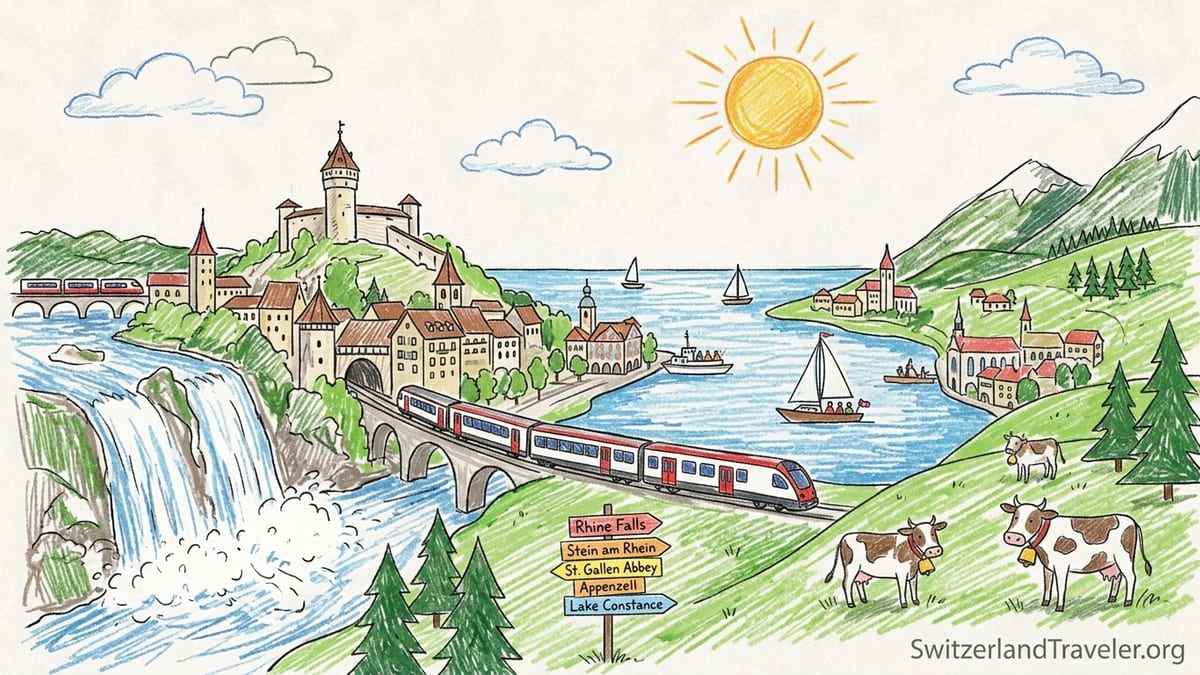
The northeastern corner of Switzerland is one of the easiest parts of the country to explore without a car, yet it also delivers classic road trip scenery: a mighty waterfall on the High Rhine, half-timbered riverside towns, a quiet stretch of Lake Constance and green foothills rising toward Appenzell and Toggenburg. This guide focuses on a compact route from the Rhine Falls and Schaffhausen to Stein am Rhein, Lake Constance, St. Gallen, Appenzell and Toggenburg, with Glarus as a rewarding extension for travelers who have an extra day. Instead of a sweeping grand tour of the whole country, you get a realistic, tightly plotted journey that fits neatly into three to six days.
Why Eastern Switzerland Works So Well as a Compact Trip
Eastern Switzerland looks made for a sweeping odyssey, but the real strength of the region is how neatly its highlights line up. From the Rhine Falls near Schaffhausen to Stein am Rhein, around the Swiss shore of Lake Constance to St. Gallen, then into the Appenzell hills and Toggenburg, distances stay short. Schaffhausen to Stein am Rhein by regional train takes around 20 to 25 minutes, with frequent departures. Stein am Rhein to the Lake Constance towns of Kreuzlingen or Romanshorn is another 40 to 60 minutes by the lakeside "Seelinie" trains. That keeps individual hops well under two hours, even if you are relying entirely on public transport.
For drivers, the appeal is equally strong but different. Parking is relatively straightforward outside the medieval cores, and roads are well signposted, with clear routes along the Rhine and Bodensee (Lake Constance) shoreline. Yet traffic around Zurich and cross-border bottlenecks can slow you down, so concentrating on the Swiss side keeps things simple. A realistic self-drive itinerary might start at Zurich Airport, collect a car, then overnight in Schaffhausen, St. Gallen and Appenzell, with flexible day trips by cable car or rural bus once you reach the mountains.
The other reason this corner of the country works so well is that it already forms the eastern segment of Switzerland’s official Grand Tour, which links the Rhine Falls, the pre-Alpine hills of Toggenburg and the eastern valleys. Instead of repeating the entire national loop, this itinerary zooms in on that section, adding time for walks, slow travel by lake boat and the kind of café pauses that fast cross-country itineraries rarely allow.
Costs are very manageable if you plan carefully. A typical midrange hotel in St. Gallen or Appenzell might run from 160 to 230 Swiss francs per night for a double in mid-season, while basic guesthouses and farm stays in the valleys can drop closer to 120 to 150 francs. Daily restaurant spending will depend on habits, but allowing 30 to 40 francs for lunch and 40 to 60 francs for dinner per person gives a realistic working budget for sit-down meals in this part of the country.
Rhine Falls and Schaffhausen: A Dramatic Starting Point
Beginning at the Rhine Falls immediately feels like a statement. The falls, just downstream from Schaffhausen, are often described as Europe’s most powerful waterfall by volume. You hear them before you see them. From the north bank at Neuhausen Rheinfall, platforms project out over the torrent; on the south side, below Schloss Laufen, stairways and terraces drop you steadily closer to the spray. Visitors typically pay a modest access fee to use the paths and viewing platforms, and separate small-boat companies run short cruises that nose up close to the central rock or shuttle between banks.
Schaffhausen itself is worth at least half a day. The compact old town is filled with oriel windows and painted facades, and the Munot fortress offers wide views back toward the Rhine. Many travelers stay here on their arrival night because regional trains and boats fan out easily from the town. Zurich to Schaffhausen by direct train usually takes about 45 minutes, and from Schaffhausen station to the Rhine Falls you can either ride a five-minute train to Neuhausen Rheinfall or a local bus. For example, a visitor with luggage arriving mid-morning could leave Zurich Airport, check in to a Schaffhausen hotel before lunch and still have a full afternoon at the falls and fortress.
If you are driving, you can park close to both sides of the waterfall. On busy summer weekends, arriving before 10 a.m. helps avoid queuing for spaces. A typical paid parking session for two to three hours costs only a handful of francs, far less than a full day in central Zurich. In peak season, combining the falls with a relaxed evening in Schaffhausen’s car-free alleys, perhaps with a glass of local Pinot Noir at a wine bar near the Fronwagplatz, gives the trip a satisfying, slow-paced start.
One practical note is that the Rhine Falls lie very close to the German border. Travelers using German regional offers, such as state day tickets, sometimes combine a cross-border train ride to Schaffhausen with a local Swiss ticket onward to Neuhausen Rheinfall. For a multi-day itinerary that stays entirely in Switzerland, however, most visitors will find a Swiss Travel Pass or Saver Day Pass eliminates the need to think about individual fares in this first section.
Stein am Rhein and the Lake Constance Shore: Trains, Boats and Back Roads
From Schaffhausen, the next logical stop is Stein am Rhein, a small town whose riverside core is almost absurdly picturesque. Regional trains run along the High Rhine, taking around 20 to 25 minutes to connect Schaffhausen and Stein am Rhein, with dozens of services each day. In summer, boats also link the two towns, turning a simple transfer into a mini cruise through a quieter, more rural stretch of the river. On a fine day, starting with the early train, exploring the town, then taking an afternoon boat back creates a loop that works equally well for rail travelers and those who have left their car at Schaffhausen.
In Stein am Rhein, the main square is ringed by buildings covered in historical frescoes. Practicalities matter though: parking in or near the medieval core is limited, and meters or ticket machines are strictly enforced. Many drivers prefer to leave the car in one of the signed parking lots on the edge of the old town and walk in. Rail users simply step out of the small station and stroll 10 to 15 minutes downhill to reach the riverfront. Cafes around the Rathausplatz serve light dishes such as rösti or seasonal salads, generally in the 20 to 30 franc range, making it easy to linger without committing to a multi-course meal.
Continuing toward Lake Constance, the Seelinie, or Lake Line, follows the southern shore of the lake all the way to Romanshorn and Rorschach. Trains on this line connect Stein am Rhein, Steckborn, Kreuzlingen and other small lakeside villages before reaching larger hubs. For instance, you could catch a late-morning train from Stein am Rhein, break your journey in Kreuzlingen for a lakeside walk, then continue to Romanshorn or Rorschach by mid-afternoon. The same shoreline can of course be driven, but the road and rail alignment is so close that the train often proves quicker and removes any stress over finding lakefront parking on sunny weekends.
Boats add another appealing layer. From spring into autumn, lake steamers and modern ferries run a mesh of routes around Lake Constance, connecting Swiss towns like Romanshorn and Rorschach with German ports such as Friedrichshafen and Konstanz. A realistic example: a traveler staying in St. Gallen could take a 20- to 30-minute train down to Rorschach, spend the late morning at the lakeside promenade, then board an afternoon boat for a two-hour round-trip cruise before returning by train in time for dinner. Many rail passes, including the Swiss Travel Pass, offer either full coverage or discounts on these lake services, so it is worth checking details before you buy individual boat tickets.
Lake Constance to St. Gallen: Choosing Your Base
At some point along the lakeshore you will need to turn inland toward St. Gallen, the region’s main cultural center and a smart base for two or three nights. Romanshorn and Rorschach both offer frequent rail connections, with journey times of roughly 25 to 35 minutes to St. Gallen on regional or S-Bahn trains. Visiting drivers tend to park in medium- or long-stay lots on the edge of the old town and explore on foot, as many streets in the center are restricted or pedestrianized.
St. Gallen itself rewards slow exploration rather than a quick photo stop. The world-famous Abbey library, with its baroque interior and priceless manuscripts, is a highlight even for travelers who rarely set foot in museums. Expect to pay a moderate entry fee and to store backpacks in lockers. Around it, the old town is filled with tall merchant houses fronted by carved and painted oriels. As a concrete example of how compact it all is, you can leave a midrange hotel near the main station, walk to the library in under 10 minutes, continue to the market square and be back in your room without ever needing a tram or bus.
For logistics, St. Gallen’s rail station anchors an impressive regional network. Hourly long-distance trains run west to Zurich and east toward Chur, while S-Bahn and private lines connect down to Lake Constance and into the Appenzell region. If you pick St. Gallen as a base, a day trip to Appenzell on the local Appenzeller Bahnen trains, or to Säntis via the cable car from Schwägalp, becomes very straightforward. Hotel staff are used to helping with these short excursions and will often look up suggested connections on the SBB timetable app for you.
In terms of costs, food and accommodation in St. Gallen are broadly similar to the rest of German-speaking Switzerland, but there are ways to keep budgets in check. Many business hotels near the station drop their rates slightly on Friday and Saturday nights outside major events. Supermarket chains like Migros and Coop offer take-away salads, sandwiches and hot dishes that work well for an inexpensive picnic lunch before you hop on a train into the hills. A simple takeaway lunch for two, plus bottled water, can easily stay under 25 to 30 francs total.
Appenzell and Toggenburg: Green Foothills and Easy Rail Links
From St. Gallen, the route curves into some of Switzerland’s gentlest pre-Alpine landscapes. Appenzell and Toggenburg offer rolling pasture, dairy farms and easily accessible walking trails rather than serious alpine mountaineering, making them ideal for travelers who want views without committing to long, steep hikes. Appenzell village, the historic center of the small canton of the same name, lies around 40 to 50 minutes from St. Gallen by direct regional train on the Appenzeller Bahnen line. Services are frequent through the day, and in normal conditions you can simply show up at the station and board the next departure.
On arrival in Appenzell, you step directly into a painted toy-town of gabled houses, shopfronts with hanging signs and a compact central square. Many visitors choose to sleep here for a night or two, enjoying early-morning calm before day-trippers arrive from St. Gallen and Zurich. A realistic option might be a family-run inn or three-star hotel with wooden balconies, breakfast included and room rates starting around the mid-100s in Swiss francs for a double in shoulder season. From the village, local buses and small cableways fan out to short hikes such as Ebenalp or the trails below Säntis.
Toggenburg, stretching roughly between Wil, Wattwil and the higher valley toward Wildhaus, is more linear and slightly less touristy than Appenzell. It makes sense either as a scenic driving section or as a rail and bus corridor on your way south. Drivers can follow well-signed roads like the route from St. Gallen via Wattwil toward the Linth plain, stopping at roadside farm shops that sell local cheese and dried meats. Rail travelers may instead take S-Bahn services along the valley and transfer to buses for side valleys and smaller villages. An example: from St. Gallen you could take a regional train to Wattwil, then a postbus up to Wildhaus for an afternoon walk with Churfirsten views before returning the same way.
For both Appenzell and Toggenburg, car-free exploration works surprisingly well. The density of small stations and bus stops means that one-way hikes and valley walks are easy to organize. You might, for instance, ride a cable car up to a mid-mountain station, walk two to three hours through pasture and forest to another village, then catch a bus back to your base. Walking maps sold in village shops and tourist offices give realistic time estimates and highlight family-friendly paths where cows greatly outnumber cars.
Glarus Extension: A Quiet Detour into Steeper Country
Travelers with an extra day or two can add a rewarding optional loop into the canton of Glarus, a narrower valley with steeper mountain walls and a different character from the soft hills of Appenzell. Reaching Glarus by public transport from Toggenburg or the St. Gallen region normally involves a change or two, for example traveling via Rapperswil or along the Linth plain, but journey times still stay around two to three hours depending on your starting point. Drivers can thread south via Wattwil and the A3 corridor, then turn up into the Glarus valley on smooth, well-maintained roads that cut between rocky slopes.
The town of Glarus itself is compact, with a grid-like center rebuilt after a devastating fire in the 19th century. A practical way to organize time here would be to stay one night in or near the town, perhaps at a modest three-star hotel, then spend a day riding cable cars or buses to side valleys like Elm or Braunwald. Braunwald, in particular, is car-free and reached by a short funicular from Linthal, making it an excellent example of how even seemingly remote corners of Eastern Switzerland remain accessible without private transport.
Costs in Glarus broadly match those in Appenzell and Toggenburg, although the relative lack of heavy international tourism can mean slightly better value in some guesthouses and restaurants. Simple overnight stays with breakfast may start around the low- to mid-100s in Swiss francs for a double room outside peak holiday weeks. Hiking remains the main activity, with well-marked paths from valley floor to alpine pasture; even so, many visitors choose shorter out-and-back walks from cable car stations rather than long full-day routes.
Although this extension is entirely optional, it underlines the broader point of this itinerary: Eastern Switzerland lends itself to modular exploration. You can fly in, see the Rhine Falls and Stein am Rhein in a single long day, or you can add Appenzell, Toggenburg and Glarus to build a week-long journey that barely leaves one quadrant of the national map while still delivering waterfalls, lakes, historic towns and mountain pastures.
Driving vs Rail: What Works Best Where
One of the defining features of this itinerary is how genuinely optional a car is. On the Rhine Falls to Lake Constance section, rail and boat connections are not only plentiful but scenic. The train that links Schaffhausen, Stein am Rhein and Romanshorn follows the river and lake edge for much of the way, often running close enough that passengers can spot swimmers and lakeside cafés as they roll past. For someone holding a Swiss Travel Pass or a point-to-point ticket, the journey becomes as much of an experience as the destinations themselves, especially on quiet midweek mornings outside the main school holiday period.
By contrast, driving shines most in the Appenzell and Toggenburg sections if you prioritize flexibility over simplicity. A rental car allows you to change plans on the fly when cloud cover rolls in, stopping at small farm shops, minor cable cars or chapels not marked on any tourist map. You can, for instance, leave Appenzell after breakfast, detour to a trailhead above Urnäsch for a short stroll, then wind through the valleys toward Wattwil and on to Glarus without worrying about timetables. For families with young children or travelers carrying sports gear, that ability to throw everything in the trunk and go can outweigh the incremental cost of fuel, parking and rental days.
The trade-offs are straightforward to describe but worth weighing carefully. Rail wins on cost predictability and stress reduction. A couple using a Swiss Travel Pass or regional day tickets can simply hop on and off trains, S-Bahn and many local buses, confident that there will be another service in 30 or 60 minutes. There is no need to navigate unfamiliar parking rules in medieval centers or worry about Switzerland’s firm enforcement of speed limits and drink-driving laws. Driving, on the other hand, can be quicker in the evenings when rural bus frequencies drop, and it opens up late returns from mountain restaurants or small festivals that would otherwise require an early departure to catch the last train or bus.
One practical hybrid model that works especially well here is to combine rail with short-term local car rental or car sharing in the hills. A visitor could travel from Zurich to St. Gallen and Appenzell entirely by train, then rent a car for one or two days in the Appenzell or Toggenburg area to reach a remote trailhead or accommodation. After returning the vehicle, they continue by rail toward Glarus or back to Zurich. This splits costs across modes and minimizes the number of days you pay for a parked car in cities where it delivers little benefit.
The Takeaway
Designing a trip around Eastern Switzerland’s Rhine Falls, Stein am Rhein, Lake Constance, St. Gallen, Appenzell, Toggenburg and optionally Glarus is less about ticking landmarks and more about following a coherent line across landscapes that change subtly every hour or two. The official Grand Tour of Switzerland captures the same broad arc in its eastern section, but by slowing down and focusing on this corridor alone, you give yourself the freedom to travel by riverside train one day, stroll through abbey cloisters the next and end the week in a quiet valley where cowbells drown out road noise.
In practice, the choice between driving and rail is not an all-or-nothing decision. The Rhine and Lake Constance segments are almost purpose-built for public transport, with tracks that hug the water and boats that tie villages together into a single, fluid waterfront. The Appenzell hills and Toggenburg offer enough infrastructure that hikers and casual walkers can still rely on trains, buses and cable cars, while drivers enjoy the added freedom of detours and spontaneous stops. However you divide the journey between road and rail, what matters most is that the route itself makes sense and leaves room for pauses: a second coffee in a St. Gallen alley, an unscheduled stop to watch evening light over the Bodensee or a slow descent from a cable car station back to a village square.
For many travelers, three or four full days will be enough to follow the core line from the Rhine Falls to Appenzell, especially if they start and finish in Zurich. Those with a week can add Toggenburg and Glarus without rushing, using St. Gallen and Appenzell as bases for day trips. Either way, this is a corner of Switzerland where the distances are short, the logistics are forgiving and every transfer feels like a continuation of the journey rather than a chore.
FAQ
Q1. How many days do I need for this Eastern Switzerland route?
A stay of three to four full days covers the Rhine Falls, Stein am Rhein, a taste of Lake Constance, St. Gallen and Appenzell at an unhurried pace. If you want to include Toggenburg and the optional Glarus extension, consider five to seven days so that travel days still leave room for two- to three-hour walks and time in village centers.
Q2. Is it realistic to do this trip entirely by train and boat?
Yes, it is unusually realistic by Swiss standards to do this itinerary without a car. Trains connect Zurich, Schaffhausen, Stein am Rhein, Romanshorn, Rorschach, St. Gallen and Appenzell with frequent services, and seasonal boats operate along the Rhine and Lake Constance. You can comfortably rely on a Swiss Travel Pass or a mix of day passes and regular tickets to string these segments together.
Q3. When is the best time of year to travel this route?
Late spring to early autumn is ideal, roughly from May through early October, when lake boats operate more frequently and most cable cars run daily. July and August bring the warmest weather but also the most crowds at the Rhine Falls and on Lake Constance, while May, June and September often see pleasant temperatures with fewer visitors and more availability in hotels.
Q4. Where should I base myself if I prefer to unpack only once or twice?
St. Gallen and Appenzell are the two most practical bases for a hub-and-spoke version of this itinerary. From St. Gallen you can visit Lake Constance towns such as Rorschach and Romanshorn, as well as make an easy day trip to the Rhine Falls and Stein am Rhein if you start early. Appenzell works well for exploring the pre-Alpine hills, short hikes and excursions into nearby valleys without changing accommodation every night.
Q5. How expensive is this region compared with the rest of Switzerland?
Prices are broadly in line with other German-speaking parts of the country, although very high-end international tourism is less dominant than in hotspots like Zermatt or Lucerne. Midrange hotels typically cost in the mid- to high-100s in Swiss francs per night for a double room, with simple guesthouses and farm stays somewhat cheaper. Using supermarket take-away food for some lunches and occasionally choosing set menus in local restaurants can keep daily food costs moderate.
Q6. Do I need to rent a car for the Appenzell and Toggenburg sections?
You do not need a car, but one can be useful if you want maximum flexibility for remote trailheads or spontaneous detours. Appenzell and Toggenburg are both well served by regional trains, postbuses and cable cars, and many classic walks start and end at public transport stops. Renting a car for just one or two days, instead of the entire trip, is often a good compromise for visitors who are otherwise relying on rail.
Q7. Is this route suitable for families with children?
Yes, this is a family-friendly itinerary. The Rhine Falls viewing platforms and short boat rides are exciting without being strenuous, and many Appenzell and Toggenburg walks are short enough for younger children. Towns like Stein am Rhein and St. Gallen have traffic-calmed old centers, which makes strolling with strollers or letting older children walk ahead more comfortable than in big cities.
Q8. How should I sequence the route if I am flying in and out of Zurich?
A logical loop from Zurich would start with Zurich to Schaffhausen and the Rhine Falls, continue to Stein am Rhein and Lake Constance, then turn inland to St. Gallen and Appenzell, with Toggenburg and Glarus added at the end if time allows. From the Appenzell or Glarus area, you can return directly to Zurich by train in a few hours, often with just one or two changes.
Q9. Are there language issues for English-speaking travelers?
German is the main language across this region, specifically Swiss German in everyday speech, but standard German and English are widely understood in hotels, tourist offices and most restaurants. Train announcements and ticket machines usually offer English options, and printed timetables are easy to interpret once you are familiar with basic station names and abbreviations.
Q10. How far in advance should I book accommodation on this route?
In peak summer and during local holiday periods, booking several weeks in advance is sensible, especially for smaller inns in Appenzell, Toggenburg and Glarus. Outside those times, you can often reserve just a few days ahead, particularly in larger towns like St. Gallen and Schaffhausen. However, if you have your heart set on a specific lakefront hotel or farm stay, securing it early reduces the risk of compromise later.